Skip to content
Tags

#Visual navigation (3)

EA-Nav: Learning Safe Visual Navigation Policies with Embodiment Awareness

EA-Nav: Learning Safe Visual Navigation Policies with Embodiment Awareness

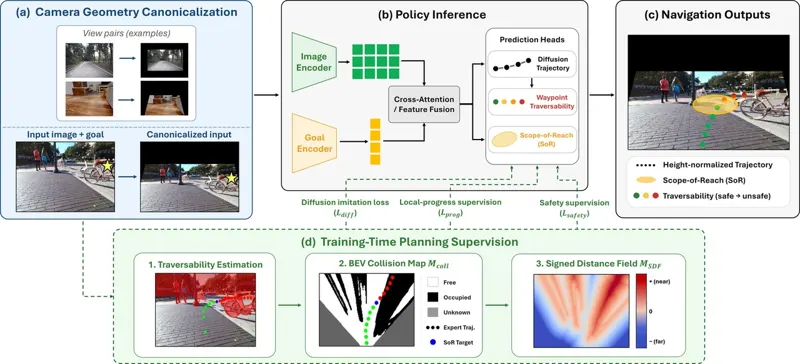
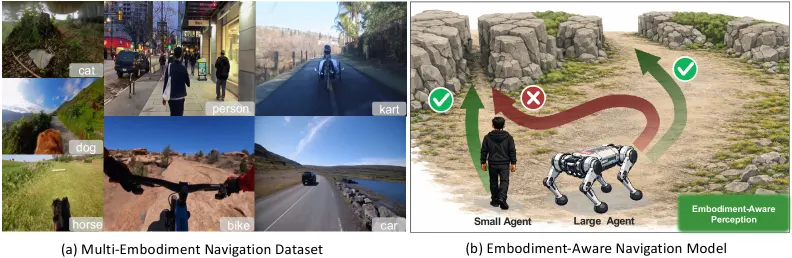
Cross-embodiment navigation is a key challenge in embodied intelligence. Due to differences in embodiment, the same visual observation may imply different actions for different agents, making prediction ambiguous when relying solely on vision. Existing studies mainly rely on reinforcement learning, which requires large-scale interaction and careful reward design, making it difficult to support scalable pretraining and real-world adaptation. In contrast, imitation-learning-based approaches remain limited. To address these challenges, we propose an imitation-learning-based embodiment-aware navigation framework with a modular multi-stage design. In pretraining, we construct a cross-embodiment navigation dataset from Internet videos and introduce embodiment geometry as conditional tokens to reduce action ambiguity under the same observation. In fine-tuning, we design a multimodal information injection mechanism based on a decoupled architecture. Specifically, we design a trajectory augmentation strategy to generate high-risk samples, which are used to train spatial perception and risk-aware correction separately, thereby explicitly incorporating embodiment geometry for safe navigation. Experimental results show that the proposed method effectively improves navigation performance across different embodiment settings, demonstrating the effectiveness of incorporating embodiment geometry into embodied navigation.

Jialu Zhang, Yong Du, Xianda GuoJul 22, 2026
Visual navigationBody-AwarenessSafetyJul 22, 2026
Learning Adaptive Safety Margins for Visual Navigation

Learning Adaptive Safety Margins for Visual Navigation

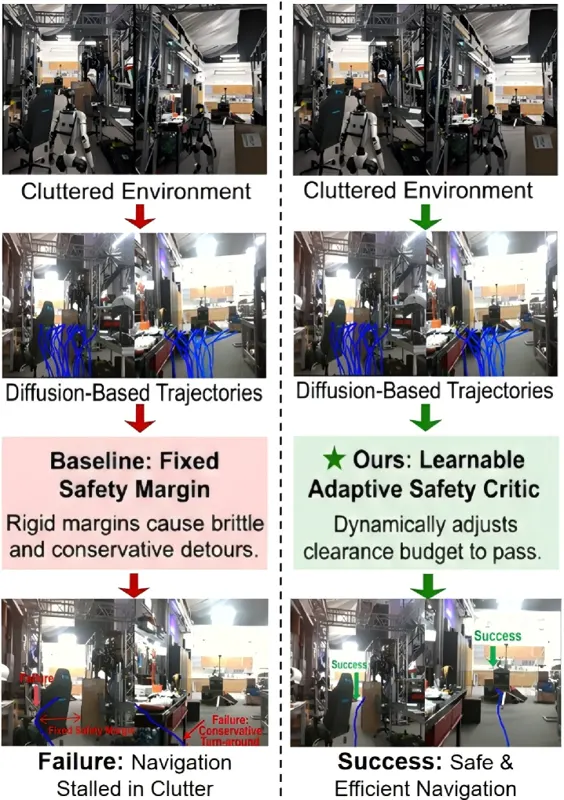
Robots in cluttered indoor spaces often fail not because they cannot generate collision-free paths, but because a fixed safety margin is mis-calibrated: conservative margins cause detours and timeouts, while permissive margins lead to near-boundary shortcuts under perception bias. Diffusion-based planners propose diverse trajectory candidates from egocentric RGB-D, yet reliable selection remains the bottleneck. We propose a context-conditioned safety critic that learns an adaptive clearance preference for ranking diffusion proposals, decomposed into three complementary terms: (i) a safety term with a clearance-budget penalty and a control-barrier-function residual for waypoint- and transition-wise safety, (ii) an efficiency term combining a smoothness penalty with a safety-gated detour-ratio penalty that avoids detours without incentivizing risky shortcuts, and (iii) a distance-constraint matching term that anchors the learned budget to realized ESDF clearances to prevent margin collapse. We train the critic with privileged ESDF geometry in simulation and distill it into a perception-only selector via a two-stage teacher-student procedure. On PointGoal navigation in HM3D and MP3D, including cross-dataset transfer, our method achieves the highest success rate (SR) and success weighted by path length (SPL) among strong diffusion, optimization, and RL baselines. Trained purely in simulation, it transfers to a Unitree G1 humanoid and navigates cluttered indoor scenes without task-specific tuning.

Junyi Hu, Shuaihang Yuan, Geeta Chandra Raju BethalaJul 20, 2026
Visual navigationSafety MarginPath PlanningJul 20, 2026