BLOG
Meta Reality Labs Research open-sourced Project SuperDex, a unified dexterous-manipulation simulation platform built on a custom contact-first physics engine with soft-body/rod/non-convex contact support, VR teleoperation for synthetic data, and a Gymnasium-style RL stack that achieved zero-shot sim2real shape sorting.
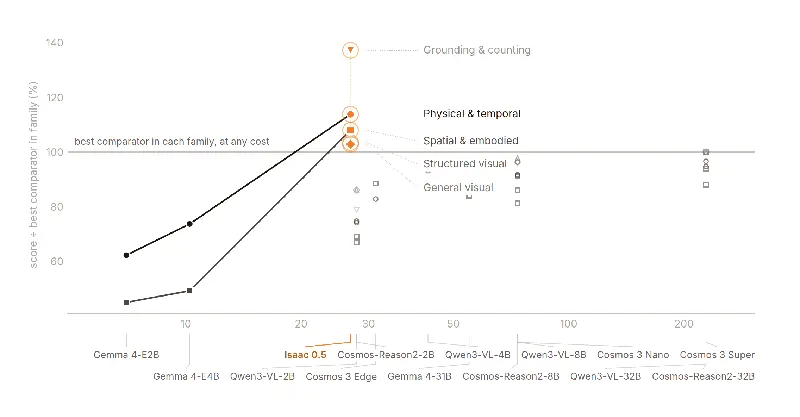
Isaac 0.5 is Perceptron's open-source embodied foundation model with 36B sparse parameters: it reads images, video, language, robot state and previous actions to answer video questions, point and track objects, report task progress, and generate robot actions. The team establishes a scaling law trading video for teleop: scaling general video from 1,000 to 1M hours cuts the teleoperation needed for action loss 2.50 from ~5,900 hours to 28 (210x). Trained on 35+ robot systems, 100K hours of robot experience, 1M hours of video and 3T multimodal tokens, it introduces semantic world modeling (predicting future percepts), the mHarmony typed multimodal interface, and Null Experts for dynamic compute — leading all five perception task families at 8.5x lower inference cost. Weights, training code and LeRobot inference code are fully released.
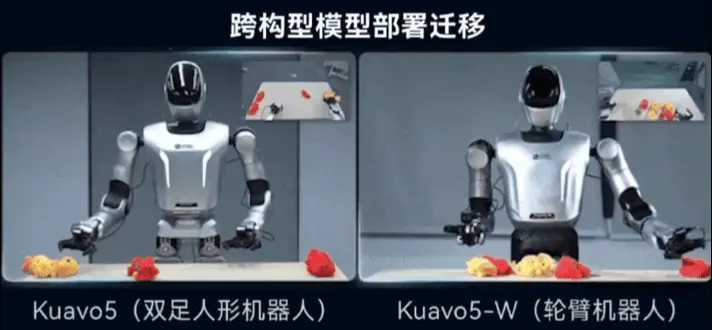
Across ICRA REAL-I and CRAIC 2026, 200+ student teams used Leju's open-source LeTools chain to go from algorithm to real-robot deployment in as little as one day. Hardware-free dry-run of a 37-node behavior tree, a 1,000-hour production-grade LET-Base dataset, a one-line simulation-to-real switch in deploy.yaml, and 10+ architectures behind a unified Adapter layer show embodied-AI competition shifting toward low-barrier dev environments covering data, models, and deployment.