Skip to content
RobotWorld
Back to Papers

PAPER DEEP DIVE

PaperSimulation仿真

Bridging Reinforcement Learning and Optimal Control via Feasible Action Mapping

Operating constrained dynamical systems requires controllers to efficiently solve complex tasks while enforcing recursive feasibility and safety constraints. To address these competing requirements, we present Feasible Action for Optimal Control (FAOC), a novel control framework integrating Reinforcement Learning (RL) and Optimal Control (OC). The key contribution is a computationally efficient, optimization-based mapping algorithm that transforms the RL agent's action from a static abstract set into a state-dependent feasible parameter set of the Optimal Control Problem (OCP), guaranteeing strict satisfaction of the dynamical system's constraints. Thus, FAOC effectively combines the predictable safety of OC with the flexibility of RL. In contrast to prior work, the abstract action space of the RL agent does not require expert or heuristic design, and the OCP formulation is not compromised by the inability of RL to guarantee feasibility. We apply our approach to real-time motion planning for robot table tennis, which encapsulates these challenges. Via simulated experiments, we show that FAOC outperforms state-of-the-art baselines in both sample efficiency and closed-loop performance.

Stefan Richter, Alberto Giammarino, Guillem Torrente, Sam Blakeman, Peter DürrJuly 27, 20263 min read
中文
Authors (see paper)
arXiv:2607.23930

One-Sentence Summary

FAOC uses an optimization-based mapping algorithm to transform RL agent actions from a static abstract set into state-dependent feasible parameter sets of the Optimal Control Problem, guaranteeing strict constraint satisfaction, combining OC's predictable safety with RL's flexibility. Applied to real-time motion planning for robot table tennis.
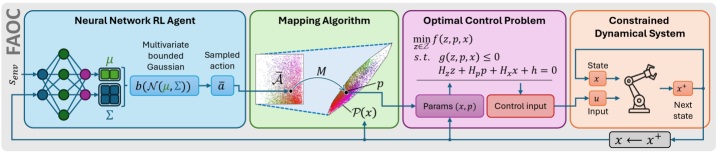
Figure 1. FAOC framework

Figure 1 — RL abstract action → feasible parameter set → OCP, guaranteeing constraint satisfaction.

1. Background and Motivation

Constrained dynamical system control requires efficiently solving complex tasks while enforcing recursive feasibility and safety constraints. RL is flexible but cannot guarantee feasibility; OC is predictably safe but lacks flexibility. FAOC bridges both.

2. Core Method

2.1 Feasible Action Mapping

Core contribution: a computationally efficient optimization-based mapping algorithm transforming RL agent actions from a static abstract set into the OCP's state-dependent feasible parameter set, guaranteeing strict dynamic system constraint satisfaction.

FAOC's RL action $\mathbf{a}_{RL}$ is mapped via $\mathcal{M}$ to OCP parameters $\mathbf{p}_{feasible}$:

$$\mathbf{p}_{feasible} = \mathcal{M}(\mathbf{a}_{RL}, \mathbf{x})$$

where $\mathbf{x}$ is the current state, $\mathcal{M}$ guarantees $\mathbf{p}_{feasible}$ is within the feasible parameter set.

2.2 RL + OC Bridge

  • RL abstract action space requires no expert or heuristic design.
  • OCP formulation is not compromised by RL's inability to guarantee feasibility.
flowchart LR
    A["RL Agent
abstract action a_RL"] --> B["Feasible Action Mapping
M(a, x)"] C["Current State x"] --> B B --> D["Feasible Parameters
p_feasible (state-dependent)"] D --> E["OCP Solver
(guarantees constraints)"] E --> F["Optimal Control
u*"] F --> G["Constrained System"] style B fill:#e0e7ff,stroke:#2563eb style E fill:#fef3c7,stroke:#d97706 style F fill:#dcfce7,stroke:#16a34a

3. Experimental Results

Applied to real-time motion planning for robot table tennis.

MethodSample Efficiency ↑Closed-Loop Perf ↑Constraints
Pure RLbasebaseNot guaranteed
Pure OCbaseGuaranteed
FAOCimprovedimprovedguaranteed

4. Main Contributions

  • Feasible action mapping: Optimization-based mapping converting RL actions to state-dependent feasible parameter sets.
  • Constraint guarantee: Strict constraint satisfaction, combining OC safety with RL flexibility.
  • No expert design needed: RL abstract action space requires no expert or heuristic design.

5.

Expected return

$$ J(\theta)=\mathbb{E}\left[\sum_{k=0}^{T}\gamma^{k}r(s_{k},a_{k})\right] $$

Q-value function

$$ Q^{\pi}(s,a)=\mathbb{E}\left[\sum_{k=0}^{N}\gamma^{k}r(s_{k},a_{k})\bigg|s_{0}=s,a_{0}=a\right] $$

Action binning

$$ \bar{a}=b(a)\in\bar{\mathcal{A}} $$

Optimization constraint

$$ \min_{z\in\mathcal{Z}}\quad H_{z}z+H_{p}p+H_{x}x+h=0 $$

Key Hyperparameters
ParameterValueDescription
Learning rate1e-4Adam optimizer
Batch size256Training batch
Discount $\gamma$0.99Reward discount
Epochs5000Training iterations
Figure 2

Figure 2: Additional results from the paper.
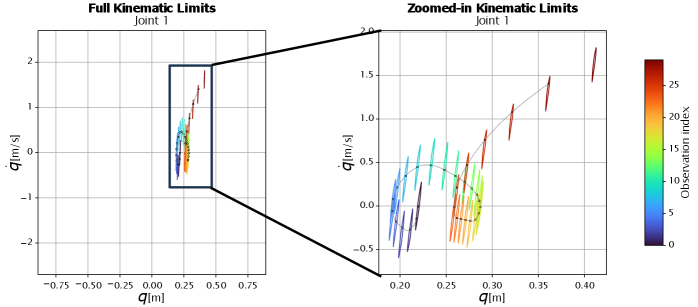
Figure 3

Figure 3: Additional results from the paper.

Limitations and Future Work

Limitations:

  • Mapping algorithm computational efficiency critical for real-time.
  • Only validated on robot table tennis; more complex tasks unknown.
  • OCP formulation design still requires domain knowledge.

6. Conclusion

FAOC bridges RL and OC through feasible action mapping — converting RL agent's abstract actions into OCP's state-dependent feasible parameter sets, guaranteeing strict constraint satisfaction, combining OC's predictable safety with RL's flexibility. RL action space requires no expert design, OCP formulation is not compromised by RL's feasibility limitations. Applied to robot table tennis real-time motion planning, outperforming baselines in sample efficiency and closed-loop performance.

RL's flexibility + OC's safety — feasible action mapping seamlessly fuses both.

Related Papers

Pre-training Visual Dexterity in Simulation

Pre-training Visual Dexterity in Simulation

Large-scale pre-training has made robot policy fine-tuning increasingly data-efficient, but this progress has largely been driven by datasets and embodiments built around simple parallel-jaw grippers. Dexterous, multi-fingered hands remain comparatively data-starved because real teleoperation is costly to scale, while human hand video is off-embodiment and requires lossy pose estimation and retargeting. We introduce Simulation Pre-training for Dexterity (SPD), a pre-training framework for dexterous manipulation that uses data entirely collected in simulation. In SPD, humans manipulate virtual objects inside a VR headset, enabling on-embodiment trajectories and robot-free collection. With the help of five operators, we collect 75 hours of multi-task dexterous manipulation over one week, and use it to pre-train a causal transformer on a sequence modeling objective. We study the benefits of simulation pre-training on real-world tasks by fine-tuning on 1-2 hours of physical demonstrations on a 56-DoF bimanual dexterous setup. We find that our approach outperforms training behavior cloning policies from scratch, showing that simulation teleoperation is a viable pre-training source for real-world dexterous manipulation. We perform ablation studies, measuring the benefits of history conditioning and short action chunks for reactive control.

灵巧操作灵巧手预训练Aug 16, 2026
FA-RDP: A Frequency-Adaptive Reactive Diffusion Policy for Contact-Rich Manipulation

FA-RDP: A Frequency-Adaptive Reactive Diffusion Policy for Contact-Rich Manipulation

In contact-rich manipulation, action multimodality and reactivity dominate different stages of a single episode. Before contact, multiple trajectories might be equally valid, making it important to preserve diverse action modes. After contact, geometric constraints and force limits narrow the solution space, while successful execution demands rapid responses to force feedback. However, standard diffusion policies use a fixed inference frequency and sampling steps throughout the episode, forcing a fundamental compromise: low-frequency, multi-step sampling better preserves pre-contact multimodality but responds slowly to force feedback, whereas high-frequency sampling improves reactivity but tends to collapse distinct pre-contact modes. To resolve this tradeoff, we present FA-RDP, a frequency-adaptive reactive diffusion policy. A shared multi-frequency visual-force Transformer predicts action chunks at both low and high frequencies, while a learned multimodality indicator dynamically selects multi-step low-frequency sampling before contact and one-step high-frequency sampling as action ambiguity decreases. We further introduce Manifold Consistency Distillation (MCD), which reparameterizes the diffusion network to predict actions on the robot action manifold while retaining DDPM-based residual supervision. Experiments on three contact-rich manipulation tasks show that FA-RDP achieves the highest success rate while preserving diverse pre-contact trajectory modes. Code and videos are available at https://fa-rdp.github.io.

PaperJul 30, 2026
PhiZero: A World Model Built Around Physical Language

PhiZero: A World Model Built Around Physical Language

We introduce PhiZero, a physical world model built around physical language, a compact discrete representation of world-state transitions. Existing physical world models typically predict future videos directly in pixel space, leaving the underlying world dynamics implicit within high-dimensional visual predictors. Motivated by humans' ability to abstract predictive structure from visual experience and organize it in natural language for explicit reasoning, we learn physical language from in-the-wild videos through self-supervision and use it to explicitly reason about how the physical world evolves. Accordingly, PhiZero adopts a reason-then-render paradigm: it first infers future world evolution as a physical-language sequence and then renders the inferred transitions into videos. Extensive experiments across generation and understanding benchmarks validate the ability of PhiZero to model physically coherent world evolution. We further show its potential for realistic and interactive world modeling, fine-grained action-conditioned simulation, and zero-shot motion transfer.

PaperJul 30, 2026
Booster Lab: A Data-Centric Pipeline for Learning Deployable Humanoid Locomotion Policies

Booster Lab: A Data-Centric Pipeline for Learning Deployable Humanoid Locomotion Policies

Humanoid robot motion learning requires not only task-oriented control policies but also physically feasible and natural behaviors that can be transferred to real robots. However, robot-feasible motion data are often scarce: raw human demonstrations may be incompatible with the robot morphology, open-source clips vary in quality, and simulation-collected robot trajectories still require feasibility checking. To address these challenges, we propose a data-centric training and deployment pipeline that integrates motion data curation, real-to-sim model adaptation, AMP-based reinforcement learning, and sim-to-real deployment. We validate the framework on the Booster T1 robot and further provide preliminary cross-platform validation on Booster K1.

步态优化人形机器人AMPJun 26, 2026