PAPER DEEP DIVE
Moving-Horizon Estimation and Nonlinear Model Predictive Control of Cable-Driven Soft Manipulators
Precise control of soft manipulators remains challenging due to the difficulty of developing accurate yet computationally tractable models for model-based estimation and control. Reduced Cosserat-rod models provide a physics-based and control-oriented description of soft-robot dynamics, offering an explicit alternative to purely data-driven input-output representations. In this paper, we propose a moving-horizon estimation (MHE) and nonlinear model predictive control (NMPC) framework for cable-driven soft manipulators based on reduced Cosserat dynamics. A smooth cable-length-driven modeling formulation is developed by approximating the complementarity relationship between cable tension and cable slackness, enabling cable-length control without direct tension sensing. Based on this formulation, an MHE method is introduced to estimate the reduced state and reconstruct the manipulator configuration from end-effector pose measurements and cable-length information. An NMPC controller is then formulated to achieve task-space control under cable-length and cable-rate constraints. The proposed framework is validated through numerical simulations and experiments. Simulation results demonstrate the effectiveness of the estimator and controller for pose and strain-related regulation on a multi-cable soft manipulator. Experimental results on a four-cable prototype further show that the proposed MHE-NMPC scheme can be implemented in real time and enables accurate end-effector position tracking through cable-length control.
1. Overview: MHE and NMPC for Cable-Driven Soft Manipulators
This paper by Lingxiao Xun, Haihong Li, and Gang Zheng (July 2026) proposes a moving-horizon estimation (MHE) and nonlinear model predictive control (NMPC) framework for cable-driven soft manipulators based on reduced Cosserat dynamics. Precise control of soft manipulators is challenging due to the difficulty of developing accurate yet computationally tractable models. Reduced Cosserat-rod models provide a physics-based, control-oriented description of soft-robot dynamics, offering an explicit alternative to purely data-driven input-output representations. A smooth cable-length-driven modeling formulation is developed by approximating the complementarity relationship between cable tension and cable slackness, enabling cable-length control without direct tension sensing. Based on this, MHE estimates the reduced state and reconstructs the manipulator configuration from end-effector pose measurements and cable-length information; NMPC achieves task-space control under cable-length and cable-rate constraints. The framework is validated through numerical simulations and experiments on a four-cable physical prototype, demonstrating pose regulation and real-time end-effector position tracking.
2. Core Problem: The Modeling and Control Dilemma of Soft Manipulators
Precise control of soft manipulators faces fundamental difficulties: continuum dynamics are highly nonlinear and infinite-dimensional, and the unilateral tension-slackness behavior of cable actuation makes traditional force control require integrating force sensors and implementing complex algorithms to manage cable tension fluctuations. Force control is challenging in engineering practice, while controlling cable length proves an effective alternative, greatly simplifying practical application. However, traditional force control algorithms struggle to transition to cable-length control in soft manipulators. The core problem: how to build a model that is both physically accurate and computationally tractable for cable-driven soft manipulators, and to achieve state estimation and constrained control on this basis.
3. Method: MHE-NMPC Framework
3.1 Reduced Cosserat Dynamics Model
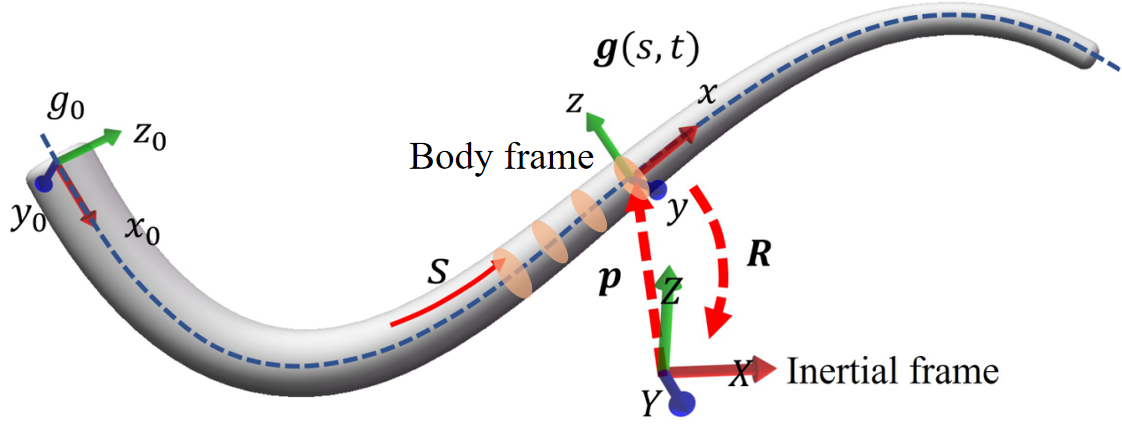
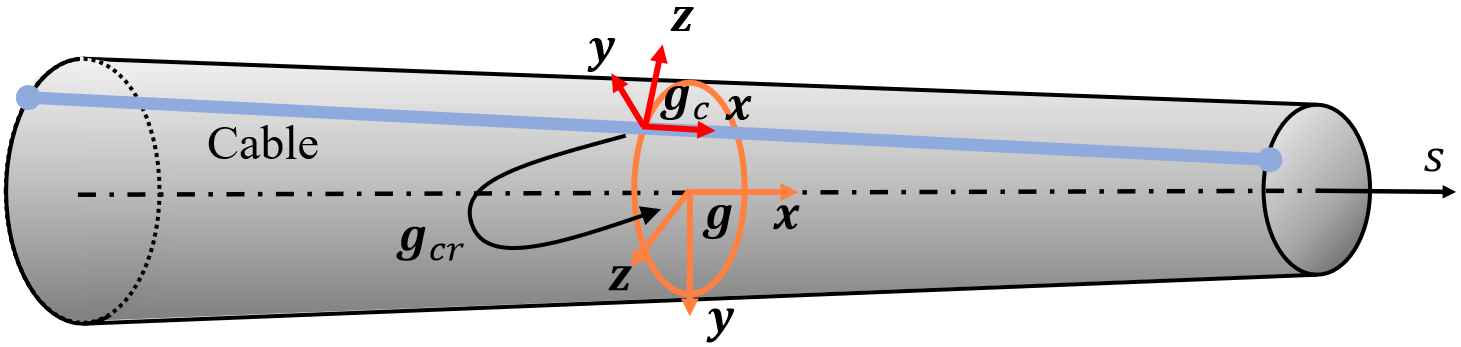
In the Cosserat framework, the soft manipulator is a set of rigid cross-sections along its centerline. The homogeneous transformation matrix for any cross section is:
$$\forall s \in [0, L], \quad \boldsymbol{g}(s, t) = \begin{bmatrix} \boldsymbol{R}(s, t) & \boldsymbol{p}(s, t) \\ \boldsymbol{0} & 1 \end{bmatrix} \in SE(3)$$where $\boldsymbol{p}(s, t) \in \mathbb{R}^3$ is the position vector, $\boldsymbol{R}(s, t) \in SO(3)$ is the rotation matrix, and $L$ is the total arc length. Strain and velocity are the left-trivialized tangent space of the homogeneous transformation:
$$\hat{\boldsymbol{\xi}}(s, t) = \boldsymbol{g}^{-1} \boldsymbol{g}' \in \mathfrak{se}(3) \simeq \mathbb{R}^6, \quad \hat{\boldsymbol{\eta}}(s, t) = \boldsymbol{g}^{-1} \dot{\boldsymbol{g}} \in \mathfrak{se}(3) \simeq \mathbb{R}^6$$To represent the state with a finite variable set, the strain field is parameterized with reduced degrees of freedom:
$$\boldsymbol{\xi}(s, t) = \boldsymbol{\xi}_0 + \boldsymbol{\Phi}(s)\, \boldsymbol{q}(t)$$where $\boldsymbol{q}(t)$ is the reduced generalized coordinate and $\boldsymbol{\Phi}(s)$ is the shape function matrix.
3.2 Cable-Driven Dynamics with Actuation Constraints
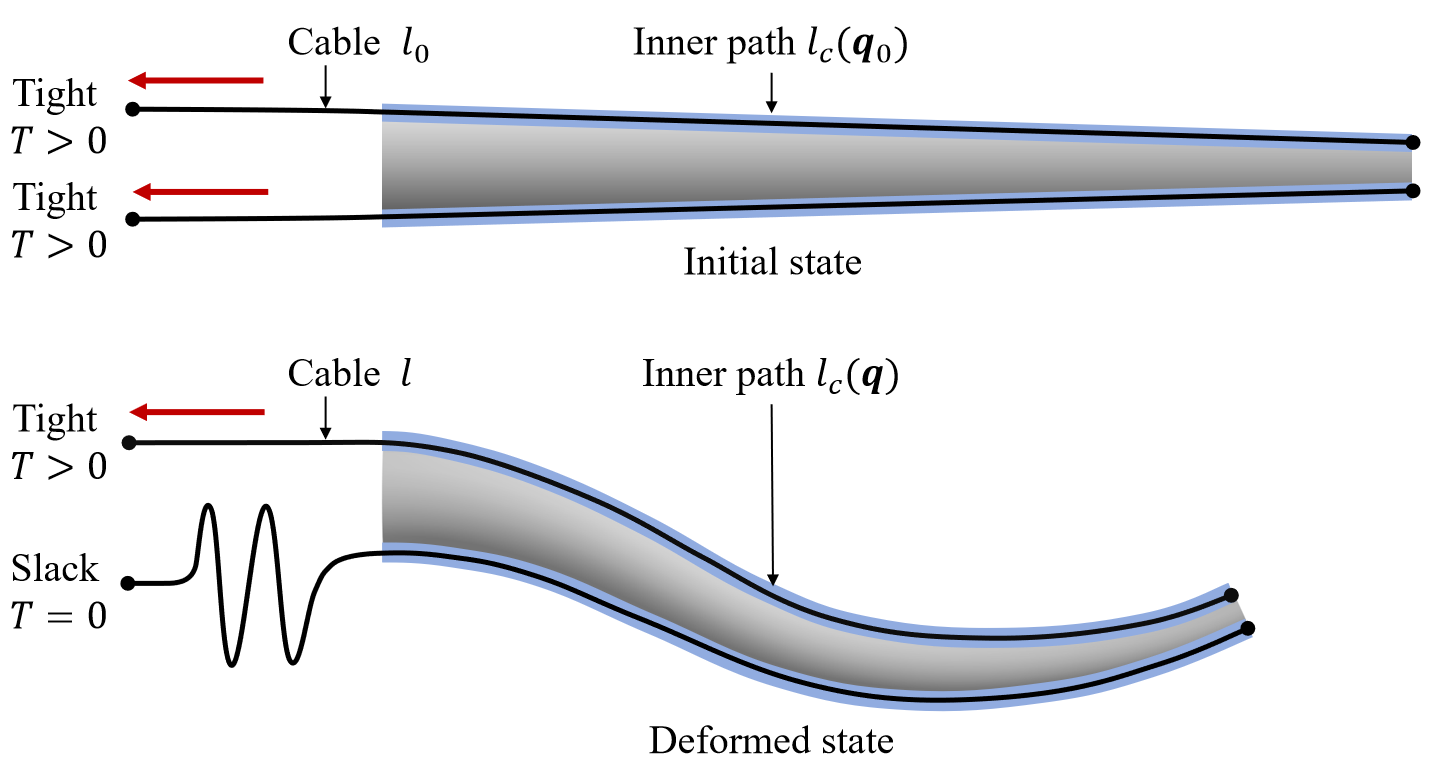
Cables route through internal paths and anchor at a cross section (typically the free end). The unilateral cable behavior manifests as a tension-slackness complementarity condition: cables can only pull, not push. Traditional complementarity conditions are non-differentiable and cannot be directly used in gradient-based optimization. This work introduces slack variables to approximate the complementarity condition as smooth equality constraints:
$$\text{Complementarity: } \lambda \geq 0, \quad \delta \geq 0, \quad \lambda \cdot \delta = 0 \quad \Longrightarrow \quad \text{Smooth approx: } \lambda \cdot \delta \approx \epsilon$$where $\lambda$ is cable tension, $\delta$ is slack, and $\epsilon$ is a small parameter. This enables cable-length inputs in a differentiable optimization framework.
3.3 NMPC-SQP Framework
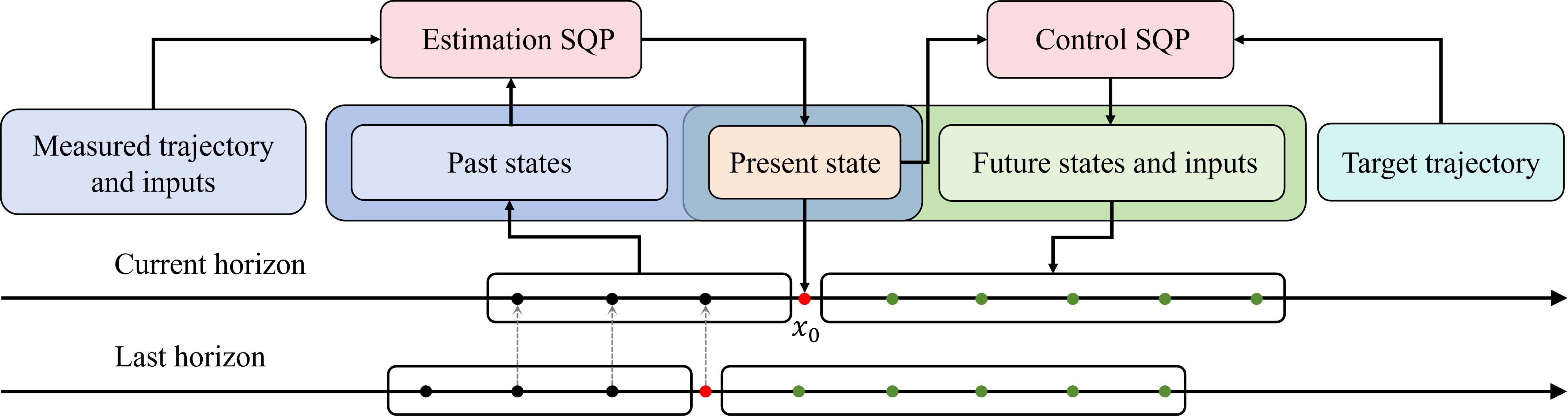
The time-continuous optimization is reformulated as a time-discrete nonlinear programming (NLP) problem. Discrete time points $t_{-M}, \dots, t_0, \dots, t_P$ are defined, with $t_{-M}=t-t_{\text{est}}$ (estimation window), $t_0=t$ (current), $t_P=t+t_{\text{ctrl}}$ (prediction window), step size $h$. State $\boldsymbol{x}_i = [\boldsymbol{q}_i^\top, \boldsymbol{q}_{i-1}^\top]^\top$. Estimation and prediction are solved as independent optimization problems. NMPC computes task-space control under cable-length and cable-rate constraints:
$$\arg\min_{\boldsymbol{u}_{0:P-1}} \sum_{i=0}^{P-1} \mathcal{J}_{\text{ctrl}}(\boldsymbol{x}_i, \boldsymbol{u}_i) + \mathcal{J}_{\text{term}}(\boldsymbol{x}_P)$$subject to dynamics constraints, cable-length constraints $\boldsymbol{u}_{\min} \leq \boldsymbol{u}_i \leq \boldsymbol{u}_{\max}$, and cable-rate constraints $|\Delta \boldsymbol{u}_i| \leq \Delta \boldsymbol{u}_{\max}$. MHE similarly minimizes estimation residuals over the past horizon.
4. Numerical Simulations
4.1 Simulation Setup
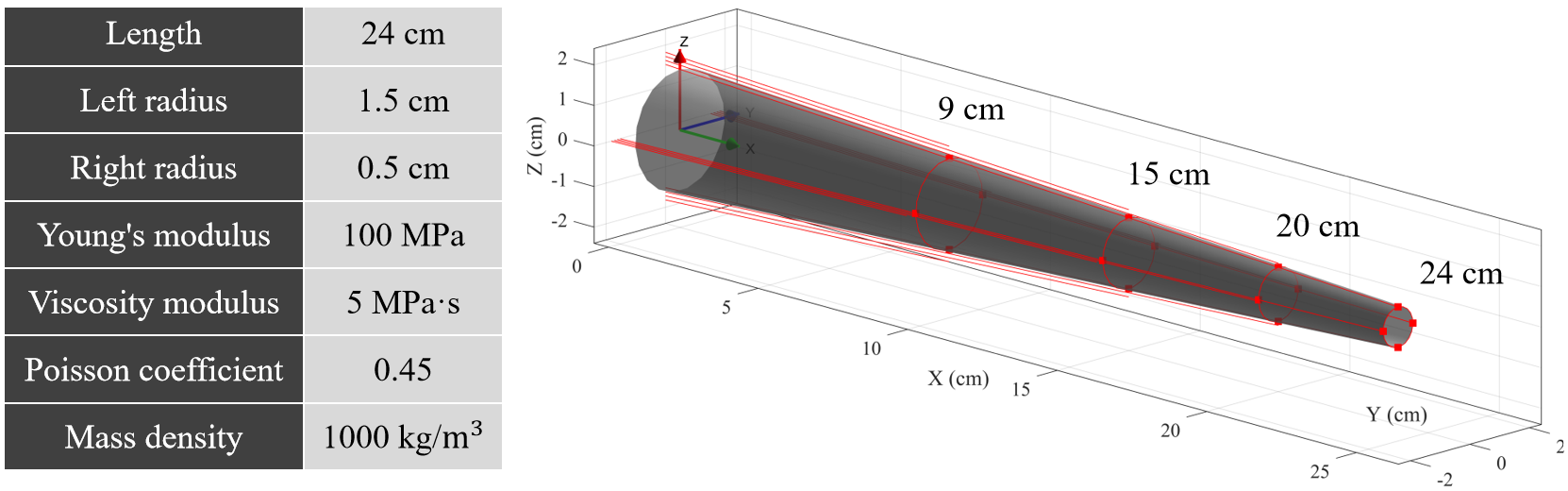
Simulations use a 16-cable soft manipulator. Tests include MHE configuration estimation, constant pose control, trajectory tracking control, and strain-pose coupled control. The pose control target is set to $\boldsymbol{\phi}_r = [1, -2, -3]^\top$, $\boldsymbol{p}_r = [5, 10, 8]^\top$, with cable length as control input. Simulation time step is 0.005 s, with 0.01 s between adjacent predicted configurations in the prediction horizon.
4.2 Simulation Results
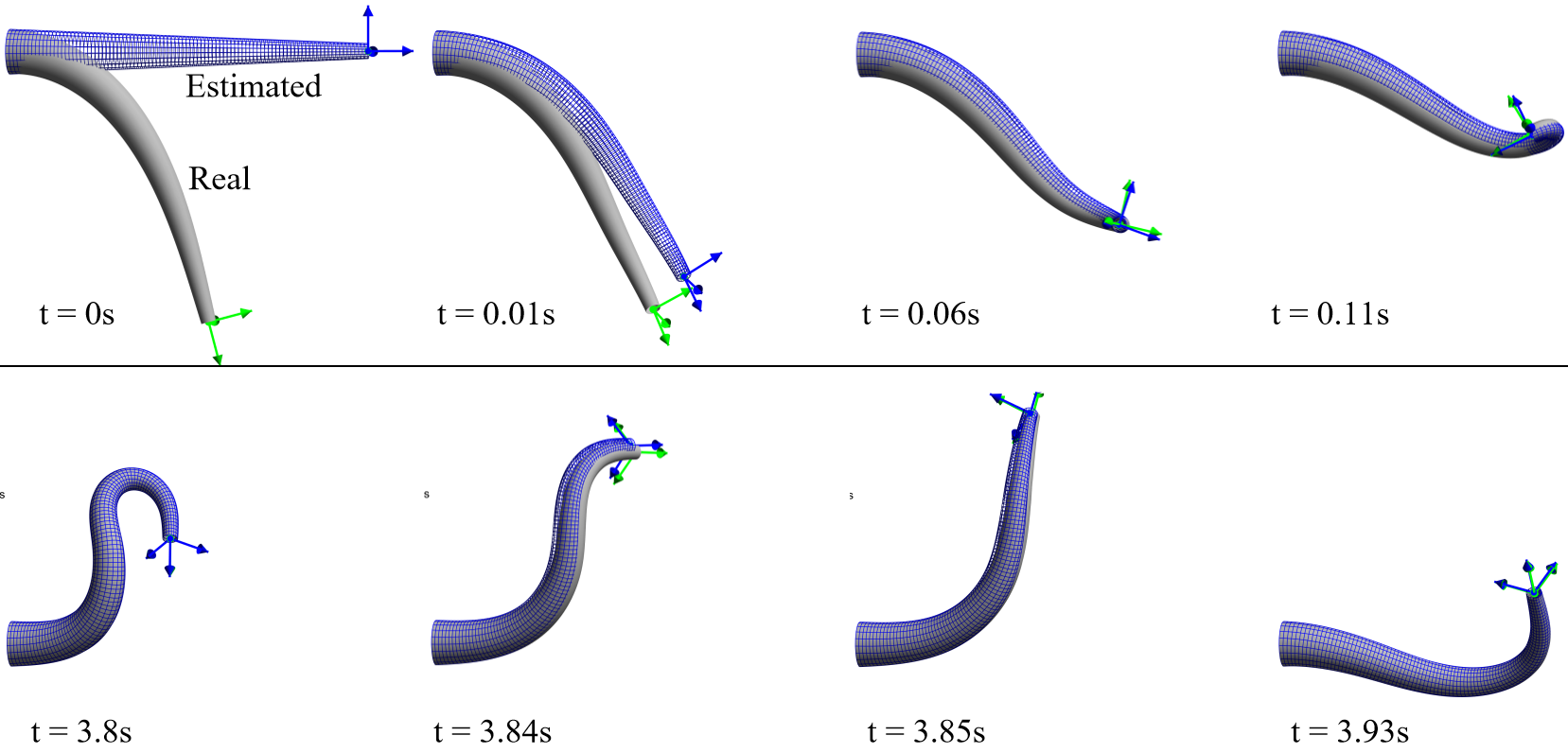
In pose control, the soft manipulator rapidly moves from a gravity-influenced steady state to the fixed target pose, with predicted configurations matching actual ones. Trajectory tracking and strain-pose coupled control both demonstrate the framework's capability. The influence of prediction horizon duration is analyzed.
5. Experimental Validation
5.1 Experimental Setup
The physical prototype is a four-cable soft manipulator: silicone cone body with rigid sleeves of varying diameters at equal intervals along the axis, four cables routing through sleeves anchored at the terminal sleeve. Material parameters: Young's modulus $E = 2.563 \times 10^5$ Pa, shear modulus $G = 8.543 \times 10^4$ Pa, density $\rho = 1.41 \times 10^3$ kg/m³. Control platform includes 4 stepper motors, a magnetic sensor (LIBERTY 240/16), and a computer.
| Component | Spec | Function |
|---|---|---|
| Soft body | Silicone cone + rigid sleeves | Bear cable contact forces, transfer to silicone |
| Actuation | 4 stepper motors | Control four cables |
| Sensing | LIBERTY 240/16 magnetic sensor | Detect end-effector position |
| Computation | Computer | Run observer and controller algorithms |
5.2 Experimental Results
MHE Observer: The operator randomly pulls four cables to generate motion; MHE (time horizon 0.3 s, 3 steps of 0.1 s each) estimates the manipulator shape from the measured end-effector trajectory. Estimation error converges rapidly and remains bounded; visual comparison qualitatively confirms consistency between estimated shape and physical prototype deformation. Trajectory Tracking: Closed-loop experiments integrate MHE with MPC, evaluating end-effector tracking under predetermined and randomly varying trajectories, demonstrating accurate position tracking. Real-time marker tracking and computational performance validate real-time feasibility.
| Experiment | Setup | Result |
|---|---|---|
| MHE observer | Horizon 0.3s, 3 steps×0.1s | Error converges rapidly, stays bounded |
| Trajectory tracking | Predetermined + random | Accurate end-effector tracking |
| Real-time marker tracking | Four-cable closed-loop | Real-time feasible |
| Computational performance | Four-cable prototype | Meets real-time constraints |
6. Limitations
- Smooth approximation accuracy: The smooth approximation of cable complementarity introduces error from the small parameter $\epsilon$, degrading when cables approach full slackness.
- Material parameter calibration: Relies on calibrated Young's modulus, shear modulus, and density; material parameter uncertainty affects model accuracy.
- Sensor dependency: MHE requires end-effector pose measurements and cable-length information; magnetic sensors may be disturbed in certain environments.
- Four-cable limitation: The experimental prototype has only four cables; scalability to more cables or more complex configurations needs further validation.
- Shape control not experimentally validated: Experiments focus on end-effector position tracking; more complex objectives like shape control are validated only in simulation.
7. Conclusion
This work proposes a unified modeling, estimation, and control framework for cable-driven soft manipulators. The unilateral tension-slackness behavior of cables is first formulated with complementarity conditions, then approximated as smooth equality constraints via slack variables, enabling cable-length inputs in a differentiable optimization framework. Analytical Jacobians of manipulator dynamics and cable-actuation constraints are derived. Based on reduced Cosserat-rod dynamics, the MHE-NMPC framework is developed: the moving-horizon estimator reconstructs the reduced state and manipulator configuration from end-effector pose and cable length, while NMPC computes cable-length commands under cable-length and cable-rate constraints. Numerical simulations demonstrate pose regulation, trajectory tracking, and strain-related control; four-cable prototype experiments validate real-time implementation and accurate end-effector position tracking. The core insight: smoothing the cable complementarity condition enables physically accurate Cosserat dynamics and gradient-based MPC to work together in real-time on soft manipulators for the first time—precise modeling and constrained control are no longer at odds.
flowchart TD
    A["Cable length input u"] --> B["Smooth cable constraint
complementarity → smooth equality"]
    C["End-effector pose measurement"] --> D["MHE moving-horizon estimator"]
    E["Cable length info"] --> D
    D --> F["Estimated reduced state q
reconstruct configuration"]
    F --> G["NMPC controller
cable length + rate constraints"]
    B --> G
    G --> H["Optimal cable-length commands"]
    H --> I["Stepper motors execute"]
    I --> A
    J["Reduced Cosserat dynamics
ξ = ξ₀ + Φ·q"] --> G
    J --> D
SOURCE LINKS