PAPER DEEP DIVE
HAF: Adapting Generalist VLAs to Humanoid Whole-Body Loco-manipulation via Hierarchical Action Flow and Spectral Latent RL
Humanoid robots hold great promise as general-purpose agents in human-centered environments, yet generalist vision-language-action (VLA) foundation models are not readily applicable to humanoid whole-body loco-manipulation. The high dimensionality and interdependence of humanoid motions make it challenging for conventional single-stage VLA architectures to coordinate locomotion, waist posture, and dual-arm manipulation effectively. Moreover, policies trained through offline behavior cloning can remain suboptimal during real-world deployment. Although online reinforcement learning can refine policies through real-world interaction, directly tuning large VLA backbones demands excessive computation and may introduce safety risks during real-robot exploration. To address these bottlenecks, we introduce HAF (Humanoid Adaptation Framework), a two-part framework consisting of HAF-VLA and HAF-Steer that transfers off-the-shelf generalist VLA foundation models to humanoid whole-body loco-manipulation. HAF-VLA is a hierarchical action-flow generator built on a pretrained flow-matching VLA. It splits full-body action denoising into three sequential stages with stage embeddings and cross-stage KV caches that retain kinematic dependencies, avoiding incoherent whole-body actions from one-shot generation. On top of the frozen HAF-VLA, HAF-Steer is a latent offline-to-online RL pipeline that leverages flow-matching invertibility and DCT-based dimensionality reduction to restrict RL optimization to a compact noise subspace and train a regularized SAC policy. This avoids updating the large VLA backbone and enables efficient real-world policy refinement. Evaluated on seven real-world humanoid loco-manipulation tasks, HAF surpasses vanilla single-stage VLA baselines and improves whole-body coordination and task performance. Project website: https://grange007.github.io/HAF .
Turning a generalist VLA into a full-body humanoid pilot
One-line summary: HAF turns an off-the-shelf flow-matching VLA into a humanoid whole-body loco-manipulation policy by splitting action denoising into a locomotion→waist→manipulation hierarchy (HAF-VLA), then fine-tunes it online through a frozen-backbone RL loop that only edits an 8-coefficient DCT noise subspace (HAF-Steer). On seven real tasks with the TienKung humanoid, average normalized score rises from 53.3% (π0.5) to 70.5%.
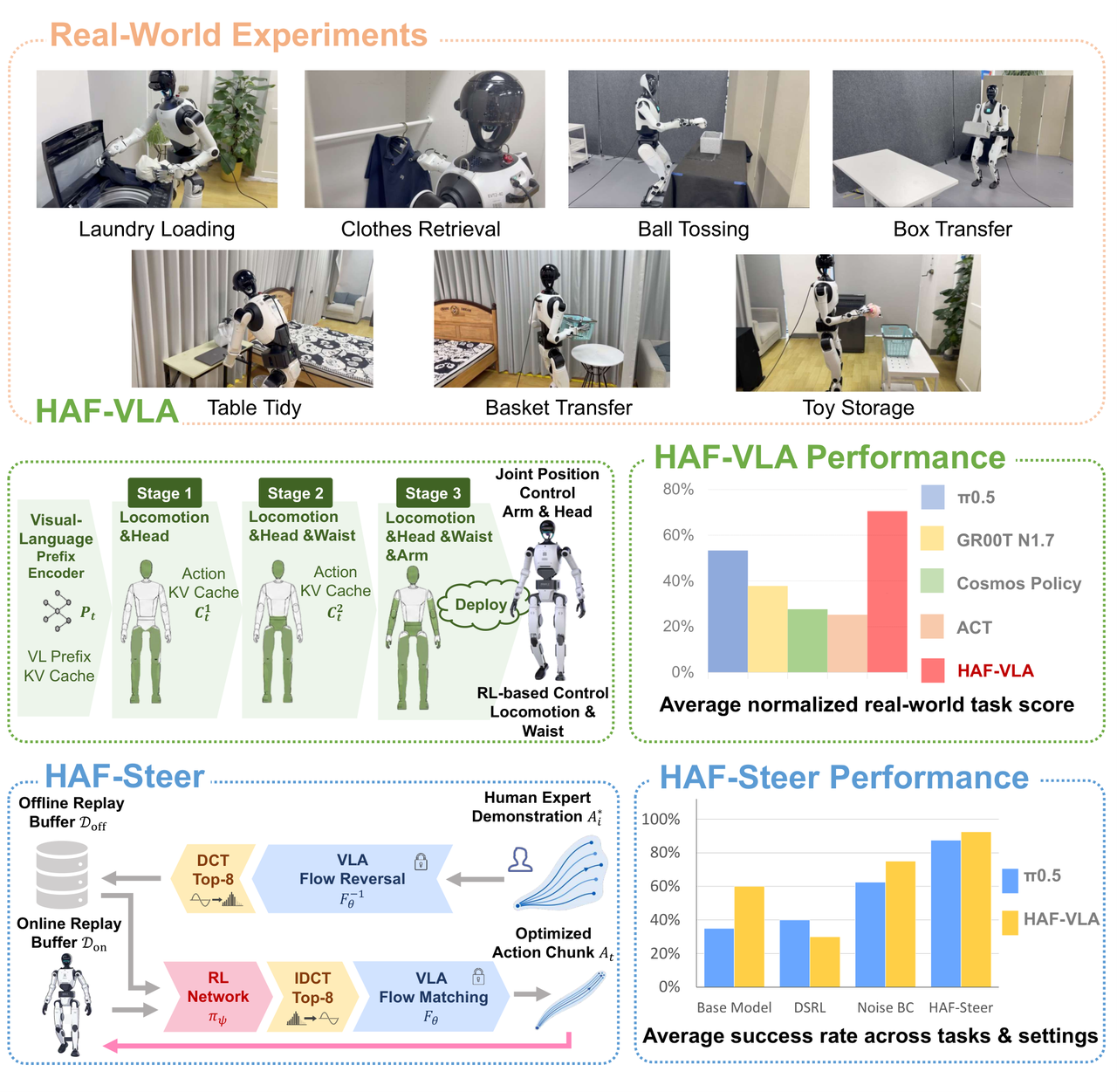
Figure 1: The HAF framework and the seven loco-manipulation tasks used for evaluation.
Paper: HAF: Adapting Generalist VLAs to Humanoid Whole-Body Loco-manipulation via Hierarchical Action Flow and Spectral Latent RL
Authors: Langzhe Gu, Chengkai Hou, Meng Li et al. (Peking University · Beijing Innovation Center of Humanoid Robotics)
Links: arXiv 2608.16837 · Project page · Code not released at time of writing
Background: why generalist VLAs stumble on humanoids
Generalist vision-language-action (VLA) models such as π0, π0.5 and GR00T produce an action chunk by denoising from Gaussian noise in a single pass, with every body part solved at once. On a fixed-base arm this works well. On a humanoid it collides with physics: locomotion, torso posture and bimanual manipulation are not interchangeable dimensions — an unstable base produces erratic compensatory arm motion that destroys manipulation accuracy. The paper frames this as the core obstacle: single-stage generation "entangles all body movements" and ignores the kinematic dependency structure.
Two prior routes exist, and both are expensive. One is humanoid-specific pretraining on large embodiment datasets, which must be re-run for every new platform. The other is online RL on the raw VLA, which is computationally heavy and unsafe on a 1.7-meter robot. Existing latent-noise RL fixes the safety problem but either optimizes the full high-dimensional temporal noise or repeats one noise vector across the horizon — trading efficiency for temporal expressiveness. HAF attacks both problems with two complementary components.
HAF-VLA: three stages, one shared expert
The action chunk is a sequence $A_t=[a_t,\ldots,a_{t+H-1}]\in\mathbb{R}^{H\times D}$ with $H=100$ steps (the robot executes the first 40 before re-querying). Each per-step action decomposes into four kinematic subsets: $a_t=[a_t^{\mathrm{move}},a_t^{\mathrm{head}},a_t^{\mathrm{waist}},a_t^{\mathrm{manip}}]$. From these the authors build nested cumulative index sets:
$$\mathcal{A}_t^{1}=\mathcal{A}_t^{\mathrm{move}}\cup\mathcal{A}_t^{\mathrm{head}},\quad \mathcal{A}_t^{2}=\mathcal{A}_t^{1}\cup\mathcal{A}_t^{\mathrm{waist}},\quad \mathcal{A}_t^{3}=\mathcal{A}_t^{2}\cup\mathcal{A}_t^{\mathrm{manip}}$$
Stage 1 denoises locomotion and head gaze; Stage 2 adds waist posture; Stage 3 activates the full space. Crucially the sets are nested rather than disjoint, so later stages may refine earlier dimensions instead of freezing them. All three stages reuse one action expert $F_\theta$, one visual-language prefix cache $P_t=F_{\mathrm{prefix}}(o_t,\ell)$, and independent Gaussian noise per stage, distinguished by a learned stage embedding $e_s$:
$$A_t^1=F_\theta(\epsilon_t^1\mid P_t,e_1),\quad A_t^2=F_\theta(\epsilon_t^2\mid P_t,C_t^1,e_2),\quad A_t^3=F_\theta(\epsilon_t^3\mid P_t,C_t^1,C_t^2,e_3)$$
The operators $C_t^1, C_t^2=\mathrm{Cache}_\theta(\cdot)$ re-encode each stage's denoised output into a KV cache consumed by later stages — this is how "stand up straight first, then reach" propagates through the network. Only $A_t^3$ is executed.
Training uses stage-wise flow matching. With a binary mask $m_s$ for stage $s$, noisy input and target are masked into the global action space:
$$X_{\tau^s,t}^{s}=\left[(1-\tau^s)\epsilon_t^s+\tau^s A_t\right]\odot m_s,\qquad u_t^{s}=(A_t-\epsilon_t^s)\odot m_s$$
$$\mathcal{L}_{\mathrm{HAF}}=\mathbb{E}\left[\sum_{s=1}^{3}\frac{1}{HD}\left\|v_\theta(X_{\tau^s,t}^{s},\tau^s;h_t^s)-u_t^s\right\|_F^2\right]$$
Inactive dimensions get zero target velocity instead of being dropped, and teacher forcing builds the cross-stage caches from ground truth during training. Deployment runs 10 denoising steps per stage — about 0.12 s for all three stages on one RTX 5090 — with receding-horizon execution of the first 40 steps.
flowchart TD
    O["Observation o_t + language l"] --> P["Prefix cache P_t
(computed once)"]
    P --> S1["Stage 1: locomotion + head
A1 = F(e1 | P, e_1)"]
    S1 --> C1["Cache C1"]
    C1 --> S2["Stage 2: + waist
A2 = F(e2 | P, C1, e_2)"]
    S2 --> C2["Cache C2"]
    C2 --> S3["Stage 3: + manipulation
A3 = F(e3 | P, C1, C2, e_3)"]
    S3 --> R["Execute first 40 of 100 steps"]
The HAF-VLA generation pipeline: one shared expert, three nested action masks, cross-stage KV caches.
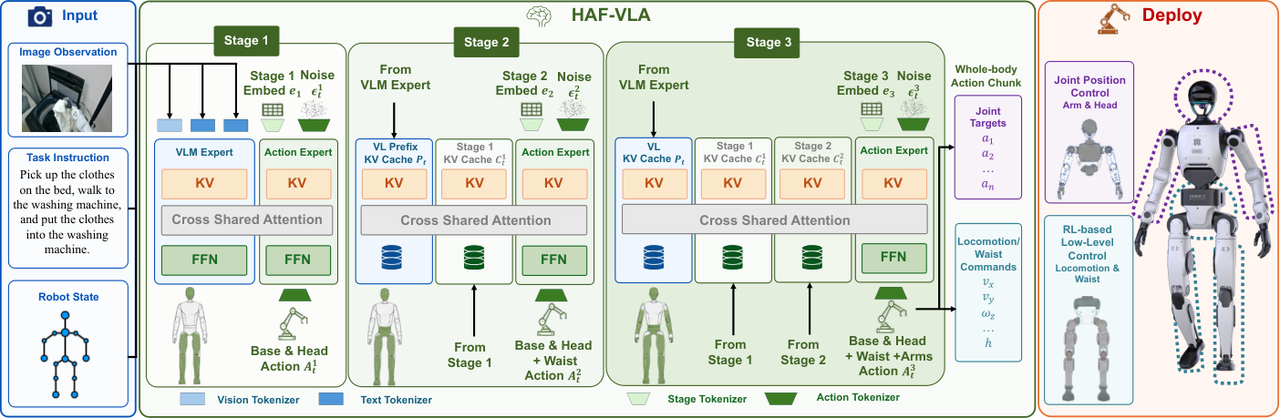
Figure 2: HAF-VLA progressively expands the active action space across three stages.
HAF-Steer: RL in an 8-coefficient spectral noise space
Flow matching is deterministic and invertible: $A_t=F_\theta(\epsilon_t\mid\zeta_t)$. Instead of retraining the backbone, HAF-Steer treats the initial noise $\epsilon_t$ as the control interface. A demonstrated action is inverted by numerically integrating the frozen flow backwards, then compressed with a truncated DCT:
$$\epsilon_i^*=F_\theta^{-1}(A_i^*\mid\zeta_i^*),\quad c_i^*=\mathrm{DCT}_K(\epsilon_i^*),\quad z_i^*=\frac{c_i^*-\mu_c}{\sigma_c+\delta}$$
With $K=8$ kept coefficients (out of $H=100$ steps), exploration shrinks from $H\times D$ to $K\times D$, and the low-frequency basis functions act as a physical smoothness prior. The authors report that the repeated-single-noise trick used by prior steering work (DSRL) caused body jerking and unsafe transients on the real robot — keeping several low-frequency modes avoids that. A stochastic actor $\pi_\psi$ is initialized by behavior cloning in this space:
$$\mathcal{L}_{\mathrm{BC}}=\mathbb{E}_{(x_i,z_i^*)\sim\mathcal{D}_{\mathrm{off}}}\left[\left\|\mu_\psi(x_i)-z_i^*\right\|_2^2\right]$$
then refined with mixed offline-online SAC using a sparse terminal reward ($r=1$ only on successful episode ends). The policy loss blends the SAC objective over mixed batches with a BC regularizer applied to offline data only:
$$\mathcal{L}_\pi=\mathbb{E}_{x_i\sim\mathcal{B},z_i\sim\pi_\psi}\left[\alpha\log\pi_\psi(z_i\mid x_i)-\min_j Q_{\omega_j}(x_i,z_i)\right]+\lambda_{\mathrm{BC}}\mathbb{E}_{(x_i,z_i^*)\sim\mathcal{B}_{\mathrm{off}}}\left[\left\|\mu_\psi(x_i)-z_i^*\right\|_2^2\right]$$
The offline sampling ratio decays during training to hand control over to live robot experience. Throughout, the entire VLA backbone stays frozen — only the spectral actor, critics and entropy temperature update. At test time: $z_t\sim\pi_\psi(\cdot\mid x_t)$, $c_t=\mu_c+(\sigma_c+\delta)\odot z_t$, $\epsilon_t=\mathrm{IDCT}_K(c_t)$, $A_t=F_\theta(\epsilon_t\mid\zeta_t)$. On HAF-VLA, steering is applied to Stage 3's initial noise only.
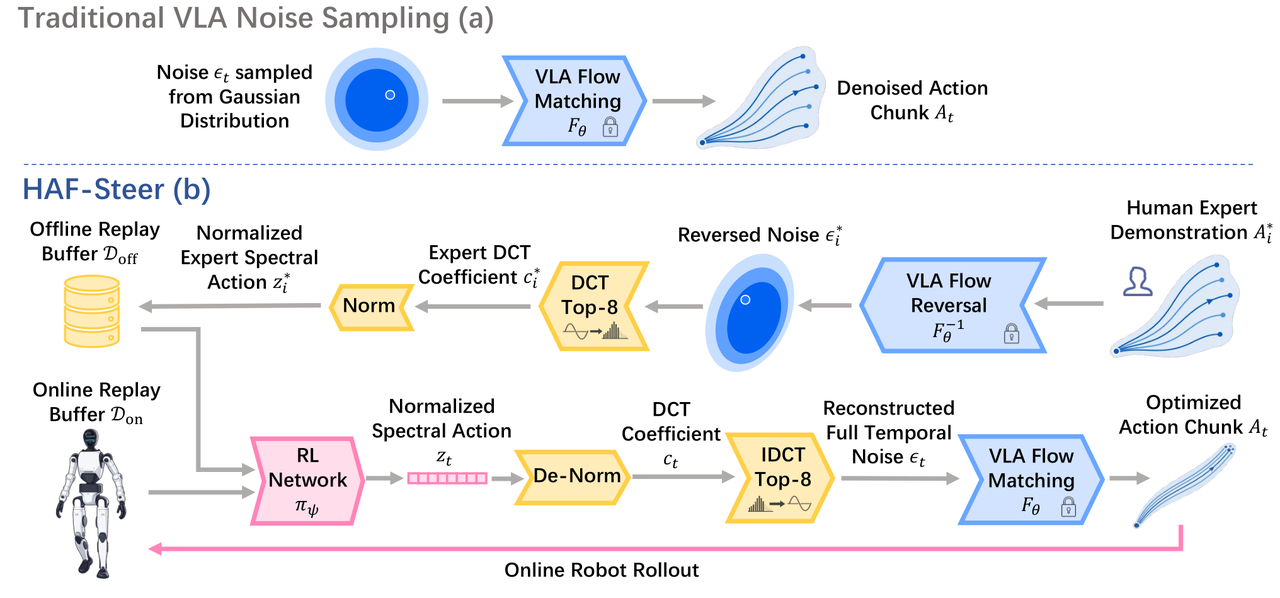
Figure 3: HAF-Steer. Flow reversal maps demos back to noise, DCT compresses them, and SAC learns in the compact spectral subspace while the VLA stays frozen.
flowchart LR
    D["Offline demos A*"] --> INV["Flow reversal
F_theta^-1 (frozen)"]
    INV --> DCT["DCT_K, K=8
+ normalize"]
    DCT --> BC["BC init of spectral actor"]
    BC --> SAC["Mixed offline-online SAC
sparse terminal reward"]
    SAC --> DEC["IDCT decode -> eps_t"]
    DEC --> GEN["Frozen VLA generator -> A_t"]
    GEN --> ROBOT["Real humanoid rollout"]
    ROBOT -->|"new transitions"| SAC
The offline-to-online loop: only the spectral actor and critics are trained.
Experiments: seven household tasks on TienKung 2.0/3.0
Data comes from isomorphic teleoperation — master arms for bimanual work, a joystick for locomotion/waist, an IMU for head gaze — 120 trajectories per task. Baselines are ACT, π0.5, GR00T N1.7 and Cosmos Policy. The metric is a normalized milestone score, averaged over 10 rollouts.
| Task | HAF-VLA | π0.5 | GR00T N1.7 | Cosmos | ACT |
|---|---|---|---|---|---|
| Laundry Loading | 66.7 | 53.3 | 40.0 | 0.0 | 10.0 |
| Clothes Retrieval | 53.3 | 53.3 | 33.3 | 26.7 | 23.3 |
| Table Tidy | 80.0 | 70.0 | 40.0 | 16.7 | 23.3 |
| Basket Transfer | 63.3 | 50.0 | 43.3 | 33.3 | 16.7 |
| Toy Storage | 80.0 | 53.3 | 30.0 | 40.0 | 23.3 |
| Ball Tossing | 56.7 | 33.3 | 36.7 | 3.3 | 30.0 |
| Box Transfer | 93.3 | 60.0 | 43.3 | 73.3 | 50.0 |
| Average | 70.5 | 53.3 | 38.1 | 27.6 | 25.2 |
Table 1: Normalized task scores across the seven loco-manipulation tasks.
HAF-VLA wins or ties on all seven tasks and lifts the average by 17.2 points. Gains concentrate where locomotion feeds into manipulation — Box Transfer (+33.3), Ball Tossing (+23.4), Laundry Loading (+13.4). The authors note π0.5 and GR00T drift while walking, and Cosmos Policy's higher inference latency hurts closed-loop performance.
Ablation on Laundry Loading isolates the hierarchy itself:
| Variant | Stage design | Steps | Score (%) |
|---|---|---|---|
| HAF-VLA | locomotion/head → +waist → +manip | 30 | 66.7 |
| All-Joint Denoising | all joints at every stage | 30 | 53.3 |
| Arm-First Hierarchy | manip → +waist → +locomotion/head | 30 | 50.0 |
| π0.5 | single stage | 30 | 20.0 |
Table 2: Ablation on Laundry Loading. Order matters as much as structure.
Two findings stand out. First, reversing the order (arm-first) drops to 50.0 — worse than the full hierarchy and barely above all-joint denoising, confirming that base and posture must be settled before fine manipulation. Second, plain π0.5 at 30 steps scores only 20.0: more denoising steps increase latency (0.075 s → 0.115 s), which amplifies the temporal mismatch of already-drifting locomotion predictions. HAF-VLA tolerates the same latency budget far better.
Robustness tests add an unseen chair on the Laundry Loading path and a 20 cm backward start shift for Clothes Retrieval; HAF-VLA scores 40.0 vs 26.7 and 43.3 vs 36.7 against π0.5. For HAF-Steer, on Toy Storage and Basket Transfer with in-distribution and 30 cm-shifted OOD goal tables, HAF-Steer improves every ID/OOD cell for both π0.5 and HAF-VLA backbones, with best-or-tied-best results in three of four settings; DSRL's repeated-noise variant produced unsafe motions and was terminated early.
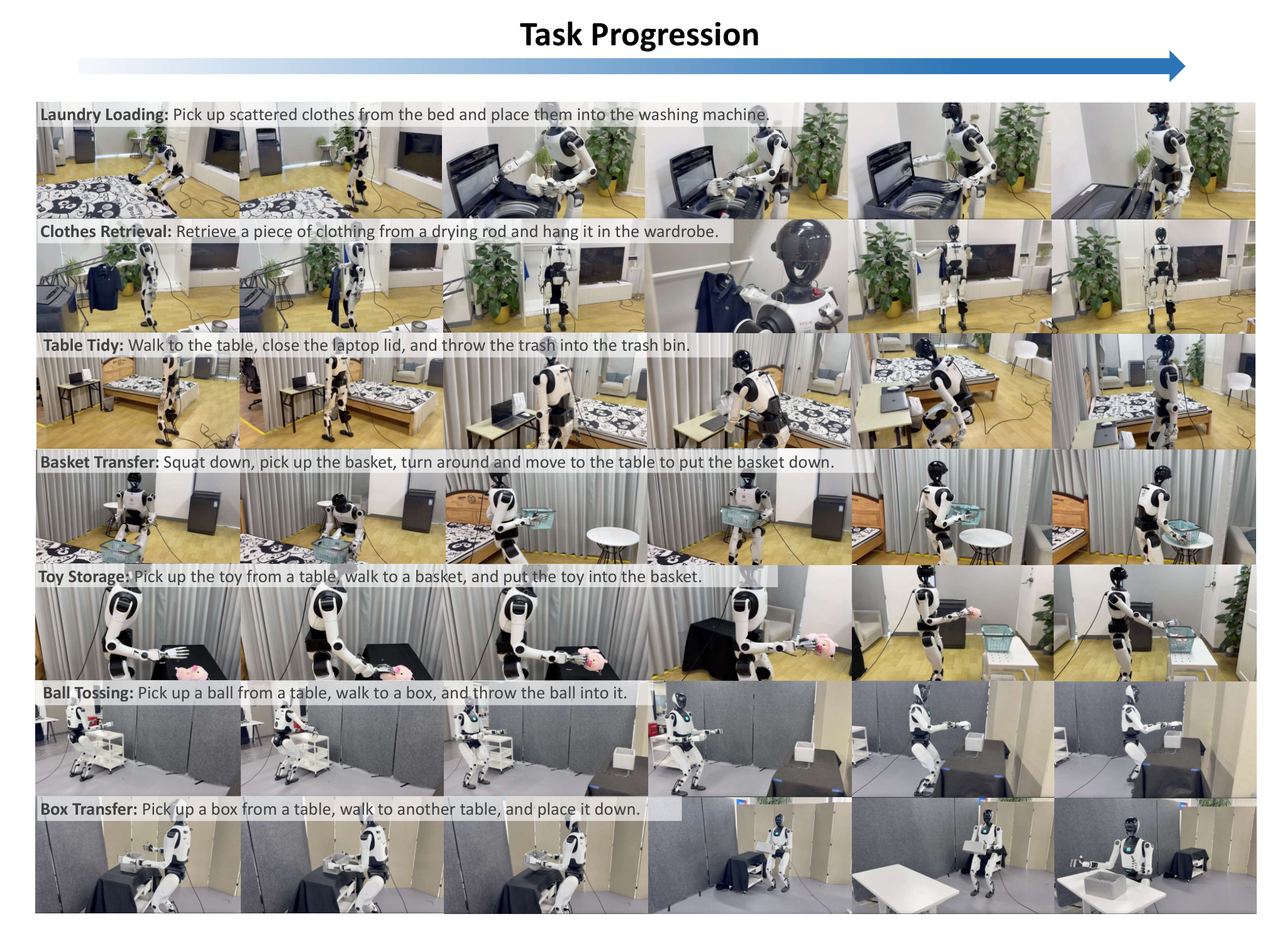
Figure 5: The seven real-world tasks demand walking, bending, squatting, carrying and throwing.
Limitations
The authors themselves flag two. The three-stage pipeline triples denoising computation and adds deployment latency — acceptable on an RTX 5090 today, but a real constraint for faster control loops or smaller hardware. Second, the latent RL module inherits the base VLA's priors: when the frozen generator's noise space simply cannot express a correction (extreme unseen scenarios), HAF-Steer cannot recover. From a reviewer's angle, the OOD tests also stay close to the demo distribution (a 20–30 cm shift), and the evaluation fleet is small — 10 rollouts per condition on a single platform family.
Conclusion
HAF's bet is that humanoid adaptation is mostly a structural problem, not a scale problem: respect the kinematic dependency order during generation, and respect the backbone's smoothness prior during RL. The result is a cheap transfer recipe — no humanoid pretraining, no backbone gradient — that moves a generalist VLA from "can operate an arm" to "can walk, bend and manipulate" on a real humanoid. If the flow-noise interface holds up at scale, steering frozen foundation policies through small spectral knobs may become a standard deployment tool.
Golden line: "Stand up first, reach later — and never touch the backbone, just tune the noise."