PAPER DEEP DIVE
RoboGesture: Real-Time Semantic-aligned Co-Speech Gestures Generation for Humanoid Interaction
Enabling humanoid robots to respond to human speech with synchronized and semantically meaningful gestures is fundamental to natural human-robot interaction. However, this task faces three critical barriers: the scarcity of semantically rich datasets, the "modality eclipse" where models ignore audio cues in favor of kinematic inertia, and the sim-to-real gap regarding physical safety. We propose RoboGesture, a robot-centric framework that co-designs data, modeling, and control to power a complete interactive human-humanoid system in which the robot listens, responds, and gestures in real time. We first establish the RoboGesture dataset featuring over 300 gesture categories and develop an automated pipeline to synthesize large-scale collision-free, robot-specific audio-motion pairs. Our architecture features a Hierarchical Semantic-Acoustic Aligner that extracts multi-granular prosodic and semantic cues directly from raw audio tokens. These cues drive a Streaming Conditional Motion Generator based on a diffusion transformer with conditional flow matching. To ensure high responsiveness, we introduce Anti-Inertia CFG Masking, which prevents the model from collapsing into repetitive historical patterns by compelling it to proactively mine control signals from the audio modality. Finally, an MPC-based safety filter ensures real-time, collision-free execution on physical hardware. Experiments on a Unitree G1 humanoid demonstrate that RoboGesture generates safer, more rhythmic, and more semantically appropriate responses compared to state-of-the-art baselines.
RoboGesture: Real-Time Semantic-aligned Co-Speech Gestures for Humanoid Interaction
Paper metadata
- Title: RoboGesture: Real-Time Semantic-aligned Co-Speech Gestures Generation for Humanoid Interaction
- Authors: Zifan Wang, Ziang Ren, Pengyang Shi (equal contribution), Zirui Wang, Chenghuai Lin, Tianze Wang, Zekun Qi, Liangliang Zhao, He Wang, Li Yi
- Affiliations: Tsinghua University, Galbot Inc., Beijing Institute of Technology, Harbin Institute of Technology, Peking University, Shanghai Qi Zhi Institute
- Date: 2026-08-27 (arXiv:2608.28693, cs.RO; accepted at ECCV 2026 according to the source tweet)
- Links: arXiv:2608.28693 · Project page RoboGesture.github.io
- Code: not yet released (the Code link on the project page is still a placeholder; only the project-page repository exists on GitHub)
- Hardware: Unitree G1 humanoid with dual BrainCo dexterous hands; 41 upper-body degrees of freedom (17 torso+arms, 24 hands)
One-Sentence Summary
RoboGesture co-designs data, modeling, and control to give humanoid robots real-time co-speech gestures: a 300+ category semantic gesture dataset and a 1000-hour robot-space semi-synthetic corpus feed a hierarchical semantic-acoustic aligner that extracts prosodic and semantic cues from raw streaming audio, which drives a diffusion-transformer motion generator parameterized by conditional flow matching, while an MPC safety filter adding only 5.6 ms per frame guarantees collision-free execution on a physical Unitree G1.
Background and Motivation
Co-speech gestures are an indispensable nonverbal channel of human communication: rhythmic hand beats while speaking, leaning forward for emphasis, or fingertips touching to signal "OK" all supplement linguistic content with semantic and emotional information. Giving humanoid robots this capability is a key step from treating them as tools to treating them as interaction partners. The paper sets its goal ambitiously and completely: the robot must listen to human speech and respond in real time with body motion that is both temporally synchronized and semantically meaningful.
The authors identify three entrenched barriers that have blocked this goal. First, data scarcity: in existing audio-motion datasets such as the 76-hour BEAT corpus, semantically rich gestures are extremely sparse, living in the long tail of natural motion distributions, so models struggle to learn which words deserve which gestures. Second, the "modality eclipse": during online streaming generation, models tend to copy the kinematic inertia of past motion and ignore the weaker audio and semantic signals; the resulting gestures look fluent but are decoupled from what is actually being said. Third, the sim-to-real safety gap: motions generated for virtual avatars and retargeted to physical robots often produce jerky trajectories and self-collisions, while social scenarios demand long-horizon stable operation beside people.
The paper's positioning differs sharply from prior work. One mainstream route (LivelySpeaker, Semantic Gesticulator, SemTalk) uses text as an intermediate representation: speech is transcribed and text features guide gesture synthesis. But speech-to-text discards prosody — the same word "Really" conveys skepticism with a rising intonation and confirmation with a falling one, and the accompanying gestures should differ — and most such methods generate offline and cannot stream. Another route (DiffSHEG) achieves streaming and text-free operation but models semantics coarsely and lacks hand detail. RoboGesture's comparison table claims all four desirable properties at once: streaming, semantic modeling, text-free input, and hand modeling, in a continuous motion space.
One stance runs through the entire paper and deserves emphasis: learning directly in robot joint space rather than generating in human skeleton space and retargeting online. RoboGesture internalizes retargeting as offline preprocessing — before data ever enters the model it is mapped to G1 kinematics and cleaned of collisions — so the training distribution and the deployment space are natively aligned, and inference requires no expensive inverse kinematics or retargeting. The appendix argues explicitly that robot-space learning "is not a matter of experimental convenience, but a fundamental requirement for achieving safe, low-latency, and high-fidelity humanoid interaction."
At the system level, the work refuses to be just a gesture module: it is built as the motion core of a complete listen–respond–gesture loop, with ASR, a LoRA-tuned Qwen3-4B LLM, and streaming TTS upstream, and 30 Hz PD control downstream, all deployed on a real G1 for social interaction. This complete-system orientation is what most distinguishes it from pure motion-synthesis papers.
Preliminaries
Mimi audio codec and multi-granular representation. The paper tokenizes streaming audio with the Mimi codec. Unlike conventional codecs, Mimi's hierarchical quantization structure decouples information natively: the first quantizer emits high-level semantic tokens while the subsequent residual quantizers encode fine-grained acoustic details such as prosody and intonation. This gives the framework a ready-made representation in which one audio stream supplies both rhythmic and semantic signals simultaneously.
Diffusion Transformer with conditional flow matching. The motion generator is a DiT parameterized by conditional flow matching (CFM): instead of iterative denoising, it learns the velocity field $v_\theta(M_\tau, \tau, C)$ along the interpolation trajectory $M_\tau = (1-\tau)M_0 + \tau M_1$ between Gaussian noise $M_0 \sim \mathcal{N}(0,I)$ and the target motion $M_1$. Compared with discrete-token autoregressive alternatives, the continuous state space is friendlier to finger-level kinematics and avoids recursive error accumulation.
FiLM modulation. Feature-wise Linear Modulation applies per-channel affine transformations (scale plus shift) to intermediate feature maps, making it suitable for injecting global-tone conditions. The paper uses it to carry compressed semantic instructions, while cross-attention carries frame-level rhythm — a deliberate division of labor.
Method in Detail
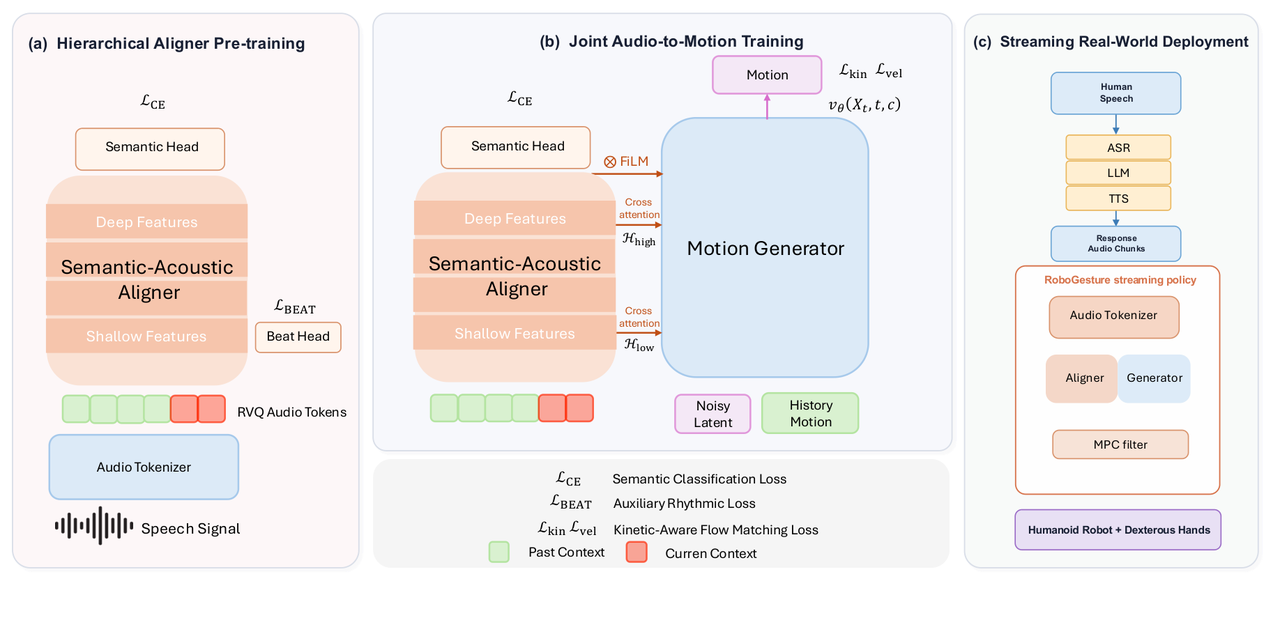
Figure 1: Overview of RoboGesture. (a) The Semantic-Acoustic Aligner is pre-trained to decouple multi-granular audio cues from streaming tokens. (b) The Motion Generator synthesizes motions via Conditional Flow Matching, jointly conditioned on hierarchical audio features and historical motion. (c) At inference, the pipeline integrates with upstream Speech-LLMs and drives the physical humanoid through the safety filter.
The framework is organized around three modules: a Hierarchical Semantic-Acoustic Aligner, a Streaming Conditional Motion Generator, and an MPC-based collision-avoidance filter. The action space is fixed at $T=30$ frames per one-second chunk, $D=41$ joint dimensions, and a history window of $T_{hist}=2T=60$ frames.
(1) Hierarchical Semantic-Acoustic Aligner: shallow layers for rhythm, deep layers for semantics. The aligner is a multi-layer transformer taking a $3T$-frame audio window (current chunk plus history) and is optimized with multi-task auxiliary learning for hierarchical disentanglement. Shallow layers are sensitive to rapid acoustic energy transients and are routed to a beat head regressing a rhythmic target:
$$B_{target} = \big[\,\text{Norm}(\text{Resample}(\|\dot{q}\|_2));\ \text{Norm}(\text{Onset}(wav))\,\big]$$
that is, the concatenation of the ground-truth motion's joint-velocity magnitude (resampled and normalized) with the audio onset strength, guaranteeing tight synchronization with acoustic onsets. Deep layers are routed to a semantic head performing 300-class gesture classification trained on the RoboGesture dataset; acting as an information bottleneck, it compresses acoustic nuance into actionable semantic tokens. The Stage-1 objective combines the two:
$$\mathcal{L}_{Stage1} = \lambda_{beat}\,\text{MSE}(\hat{B}, B_{target}) + \text{CE}(\hat{Y}, Y_{target})$$
The design is motivated by pre-phonetic anticipation: before uttering an emphatic word like "Stop!", the human body typically begins accumulating energy — leaning back or raising a hand. These preparatory signals hide in subtle acoustic precursors preceding vocalization; only processing raw audio can capture them, and text-based intermediate representations are structurally blind to them.
(2) Streaming Conditional Motion Generator: dual-condition injection. The generator's core tension is the modality eclipse: history motion is a strong signal while audio conditioning is weak, so the model lazily extrapolates from kinematic inertia. RoboGesture's answer is an explicit dual-channel injection. Framewise micro-alignment: the aligner's shallow rhythmic features, deep local-semantic features, and the past motion chunk are all projected as Key-Value pairs for cross-attention, handling frame-level rhythmic synchronization and smooth transitions between windows. Global macro-modulation: the highly compressed semantic instruction is injected through FiLM into the DiT's intermediate features, establishing the emotional and semantic tone of the whole segment without being drowned by local kinematic noise.
(3) Anti-Inertia CFG Masking: forcing the model to actually listen. During training, the Past Motion condition is masked entirely with 15% probability, forcing the network to generate from a cold start using only aligner features. This is the training-side realization of Classifier-Free Guidance: at inference both conditional and unconditional passes run and are extrapolated, preserving guidance strength from both history and audio. Appendix C's controlled perturbation experiments — audio shuffling, gradient-magnitude analysis, and delayed history injection — systematically verify both the existence of history-dominant bias and the necessity of this mechanism.
(4) Training objectives: spatio-temporally weighted velocity matching plus kinetic consistency. Stage 2 unfreezes the DiT for joint training. To keep fine hand kinematics from being submerged, the paper defines a spatial weight $W_s \in \mathbb{R}^D$ ($w_{hand}=4.0$ for hand joints) and a temporal weight $W_t \in \mathbb{R}^T$ ($w_{frame} \in \{5, 10\}$ within semantic intervals). The core supervision is the weighted velocity-matching loss:
$$\mathcal{L}_{vel} = \mathbb{E}_{\tau, M_1, M_0}\Bigg[\sum_{t=1}^{T}\sum_{d=1}^{D} W_t^{(t)} W_s^{(d)} \cdot \Big(v_\theta(M_\tau,\tau,C)^{(t,d)} - (M_1 - M_0)^{(t,d)}\Big)^2\Bigg]$$
where $\tau \sim \mathcal{U}(0,1)$ is the flow-matching timestep. To suppress high-frequency jitter, a Kinetic Consistency Loss penalizes first-order temporal differences. Using the single-step Euler approximation $\hat{M}_1 = M_\tau + (1-\tau)\,v_\theta(M_\tau,\tau,C)$:
$$\mathcal{L}_{kin} = \mathbb{E}_{\tau, M_1, M_0}\Bigg[\sum_{t=1}^{T-1}\sum_{d=1}^{D} \bar{W}_t^{(t)} W_s^{(d)} \cdot \Big(\Delta\hat{M}_1^{(t,d)} - \Delta M_1^{(t,d)}\Big)^2\Bigg]$$
where $\Delta M^{(t)} = M^{(t+1)} - M^{(t)}$ is the inter-frame displacement. The final Stage-2 objective is:
$$\mathcal{L}_{Stage2} = \mathcal{L}_{vel} + \lambda_{kin}\,\mathcal{L}_{kin} + \lambda_{sem}\,\text{CE}(\hat{Y}, Y_{target})$$
The kinetic-aware loss deserves particular attention: it does not only supervise where the motion goes but also how it moves between frames — velocity matching fixes trajectory shape while kinetic consistency fixes motion texture, and the ablation (removing it drops the hand-detail score from 7.203 to 3.947) shows it is the key ingredient for expressive hand gestures.
(5) MPC safety filter: a per-frame convex program. Because generative models cannot guarantee absolute physical safety, every synthesized chunk passes through an inference-time MPC filter. In MuJoCo the minimum distance between bodies in each collision pair is $dist(q)$, constrained by $dist(q) \geq dist_{th}$. A first-order Taylor expansion linearizes it:
$$dist(q) \approx dist(q_0) + \left.\frac{\partial dist(q)}{\partial q}\right|_{q=q_0} \cdot \Delta q$$
with the contact Jacobian obtained via the mujoco.mj_jac API. The per-frame problem becomes a convex QP:
$$\min_{\Delta q}\ J_1(\Delta q) + J_2(\Delta q) + J_3(\Delta q) = W_1\|\Delta q\|_2^2 + W_2\|q_0 + \Delta q - q_{ref}\|_2^2 + W_3\|q_0 + \Delta q - q_{prev}\|_2^2$$
combining a velocity cost, a trajectory-tracking cost toward the generated reference, and a smoothing cost toward the previous state, solved per frame with OSQP. To save computation, bodies are grouped into three collision pairs — FINGER_FINGER_PAIR, FINGER_HAND_PAIR, OTHER_CHECK_PAIR — reducing checks from $C_M^2$ over all $M$ bodies to $C_N^2$ within each pair of $N$ selected bodies. The same filter doubles as a data-cleaning tool: applied offline to the training corpus, it removes every potential self-collision before learning even begins; applied online it drops the self-collision frame ratio from 4.16% to 0.13% at only 5.6 ms per frame.
flowchart LR
    A[Streaming audio chunk] --> B[Mimi tokenizer]
    B --> C[Semantic-Acoustic Aligner]
    C --> D[Shallow features: rhythm]
    C --> E[Deep features: local semantics]
    C --> F[Semantic tokens via 300-class head]
    G[Past motion 60 frames] --> H[Cross-attention KV]
    D --> H
    E --> H
    F --> I[FiLM global modulation]
    H --> J[DiT + Conditional Flow Matching]
    I --> J
    J --> K[1-second motion chunk 30 frames x 41 DoF]
    K --> L[MPC safety filter OSQP 5.6 ms/frame]
    L --> M[Unitree G1 PD control 30 Hz]
    M -->|history window| G
RoboGesture streaming pipeline: dual-condition injection into the DiT generator, closed by the MPC filter and the history feedback loop.
Data: The RoboGesture Dataset and Semi-Synthetic Pipeline
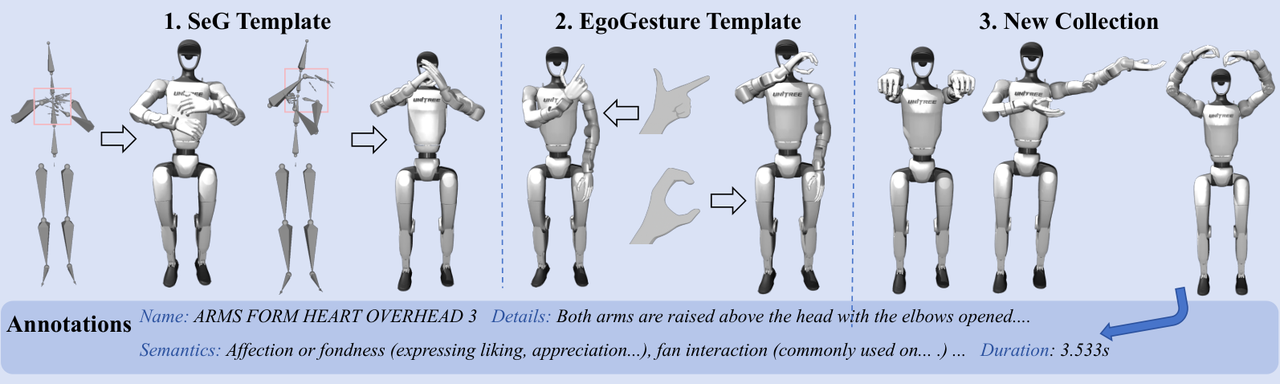
Figure 2: Visualization of the RoboGesture dataset. It refines the SeG dataset by correcting motion penetration, augments EgoGesture with full-body motion, and adds newly collected gestures, all with detailed semantic labels.
The data engine has two halves. The RoboGesture dataset itself contains over 300 gesture categories whose class list derives from SeG and EgoGesture templates expanded via user questionnaires. Every gesture is recorded with a marker-based motion-capture system to preserve fine-grained kinematics, manually annotated with motion descriptions and possible meanings across scenarios, then retargeted with enhanced GMR (body) and Dex-Retargeting (hands), optimized by the collision filter, and finally replayed on the physical robot to verify reachability and control fidelity.
The semi-synthetic pipeline then scales it up in five stages: (1) Scenario Generation — LLMs produce diverse daily scenarios and narrative scripts enriched with emotional descriptions; (2) Gesture Tagging — LLMs select semantically appropriate gestures from RoboGesture, decide their insertion points, and adjust wording for natural integration; (3) Multimodal Synthesis — emotion-aware TTS audio with word-level timestamps is generated alongside rhythmic beat gestures from a model trained on BEAT; (4) Temporal Blending — semantic gestures are scheduled to start 0.4 s before their corresponding spoken keywords, mimicking human anticipation, and fused with rhythmic motion by fifth-order interpolation; (5) Safety Optimization — the collision filter cleans the blended trajectories. Varying prompts or text libraries yields millions of paired audio-motion samples; the paper ultimately uses roughly 1000 hours of this semantic-centric corpus, blended with a 3x-upsampled beat-centric BEAT subset (about 76 hours) for Stage-2 training.
Experiments
Setup. Co-speech gesture generation is evaluated on BEAT (76 hours, 30 participants) and SemanticBEAT, a new test set of 1,000 online speech videos with manual temporal annotation of semantic-gesture intervals. Baselines are LivelySpeaker (ICCV 2023), DiffSHEG (CVPR 2024), SemTalk (ICCV 2025), and Semantic Gesticulator (SIGGRAPH 2024); all baseline outputs are human motions retargeted carefully to the robot, and the appendix verifies that re-training representative baselines directly in robot joint space yields nearly identical results — gains come from the model, not retargeting artifacts.
| Method | BEAT FGD ↓ | BC ↑ | MSE ↓ | DIV ↑ | Col. ↓ | SemanticBEAT BC ↑ | DIV ↑ | Col. ↓ |
|---|---|---|---|---|---|---|---|---|
| LivelySpeaker | 3.0350 | 0.1811 | 0.1861 | 0.1485 | 21.41 | 0.2852 | 0.1384 | 13.36 |
| DiffSHEG | 2.2316 | 0.1851 | 0.1753 | 0.1218 | 0.85 | 0.2859 | 0.1209 | 1.20 |
| SemTalk | 7.9328 | 0.1828 | 0.3931 | 0.1781 | 52.82 | 0.2913 | 0.1440 | 42.65 |
| Semantic Gesticulator | 3.0147 | 0.1771 | 0.2375 | 0.2818 | 13.11 | 0.2906 | 0.2831 | 13.84 |
| RoboGesture | 0.8452 | 0.1866 | 0.1347 | 0.2075 | 0.88 | 0.2950 | 0.2041 | 0.13 |
Table 1: Quantitative comparison on BEAT and SemanticBEAT (paper Table 2). FGD/MSE are omitted for SemanticBEAT since it lacks ground-truth motion.
Three numbers carry the story. FGD 0.8452 — roughly 2.7x better than DiffSHEG — says the generated motion distribution is far closer to real motion. Collision rate 0.88% on BEAT and 0.13% on SemanticBEAT, against 13–53% for every baseline except DiffSHEG (1.20/0.85), says the robot-space design plus the MPC filter makes output physically executable where others self-intersect. Beat consistency leads on both datasets. Only diversity loses to Semantic Gesticulator's 0.2818, and the paper's defense is fair: DIV can be artificially inflated by unstable or jittery motion, and RoboGesture chooses the balance of kinematic realism, synchronization, and safe diversity.
| Model | BEAT RA ↑ | SA ↑ | PHC ↑ | OP ↑ | SemanticBEAT RA ↑ | SA ↑ | PHC ↑ | OP ↑ |
|---|---|---|---|---|---|---|---|---|
| LivelySpeaker | -0.2223 | -0.3994 | -0.4304 | -0.3064 | -0.2126 | -0.3015 | -0.3466 | -0.3497 |
| DiffSHEG | -0.0058 | -0.2691 | -0.1440 | -0.0992 | -0.0090 | -0.0817 | -0.0458 | -0.0626 |
| SemTalk | 0.0128 | 0.0151 | 0.1679 | -0.0132 | 0.0650 | -0.0012 | 0.1207 | 0.0970 |
| Semantic Gesticulator | 0.0819 | 0.2264 | -0.0273 | 0.1137 | 0.0296 | 0.1605 | -0.0347 | 0.0640 |
| RoboGesture | 0.1334 | 0.4270 | 0.4338 | 0.3050 | 0.1269 | 0.2239 | 0.3066 | 0.2514 |
Table 2: Pairwise human evaluation (paper Table 3), merit scores over 200 comparison pairs. RA: rhythmic alignment, SA: semantic accuracy, PHC: physical and hand consistency, OP: overall preference.
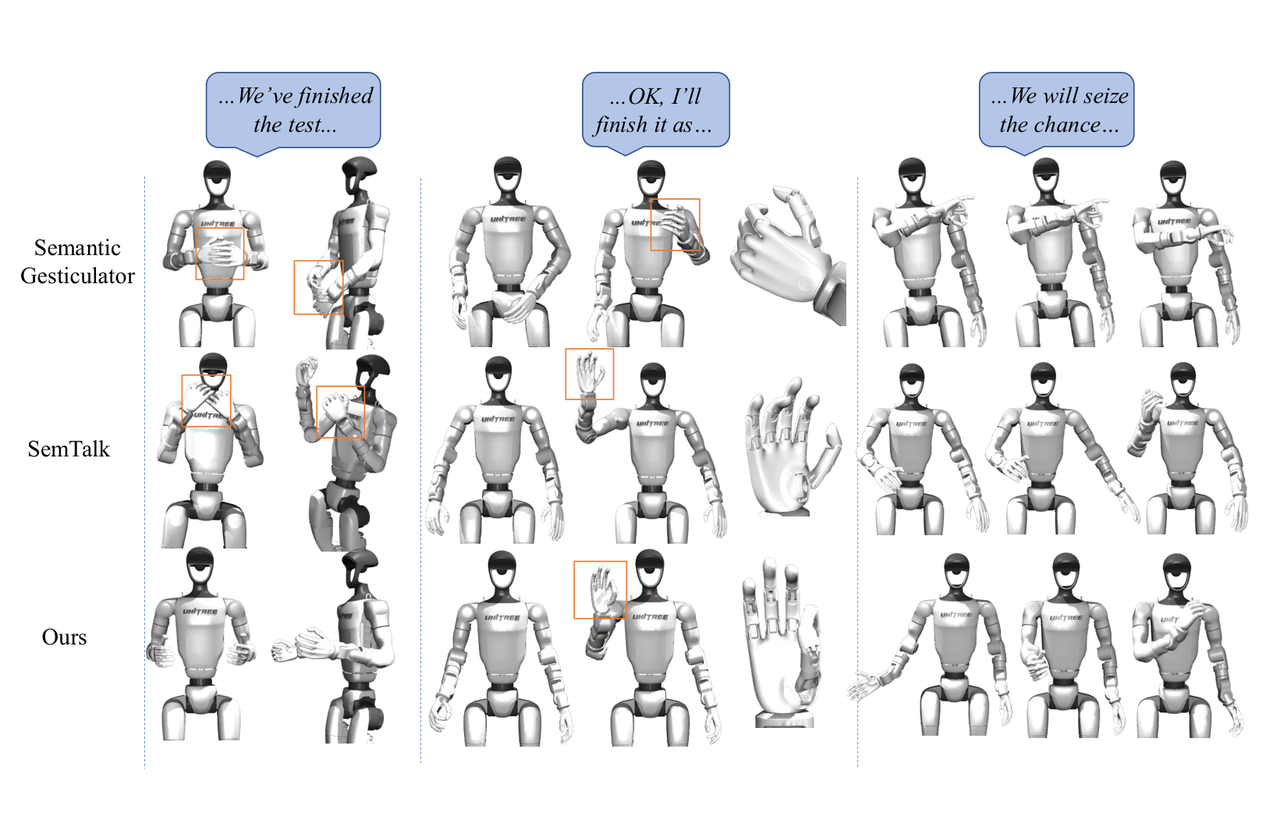
Figure 3: Qualitative comparison. Left: baselines such as Semantic Gesticulator occasionally suffer severe self-penetration while RoboGesture stays collision-free. Middle: given the explicit cue "OK", RoboGesture synthesizes the precise "OK" hand gesture. Right: for emphatic speech like "seize the chance", it generates expressive body language such as confidently patting the chest.
The human study sampled 20 clips per baseline into 200 pairwise comparisons scored on four dimensions; RoboGesture leads every dimension on both datasets, most decisively in Physical & Hand Consistency (0.4338 merit), which is exactly where the kinetic-aware loss and the safety filter should pay off. The qualitative figure makes the semantic story concrete: baselines miss the "OK" hand shape entirely and occasionally produce arm-body interpenetration, while RoboGesture hits the semantic target and stays physically safe.
| Configuration | SA ↑ | HD ↑ | HN ↑ | BM ↑ |
|---|---|---|---|---|
| w/o Semi-data | 4.281 | 2.321 | 4.945 | 4.628 |
| 1/4 Semi-data (~250 h) | 6.316 | 5.980 | 6.882 | 6.892 |
| w/o Context Motion | 4.237 | 4.263 | 2.192 | 1.928 |
| w/o FiLM Injection | 5.181 | 4.389 | 4.506 | 4.589 |
| w/o Semantic Classification | 5.007 | 4.747 | 4.750 | 5.268 |
| w/o CFG | 4.628 | 4.885 | 6.453 | 6.212 |
| AR Strategy | 4.843 | 5.031 | 5.358 | 6.850 |
| w/o Kinetic-Aware Loss | 5.573 | 3.947 | 4.763 | 5.587 |
| w/o Filter | 6.541 | 6.913 | 6.891 | 7.387 |
| Full Model | 7.175 | 7.203 | 7.394 | 7.529 |
Table 3: Ablation study with 200 participants (paper Table 4). SA: semantic action, HD: hand detail, HN: human-likeness and naturalness, BM: beat matching.
The ablation decomposes cleanly along three axes. Data scale: removing the semi-synthetic corpus collapses semantic action from 7.175 to 4.281 and hand detail to 2.321 — without it the model degrades to rhythm-only beat gestures — and even a quarter of it (~250 hours) remains noticeably sub-optimal. Architecture and strategy: removing the past-motion context produces severe discontinuities (HN 2.192, BM 1.928 — the worst of all configurations); dropping FiLM hurts expressiveness; dropping the semantic classification task prevents explicit semantic learning from audio tokens; and removing CFG lets the model infer motion from past state alone. Notably, replacing flow matching with an autoregressive strategy also degrades every dimension (e.g., HN 5.358), corroborating the choice of continuous CFM over discrete tokens. Loss refinement: the kinetic-aware loss is the hand-detail workhorse (HD drops to 3.947 without it), and disabling the filter produces a smaller but consistent penalty, confirming its role as the final smoothness and safety stage.
Real-world social interaction. The deployed system comprises a language interaction module (ASR, LoRA-tuned Qwen3-4B, streaming Seed-TTS), the streaming speech-to-motion module, and robot execution. The motion stack runs far faster than real time — the generator sustains roughly 120 FPS (249.78 ms average per one-second chunk over 240 chunks) and the MPC filter adds 5.6 ms per frame, both comfortably above the 30 Hz control rate — so system latency is dominated by the upstream speech pipeline, with the first audio chunk typically available in under 1.5 seconds.
| Module | Online latency (first usable output) |
|---|---|
| ASR | max(0.157 s, T_idle) ≈ 0.5 s (T_idle = 0.5 s endpoint detection) |
| Qwen3-4B-Instruct (LoRA-tuned) | 0.142 s time-to-first-token |
| TTS (Seed-TTS) | 0.414 s first speech chunk |
| Mimi audio tokenizer | 0.161 s first streaming token |
| Motion generator | 0.250 s per chunk (≈120.11 FPS) |
| MPC filter | 0.170 s per chunk (0.0056 s per frame) |
Table 4: Runtime latency breakdown of the deployed system (paper Table 5).
Deployment scope is explicitly stationary upper-body gesturing: arms and dexterous hands only, with lower-body balance handled by the G1's built-in standing controller. The experimental results validate the framework's capacity to generate semantically coherent and safety-constrained gestures on the physical robot.
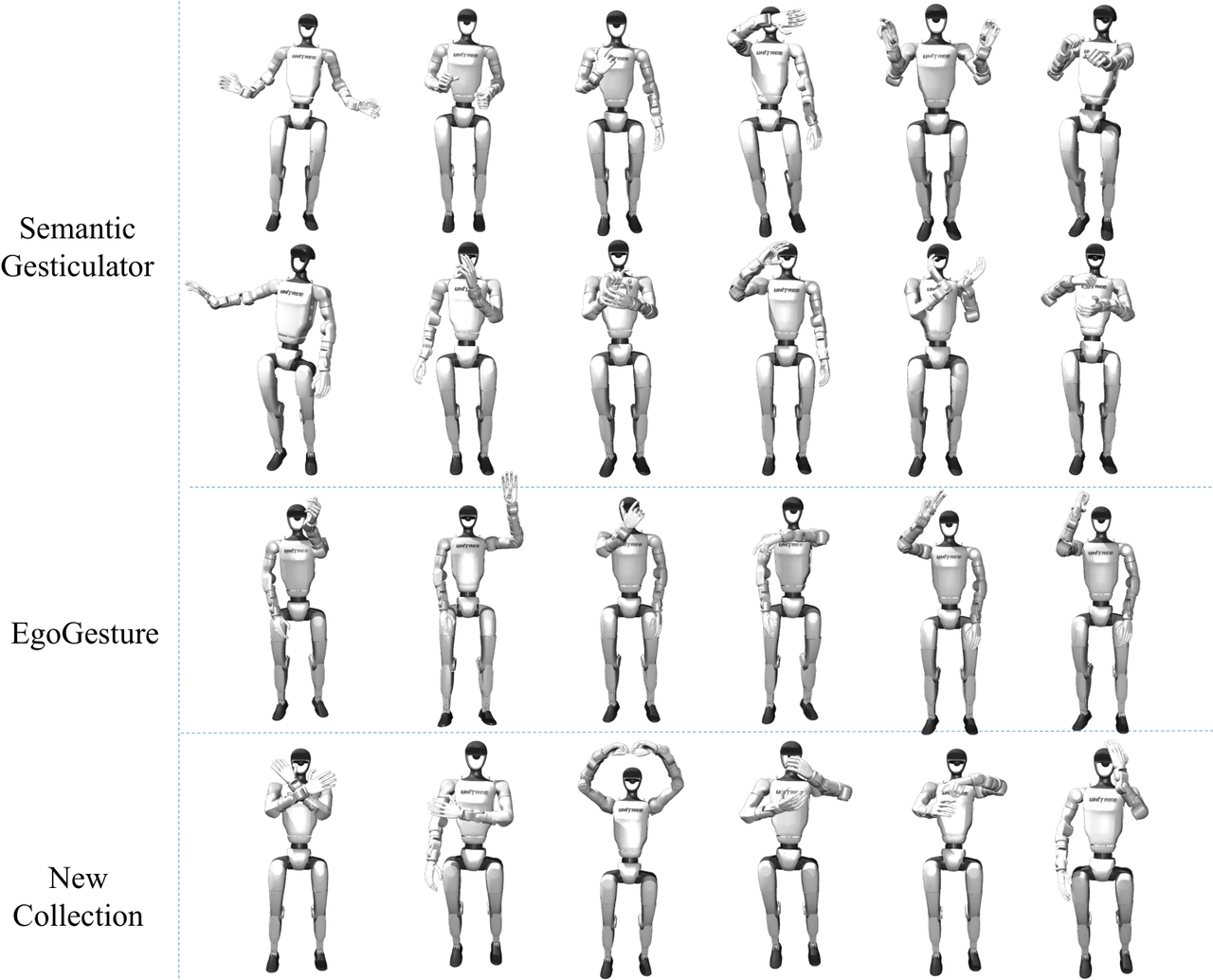
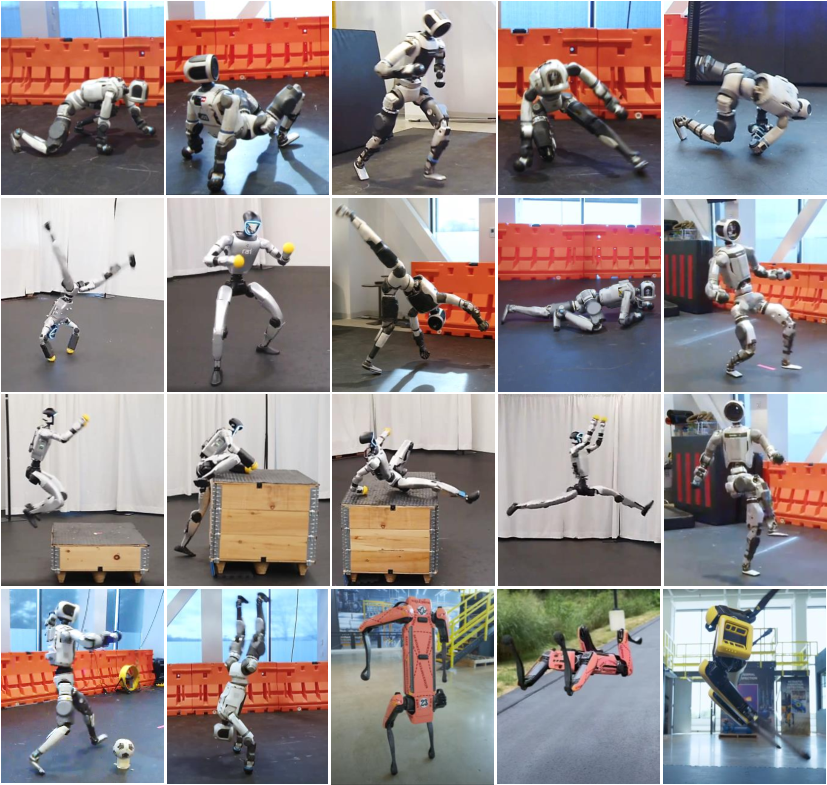
Figure 4: Supplementary dataset visualization. RoboGesture comprises over 300 high-quality full-body gesture classes, each semantically annotated and verified by replay on the physical robot.
Diagnosing Modality Eclipse: Evidence, Not Just Ablation
Beyond the headline ablations, the supplementary material contains a controlled diagnostic study that is arguably the paper's most convincing evidence, because it measures the failure mode directly instead of only measuring end-task quality.
Controlled perturbation protocol. On 50 validation samples the authors construct two perturbations: (i) fix the past-motion context and swap in a different audio clip, and (ii) fix the audio and swap in a different past-motion context. They then measure the MSE between the two generated motion sequences. If swapping history perturbs the output far more than swapping audio, the generator is history-dominated. The Full Model shows an audio-swap MSE of 0.0619 versus a history-swap MSE of 0.1261, a history-to-audio sensitivity ratio of 2.04. The Only-DiT variant (generative backbone with the semantic-acoustic conditioning pathway removed) reaches a ratio of 4.57 (0.0312 vs 0.1428). The ratio more than doubles once conditioning is stripped away, quantifying exactly how much the anti-eclipse mechanisms buy back.
Audio-shuffle and gradient-magnitude analysis. Two more direct probes run on BEAT. First, shuffling the input audio at inference: a model genuinely driven by audio should degrade sharply. The Full Model's FGD jumps from 0.624 to 9.151 ($\Delta=+8.53$), while Only-DiT barely reacts ($\Delta=+0.11$) and the no-CFG variant even improves slightly ($\Delta=-0.33$) — the signature of a model that ignores audio. Second, gradient-magnitude analysis compares $G_{hist}=|\partial\mathcal{L}/\partial E_{hist}|$ against $G_{audio}=|\partial\mathcal{L}/\partial E_{audio}|$. The Full Model attains the lowest ratio $G_{hist}/G_{audio}=0.55$ together with the largest absolute audio gradient ($G_{audio}=0.245$); Only-DiT is history-dominated at a ratio of 4.88. Together these numbers show that the 15% history masking plus anti-inertia CFG drives the gradient ratio down from 4.88 to 0.55, grounding rollouts in audio rather than inertia.
Delayed history injection. A simple architectural choice reinforces the training-side mechanism: history conditioning is injected only in the later DiT blocks, while early blocks attend primarily to audio and semantic cues (with first-layer audio features also fed into the initial block). The idea is to let the generator first commit to a response to the current acoustic input, then refine it with history for continuity. Reversing this injection order degrades every metric — semantic action accuracy $7.175\rightarrow5.376$, hand detail $7.203\rightarrow5.136$, beat matching $7.529\rightarrow6.100$ — confirming that not just what is injected but when it is injected matters for resisting eclipse.
Semantic Head Accuracy and the Text-Conditioning Question
A natural objection to the finite 300-class semantic head is that it might reduce the generator to a fixed action set, and that open-vocabulary text conditioning would be a strictly better semantic interface. The paper answers both.
On the 300-class gesture-semantic classification task, the aligner's semantic head reaches 88.72%/64.71% train/test top-1 accuracy. Because many gesture classes are semantically interchangeable (different "greeting" variants, for example), the authors also report a semantic-equivalent accuracy that credits interchangeable predictions:
| 300-class semantic head (test) | Top-1 $\uparrow$ | Top-5 $\uparrow$ | F1 $\uparrow$ |
|---|---|---|---|
| Strict (exact class) | 64.71 | 87.00 | 70.31 |
| Semantic-equivalent | 72.76 | 95.67 | – |
Table 5: Accuracy of the 300-class semantic head (paper Table 13). This head is auxiliary supervision only; the generator operates in a continuous DiT latent, not a 300-way discrete action space.
To test whether text is a better interface, the authors replace their aligner with text encoders (Qwen and T5) under the identical two-stage protocol, and on 100 SemanticBEAT videos count identifiable semantic gestures and judge contextual reasonableness:
| Conditioning (100 SemanticBEAT videos) | Semantic gestures $\uparrow$ | Reasonable ratio $\uparrow$ |
|---|---|---|
| Ours (audio aligner) | 249 | 79.0% |
| Qwen text encoder | 145 | 21.4% |
| T5 text encoder | 73 | 57.0% |
| Semantic Gesticulator | 94 | 42.6% |
| DiffSHEG | 73 | 41.1% |
Table 6: Text-conditioning ablation (paper Table 14). The audio aligner produces far more contextually reasonable semantic gestures than text encoders.
The audio aligner yields 249 identifiable semantic gestures at a 79.0% reasonableness ratio — decisively ahead of every text encoder and baseline. The authors use this to argue the finite head does not collapse generation into a fixed set, and to reframe the lower global DIV: Semantic Gesticulator posts the highest DIV yet a low reasonable ratio, showing global diversity can be inflated by semantically mismatched motion. RoboGesture's lower-but-appropriate DIV is therefore "semantically grounded selectivity" rather than mode collapse.
Limitations
Four self-reported limitations. First, the interaction scope is upper-body co-speech gesture only — no locomotion, object manipulation, or scene-level decision making; the authors frame it as an important but scoped step toward broader humanoid social intelligence. Second, history-conditioned generation cannot be fully removed: anti-inertia masking, delayed history injection, and semantic-acoustic conditioning reduce history dominance but motion-continuity priors remain necessary, since good co-speech motion must balance responsiveness to new audio with temporal smoothness across chunks. Third, performance is bounded by the diversity of the semi-synthetic distribution; richer real-world interactive recordings would likely improve robustness in broader social scenarios. Fourth, system-level latency is dominated by the speech pipeline (language generation, speech synthesis, chunked streaming), not the motion model.
Additional observations. First, the semantic space is a closed 300-class classification problem: generalization to out-of-vocabulary semantic gestures is unvalidated, and the 0.4 s rule-based scheduling of gestures before keywords means the system behaves partly as a semantic-gesture retriever fused with a rhythm generator rather than open-ended semantic understanding. Second, ecological validity of the evaluation is limited: SemanticBEAT is new but still an offline simulation-space benchmark, and the real-robot portion is qualitative demonstration plus latency measurement — no systematic user study of multi-turn conversational naturalness, so the final verdict on social naturalness remains in real deployments. Third, the MPC collision constraint relies on first-order linearization valid only near $q_0$; the paper gives no systematic analysis of conservatism or feasibility bounds for large, fast motions.
Conclusion and Outlook
RoboGesture's contribution is redefining co-speech gestures from a virtual-avatar animation problem into a humanoid systems problem: data must live in robot space, the model must stream and resist modality eclipse, and control must carry safety guarantees. None of the three modules is individually novel — hierarchical audio coding, CFM diffusion, and MPC filtering all have precedents — but screwing them together into a listen–respond–gesture loop and proving each part non-removable via ablation is solid engineering science. FGD 0.8452 and a 0.13% collision rate on BEAT provide clean numerical evidence, while 120 FPS generation and a 5.6 ms filter cost show that on a social humanoid, "understanding the speech, moving correctly, and not colliding with itself" can simultaneously hold under real-time constraints.
The natural extensions are clear: coupling upper-body gestures with manipulation skills (in service scenarios, talking while acting is the norm), expanding the closed 300-class semantics to open-vocabulary conditioning, replacing part of the semi-synthetic corpus with real multi-turn interaction recordings, and compressing upstream speech-pipeline latency. The paper's ethical note is worth keeping: more expressive robot behavior shapes user expectations more strongly than purely functional systems, and deployment should remain transparent about its generated nature and intended scope.
Golden Quotes
"Real-time performance is not an elective feature but a fundamental necessity for seamless social engagement." — Appendix A.1 on low-latency streaming inference.
"Learning directly in robot-space is not a matter of experimental convenience, but a fundamental requirement for achieving safe, low-latency, and high-fidelity humanoid interaction." — the paper's answer to the human-space versus robot-space debate.
"Models often 'cheat' by relying excessively on past kinematic inertia, effectively ignoring the weaker audio and semantic guidance." — a vivid characterization of modality eclipse and the starting point of Anti-Inertia masking.
SOURCE LINKS