Skip to content
Agent World Model in the Wild: Computer-Use Agent Environment Synthesis

Agent World Model in the Wild: Computer-Use Agent Environment Synthesis

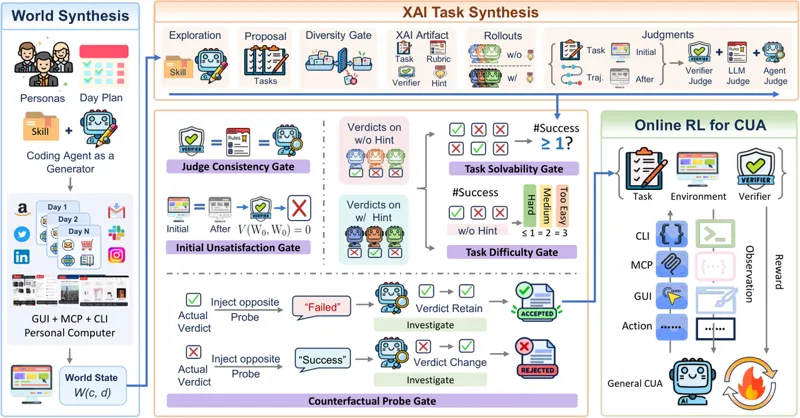
Agent learning is shifting from learning from human data toward learning through interaction with the world. However, scaling such learning directly in real-world computer systems is challenging and can introduce substantial security risks. We therefore propose Agent World Model in the Wild (WildAWM), a scalable pipeline for synthesizing controllable environments and tasks for training general computer-use agents (CUAs). Whereas existing approaches typically specialize in a single agent interaction interface, we construct executable environments that jointly support graphical user interfaces, model context protocol services, and command-line interfaces, allowing agents to flexibly combine visual interaction, tool use, and code execution. WildAWM is entirely powered by open-source models, demonstrating that high-quality computer-use environments can be generated without proprietary frontier models. Beyond environments, we address three recurring challenges in task synthesis: ensuring solvability, maintaining sufficient difficulty, and producing reliable verifiers, by introducing execution-based quality gates that combine heterogeneous agent rollouts, cross-judge consistency checks, and counterfactual probes of judgment robustness. The resulting pipeline synthesizes 341 long-horizon environment-task pairs that can require over 100 agent steps to solve and remain challenging even for frontier models, with GPT-6-Astra solving only 60% of them. We train two Qwen models of different sizes exclusively in these synthetic worlds. Both models achieve substantial gains across 8 out-of-distribution benchmarks spanning web, claw, and computer-use agents, demonstrating that learning in WildAWM's synthesized worlds generalizes broadly to unseen computer-use tasks. The code is publicly available at https://github.com/MSR-Orchard/WildAWM.

Computer-Use AgentWorld Models
Zhaoyang Wang, Qianhui Wu, Haorui Wang · 527 views · Oct 19, 2026
Social-WM: Safety-Aware Latent World Models for Robot Social Navigation

Social-WM: Safety-Aware Latent World Models for Robot Social Navigation

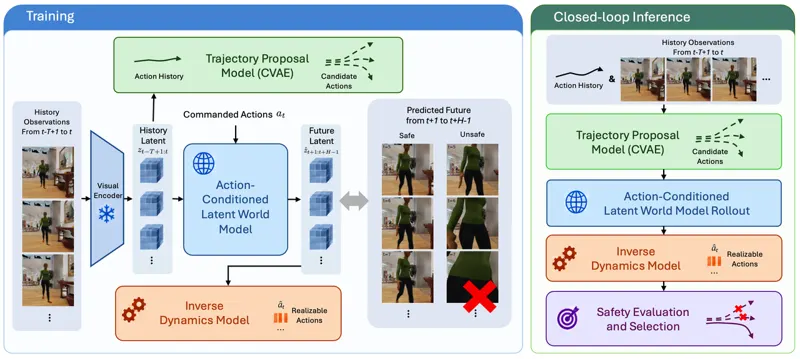
Safe social navigation requires a robot to anticipate not only the future consequences of its actions, but also whether a nominal action can actually be executed under surrounding physical and social constraints. We present Social-WM, an efficient latent world-model planning framework trained from egocentric RGB video sequences. Our key observation is that social-navigation experience contains a systematic discrepancy between the nominal action and the realizable action: a nominal forward action may be fully executed in free space, but needs to be constrained when heading towards a pedestrian or obstacle. Social-WM learns these safety-relevant consequences directly through action-conditioned future prediction, where the target is the actual observed future following each command. We further introduce a realizable inverse-dynamics objective that associates observed latent transitions with the action actually realized rather than the nominal one. At deployment, candidate actions are imagined through the latent world model, and the inverse dynamics model estimates their realizability; nominal–realizable discrepancy then provides a safety signal before execution. The learned dynamics and realizability model remain goal-independent and support both position- and image-goal navigation. On Social-HM3D, Social-WM achieves 63.77% success while reducing human collisions to 21.67%, and maintains strong performance under zero-shot transfer to Social-MP3D, without explicit pedestrian tracking, privileged human state, or online reinforcement learning.

Social NavigationWorld Models
Zhihao Zheng, Mooi Choo Chuah · 413 views · Sep 30, 2026
Juno: Taming Predictive Latents for Vision-Language-Action Models

Juno: Taming Predictive Latents for Vision-Language-Action Models

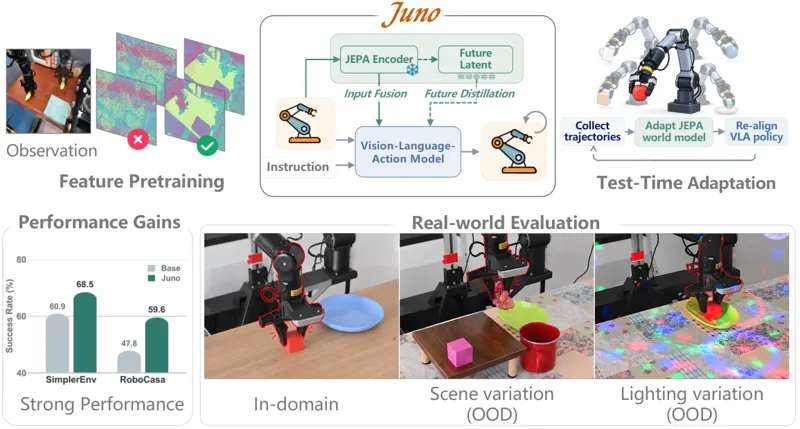
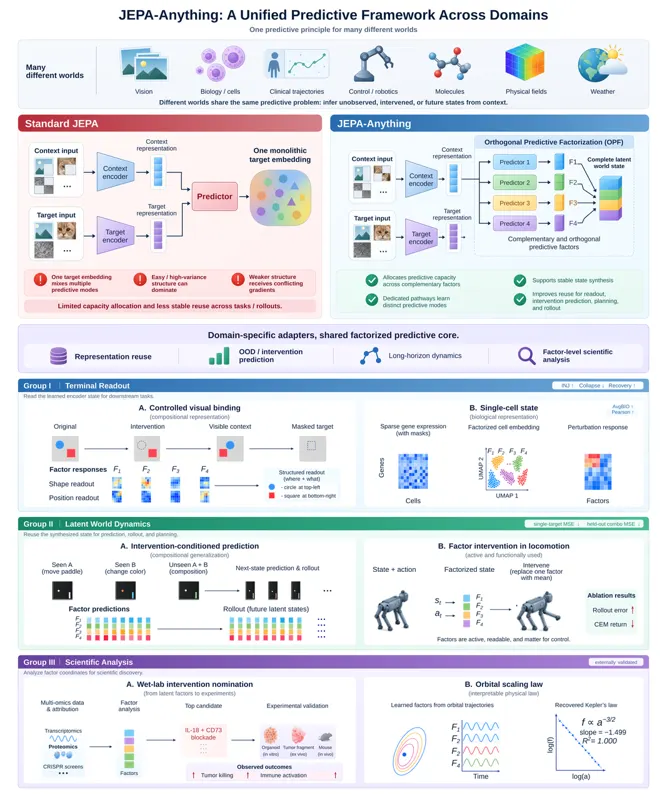
Joint-embedding predictive architectures (JEPAs) predict masked or future observations in representation space, offering a natural source of predictive latents for vision-language-action (VLA) models. Yet making these latents useful across pretraining, policy learning, and deployment requires addressing three failures: mismatch with embodiment-specific control, interference with action learning, and teacher miscalibration under distribution shifts. We introduce Juno, a unified framework built around one action-conditioned JEPA that serves as a control-aligned representation backbone, a predictive teacher, and an adaptable dynamics model. During pretraining, we train it on embodiment-matched trajectories and use a dynamic CLS loss to transfer motion-weighted patch dynamics to a compact global state. During policy learning, we fuse current-frame JEPA patches into VLA perception and use a decoupled reasoning branch with separate transformation parameters to distill future latent states for action generation. During deployment, we adapt the world model on all observed transitions, including failed rollouts, freeze the adapted teacher, and re-align the policy on verified executions using LoRA adapters and a trainable action head, without expert corrections or task rewards. On SimplerEnv, Juno raises average success from 60.9% to 68.5% over Qwen3GR00T, the strongest baseline, and test-time adaptation further reaches 72.7%; on a real robot, it retains 70%–75% success under background, height, and object shifts where the base policy collapses to 0%.
Vision-language-action (VLA)World Models
Yuchen Zhu, Chenyi Xu, Yulin Zhang · 347 views · Oct 7, 2026
Into the LidarVerse: A Real-Time Unified LiDAR World Model Across Tasks and Sensors

Into the LidarVerse: A Real-Time Unified LiDAR World Model Across Tasks and Sensors

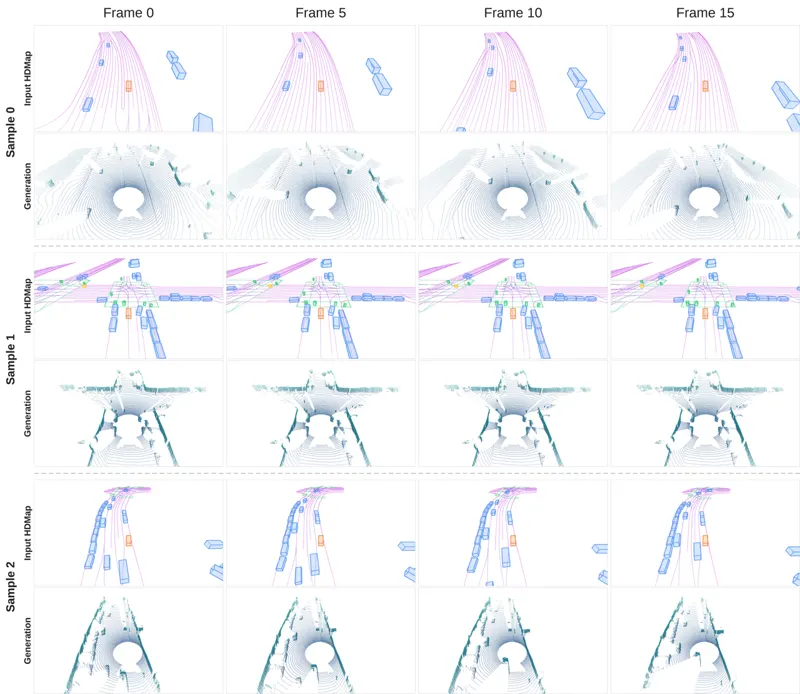
We present LidarVerse, a real-time unified LiDAR world model for sensor simulation across tasks and sensors. Existing LiDAR simulators largely follow one of two complementary paradigms: reconstruction-based methods preserve the geometry of a captured scene but require lengthy per-scene optimization, whereas generative methods amortize learning across data but lack the consistency needed for long-horizon rollouts. LidarVerse brings both paradigms into a single, unified conditional generative framework. A universal tokenizer maps LiDAR range sequences into a shared latent space, where a bidirectional teacher learns a common interface for conditioning on a LiDAR prefix, an HD-Map, a persistent spatial cache, and optionally, text. Varying the available scene evidence turns the same model into a generator of new worlds, a point-cloud forecaster, or a generalizable resimulator of observed scenes without per-scene optimization. We distill the teacher into a four-step autoregressive causal student and maintain both a rolling temporal K/V cache and a world-aligned spatial cache, enabling persistent long-horizon rollouts with real-time inference at 11 FPS on a single H100 GPU. LidarVerse achieves state-of-the-art performance on most reported metrics across all three evaluation protocols, while its tokenizer supports 32-, 64-, and 128-beam LiDAR and generalizes to an unseen scanning pattern. These results demonstrate that generative and reconstruction-grounded LiDAR simulation can be realized within one model, providing the core capabilities for future closed-loop sensor simulation.

LiDARWorld Models
Che, Henry, Ren, Xuanchi, Fidler, Sanja · 552 views · Oct 13, 2026
AgentGarten: Code Worlds for Evolving Agents

AgentGarten: Code Worlds for Evolving Agents

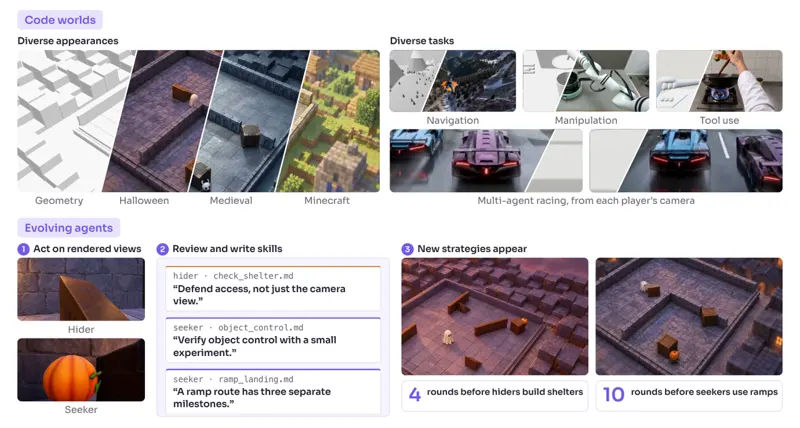
Interactive virtual worlds allow agents to learn through exploration and interaction. What agents can learn is bounded by the environments they practice in, which must be faithful, with consistent state, rules, and dynamics, and realistic, with observations that follow the real-world visual distributions. Achieving both across diverse worlds remains a bottleneck. We introduce AgentGarten, a framework that couples simulators and game engines with a shared neural renderer to build real-time interactive environments. Its simulation backends maintain persistent world state and execute program-defined interaction rules, while the renderer generates visual observations from structured conditions exported through a common interface. To build the neural renderer, we adapt a pretrained video model to geometry conditions, distill it with our proposed Adversarial Forcing, and optimize inference for real-time interaction. Adversarial Forcing makes history prefilling differentiable through exact replay, so that losses on later predictions update how the renderer encodes prior observations, and adds real-data adversarial supervision to improve its visual quality. In AgentGarten, agents perceive the world through visual observations, interact with it in real time, and improve by distilling each round of experience into playbooks that subsequent agents inherit and refine. Our empirical study demonstrates a substantial gain in learning efficiency, with agents learning from just 4 rounds compared with millions for a conventional reinforcement learning counterpart. As new worlds can be written as code and rendered through the same interface, environments can scale in both number and difficulty alongside their agents, a step toward agents that keep evolving through interactive experience.

World ModelsNeural rendering
Jiawei Chi, Shangchen Miao, Zhiyuan Shi · 818 views · Oct 8, 2026
CAP: Continuously Adaptive Perception-Blind Humanoid Locomotion via Learned Denoising

CAP: Continuously Adaptive Perception-Blind Humanoid Locomotion via Learned Denoising

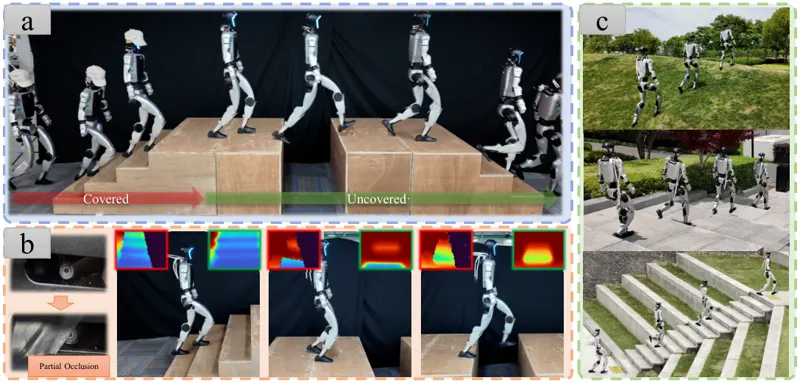
Humanoid locomotion across complex terrain demands forward-looking exteroception to anticipate obstacles, yet this signal is unreliable in real-world deployment, failing partially and intermittently. Existing perceptive policies often assume that depth observations remain clean and in-distribution, while recent attempts to unify perceptive and blind control typically route or switch between separate sub-policies, leaving recoverable information in partially corrupted depth unexploited. We instead propose CAP, a single-stage humanoid locomotion policy that recovers this signal with a perceptive world-model encoder trained as a learned denoiser to reconstruct clean depth from a corrupted input, together with a co-active proprioceptive variational encoder that supplies depth-free body-state information. A coupled training recipe pairs a depth-noise curriculum on the world-model input with world-model feature dropout on the policy-facing latent, exposing the policy to failures across the entire perception-quality spectrum. In simulation, CAP matches or improves upon perceptive baselines when depth remains informative, and degrades more smoothly than a binary-switching baseline as perception worsens. On the Unitree G1, controlled trials and indoor-outdoor deployments demonstrate perception-robust locomotion under intermittent occlusion, real-sensor corruption, and outdoor depth artifacts.

Humanoid LocomotionWorld Models
Chen, Hongjin, Xu, Zijun, Ma, Shihao · 1.5k views · Sep 10, 2026

As an Amazon Associate, we earn from qualifying purchases.