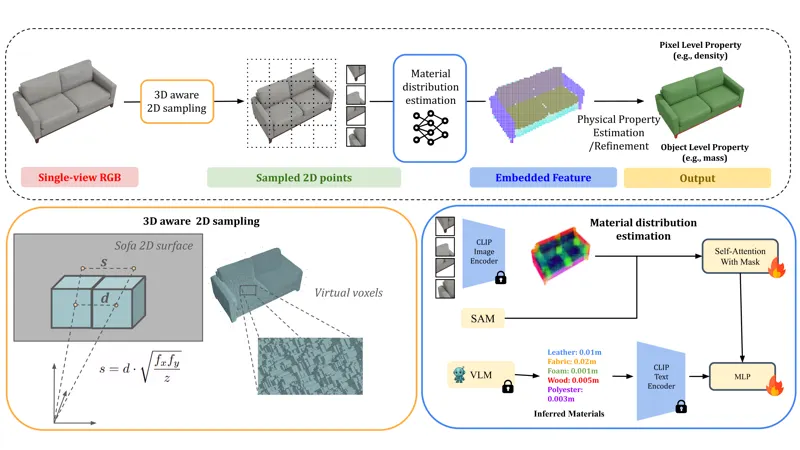
Inferring physical properties such as mass, stiffness, and elasticity from a single image is essential for simulation and embodied AI, yet most existing approaches rely on multi-view reconstruction or physics-based supervision. We introduce SiPhy, a unified framework for single-image physical property reasoning that aligns 3D-aware visual cues, depth with language-based material knowledge. From one RGB image, SiPhy samples pseudo-voxel points, extracts CLIP features, and grounds them to material candidates proposed by a VLM. A part-based contrastive aggregator enforces region consistency, while a heaviness-aware refinement improves thickness and volume estimation for dense objects. Across ABO-500, MVImgNet-100, and PhysXNet-100, SiPhy achieves state-of-the-art single-image performance, surpassing multi-view reconstruction methods by improving mass MnRE by up to 93% (vs. PUGS), reducing density MAE by 35.5% (vs. NeRF2Physics), and lowering Young's modulus error by 23.5%. We further validate SiPhy on real hand-object interaction datasets, demonstrating its potential as a data annotation engine for physical understanding from single-view imagery.
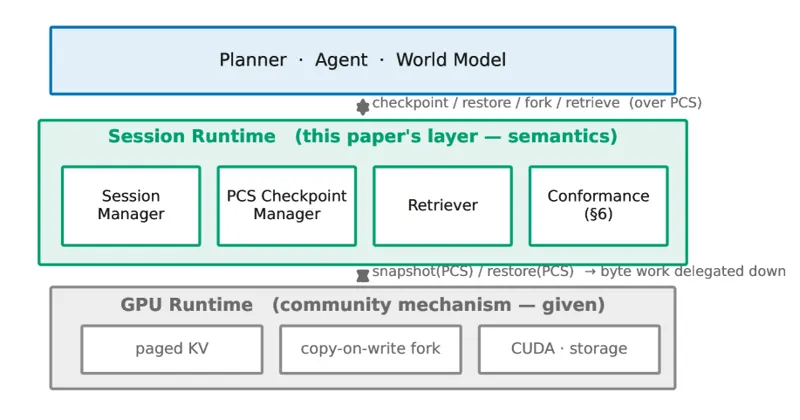
Generative world models are increasingly driven as simulators: a planner forks a state, rolls out futures, backtracks, and returns to a visited viewpoint. Recent benchmarks establish that current video world models fail this usage, and attribute it to the model, prescribing new architectures and training objectives. We show this attribution is incomplete, and for an important class of models simply wrong. Snapshotting the state the runtime already holds – an observation plus RNG state, a memory bank, or a windowed KV context, by architecture – and restoring it after a genuine excursion reproduces the never-left continuation byte-identically on all three; corrupting only the RNG degrades it. The capability was never missing: request-centric serving discarded it, inheriting from language-model serving the assumption that runtime state is recomputable – but world-model state carries a non-recomputable kernel. We define Persistent Computational State (PCS), the minimal non-recomputable state that must survive across requests, show it can be discovered by measurement, and build a session-centric runtime over it. Checkpoint and restore cost 0.012 ms against a 1.85 s generation step; resident sessions become host- rather than device-bounded (measured to 1,024); and world memory must be evicted by relevance to the return, not recency – the inverse of LLM practice.
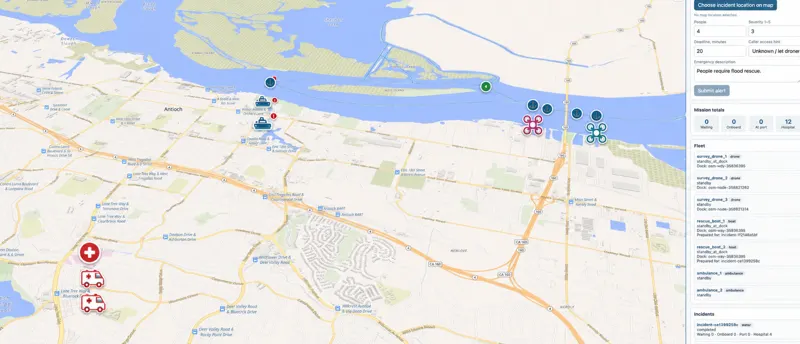
TRACE-RealWorld addresses a core data-management problem: maintaining an actionable materialized view over a continuously changing physical world when reads of the base state are priced, delayed, heterogeneous, and fallible. Its data-management contributions are a commitment-level validity abstraction for materialized predictions; consequence-conditioned adaptive view maintenance; transaction-style, dependency-scoped compensation for commitments invalidated after authorization; and append-only provenance supporting exact replay. The work builds directly on materialized-view maintenance, adaptive stream synchronization, transaction recovery, sagas, data freshness, and provenance. The end-to-end Flood-SAR evaluation treats sensing as physical data acquisition and measures freshness, verification cost, stale reads, recovery scope, restoration failure, and replayability through six pre-registered questions with held-out seeds. The contribution is therefore not a new predictive model, but a consistency, recovery, and accountability contract for deploying learned world representations as operational data systems.
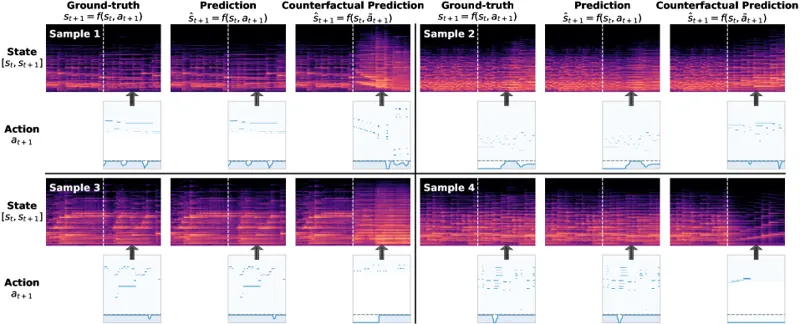
Joint Embedding Predictive Architectures (JEPA) have recently emerged as a paradigm for learning world models by predicting latent representations, offering a promising direction for self-supervised learning. While initial attempts have applied JEPA to the music domain, it remains unclear how such frameworks can naturally support the formation of a world model for music. In this work, we propose to learn a world model of piano sound using JEPA by framing music as an action-conditioned system: the audio is treated as the state, and the pianoroll as the instrument action. Given a current audio state and an action, the model predicts the resulting future audio state, mirroring how humans learn musical sound through interaction. The model is trained in a fully offline setting using paired audio-pianoroll data, without environment interaction. Experiments show that the learned model captures the relationships between musical actions and their resulting sound. The resulting representations support downstream tasks, including beat tracking, composer identification, and key estimation, and enable piano transcription via planning, by searching for actions that best explain a target sound.
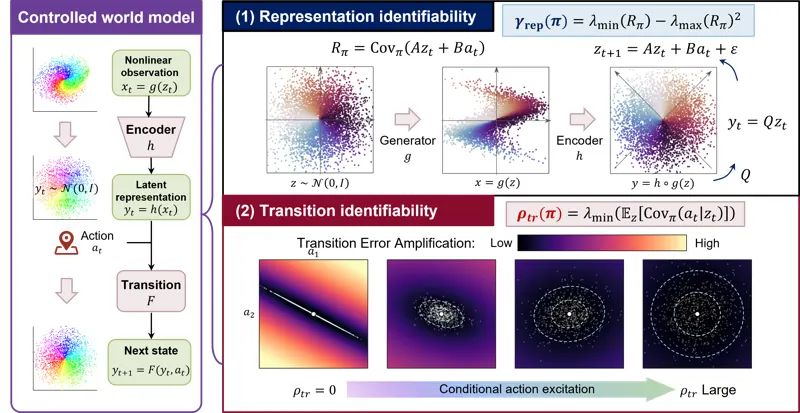
Learning world models that infer environment dynamics from high-dimensional observations and predict outcomes under candidate actions is central to planning and control. Joint-Embedding Predictive Architectures (JEPAs) provide a compelling framework for learning such models in representation space. Recent action-conditioned extensions perform promisingly in visual control and latent-space planning, but leave a fundamental question unresolved: when does controlled latent prediction identify both the underlying state and the controlled dynamics? This is challenging under nonlinear observations and behavior policies with limited conditional action variation, where state-dependent evolution and action effects can be statistically confounded. We establish a joint identifiability theory for controlled world models with Gaussian latent states under state-dependent Gaussian behavior policies. We identify two policy-dependent conditions: spectral separation of the predictable signal governs representation identifiability, while non-degenerate conditional action variation governs transition identifiability. We prove that when both conditions hold, every global minimizer of the JEPA objective identifies the latent state and controlled transition up to an orthogonal transformation. We further derive quantitative bounds on representation and transition identifiability under approximate optimization. Finally, we construct predictor perturbations along weakly excited action directions whose counterfactual-to-on-policy error ratio is the inverse transition-identifiability margin, revealing the cost of limited action coverage. Experiments across nonlinear observation maps and behavior policies corroborate the theory and demonstrate implications for transition identifiability, counterfactual prediction, and goal-conditioned latent planning.
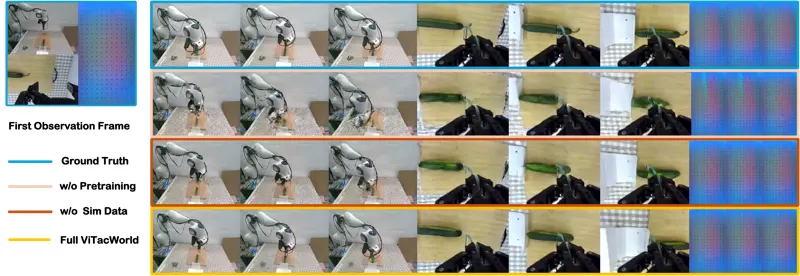
Contact-rich robot manipulation requires physical interaction cues that are often invisible to cameras, making tactile sensing essential for robust control. However, scaling visuo-tactile robot learning remains difficult because real tactile interaction data are expensive to collect, hardware-dependent, and limited in task and scene diversity. We present ViTacWorld, an action-conditioned visuo-tactile world model for scalable contact-rich robot manipulation. ViTacWorld leverages public real tactile datasets and a constructed simulation environment to scale visuo-tactile-action data, exploiting the fact that tactile signals are directly grounded in physical contact and can exhibit a smaller simulation-to-real gap than purely visual observations. The model is first pretrained with large-scale real and simulated visuo-tactile trajectories, and then finetuned with real-world policy rollouts to better match downstream manipulation behaviors. Given robot actions, ViTacWorld predicts temporally aligned visual observations and tactile feedback, enabling visuo-tactile-action rollout generation. To the best of our knowledge, ViTacWorld is the first framework that uses a world model for robot visuo-tactile-action trajectory generation and policy evaluation. It serves two roles: synthesizing rollouts to improve downstream tactile policies, and evaluating policies by predicting action-conditioned visuo-tactile outcomes under controlled action sequences. Experiments on contact-rich manipulation tasks show that ViTacWorld generates physically meaningful rollouts, improves policy performance through scalable data augmentation, and enables action-conditioned policy evaluation. Project page: https://vitacworld.github.io/
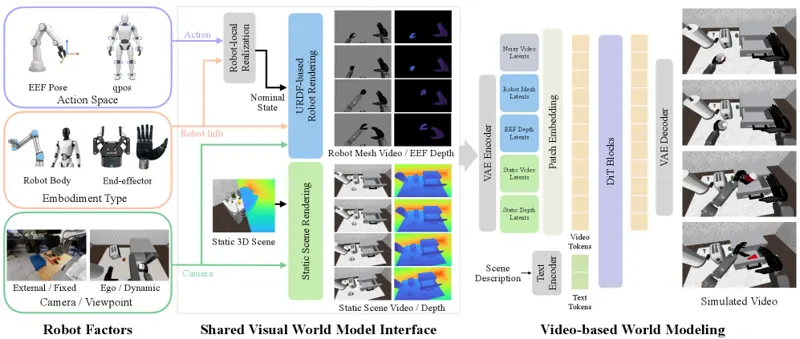
Action-conditioned video world models predict future observations from an initial observation and an action signal. In robotics, actions influence future observations through two distinct processes: they are first realized into robot motion by the robot body and controller, and the scene then responds through contact and object motion. Conditioning directly on action commands asks the world model to learn the realization process itself, while conditioning on logged future states leaks the interaction outcomes it is meant to predict. We propose robot-factored world models, which move two robot-specific factors outside the world model. First, action realization: each command is rolled through the robot's own controller and kinematics into a deployment-available nominal trajectory, a middle signal that avoids both action-realization learning and future-state leakage. Second, robot rendering: this nominal trajectory is rendered through the robot URDF, factoring the robot's geometry, kinematics, and appearance out of the model and into explicit rendered robot geometry. To resolve depth ambiguity, we pair end-effector depth with scene depth, giving geometric cues for contact and occlusion beyond image-plane overlap. Together, camera-aware static RGB/depth context and rendered robot geometry form a shared visual world-model interface that stays consistent across viewpoints and robot embodiments, so the model sees the action only as visible robot geometry and learns how objects respond to it. Our experiments show that the rendered interface outperforms vector-conditioned baselines and generalizes to unseen robot embodiments at inference. We further demonstrate that our model generates robot manipulation videos from human demonstrations by retargeting and rendering the hand motion as robot geometry.
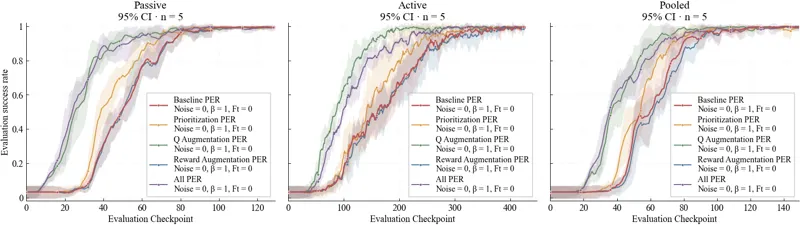
Human-in-the-loop Reinforcement Learning has become a popular approach to training, finetuning, and aligning robot behavior with user preferences. Our paper explores the feasibility of using brain signals via functional near-infrared spectroscopy (fNIRS) to modulate robot learning in simulation. We compare agents trained on passive (observational) versus active (demonstrative) interaction tasks, and test multiple methods for enhancing the RL algorithm with the neural signal, focusing on parameter augmentation rather than replacement. We further examine how model granularity and noise affect agent learning. Our results show that this framework is effective: the neural signal improves learning when augmenting trajectory priorities and state-action q-values. Additionally, the framework learns successfully from offline data, offering a practical alternative for settings where real-time BCI setups are impractical or only limited data is available.
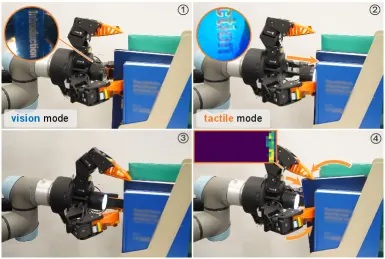
This paper presents a tactile-reactive gripper that integrates a Visuo-Tactile Active Palm (VTAP) and compliant, reconfigurable fingers equipped with tactile array sensors. The design exploits structured finger-palm synergy and multi-modal perception to achieve both robust grasping and fine manipulation. The actuated bi-modal palm seamlessly combines long-range visual localization with contact-rich tactile feedback, substantially extending the system's manipulation capability. To bridge the embodiment gap between human hand motion and the heterogeneous three-finger structure, we further propose a staged, gesture-conditioned retargeting framework for dexterous teleoperation. Extensive experiments validate the system across a range of challenging tasks: reactive grasping of YCB and fragile objects, in-hand syringe reorientation and plunger actuation, singulation of clustered objects down to 3 mm in diameter, and vision-tactile peg-in-hole insertion. Results demonstrate that high manipulation performance can be achieved through coordinated finger-palm interaction and multi-modal sensing, without resorting to high degrees of freedom anthropomorphic designs. The VTAP gripper and its retargeting framework offer a practical reference architecture for dexterous gripper design, manipulation, and contact-rich data collection in support of learning-based approaches. Project webpage: https://yuhochau.github.io/vtap/.
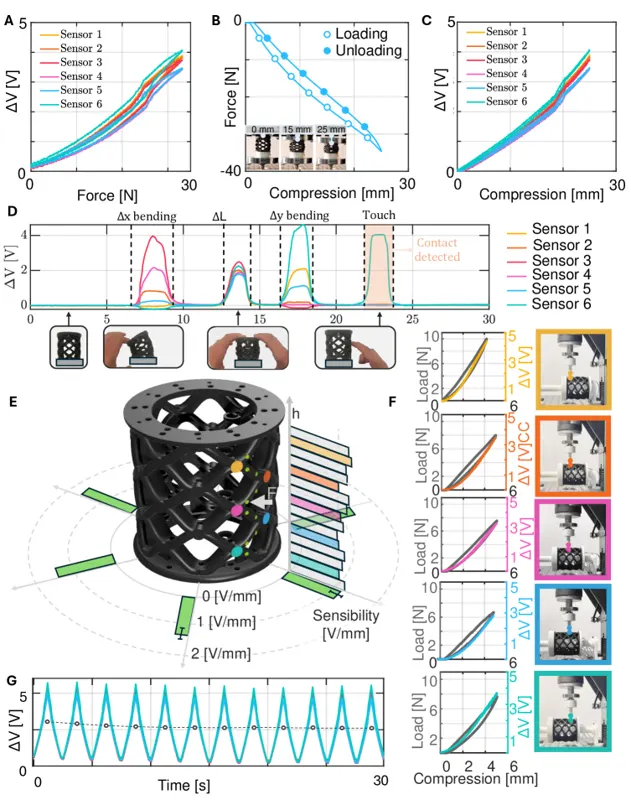
Soft continuum robots require embedded sensing for proprioception and contact detection, yet integrating sensors into sparse, highly deformable architected structures remains challenging. We present a model-based strategy that decouples proprioceptive and contact signals from a common set of fluidic pressure sensors embedded in a soft architected segment. Each segment of the Innervated Trimmed Helicoid (ITH) contains six air channels routed in a localized zigzag pattern along the circumference. With only three principal kinematic degrees of freedom (axial compression, bending in x, bending in y), the six pressure readings form an overdetermined system. A piecewise constant curvature model maps pressures to shape, and Huber regression identifies outlier channels whose residuals indicate external contact. On a single ITH segment, this approach achieves proprioceptive shape estimation with a relative bending error of 0.11 +/- 0.02 and a contact detection rate of 97% across 178 trials. We integrate eight ITH segments into Air-Helix, a tendon-driven soft continuum manipulator, and present exploratory whole-arm demonstrations that include tactile teaching by demonstration, admittance-controlled force regulation, and tactile object reconstruction. The results suggest that localized fluidic innervation combined with model-based redundancy resolution is a practical path toward concurrent proprioception and contact sensing in architected soft robots.
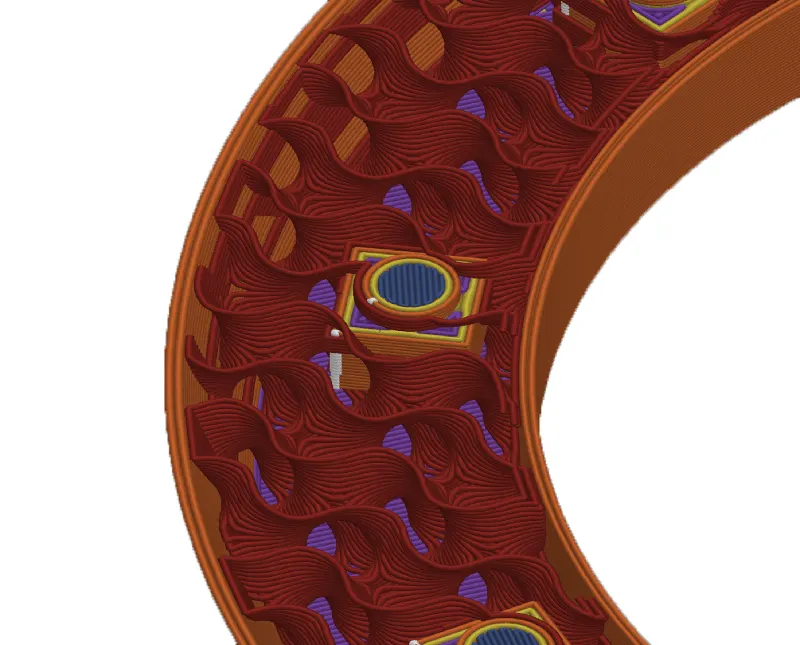
This paper presents a scalable, open-source visuotactile sensing system for tensegrity robots that enables six-axis wrench estimation and contact detection. The proposed endcap sensor integrates an elastomeric shell, a 3D-printed thermoplastic polyurethane (TPU) interface, and a rigid base housing an embedded camera and LED illumination ring. A novel gyroid-infill bonding technique is introduced to form a durable elastomer-TPU interface without adhesives, yielding a lightweight and modular design compatible with large-scale tensegrity structures. A tactile-to-wrench neural network maps shear vector fields to six-dimensional force and torque measurements. Experimental results demonstrate accurate and stable wrench estimation with a mean squared error (MSE) of 0.1531 on static validation data and out-of-domain generalization under dynamic motion. Furthermore, full-system integration on a 12 kg tensegrity robot confirms the sensor's ability to reliably identify ground contacts. The system substantially improves the practicality of tactile feedback for tensegrity robots, offering a low-cost, reproducible, and physically interpretable pathway toward contact-aware proprioception and state estimation. Open source files are available at https://github.com/Jonathan-Twz/tensegrity-gelfoot
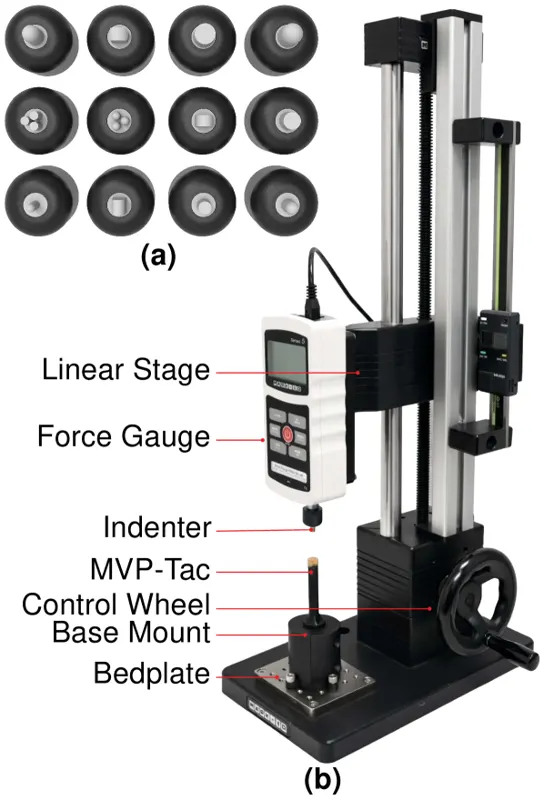
Robot-assisted minimally invasive surgery (RMIS) offers major benefits over open and conventional laparoscopic procedures, yet it still lacks tactile feedback for palpation while operating under strict requirements to preserve reliable vision for navigation and safety. In practice, visual feedback is indispensable, and tactile solutions that cannot coexist with vision are difficult to translate into RMIS tools. To address both needs, we introduce MVP-Tac, a compact, vision-based tactile sensor that provides co-located vision and tactile sensing. MVP-Tac uses reflective photoelastic imaging: a thin photoelastic elastomer produces stress-dependent interferograms under contact that are captured by an embedded camera through a miniaturized reflective polariscope. A semi-transparent membrane and controllable illumination enable switching between visual mode and tactile mode, enabling tactile perception without sacrificing vision. We validate MVP-Tac through force calibration in the 0 to 2 N range and demonstrate its potential for tumor palpation via video-based hardness classification on tissue phantoms, achieving 97% accuracy for exposed-tumor classification and 92% accuracy for subdermal-tumor classification. Finally, we conduct a simulated colonoscopy to validate both visual and tactile modalities in a constrained lumen, including vision-guided 3D photomapping of the luminal wall and in situ hardness classification of localized nodules. Overall, MVP-Tac provides a practical path toward restoring clinically useful palpation in RMIS while maintaining essential visual feedback. The design, fabrication, and firmware of MVP-Tac are open-sourced at https://mvp-tac.github.io/