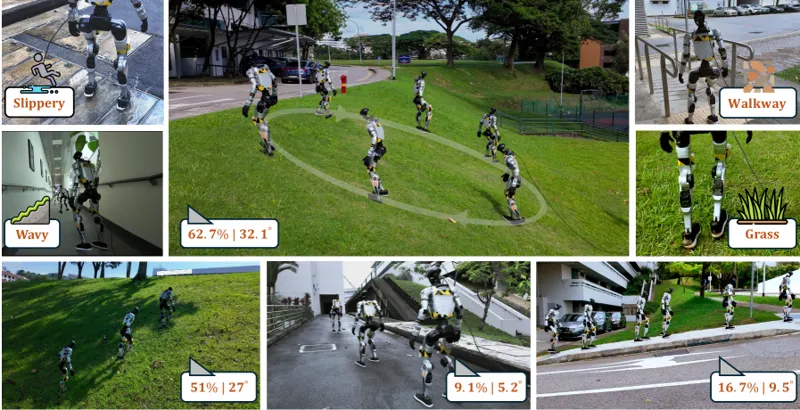
Model-free reinforcement learning has enabled impressive humanoid locomotion; however, control on steep slopes remains largely unexplored. Unlike flat or discrete terrains, sloped terrains impose a persistent gravitational bias that demands simultaneous stability and posture control. Consequently, under generic reward formulations, policies can converge to slow, conservative low-center-of-mass (CoM) crouched gaits. In this work, we propose a novel two-stage physics-guided framework, dubbed HumoSlope, dedicated to robust humanoid locomotion on diverse sloped terrains. Specifically, Stage I establishes a terrain-consistent balance prior by introducing a slope-adaptive Zero Moment Point (ZMP) regularizer evaluated directly on the local inclined support plane rather than a world-horizontal reference. To prevent the resulting policy from defaulting to a crouched posture, Stage II introduces the Biomechanical Slope Gait Adapter (BSGA). Utilizing extracted macroscopic terrain descriptors as privileged, training-only signals, BSGA dynamically gates soft reward priors to modulate CoM height and lower-limb coordination based on the estimated slope geometry – encouraging hip-dominant uphill propulsion and knee-oriented downhill braking. Crucially, the deployed actor remains entirely proprioceptive, requiring no online exteroceptive sensing. Extensive Sim-to-Real experiments demonstrate that our framework effectively mitigates posture degeneration and enables blind, continuous traversal of outdoor grass slopes up to 62.7% (32.1^∘), validating a physics-guided approach to challenging slope terrain adaptation.
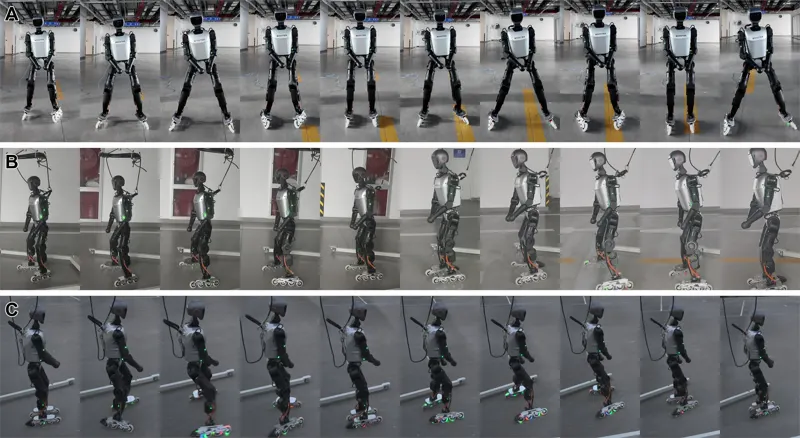
Humanoid roller-skating is difficult because the robot must coordinate whole-body balance, rolling contacts, and velocity-dependent posture regulation. This paper presents an adversarial motion prior based reinforcement learning framework for two humanoid roller-skating gaits: Pump Glide skating and Push Glide skating. The two gait datasets are collected independently through motion capture and retargeted to the humanoid robot separately. The retargeted data are then smoothed and resampled into reference motion states for AMP training. The two gaits are learned by independent AMP training pipelines with separate reference datasets, separate policies, and independent reward architectures. Simulation experiments are designed to evaluate gait quality, velocity tracking, turning, and gait-specific reward ablations.
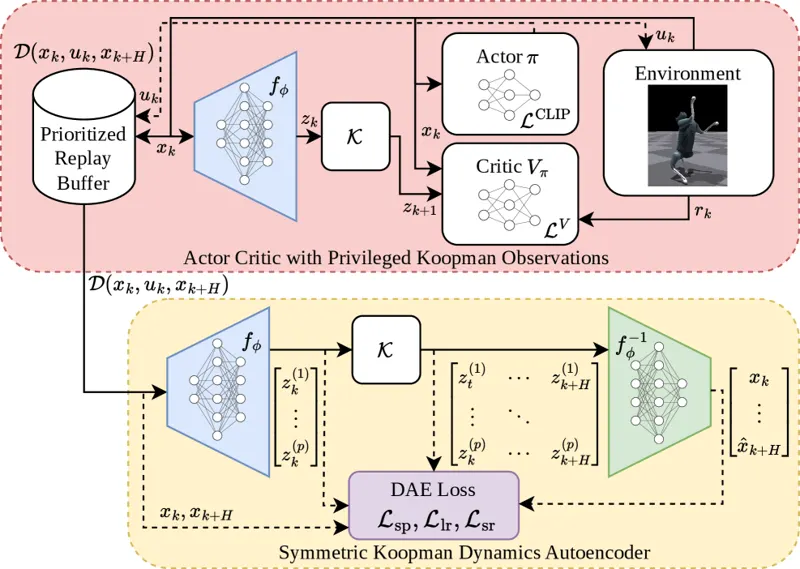
Reinforcement learning (RL) algorithms classically suffer from poor sample efficiency. In robotics, a recent line of work has emerged addressing this problem by encoding physics priors in the learning process. However, most of these approaches are validated on well-defined, low-dimensional benchmark systems rather than high-dimensional robots with complex nonlinear dynamics. In this paper, we introduce SKooP (Symmetric Koopman Predictions), an approach combining the advantages of morphological symmetries with those of a Koopman model learned via autoencoder to enhance policy learning. SKooP learns a Koopman model of the system dynamics alongside the policy. The resulting Koopman predictions are used as privileged observations for the critic, allowing the agent to learn based on smoother, more informative features. We also incorporate group symmetries into the actor, critic, encoder and decoder networks to produce a highly equivariant policy. The SKooP approach is validated via in-depth analysis of the learned Koopman models and symmetric policies to showcase how each of these influences the agent's performance. We also show that the learned policies are transferable to different simulation environments. Our results show that SKooP consistently reduces convergence time and increases the learned reward for multiple challenging bipedal locomotion tasks on a quadruped robot. Project page: https://evelyd.github.io/SymmetricKoopmanPredictions
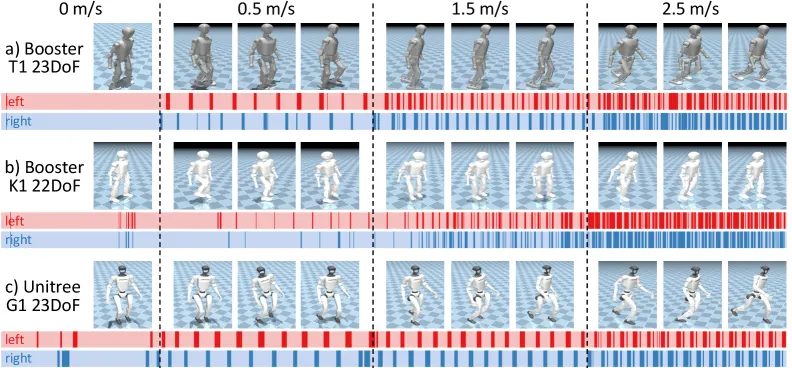
A humanoid that can walk should not relearn locomotion from scratch to jog or run. Yet current approaches often obtain gait diversity by prescribing gait schedules, imitating motion clips, training experts to switch between or distilling skills into one policy. These strategies can produce impressive behaviors, but offer limited flexibility across continuous speed commands, terrains, and morphologies. We study skill growth with GaitSpan, a framework that expands a pretrained, basic walking policy into faster locomotion. It treats walking as a seed skill: reusable motor structure for balance, support, body coordination, and contact transition that can be regenerated at new rhythms, extended into longer/higher strides, and corrected by residual adaptation. This expansion has three aspects: 1) rhythm generation, which modulates the frozen walking policy with multiple internal clocks and learns command-conditioned combinations of the resulting canonical actions; 2) stride shaping, which rewards dynamic locomotion patterns appropriate for higher commanded speeds using a physically grounded objective inspired by spring-loaded inverted pendulum dynamics; and 3) residual adaptation, which captures motion details not accounted for by rhythm generation or stride shaping. GaitSpan is the first to deliver a single command-conditioned humanoid policy that spans walking, jogging, and running-like regimes covering a continuous speed range, transfers across morphologies, and deploys zero-shot on unseen sim-to-sim, and real-world terrains. Compared with baselines either trained with multi-experts or imitation from humans, it learns faster and achieves stronger gait performance.
Fast planning of novel behaviors in unseen scenarios remains a fundamental challenge in robotics. The high-dimensional, hybrid, and underactuated nature of humanoid loco-manipulation continues to hinder the realization of this goal. In this paper, we address this challenge by proposing a nested kino-dynamic framework for rapid feasibility checking and dynamically consistent trajectory generation given a candidate contact sequence. By integrating this module with a feasibility-guided tree search and a Large Language Model (LLM)-based contact plan sampling strategy, we demonstrate that the proposed framework can substantially improve the search process. Furthermore, we show that the generated trajectories can be tracked using a reinforcement learning (RL)-based controller and show that the resulting trajectories are of sufficiently high quality for execution in real-world loco-manipulation scenarios. A supplementary video is available at: https://youtu.be/R6qCHoCormQ.
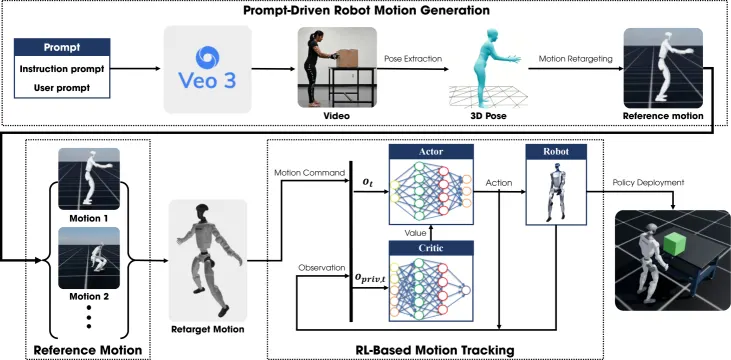
The human-like morphology of humanoid robots grants them exceptional potential for agile and versatile motor capabilities, but it also introduces significant challenges in acquiring complex skills. Traditional Learning-from-Demonstrations methods are often constrained by the high cost of collecting real-world data, the difficulty of capturing motion-specific behaviors, and the limited diversity of demonstrations across individuals. Moreover, even for the same task, humans may execute the motion in multiple distinct ways. In this paper, we propose a new framework that leverages the power of Generative AI to convert textual prompts into realistic and diverse sequences of human body movements, enabling the robot to observe multiple variations of how a single task can be performed. These synthetic demonstrations are then used as a training resource, allowing the robot to learn a broad range of task-execution styles without requiring direct human intervention. We evaluate the proposed method across four simulation scenarios. Experimental results show that the robot not only completes the tasks successfully but also demonstrates strong adaptability to complex variations in motion.
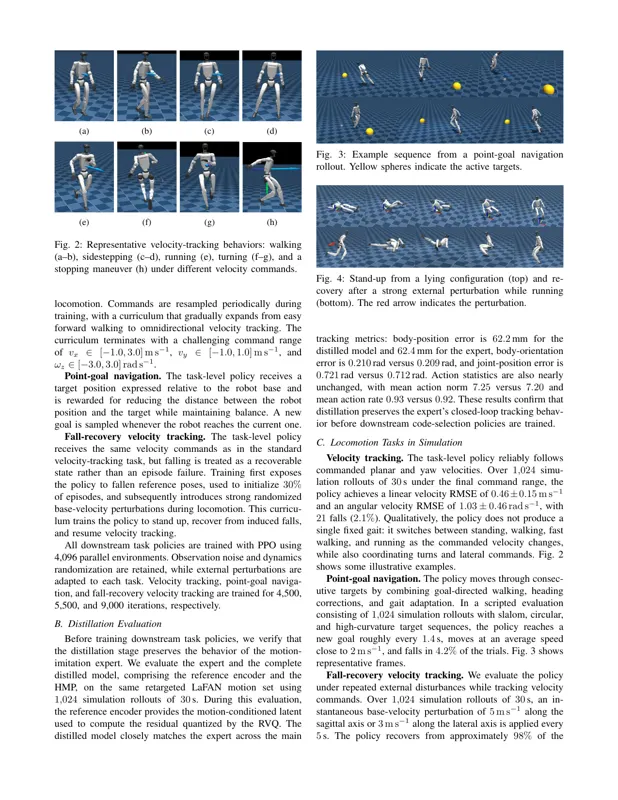
Reinforcement learning can produce robust humanoid controllers, but each new task is typically trained as a separate policy with its own reward design and training process. Motion imitation provides an alternative source of motor competence by training policies to track retargeted human motions, yet the resulting controllers remain reference trackers and are not directly usable as task policies. We propose a three-stage pipeline that turns motion-imitation skills into a reusable hybrid motion prior (HMP) for humanoid locomotion. First, an expert policy is trained to imitate retargeted human motion-capture clips. Second, the expert is distilled into a frozen architecture composed of a proprioceptive encoder, a residual vector-quantized (RVQ) codebook, and an action decoder. Third, task-level policies are trained to solve locomotion tasks by selecting discrete codebook entries while the HMP remains frozen. We evaluate the method on velocity tracking, point-goal navigation, and fall-recovery velocity tracking in simulation, and deploy the velocity-tracking policy on a real Unitree G1 robot. The distillation process preserves the tracking behavior of the expert, while the resulting HMP can be reused without retraining as the action interface for different downstream locomotion policies. The learned HMP reveals an interpretable codebook structure in which the number of active RVQ stages modulates the available gait patterns. We further show that training the codebook with the rotation trick improves latent organization and reduces downstream falls compared with a standard straight-through estimator.
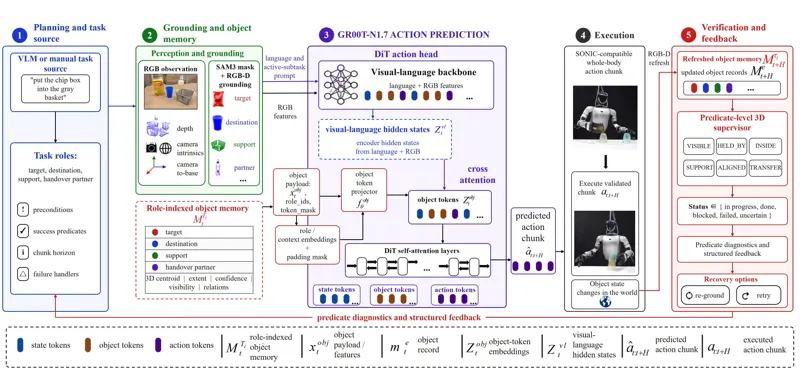
Vision-language-action policies are a promising foundation for general robot control, but long-horizon humanoid loco-manipulation requires the robot to treat task objects as persistent physical entities across movement, contact, occlusion, and recovery. We study this problem as object-state divergence: the object state used to condition a whole-body action can differ from the state used to decide whether the action achieved the intended physical relation. We propose Persistent Object Tokenization (POT), which maintains role-indexed 3D object records from RGB-D observations and converts them into object tokens for a whole-body action expert. Instantiated as POT-VLA, the same object records condition action generation and support geometric predicate checks, yielding a closed-loop execution system in which object state is both actionable and verifiable. On a Unitree G1, POT-VLA improves a matched direct GR00T-N1.7 baseline from 39/80 to 71/80 successes over eight real-world task families. In an external Being-0-aligned reference, POT-VLA achieves 44/50 successes on aligned service tasks, compared with the 37/50 success reported by the Being-0 paper. The largest gains occur on tasks requiring maintained 3D relations, suggesting that persistent object-centered state is a useful abstraction for verifiable humanoid VLA execution.
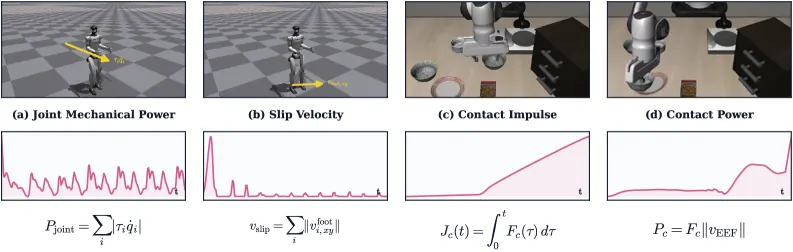
Robot policies are typically MLPs mapping observations to actions. Yet robot observations are physical variables, and many action-relevant cues arise not from individual variables but from their interactions; power, inertial effects, contact, slip, and compliance depend on products among observable signals. We introduce PRISM, a policy representation that makes polynomial interactions among observable physical variables explicit, learnable, and compact. Rather than listing all polynomial terms, PRISM uses a factorized polynomial module to expose higher-order interaction features efficiently. In reinforcement learning, it keeps the standard MLP backbone but applies a gradually activated element-wise polynomial function after it. In imitation learning, it replaces linear proprioceptive conditioning in Diffusion Policy with a polynomial layer trained end-to-end. Across humanoid locomotion and contact-rich manipulation, PRISM improves performance over standard MLP policies and larger MLPs with matched capacity, showing that interaction structure cannot be replaced by capacity alone. It also yields sensorless compliant behavior without force, wrench, tactile input, contact labels, or admittance control. These results suggest that polynomial representations should become a standard architectural choice for embodied motor control. The project page is available at https://lsh3163.github.io/prism/
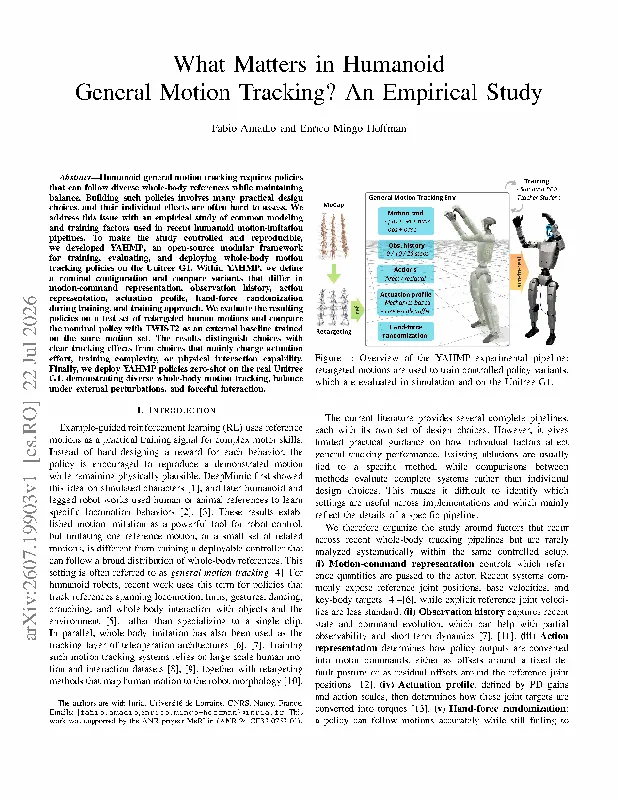
Humanoid general motion tracking requires policies that can follow diverse whole-body references while maintaining balance. Building such policies involves many practical design choices, and their individual effects are often hard to assess. We address this issue with an empirical study of common modeling and training factors used in recent humanoid motion-imitation pipelines. To make the study controlled and reproducible, we developed YAHMP, an open-source modular framework for training, evaluating, and deploying whole-body motion tracking policies on the Unitree G1. Within YAHMP, we define a nominal configuration and compare variants that differ in motion-command representation, observation history, action representation, actuation profile, hand-force randomization during training, and training approach. We evaluate the resulting policies on a test set of retargeted human motions and compare the nominal policy with TWIST2 as an external baseline trained on the same motion set. The results distinguish choices with clear tracking effects from choices that mainly change actuation effort, training complexity, or physical interaction capability. Finally, we deploy YAHMP policies zero-shot on the real Unitree G1, demonstrating diverse whole-body motion tracking, balance under external perturbations, and forceful interaction.
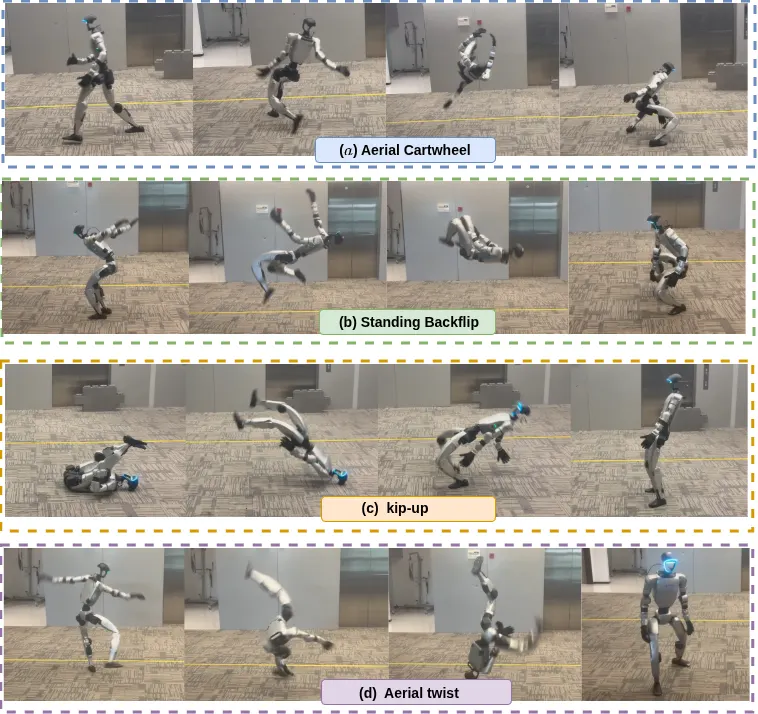
Humans can progressively acquire highly dynamic motor skills while preserving reliable everyday motor abilities. In contrast, existing humanoid controllers face a trade-off between generalist and specialist capabilities: generalist motion tracking policies struggle to reliably execute rare highly dynamic motions, whereas specialist training can degrade previously acquired behaviors. We introduce Extreme-RGMT, a two-stage continual learning framework for robust generalist humanoid control. The method first learns a generalist motion-tracking base policy from diverse multi-source motion data, then employs an asymmetric skill acquisition and capability consolidation mechanism to constrain policy drift on mastered motions while emphasizing difficult dynamic segments. To address the scarcity of highly dynamic motions, their high failure rates, and the resulting shortage of informative samples, Extreme-RGMT combines difficulty-aware sampling with advantage-prioritized trajectory resampling to emphasize critical segments. Experiments show that Extreme-RGMT achieves state-of-the-art generalist whole-body motion-tracking performance, including substantially improved completion of challenging highly dynamic motions. The resulting controller directly executes diverse unseen highly dynamic motions under fixed references and online inertial motion-capture inputs, advancing generalist whole-body motion-tracking controllers toward highly dynamic motor capabilities at the human-expert level.
Offline goal-conditioned reinforcement learning (RL) holds the promise of learning general-purpose policies from static datasets. However, scaling these methods to long-horizon tasks remains a challenge due to the curse of horizon, where value estimation errors can compound through long chains of bootstrapped Bellman backups. Existing hierarchical approaches mitigate this by decomposing tasks into subgoals, yet they often rely on low-level controllers that suffer from myopic execution and biased value estimates. In this work, we propose Hierarchical Implicit Q-Chunking (HiQC), an offline goal-conditioned RL algorithm that combines high-level latent planning with low-level action chunking. By conditioning the low-level critic on temporally extended action sequences, HiQC enables unbiased k-step value backups, compressing the horizon at both the planning and execution levels. We theoretically demonstrate that this dual decomposition results in a tighter bound on value error under a bounded per-backup error model compared to standard hierarchy or flat chunking alone. Empirically, HiQC achieves the highest aggregate performance among the compared methods on the OGBench suite, with its largest gains on long-horizon navigation tasks such as humanoid-giant.