Skip to content
Real2Sim2Real for Vision-Language-Action Manipulation: An AMD ROCm-Based Pipeline

Real2Sim2Real for Vision-Language-Action Manipulation: An AMD ROCm-Based Pipeline

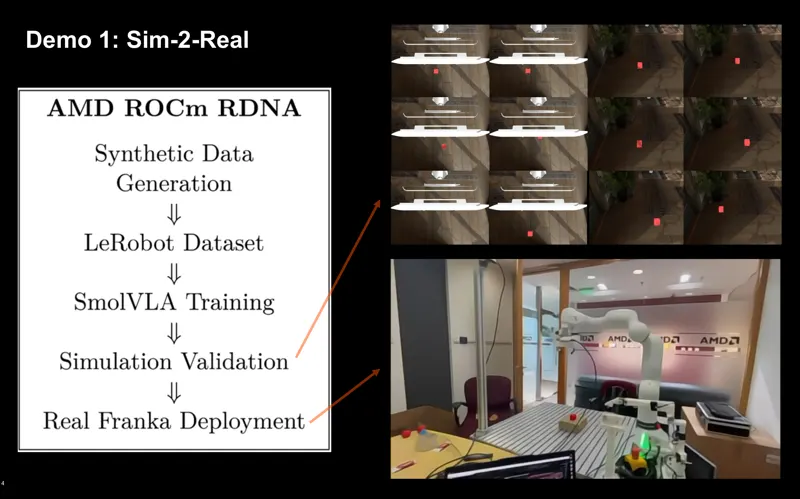
Physical AI – the integration of large vision-language-action (VLA) models with embodied agents that act in the real world – has emerged as the next major frontier for AI, echoed by industry leaders such as Jensen Huang (``the next big thing is Physical AI, AI with a body,'' GTC Paris, June 2025) and Dr. Lisa Su (`we're entering the world of Physical AI... this is where AI enters the real world,' CES 2026). This paper presents an end-to-end, fully AMD-accelerated technology stack for embodied manipulation, spanning data-center training silicon, Radeon PRO simulation/rendering GPUs, and Ryzen AI edge compute, unified by the open ROCm software stack. We demonstrate that training and deploying VLA-based manipulation policies does not require a CUDA-locked ecosystem. Four progressive demonstrations are presented: (1) a Sim-to-Real manipulation pipeline trained with SmolVLA and deployed on a physical Franka arm; (2) a semantic, language-grounded object-selection task (`one-of-three'); (3) a Real2Sim synthetic-data generation pipeline that fuses 3D Gaussian Splatting (3DGS) reconstructions of real scenes with the Genesis physics engine; and (4) large-scale reinforcement learning for quadruped and humanoid locomotion benchmarked across multiple hardware platforms. All pipelines run natively on ROCm + PyTorch on RDNA4 (Radeon AI PRO R9700) and RDNA3.5 (Radeon PRO W7900) hardware and are reproducible on the free Radeon Cloud Platform.

Embodied AI
Qing Yang, Xun Wang, Ziguan Wang · 353 views · Jul 25, 2026
LabRobFail: A Benchmark for Robotic Failure Analysis in Chemical Self-driving Laboratories

LabRobFail: A Benchmark for Robotic Failure Analysis in Chemical Self-driving Laboratories

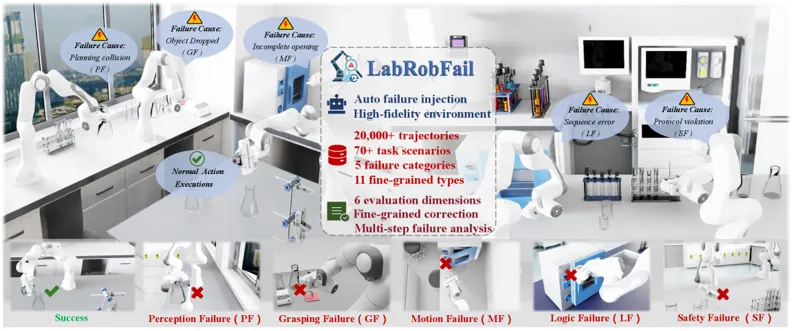
The deployment of embodied agents in self-driving laboratories could accelerate scientific discovery, yet their reliability is constrained by the irreversible and safety-critical nature of chemical experiments. Progress is further hindered by scarce failure data and the lack of fine-grained evaluation protocols. To address these challenges, we introduce LabRobFail, a failure-centric framework for learning and evaluating robotic failure analysis in chemical laboratories. LabRobFail-Sim injects controllable failures at the control, physics, and semantic levels, enabling the construction of LabRobFail-Data, which contains over 20,000 trajectories across 70+ task scenarios, five failure categories, and 11 fine-grained failure types. LabRobFail-Bench evaluates six capabilities spanning task understanding, failure detection, temporal localization, severity assessment, failure classification, and actionable correction. We further develop LabRobFail-VLM, a domain-specialized vision-language model that generates structured failure diagnoses and recovery instructions. On seen environments, it achieves 92.58% failure-detection accuracy and 85.58% temporal-localization accuracy, substantially outperforming general-purpose VLMs. When integrated as a real-time supervisor, it improves downstream VLA task success rates by 10-20 percentage points, demonstrating the value of fine-grained failure understanding for closed-loop recovery and reliable laboratory autonomy. Our code and data are available at https://github.com/Su-ISE-2001/SciRobo

Embodied AI
Haobo Wang, Baoli Sun, Anqi Zou · 370 views · Jul 26, 2026
N₀-TWAM: Scaling Tactile-Native World-Action Model for Contact-Rich Manipulation

N₀-TWAM: Scaling Tactile-Native World-Action Model for Contact-Rich Manipulation

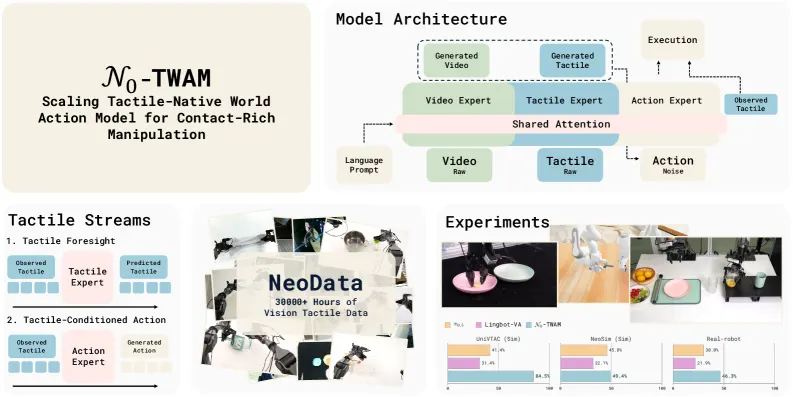
We present N₀-TWAM, a tactile-native world-action model for contact-rich manipulation that predicts both future vision and future contact. To our knowledge, it is the first tactile world-action model trained at large scale, and it shows strong capability on contact-rich tasks. We pre-train N₀-TWAM at large scale with visuo-tactile joint training over tactile-rich demonstrations spanning six embodiments and 450 tasks. We use NeoForce, a unified force-based tactile representation, to form a physically grounded contact signal that conditions action generation. To improve long-horizon and multi-stage manipulation, we introduce tactile contact events for task staging and advance through them during execution. For real-time efficiency, we adopt an asymmetric Mixture-of-Transformers architecture that pairs a full-width expert for video prediction with slim experts for downstream action and tactile prediction. Evaluations on both real and simulated benchmarks justify the capabilities of N₀-TWAM across a range of contact-rich tasks, and demonstrate the benefit of data scaling for precise tactile and action prediction. In summary, N₀-TWAM endows a world-action model with predictive capabilities to foresee vision, touch and action, building a solid foundation for fine-grained manipulation on open contact-rich tasks. The codebase and model checkpoints will be made publicly available to foster further research and development in tactile-enabled robotic manipulation.

Embodied AI
NeoteAI Team, Fudan TEAI Team · 529 views · Jul 26, 2026
Embodied GPT-5.1: Evidence of a World Model?

Embodied GPT-5.1: Evidence of a World Model?

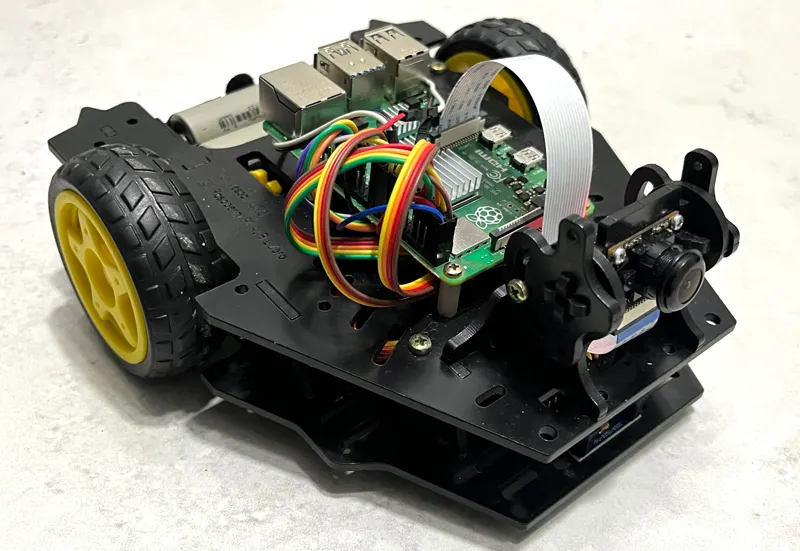
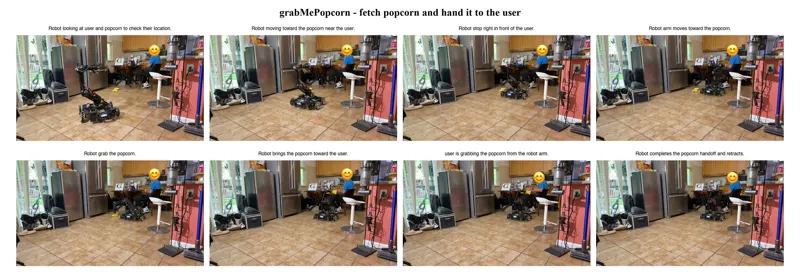
This exploratory study examines whether a large multimodal language model, GPT-5.1, can serve as the high-level controller of a physical mobile robot despite having no prior embodiment, no training in simulated environments, and no exposure to sensorimotor experience. Using only low-resolution first-person images and a discrete action set, the model was tasked with navigation and object-directed behaviors such as locating and contacting a target toy. Across multiple trials, GPT-5.1 demonstrated emergent capabilities that suggest elements of spatial reasoning and physical understanding. These included maintaining short-term memory of object locations after they left the camera frame, inferring the physical consequences of its own movements, and executing coherent action sequences such as colliding with an object and reversing to visually verify the outcome. At the same time, the model displayed inefficiencies and perceptual limitations, including imprecise alignment strategies and occasional misidentification of distant distractors. Overall, the results indicate that GPT-5.1 exhibits signs of world-model-like behavior in an embodied setting, despite the absence of any embodiment-related training, a finding that challenges long-standing views in cognitive science and robotics which hold that a physical body is a necessary prerequisite for developing such forms of intelligence. The findings motivate deeper investigation into the emergence, limits, and robustness of physical understanding in large language models.

Embodied AI
Roberto Spinelli, Thiago C. Martins · 313 views · Jul 27, 2026
LeapBot-WA: World-Anchor Action Models via Predictive Latent Alignments

LeapBot-WA: World-Anchor Action Models via Predictive Latent Alignments

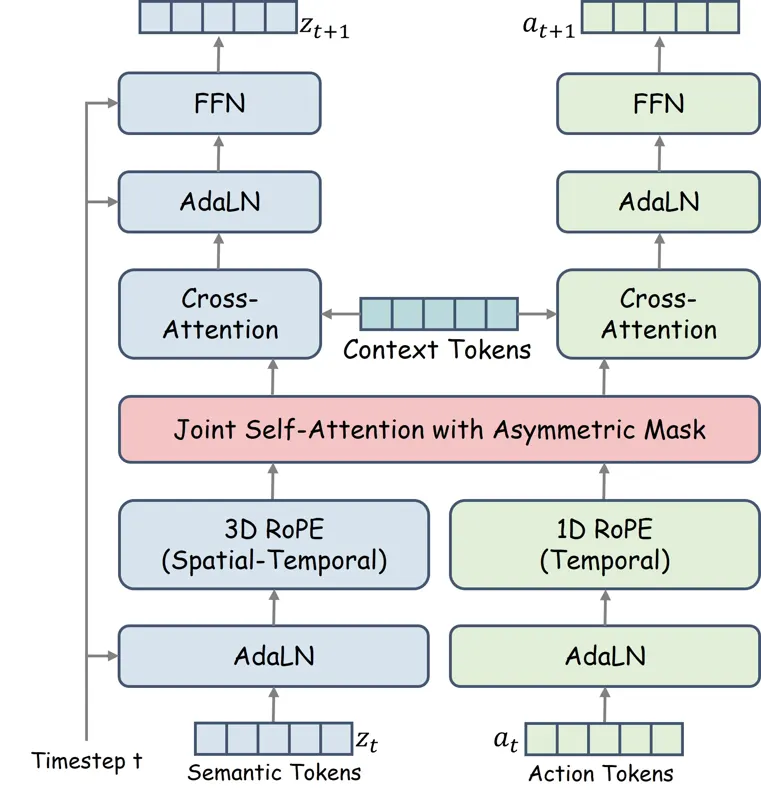
World Action Models (WAMs) have emerged as a powerful paradigm for embodied intelligence, yet the prevailing reliance on pixel-level video generation creates a fundamental bottleneck. Forcing models to reconstruct task-irrelevant visual details dissipates representational capacity and renders policies vulnerable to visual distractors. In this paper, we propose LeapBot-WA, which establishes a novel Predictive-Latent paradigm for WAMs by operationalizing the Joint-Embedding Predictive Architecture (JEPA) as a World-Anchor. Departing from the traditional reliance on visual synthesis, LeapBot-WA shifts the core of world modeling to Predictive Semantic Alignment, extracting abstract physical dynamics directly within a latent foundation space. To bridge the modality gap between non-Gaussian predictive features and diffusion priors, we introduce the Isotropic Semantic Autoencoder (ISAE), which reshapes the anchor's latent space into a diffusion-friendly manifold to prevent off-manifold drift. Furthermore, we design an Asymmetric Mixture-of-Transformers (MoT) architecture. During training, an Anchor Diffusion Transformer acts as a privileged dynamics expert to guide the Action Diffusion Transformer; at inference, this heavy dynamics branch is pruned, enabling zero-overhead execution. LeapBot-WA achieves state-of-the-art performance among predictive models on LIBERO and matches top-tier generative WAMs on RoboTwin 2.0 without requiring large-scale trajectory pre-training. It further demonstrates superior zero-shot robustness to unseen environments and successful real-world transfer, establishing a highly efficient and robust latent-centric paradigm for scalable robotic control. Code: https://github.com/LeapWM/leapbot-wa.

Embodied AI
Pei Liu, Nan Zheng, Lang Zhang · 550 views · Jul 27, 2026
Data Pyramid for Embodied Manipulation: A Survey

Data Pyramid for Embodied Manipulation: A Survey

Multimodal foundation models learned to see and to speak by consuming the whole internet. Embodied agents admit no such shortcut, since they require data that couple observations with physical states and actions. These signals can be provided, to varying degrees, by multiple data sources. In this work, we organize the embodied data ecosystem as a "pyramid" spanning five complementary sources: real-robot data, UMI-style data, egocentric and exocentric data, simulation data, and general vision-language data. We organize the pyramid around the tension between scalability and robot alignment, and further characterize each source in terms of data quality, diversity, reusability, and physical fidelity. We then analyze recent embodied foundation models through the lens of their data recipes, examining how different sources are selected, aligned, and mixed during pretraining. For embodied brain models, vision-language-action models, and world-action models alike, we relate data composition to capabilities in perception, reasoning, planning, action generation, and world prediction. We close by discussing six open challenges: building large-scale tactile datasets, collecting failure and recovery data, developing scalable data-collection pipelines, aligning actions across embodiments, leveraging egocentric data for dexterous manipulation, and designing principled data recipes for robot learning. We hope this work paves the foundation for the design of next-generation embodied systems.
Embodied AI
Yifan Ye, Yankai Fu, Yaoxu Lv · 401 views · Jul 27, 2026
Addressing the Orchestration Gap in Generalist Robots via Physical Agency

Addressing the Orchestration Gap in Generalist Robots via Physical Agency

General-purpose robots need to reason about their actions, combining perception, world knowledge, planning, success detection, recovery, and low-level control. Today's state-of-the-art models attempt to combine all these capabilities into the learned policy via large-scale pre-training. Instead, we show that these capabilities can be decomposed into a general language-conditioned policy/control agent and a high-level agent manager/orchestrator. Rather than training policies to reason via pre-training, we build a closed-loop physical agent orchestrator that can do high-level planning, decompose the goal into achievable subgoals, command low-level motor commands, track and verify the outcome from low-level observations, and recover from failures. Our Physical Agency orchestrator (Pigey) can control existing vision-language-action (VLA) policies as well as parametrized skills to solve complex reasoning tasks in the real world, without any additional data collection or post-training. We evaluate Pigey extensively across simulation benchmarks and challenging real-world robotic manipulation tasks, and demonstrate significant performance improvements over existing generalist policies. On LIBERO-PRO, Pigey advances the state-of-the-art by over 4x (12.8% -> 53.3%) with no task-specific fine-tuning. On a real robot, Pigey lifts the frozen policy from near-zero to over 90% on reasoning-limited tasks. We call the difference between what frozen motor skills achieve alone and inside the agentic loop the orchestration gap.

VLAOrchestration
Liane Galanti, Dhruv Shah, Tri Dao · 564 views · Jul 23, 2026
PAVXploreRL: Physical-Action-Visual World Model Reinforcement Learning with Action Exploration

PAVXploreRL: Physical-Action-Visual World Model Reinforcement Learning with Action Exploration

Action-conditioned world models are a key component of embodied AI, serving as scalable policy evaluators that reduce reliance on expensive real-world rollouts. To accurately capture diverse action-induced dynamics, such models should satisfy three key objectives-Physical Plausibility (P), Action Adherence (A), and Visual Fidelity (V), collectively referred to as PAV-while remaining robust to both in-distribution (ID) expert demonstrations and out-of-distribution (OOD) actions. However, existing methods primarily rely on ID action-video pairs and pixel-level reconstruction losses, which do not explicitly optimize PAV objectives and generalize poorly beyond expert data. To address this, we propose PAVXploreRL, a reinforcement learning framework built on a pretrained latent world model that explicitly optimizes PAV objectives through reward-driven training. To improve action generalization, our method jointly leverages ID trajectories and noise-driven OOD action exploration, without paired video supervision. Experiments show that PAVXploreRL consistently outperforms pretrained baselines, achieving a 5.6% average gain across benchmarks and producing higher-quality PAV properties. As a policy evaluator, it also yields more reliable performance estimates and reduces the overestimation bias of prior expert-only world models such as Ctrl-World. Code: https://github.com/Social-AI-Studio/PAVXploreRL

World ModelsReinforcement Learning
Han Wang, Zijun Wang, Shuoshuo Xue · 404 views · Jul 18, 2026
Athena-Brain Technical Report: An Efficient Robot Brain for General Intelligence and Embodied Interaction

Athena-Brain Technical Report: An Efficient Robot Brain for General Intelligence and Embodied Interaction

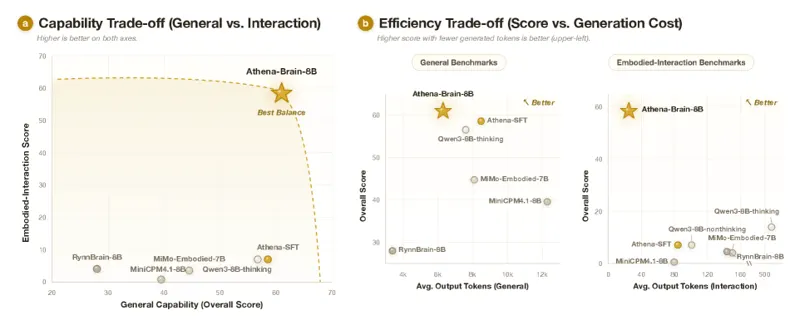
Large language models (LLMs) have demonstrated remarkable capabilities in language understanding, reasoning, and world knowledge. As embodied agents become increasingly capable, there is a growing demand for compact models that can serve as an on-device brain, preserving the broad general intelligence of LLMs while enabling effective high-level interaction with embodied environments. Existing approaches, however, often prioritize either general-purpose intelligence or specialized embodied capabilities, making it challenging to satisfy both requirements within a single model. We present Athena-Brain-8B, an 8B LLM designed to serve as an on-device brain for embodied intelligence for embodied intelligence. Through a multi-stage post-training pipeline consisting of General Supervised Fine-Tuning, General Reinforcement Learning, Embodied Expert training, and Model Merge, Athena-Brain-8B maintains strong general capabilities while acquiring strong high-level embodied interaction capabilities and generating concise responses for efficient embodied interaction. Experimental results demonstrate the effectiveness of Athena across both general and embodied evaluations. Compared with the corresponding Qwen3-8B thinking model, Athena-Brain-8B achieves comparable performance on general language and reasoning benchmarks while generating substantially shorter responses. On in-domain embodied benchmarks, Athena-Brain-8B consistently outperforms models of similar scale and surpasses several substantially larger frontier models evaluated zero-shot, demonstrating that compact language models can effectively integrate strong general intelligence with embodied capabilities.

Embodied AIRobot Brain
Jialian Li, Junhong Liu, Yuchen Cao · 386 views · Jul 21, 2026

As an Amazon Associate, we earn from qualifying purchases.