Skip to content
Heavy lifting tasks via haptic teleoperation of a wheeled humanoid

Heavy lifting tasks via haptic teleoperation of a wheeled humanoid

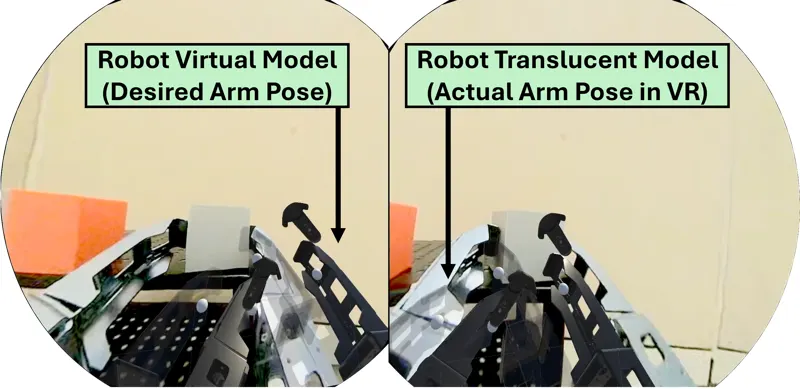
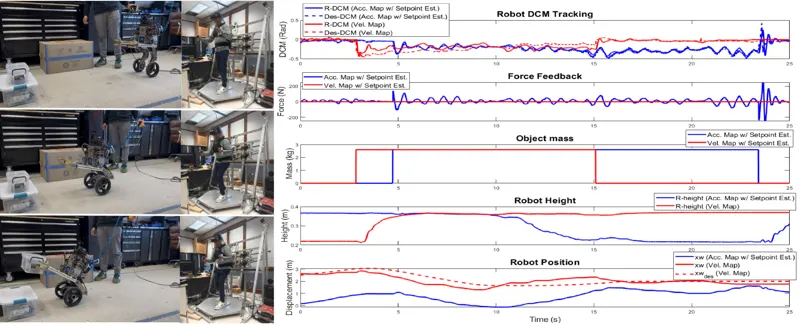
Humanoid robots can support human workers in physically demanding environments by performing tasks that require whole-body coordination, such as lifting and transporting heavy objects.These tasks, which we refer to as Dynamic Mobile Manipulation (DMM), require the simultaneous control of locomotion, manipulation, and posture under dynamic interaction forces. This paper presents a teleoperation framework for DMM on a height-adjustable wheeled humanoid robot for carrying heavy payloads. A Human-Machine Interface (HMI) enables whole-body motion retargeting from the human pilot to the robot by capturing the motion of the human and applying haptic feedback. The pilot uses body motion to regulate robot posture and locomotion, while arm movements guide manipulation.Real time haptic feedback delivers end effector wrenches and balance related cues, closing the loop between human perception and robot environment interaction. We evaluate the different telelocomotion mappings that offer varying levels of balance assistance, allowing the pilot to either manually or automatically regulate the robot's lean in response to payload-induced disturbances. The system is validated in experiments involving dynamic lifting of barbells and boxes up to 2.5 kg (21% of robot mass), demonstrating coordinated whole-body control, height variation, and disturbance handling under pilot guidance. Video demo can be found at: https://youtu.be/jF270_bG1h8?feature=shared

TeleoperationTactile Feedback
Amartya Purushottam, Jack Yan, Christopher Yu · 544 views · May 26, 2025
CoorDex: Coordinating Body and Hand Priors for Continuous Dexterous Humanoid Loco-Manipulation

CoorDex: Coordinating Body and Hand Priors for Continuous Dexterous Humanoid Loco-Manipulation

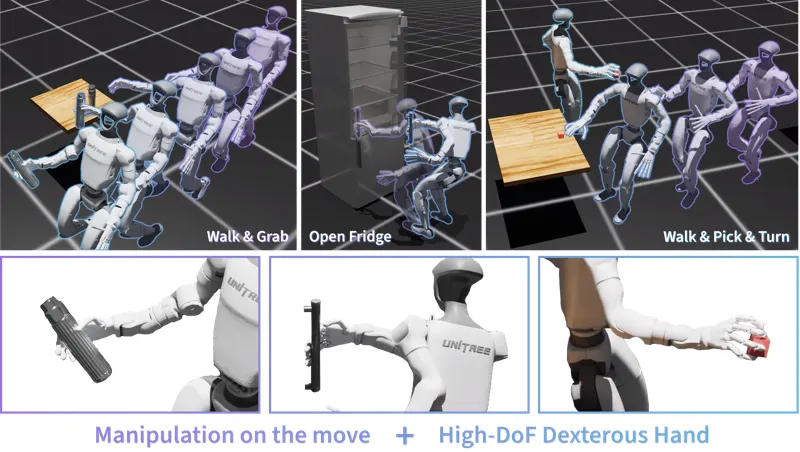
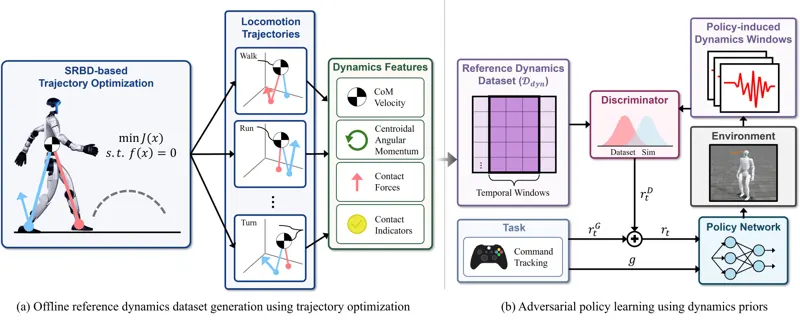
Humanoid loco-manipulation is often simplified into a stop-and-go process: walking to an object, stopping to manipulate it, and then resuming locomotion. It also commonly relies on low degree-of-freedom (DoF) end effectors that behave like an open-close grasp primitive. We introduce CoorDex, a learning pipeline that converts high-dimensional body and dexterous hand control into coordinated latent residual control, enabling high-DoF dexterous loco-manipulation on the move. Starting from simulated whole-body and hand demonstrations, CoorDex trains privileged motion tracking teachers for the humanoid body and dexterous hand, distills them into proprioception-conditioned latent priors, and uses the frozen priors as the action space for downstream residual reinforcement learning. A coordinated latent residual policy composes these priors through shared task context and separate body-hand residual heads, preserving natural whole-body motion while improving finger-level contact reliability. CoorDex enables a Unitree G1 humanoid with a 20-DoF WUJI hand to execute dexterous manipulation while in motion, including non-stop bottle grasping and carrying, fridge door opening on the move, and cube pick-and-turn. Ablations on the walk-grasp-carry task show that joint-space PPO, joint-space hand control, and monolithic latent prediction all fail under the same reward budget, while the latent-prior interface and coordinated residual structure make high-dimensional contact-rich loco-manipulation trainable. Project Page: https://skevinci.github.io/coordex/

Loco-manipulationCoorDex
Sikai Li, Shuning Li, Zhenyu Wei · 558 views · Jun 22, 2026
Reinforcement Learning-Based Control for an Inline Skating Humanoid Robot

Reinforcement Learning-Based Control for an Inline Skating Humanoid Robot

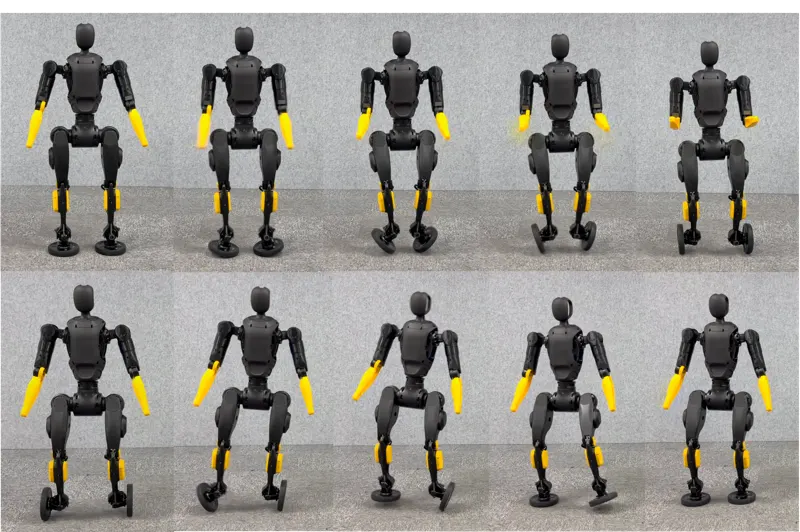
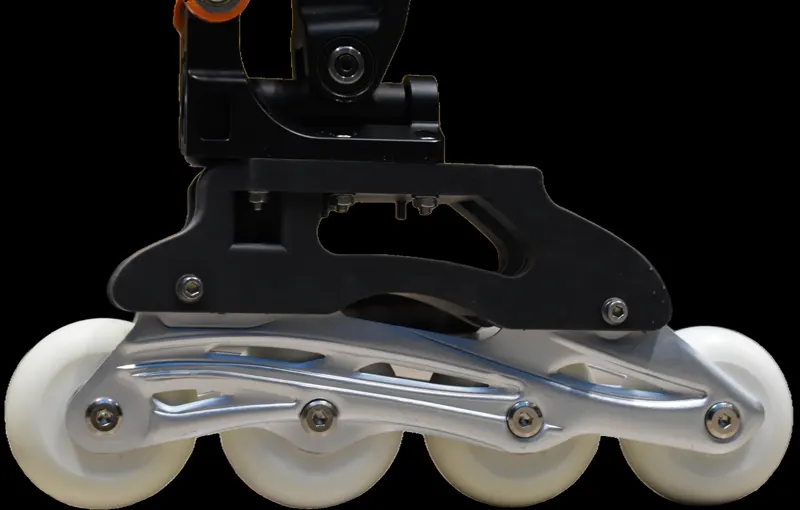
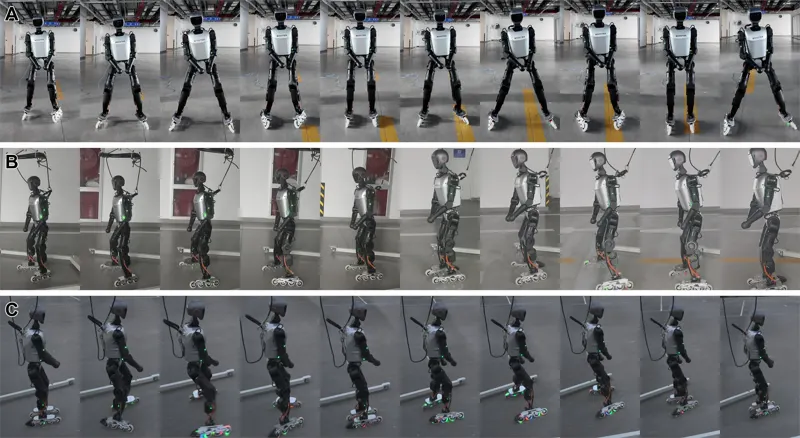
As humanoid robots become increasingly dynamic, coupling them with reinforcement learning offers a promising approach to solving the complex, underactuated mechanics of passive inline skating. Equipping a humanoid robot with passive inline skating wheels presents an opportunity to combine the versatile agility of humanoids with the high-speed, energy-efficient locomotion strategies utilized by human skaters. In this paper, we train and deploy a reinforcement learning control policy that enables novel locomotion strategies for a humanoid robot modified to equip consumer inline skates instead of conventional feet. Unlike previous work limited to quadrupedal robots or actively driven wheels, our system allows for precise 6-DoF control of the skates to execute dynamic, edge-driven propulsion strategies. Our skating strategies emerge entirely from our reward structure, without reliance on human motion data, imitation learning, or kinematic priors. We overcome the inherent instability of passive wheels and simulation contact artifacts by utilizing different geometric wheel models (spherical and ellipsoidal) during training and validation, along with a custom success-based command curriculum and a specialized rolling reward. Consequently, our policy demonstrates up to a 50% reduction in Cost of Transport (CoT) compared to standard walking gaits. The resulting policy successfully transfers zero-shot to the physical Booster T1 hardware. Real-world deployments demonstrate dynamic balance, the ability to reject active physical perturbations, and agile locomotion strategies capable of turning at speed. A video of our results can be found at https://www.youtube.com/watch?v=-_APcOS7uFo.

Inline SkatingGait optimization
Ethan Marot, Thomas Bi, Clemens Schwarke · 511 views · Jun 30, 2026
Physics-Guided Biomechanical Gait Adaptation for Humanoid Locomotion on Extreme Sloped Terrains

Physics-Guided Biomechanical Gait Adaptation for Humanoid Locomotion on Extreme Sloped Terrains

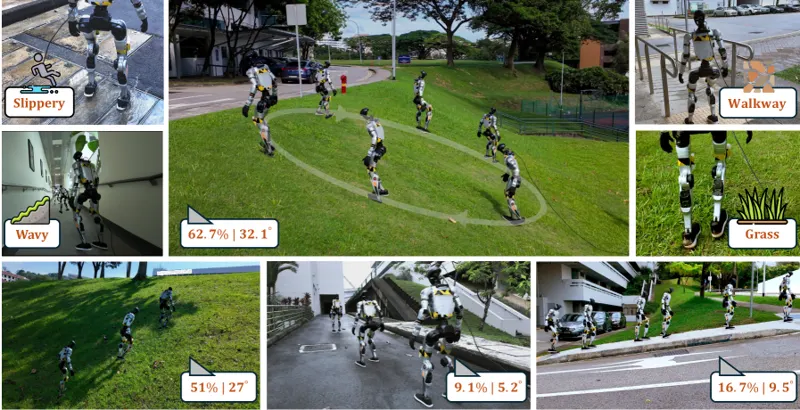
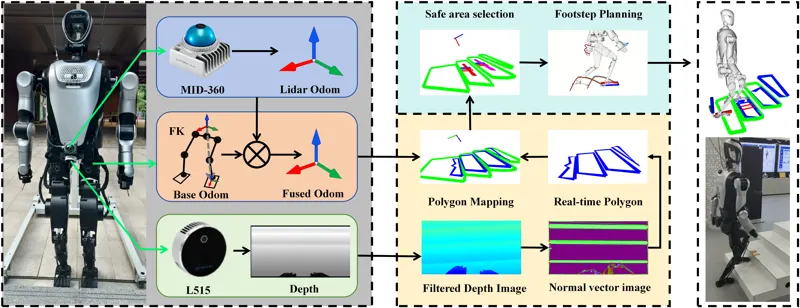
Model-free reinforcement learning has enabled impressive humanoid locomotion; however, control on steep slopes remains largely unexplored. Unlike flat or discrete terrains, sloped terrains impose a persistent gravitational bias that demands simultaneous stability and posture control. Consequently, under generic reward formulations, policies can converge to slow, conservative low-center-of-mass (CoM) crouched gaits. In this work, we propose a novel two-stage physics-guided framework, dubbed HumoSlope, dedicated to robust humanoid locomotion on diverse sloped terrains. Specifically, Stage I establishes a terrain-consistent balance prior by introducing a slope-adaptive Zero Moment Point (ZMP) regularizer evaluated directly on the local inclined support plane rather than a world-horizontal reference. To prevent the resulting policy from defaulting to a crouched posture, Stage II introduces the Biomechanical Slope Gait Adapter (BSGA). Utilizing extracted macroscopic terrain descriptors as privileged, training-only signals, BSGA dynamically gates soft reward priors to modulate CoM height and lower-limb coordination based on the estimated slope geometry – encouraging hip-dominant uphill propulsion and knee-oriented downhill braking. Crucially, the deployed actor remains entirely proprioceptive, requiring no online exteroceptive sensing. Extensive Sim-to-Real experiments demonstrate that our framework effectively mitigates posture degeneration and enables blind, continuous traversal of outdoor grass slopes up to 62.7% (32.1^∘), validating a physics-guided approach to challenging slope terrain adaptation.
ZMPHumanoid
Xuanyu Chen, Mohan Liu, Dengchen Mei · 473 views · Jul 8, 2026
SKooP: Symmetric Koopman Predictions for Faster and More Generalizable Legged Robot Locomotion with Reinforcement Learning

SKooP: Symmetric Koopman Predictions for Faster and More Generalizable Legged Robot Locomotion with Reinforcement Learning

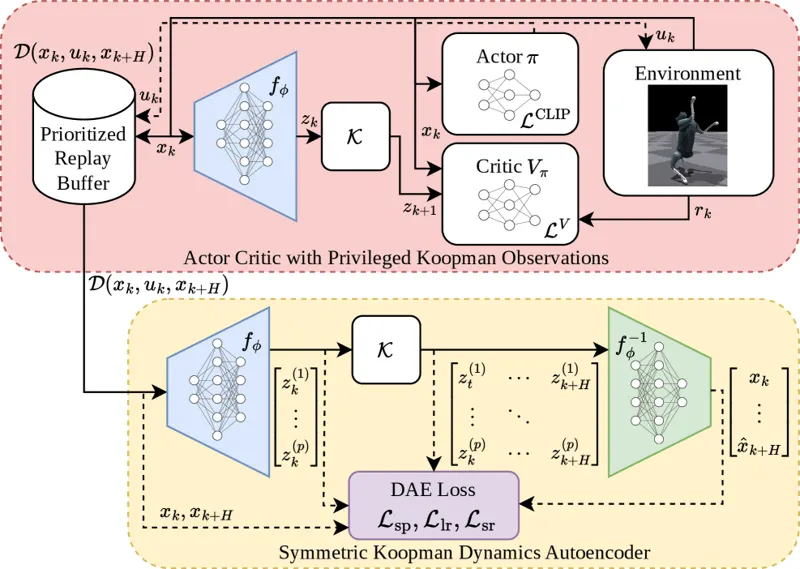
Reinforcement learning (RL) algorithms classically suffer from poor sample efficiency. In robotics, a recent line of work has emerged addressing this problem by encoding physics priors in the learning process. However, most of these approaches are validated on well-defined, low-dimensional benchmark systems rather than high-dimensional robots with complex nonlinear dynamics. In this paper, we introduce SKooP (Symmetric Koopman Predictions), an approach combining the advantages of morphological symmetries with those of a Koopman model learned via autoencoder to enhance policy learning. SKooP learns a Koopman model of the system dynamics alongside the policy. The resulting Koopman predictions are used as privileged observations for the critic, allowing the agent to learn based on smoother, more informative features. We also incorporate group symmetries into the actor, critic, encoder and decoder networks to produce a highly equivariant policy. The SKooP approach is validated via in-depth analysis of the learned Koopman models and symmetric policies to showcase how each of these influences the agent's performance. We also show that the learned policies are transferable to different simulation environments. Our results show that SKooP consistently reduces convergence time and increases the learned reward for multiple challenging bipedal locomotion tasks on a quadruped robot. Project page: https://evelyd.github.io/SymmetricKoopmanPredictions

KoopmanReinforcement Learning
Evelyn D'Elia, Weishu Zhan, Giulio Turrisi · 464 views · Jul 13, 2026

As an Amazon Associate, we earn from qualifying purchases.