Skip to content
Figure sends its retired F.02 humanoids leaping autonomously into a Finnish foundry furnace: a Terminator 2 homage whose real motive is IP-safe disposal
VIDEOOct 1, 2026

Figure sends its retired F.02 humanoids leaping autonomously into a Finnish foundry furnace: a Terminator 2 homage whose real motive is IP-safe disposal

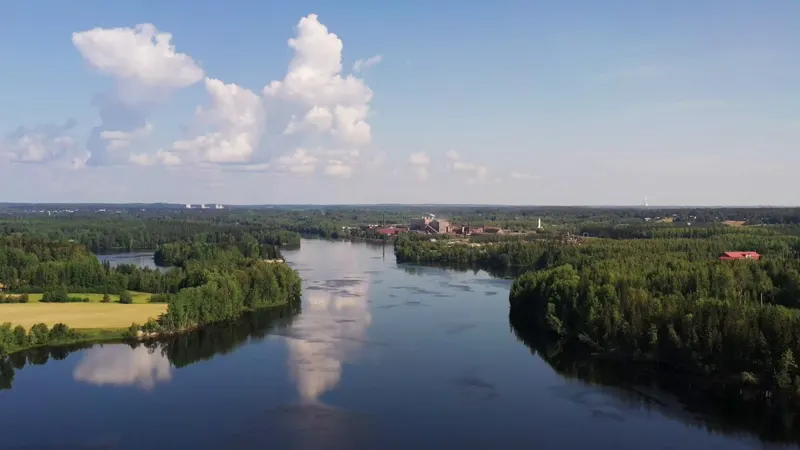
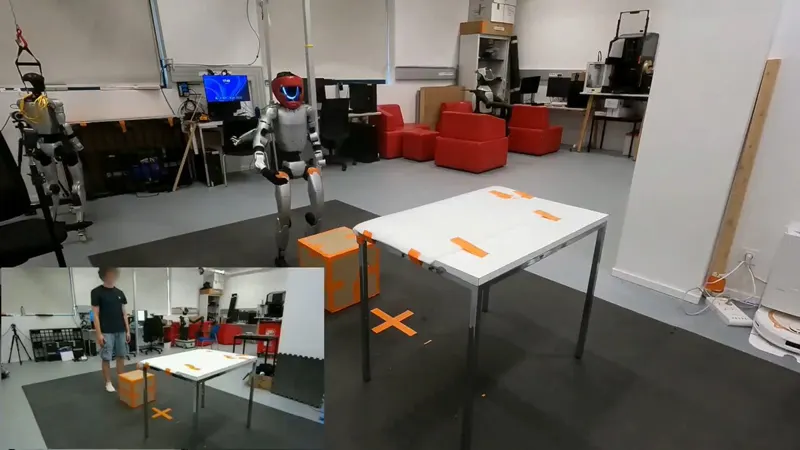
Figure AI gave its retired second-generation humanoid F.02 a Terminator-style send-off: with the newer F.03 fleet arrived, maintaining old units no longer made sense, and dismantling each machine would eat engineering time needed for the next-gen F.04 while risking exposure of proprietary hardware and IP. After multiple steel mills declined, only a foundry in Imatra, Finland took the job. The team rigged a large air cushion at its San Jose HQ, captured stunt-performer motion data, and trained a new AI motion model in simulation so the robots could **autonomously leap from a second floor and land precisely inside a 75-ton electric arc furnace they had never surveyed** — then be melted into steel. The company cut a 3+ minute video homaging the T-800's thumbs-up furnace scene in Terminator 2 (complete with the thumbs-up), but blogger xiaohu finds it "a bit tragic and cruel — I worry about the robots of the future seeing this." Context: before retirement the F.02 fleet spent 11 months at BMW Spartanburg — 30,000+ X3s assisted, 90,000+ sheet-metal parts loaded (84 s cycles / 37 s loads / 99%+ accuracy), 1,250+ runtime hours, ~200 miles walked, zero injuries — with those battle scars feeding directly into Figure 03's redesign (no more wrist dynamic cabling or distribution boards). Only a few F.02 units remain at HQ for display.

Delta Intelligence unveils Delta-0: a humanoid foundation model for whole-body loco-manipulation across 69 DoFs
VIDEOSep 28, 2026

Delta Intelligence unveils Delta-0: a humanoid foundation model for whole-body loco-manipulation across 69 DoFs

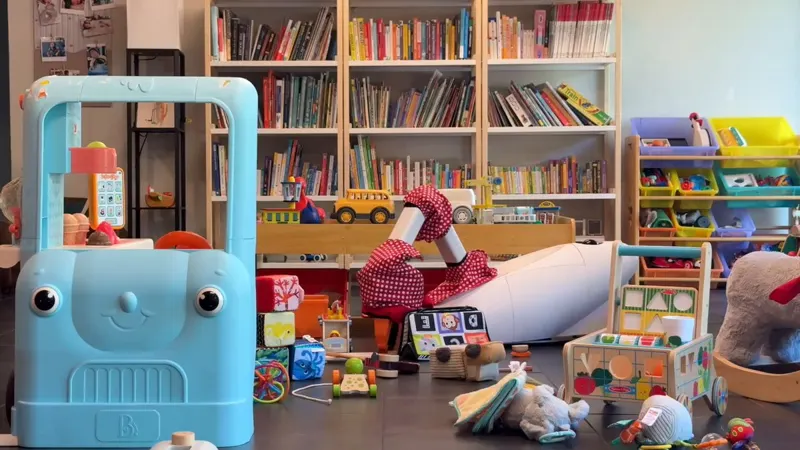
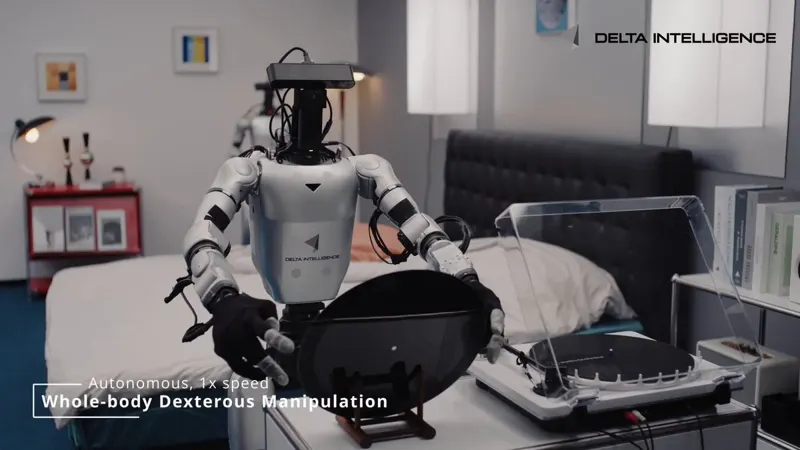
Delta Intelligence has released Delta-0, a humanoid foundation model for whole-body loco-manipulation built on a co-designed brain and controller. The brain is a latent world-action model: a mixture-of-transformers with three branches (vision-language reading multi-view observations and instructions, a vision branch predicting future frames in DINO semantic feature space, and an action branch modelling whole-body motion from proprioception), trained jointly in four modes - forward dynamics, inverse dynamics, visual planning and policy-only. The controller converts motion commands into joint targets across 69 degrees of freedom through a delta-action interface shared by policy output, teleoperation and human corrections; in zero-shot evaluation on roughly 3 h 31 min of everyday-task motion it beats HEFT, MimicLite v1.1, SONIC v1.1 and ScaleBFM XL on both global root error and MPJPE. Pretraining uses more than 10,000 hours of paired egocentric video and whole-body human motion, plus a 154-dimensional shared action representation padded to 180 so single-arm, dual-arm, ego, UMI and humanoid data all live in one action space; high-precision tracking coverage rises from 29.2% to 72.6% as motion data goes from 10% to 100%. Evaluation runs a real-to-sim-to-real loop, rebuilding deployment scenes into simulation assets with 3D reconstruction and LLM agents, running repeatable autonomous rollouts, then returning selected checkpoints to hardware. Real-world RL post-training uses a value model that estimates cost-to-go, giving positive or negative conditioning signals to autonomous action chunks and to human-in-the-loop corrections - on the dishwasher task in a mirrored kitchen layout the success rate climbs from 20% (4/20) after SFT to 65% (13/20). The demo video covers six long-horizon household tasks: loading a record on a turntable, making a bed, picking a toy off the floor, opening a dishwasher, pressing a step trash can and sitting down on a sofa.

As an Amazon Associate, we earn from qualifying purchases.