Skip to content
PAPERSep 10, 2026

CAP: Continuously Adaptive Perception-Blind Humanoid Locomotion via Learned Denoising

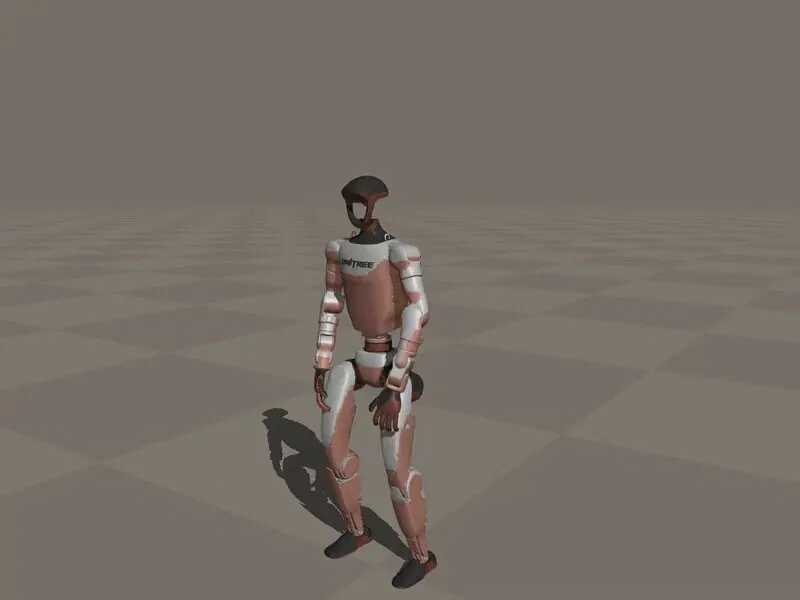
Humanoid locomotion across complex terrain demands forward-looking exteroception to anticipate obstacles, yet this signal is unreliable in real-world deployment, failing partially and intermittently. Existing perceptive policies often assume that depth observations remain clean and in-distribution, while recent attempts to unify perceptive and blind control typically route or switch between separate sub-policies, leaving recoverable information in partially corrupted depth unexploited. We instead propose CAP, a single-stage humanoid locomotion policy that recovers this signal with a perceptive world-model encoder trained as a learned denoiser to reconstruct clean depth from a corrupted input, together with a co-active proprioceptive variational encoder that supplies depth-free body-state information. A coupled training recipe pairs a depth-noise curriculum on the world-model input with world-model feature dropout on the policy-facing latent, exposing the policy to failures across the entire perception-quality spectrum. In simulation, CAP matches or improves upon perceptive baselines when depth remains informative, and degrades more smoothly than a binary-switching baseline as perception worsens. On the Unitree G1, controlled trials and indoor-outdoor deployments demonstrate perception-robust locomotion under intermittent occlusion, real-sensor corruption, and outdoor depth artifacts.

Chen, Hongjin, Xu, Zijun, Ma, Shihao

Humanoid LocomotionWorld ModelsDepth DenoisingPerception Robustness
PAPERSep 9, 2026

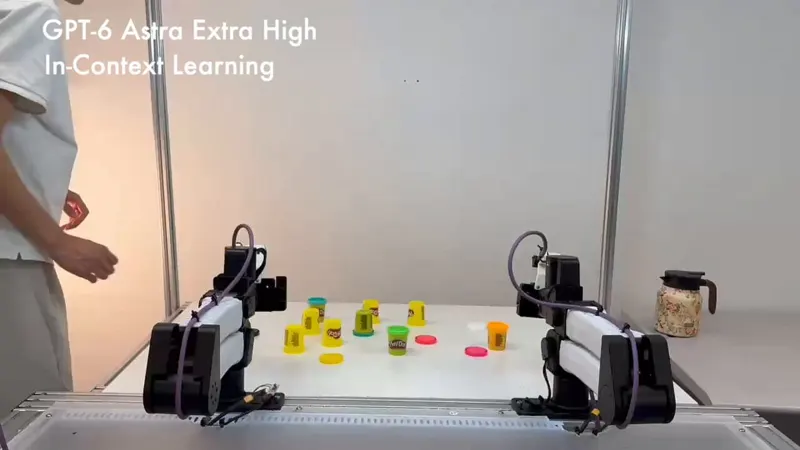
Show-Harness: Just a VLM Agent Can Play Robots

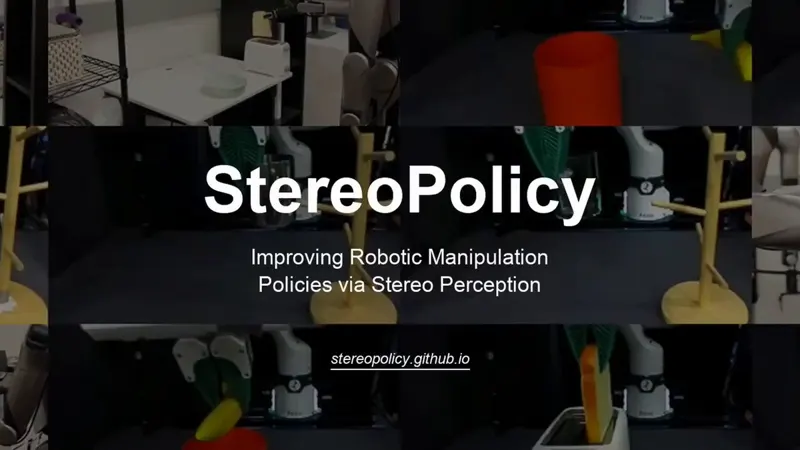
Foundation vision-language models (VLMs) exhibit broad intelligence about the world, yet translating this intelligence into robot control remains challenging. We present Show-Harness, an Embodied Harness that enables VLMs to "play" robots through a compact semantic interface linking intent to action. Show-Harness exposes discrete semantic action units that VLMs can naturally reason over, while embodiment-specific interpreters deterministically ground them into local robot actions, keeping the VLM directly responsible for fine-grained physical decisions. Through the same interface, Show-Harness demonstrates the feasibility of (1) directly unlocking closed-source frontier VLMs for zero-shot robot control, and (2) adapting small-scale open-source VLMs for low-cost deployment with just a few GPU-hours of fine-tuning. We further develop GUMI (GUI Manipulation Interface), which extends the same semantic action space to GUI-based demonstration collection, allowing humans and agents to "play" robots across embodiments without specialized teleoperation hardware. Extensive experiments show that Show-Harness-equipped VLM agents generalize robustly across tasks, embodiments, and environments, outperforming representative agentic and VLA paradigms. These results suggest that the right interface can unlock substantial embodied capability from foundation VLMs, without requiring additional model capacity or costly embodiment-specific pretraining.

Yanzhe Chen, Zechen Bai, Zhijun Cao

Vision-language modelsAgentic HarnessSemantic Action InterfaceRobot Manipulation

As an Amazon Associate, we earn from qualifying purchases.