Skip to content
← Tags
AI CodingDevelopmentC

v0: the code-generation agent that opens its own app, uses it, and ships through your protected branch

Vercel's v0 has the most complete agent loop among closed full-stack generators: web search with clickable citations, a browser that actually uses the app it built and sends back screenshots, terminal and unit tests inside a sandbox, bring-your-own MCP for external tools, and since Sep 2026 a one-step Publish that walks PR to merge to deploy for GitHub projects. Its boundaries are equally clear: the default stack is Next.js + shadcn, the shortest path is locked to Vercel, credits scale with iteration rounds, and there is no public correctness benchmark.

One-step PR → merge → deployGitHub project release pathVendor Claim · 2026-09
ProductVercelSite
v0: the code-generation agent that opens its own app, uses it, and ships through your protected branch
Agentic World Action Models

Agentic World Action Models

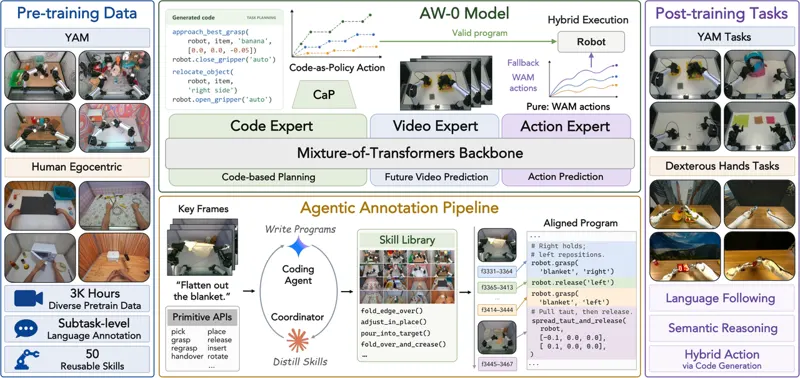
Recent world action models provide visual foresight and future prediction for robot manipulation, but lack explicit mechanisms for compositional skill reuse. Agentic robotics combines code-based planning and reasoning with reusable skills, but often lacks predictive grounding in physical dynamics. We introduce AW-0, an agentic world action model framework that integrates code-based planning with joint video and action prediction. We jointly model code, future video, and robot actions as three coupled generative streams within a unified mixture-of-transformers architecture. Within this architecture a code expert generates parameterized skill routines and control logic while video and action experts generate future visual states and low-level motor commands. Code serves two complementary roles: it structures multi-step prediction and control within the world model and represents skills as reusable programs for subsequent agentic execution. We further introduce an automated curation pipeline that labels robot and human video trajectories with aligned programs and consolidates recurring routines into reusable skill libraries. Evaluations on RoboTwin 2.0 and physical bimanual manipulation tasks show improved task performance over VLA and WAM baselines, alongside gains in language following, semantic reasoning and robustness, demonstrating that agentic code enables connection between planning, prediction and execution within WAMs.

Liu, Zhuoyang, Niu, Dantong, Zhang, Botong · 238 views · Oct 21, 2026
World-action modelsVision-language-action (VLA)
Oct 21, 2026
ReST-RL: Reinforcing LLM Reasoning through Unified Self-Training and Value-Guided Search

ReST-RL: Reinforcing LLM Reasoning through Unified Self-Training and Value-Guided Search

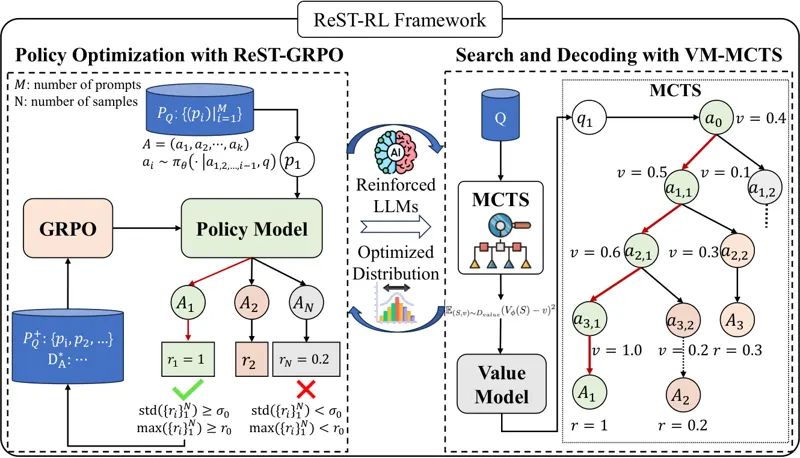
GRPO is the representative RL method for improving LLM reasoning, yet it only ever sees one sparse reward at the end of a whole trajectory: when the rewards inside a sampled group land close together, the group-relative advantage collapses into noise and the policy learns almost nothing. ReST-RL reconnects policy optimization and value-guided search into a single self-training pipeline. Stage one, ReST-GRPO, first filters out low-information prompts by reward standard deviation, then draws prefixes from each prompt's highest-reward trajectory under a discrete exponential distribution and uses them as fresh online-GRPO starting contexts. A selected prefix is context only; its suffix is re-sampled and optimized rather than imitated. Stage two, VM-MCTS, runs MCTS under the now-static policy to self-collect value targets and trains a value model that predicts expected terminal reward. At inference the same model both allocates the tree search through UCT and ranks completed candidates in a Best-of-N fashion, so search and verification share one state-value scale. On coding benchmarks including APPS, BigCodeBench and HumanEval, Qwen3-8B moves from 0.503 to 0.689 average. In matched policy-value controls, ReST-GRPO + VM-MCTS reaches 0.642 on APPS-500 while GRPO + VM-MCTS reaches only 0.538, so the stage-one distributional shift survives value learning. End-to-end accounting puts ReST-GRPO at 1,752 GPU-hours against 2,080 for GRPO, hitting a 9% gain in 71 hours instead of 207. A value model trained only on code trajectories also transfers to MATH, Omni-MATH and GPQA-Diamond without target-domain tuning.

Sining Zhoubian, Dan Zhang, Jie Tang · 721 views · Aug 27, 2025
Reinforcement LearningGRPO
Aug 27, 2025
As an Amazon Associate, we earn from qualifying purchases.