Skip to content
← Tags

#Grasping (17)

Optimizing Grasping in Legged Robots: A Deep Learning Approach to Loco-Manipulation

Optimizing Grasping in Legged Robots: A Deep Learning Approach to Loco-Manipulation

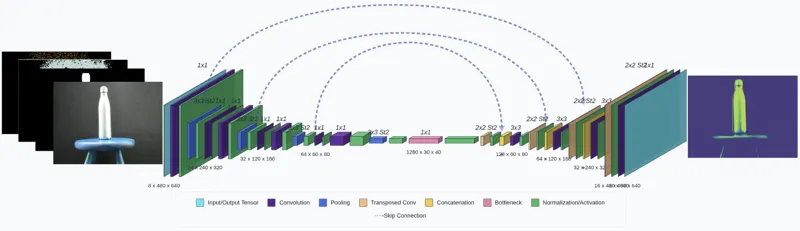
This paper presents a deep learning framework designed to enhance the grasping capabilities of quadrupeds equipped with arms, with a focus on improving precision and adaptability. Our approach centers on a sim-to-real methodology that minimizes reliance on physical data collection. We developed a pipeline within the Genesis simulation environment to generate a synthetic dataset of grasp attempts on common objects. By simulating thousands of interactions from various perspectives, we created pixel-wise annotated grasp-quality maps to serve as the ground truth for our model. This dataset was used to train a custom CNN with a U-Net-like architecture that processes multi-modal input from an onboard RGB and depth cameras, including RGB images, depth maps, segmentation masks, and surface normal maps. The trained model outputs a grasp-quality heatmap to identify the optimal grasp point. We validated the complete framework on a four-legged robot. The system successfully executed a full loco-manipulation task: autonomously navigating to a target object, perceiving it with its sensors, predicting the optimal grasp pose using our model, and performing a precise grasp. This work proves that leveraging simulated training with advanced sensing offers a scalable and effective solution for object handling.

Dilermando Almeida, Guilherme Lazzarini, Juliano Negri · 341 views · Aug 24, 2025
Legged robotsDeep LearningGraspingAug 24, 2025
SeededGrasp: Language-Guided Grasping in Complex Scenes with Multiple Embodiments

SeededGrasp: Language-Guided Grasping in Complex Scenes with Multiple Embodiments

Practical robotic grasping in complex scenes requires both 3D spatial reasoning and alignment with task-specific requirements. Vision-language models (VLMs) offer a natural way to specify these requirements using language, but existing approaches either use a VLM to predict the grasp directly with limited spatial awareness, or train the VLM together with the grasping model, which requires significantly more data and compute. These limitations impede performance and have prevented scaling to multiple embodiments in complex scenes. We address this by proposing SeededGrasp, a novel data-efficient framework that enables a VLM to predict a seed point to be used as conditioning for a subsequent lightweight grasp-generation model. Our architecture decouples high-level semantic reasoning from low-level geometric execution, enabling multi-embodiment support while bypassing the need for expensive end-to-end training. To enable training such models, we release the first multi-embodiment tabletop grasping dataset comprising over 2.5M grasps in cluttered scenes. Experimental results demonstrate that our approach outperforms existing baselines, achieving 72% success in simulation and 78% in real-world grasping experiments. See our project site for data and code: https://uoft-isl.github.io/seeded-grasp/

Yang Xu, Gurpreet Singh Mukker, Raymond Wang · 284 views · Jul 22, 2026
GraspingLanguage-GuidedMulti-EmbodimentJul 22, 2026

As an Amazon Associate, we earn from qualifying purchases.