Skip to content
Tags

#Motion Tracking (7)

Towards Adaptable Humanoid Control via Adaptive Motion Tracking

Towards Adaptable Humanoid Control via Adaptive Motion Tracking

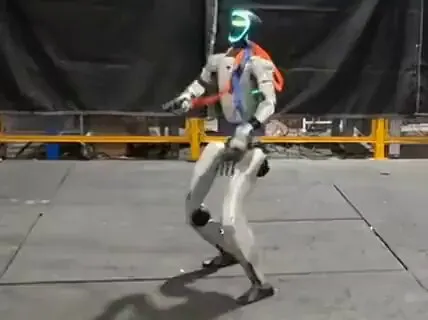
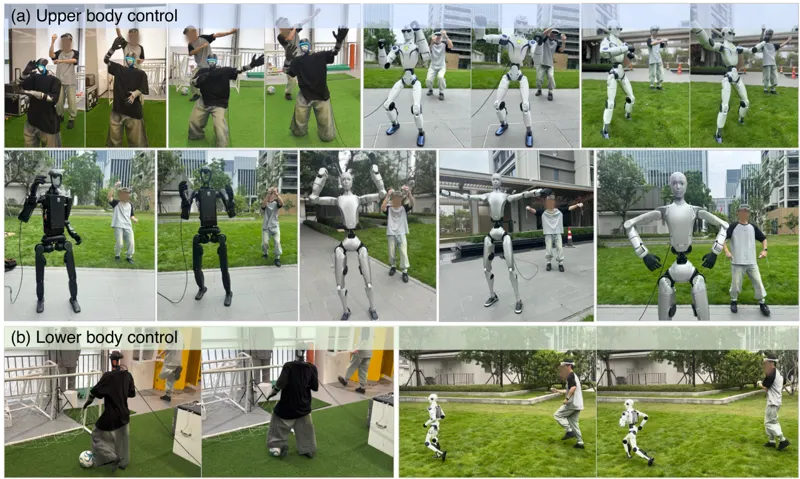
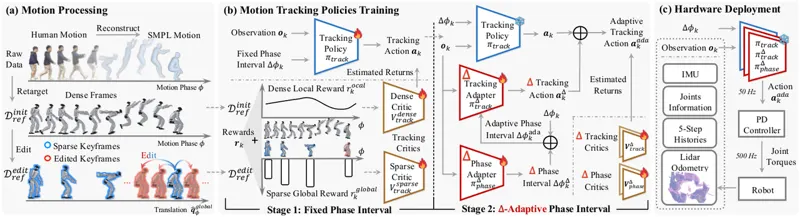
Humanoid robots are envisioned to adapt demonstrated motions to diverse real-world conditions while accurately preserving motion patterns. Existing motion prior approaches enable well adaptability with a few motions but often sacrifice imitation accuracy, whereas motion-tracking methods achieve accurate imitation yet require many training motions and a test-time target motion to adapt. To combine their strengths, we introduce AdaMimic, a novel motion tracking algorithm that enables adaptable humanoid control from a single reference motion. To reduce data dependence while ensuring adaptability, our method first creates an augmented dataset by sparsifying the single reference motion into keyframes and applying light editing with minimal physical assumptions. A policy is then initialized by tracking these sparse keyframes to generate dense intermediate motions, and adapters are subsequently trained to adjust tracking speed and refine low-level actions based on the adjustment, enabling flexible time warping that further improves imitation accuracy and adaptability. We validate these significant improvements in our approach in both simulation and the real-world Unitree G1 humanoid robot in multiple tasks across a wide range of adaptation conditions. Videos and code are available at https://taohuang13.github.io/adamimic.github.io/.

Huang, Tao, Wang, Huayi, Ren, JunliOct 16, 2025
HumanoidMotion TrackingReinforcement LearningOct 16, 2025
Learning Whole-Body Humanoid Locomotion via Motion Generation and Motion Tracking

Learning Whole-Body Humanoid Locomotion via Motion Generation and Motion Tracking

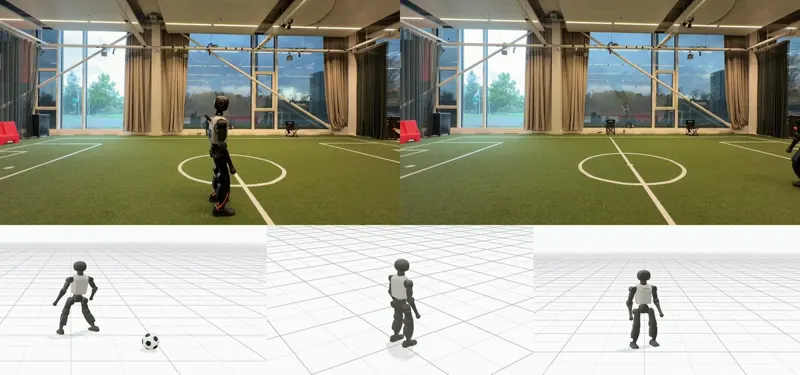
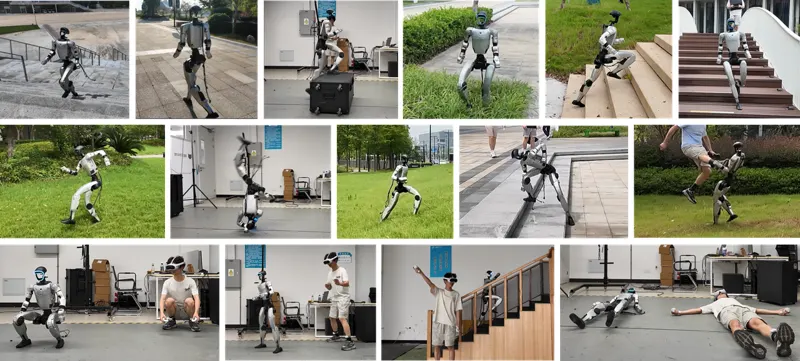
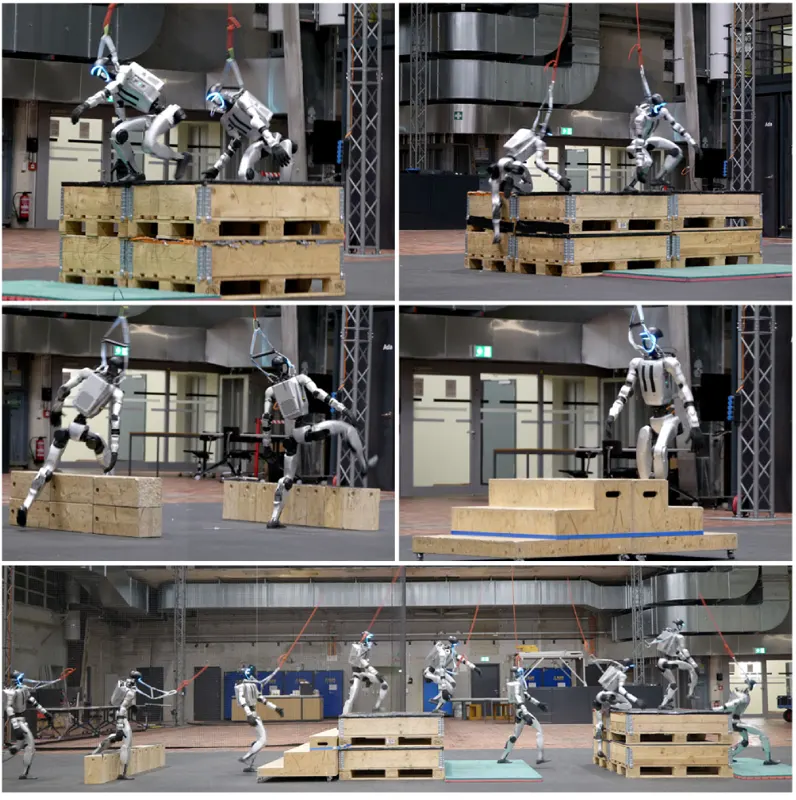
Whole-body humanoid locomotion is challenging due to high-dimensional control, morphological instability, and the need for real-time adaptation to various terrains using onboard perception. Directly applying reinforcement learning (RL) with reward shaping to humanoid locomotion often leads to lower-body-dominated behaviors, whereas imitation-based RL can learn more coordinated whole-body skills but is typically limited to replaying reference motions without a mechanism to adapt them online from perception for terrain-aware locomotion. To address this gap, we propose a whole-body humanoid locomotion framework that combines skills learned from reference motions with terrain-aware adaptation. We first train a diffusion model on retargeted human motions for real-time prediction of terrain-aware reference motions. Concurrently, we train a whole-body reference tracker with RL using this motion data. To improve robustness under imperfectly generated references, we further fine-tune the tracker with a frozen motion generator in a closed-loop setting. The resulting system supports directional goal-reaching control with terrain-aware whole-body adaptation, and can be deployed on a Unitree G1 humanoid robot with onboard perception and computation. The hardware experiments demonstrate successful traversal over boxes, hurdles, stairs, and mixed terrain combinations. Quantitative results further show the benefits of incorporating online motion generation and fine-tuning the motion tracker for improved generalization and robustness.

Zewei Zhang, Kehan Wen, Michael XuApr 19, 2026
HumanoidWhole-body locomotionMotion GenerationApr 19, 2026
What Matters in Humanoid General Motion Tracking? An Empirical Study

What Matters in Humanoid General Motion Tracking? An Empirical Study

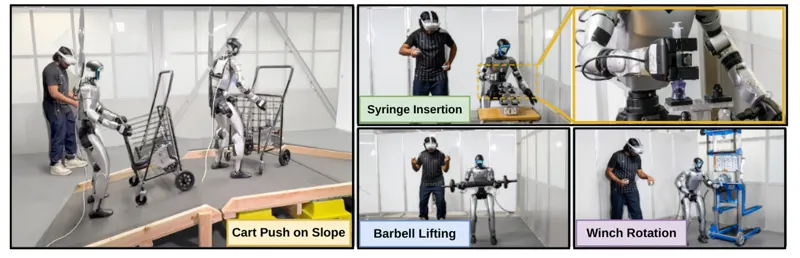
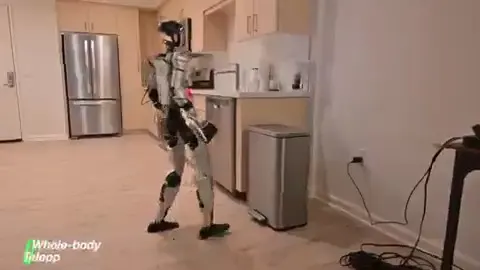
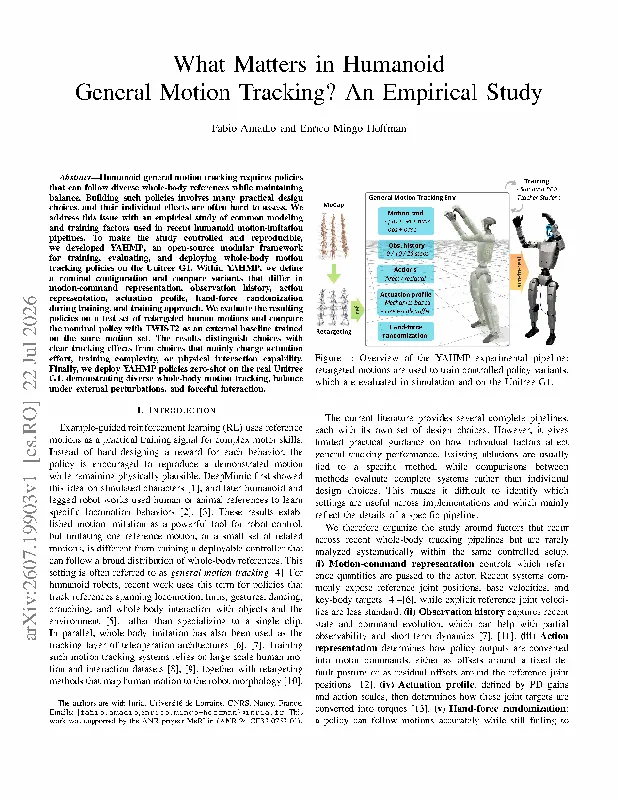
Humanoid general motion tracking requires policies that can follow diverse whole-body references while maintaining balance. Building such policies involves many practical design choices, and their individual effects are often hard to assess. We address this issue with an empirical study of common modeling and training factors used in recent humanoid motion-imitation pipelines. To make the study controlled and reproducible, we developed YAHMP, an open-source modular framework for training, evaluating, and deploying whole-body motion tracking policies on the Unitree G1. Within YAHMP, we define a nominal configuration and compare variants that differ in motion-command representation, observation history, action representation, actuation profile, hand-force randomization during training, and training approach. We evaluate the resulting policies on a test set of retargeted human motions and compare the nominal policy with TWIST2 as an external baseline trained on the same motion set. The results distinguish choices with clear tracking effects from choices that mainly change actuation effort, training complexity, or physical interaction capability. Finally, we deploy YAHMP policies zero-shot on the real Unitree G1, demonstrating diverse whole-body motion tracking, balance under external perturbations, and forceful interaction.

Fabio Amadio, Enrico Mingo HoffmanJul 22, 2026
HumanoidMotion TrackingEmpirical StudyJul 22, 2026