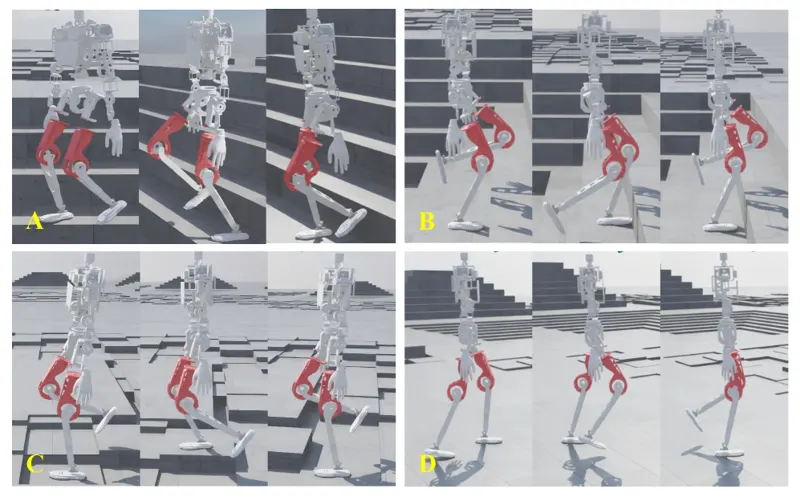
Training perceptive humanoid locomotion policies that traverse complex terrains with natural gaits remains an open challenge, typically demanding multi-stage training pipelines, adversarial objectives, or extensive real-world calibration. We present PRIOR, an efficient and reproducible framework built on Isaac Lab that achieves robust terrain traversal with human-like gaits through a simple yet effective design: (i) a parametric gait generator that supplies stable reference trajectories derived from motion capture without adversarial training, (ii) a GRU-based state estimator that infers terrain geometry directly from egocentric depth images via self-supervised heightmap reconstruction, and (iii) terrain-adaptive footstep rewards that guide foot placement toward traversable regions. Through systematic analysis of depth image resolution trade-offs, we identify configurations that maximize terrain fidelity under real-time constraints, substantially reducing perceptual overhead without degrading traversal performance. Comprehensive experiments across terrains of varying difficulty-including stairs, boxes, and gaps-demonstrate that each component yields complementary and essential performance gains, with the full framework achieving a 100% traversal success rate. We will open-source the complete PRIOR framework, including the training pipeline, parametric gait generator, and evaluation benchmarks, to serve as a reproducible foundation for humanoid locomotion research on Isaac Lab.
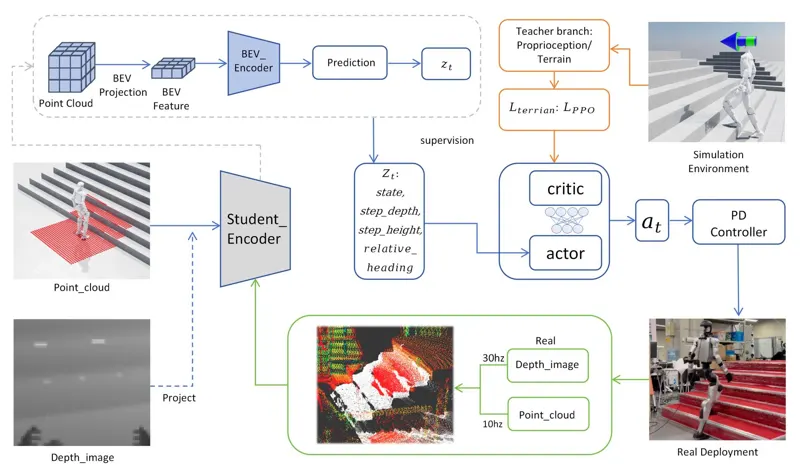
Robust humanoid stair climbing remains challenging due to geometric discontinuities, sensitivity to step height variations, and perception uncertainty in real-world environments. Existing learning-based locomotion policies often rely on implicit terrain representations or blind proprioceptive feedback, limiting their ability to generalize across varying stair geometries and to anticipate required gait adjustments. This paper proposes an explicit stair geometry conditioning framework for robust humanoid stair climbing. Instead of encoding terrain as high-dimensional latent features, we extract a compact set of interpretable geometric parameters, including step height, step depth, and current yaw angle relative to the robot heading. These explicit stair parameters directly condition a Proximal Policy Optimization (PPO)-based locomotion policy, enabling proactive modulation of swing-foot clearance and stride characteristics according to stair structure. Simulation experiments demonstrate improved generalization across unseen stair heights beyond the training distribution. Real-world experiments on the Unitree G1 humanoid validate reliable indoor and outdoor stair traversal. In challenging outdoor scenarios, the robot successfully ascends 33 consecutive steps without failure, demonstrating robustness and practical deployability.
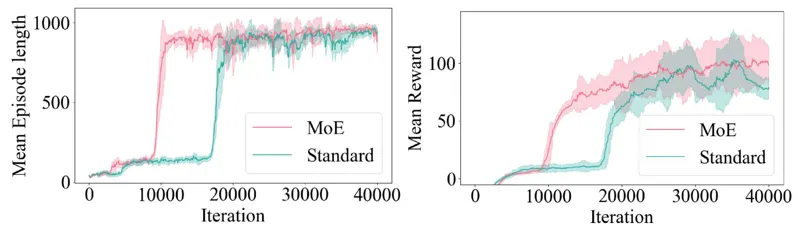
We present MoE-Loco, a Mixture of Experts (MoE) framework for multitask locomotion for legged robots. Our method enables a single policy to handle diverse terrains, including bars, pits, stairs, slopes, and baffles, while supporting quadrupedal and bipedal gaits. Using MoE, we mitigate the gradient conflicts that typically arise in multitask reinforcement learning, improving both training efficiency and performance. Our experiments demonstrate that different experts naturally specialize in distinct locomotion behaviors, which can be leveraged for task migration and skill composition. We further validate our approach in both simulation and real-world deployment, showcasing its robustness and adaptability.
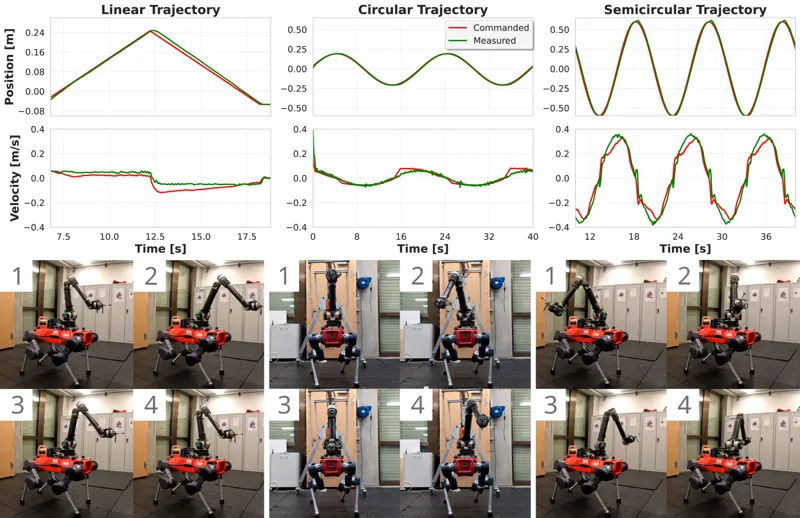
Learning whole-body control for locomotion and arm motions in a single policy has challenges, as the two tasks have conflicting goals. For instance, efficient locomotion typically favors a horizontal base orientation, while end-effector tracking may benefit from base tilting to extend reachability. Additionally, current Reinforcement Learning (RL) approaches using a pose-based task specification lack the ability to directly control the end-effector velocity, making smoothly executing trajectories very challenging. To address these limitations, we propose an RL-based framework that allows for dynamic, velocity-aware whole-body end-effector control. Our method introduces a multi-critic actor architecture that decouples the reward signals for locomotion and manipulation, simplifying reward tuning and allowing the policy to resolve task conflicts more effectively. Furthermore, we design a twist-based end-effector task formulation that can track both discrete poses and motion trajectories. We validate our approach through a set of simulation and hardware experiments using a quadruped robot equipped with a robotic arm. The resulting controller can simultaneously walk and move its end-effector and shows emergent whole-body behaviors, where the base assists the arm in extending the workspace, despite a lack of explicit formulations. Videos and supplementary material can be found at multi-critic-locomanipulation.github.io.
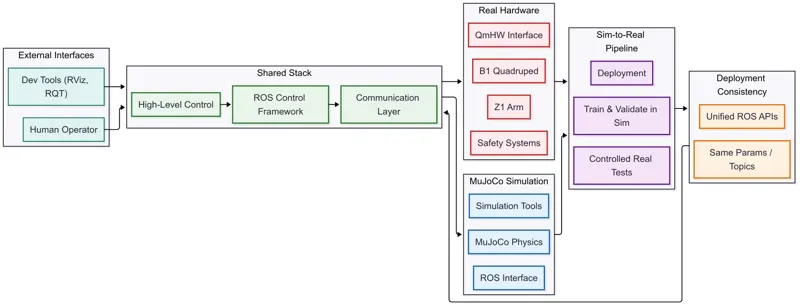
Quadruped mobile manipulators offer strong potential for agile loco-manipulation but remain difficult to control and transfer reliably from simulation to reality. Reinforcement learning (RL) shows promise for whole-body control, yet most frameworks are proprietary and hard to reproduce on real hardware. We present an open pipeline for training, benchmarking, and deploying RL-based controllers on the Unitree B1 quadruped with a Z1 arm. The framework unifies sim-to-sim and sim-to-real transfer through ROS, re-implementing a policy trained in Isaac Gym, extending it to MuJoCo via a hardware abstraction layer, and deploying the same controller on physical hardware. Sim-to-sim experiments expose discrepancies between Isaac Gym and MuJoCo contact models that influence policy behavior, while real-world teleoperated object-picking trials show that coordinated whole-body control extends reach and improves manipulation over floating-base baselines. The pipeline provides a transparent, reproducible foundation for developing and analyzing RL-based loco-manipulation controllers and will be released open source to support future research.
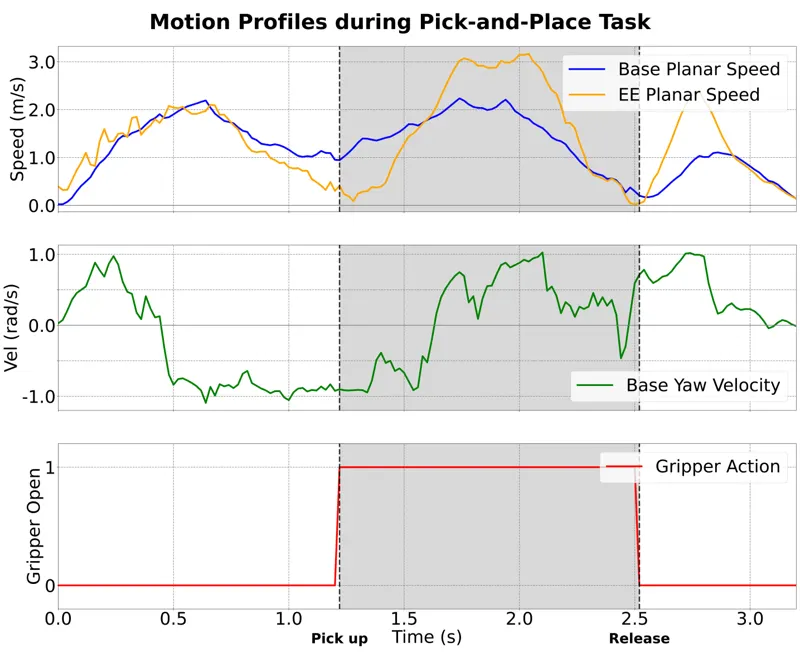
Legged manipulators extend robotic capabilities beyond static manipulation by integrating agile locomotion with versatile arm control. However, achieving precise manipulation while maintaining coordinated locomotion remains a major challenge. This work presents a hierarchical reinforcement learning framework for dynamic pick-and-place tasks using a quadruped equipped with a 6-DOF robotic arm. The framework incorporates an explicit mass estimation module enabling adaptive whole-body control for objects with varying weights. In simulation, the system achieves an 86.05% success rate with payloads up to 2.3 kg. The approach is further validated through real-world experiments across six representative scenarios with controlled variations in object physical properties (size and mass) and task heights. Specifically, within a wide vertical workspace ranging from ground level to 1.1~m-high tabletops, the system demonstrates an average success rate of 73.3% for payloads up to 1.3 kg, with an average execution time of 4.06 s. Unlike prior works that handle lightweight objects and execute pick-and-place motions with slow, piecewise motions, the proposed framework exploits concurrent locomotion and manipulation for dynamic, continuous execution. These results demonstrate the potential of quadrupedal mobile manipulators for adaptive, whole-body pick-and-place with heavier payloads and extended workspaces.
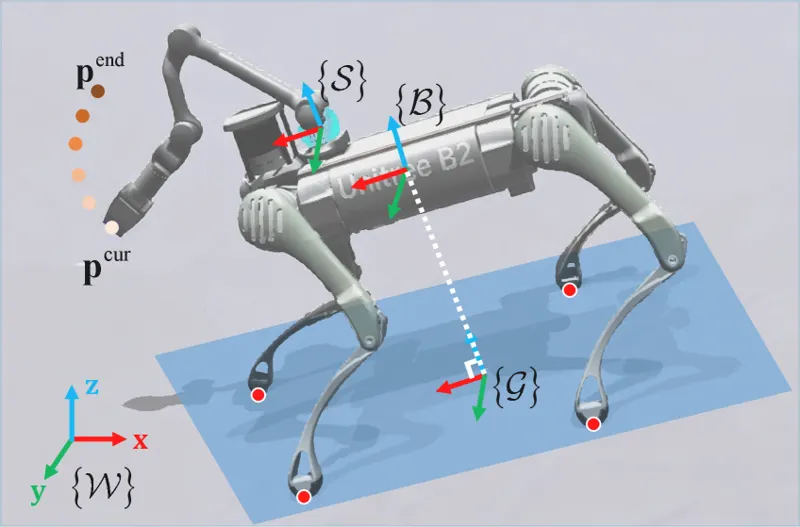
Legged manipulators integrate exceptional terrain adaptability along with mobile manipulation capabilities, which make them highly promising for deployment in human-centric environments. By coordinating the control of both legs and arms, a whole-body controller can significantly expand the operational workspace of legged manipulators. However, many existing whole-body controllers primarily depend on proprioception and do not incorporate the critical exteroception required for effective terrain topology perception. This limitation can hinder their ability to adapt to varying environmental conditions and navigate complex terrains effectively. In this paper, we introduce TA-WBC, a terrain-aware whole-body control framework for legged manipulators, which features a novel RL-based unified policy tailored to whole-body loco-manipulation tasks in various terrains. Specifically, we employ a hybrid exteroception encoder to extract terrain features, providing an essential basis for the robot to proactively adapt posture and footholds. Furthermore, to facilitate stable cross-terrain loco-manipulation, we propose a novel end-effector sampling method based on the foot contact plane, decoupling manipulation target from base fluctuations. Moreover, a dual-policy distillation module is introduced to integrate expansive whole-body motion with terrain adaptability without catastrophic forgetting. The simulation and real-world experiments validate the robustness of our proposed controller, which leads to a larger reachable space, less tracking error, and reduced unexpected stumbles. This unified policy highlights the promising capabilities of legged manipulators in performing loco-manipulation tasks across complex terrains.
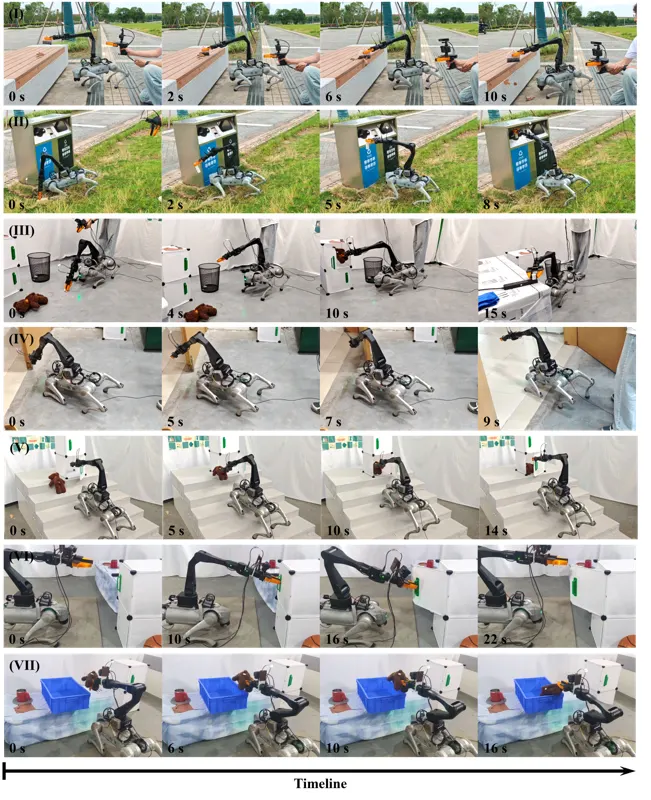
Whole-body loco-manipulation for quadruped robots with arms remains a challenging problem, particularly in achieving multi-task control. To address this, we propose MLM, a reinforcement learning framework driven by both real-world and simulation data. It enables a six-DoF robotic arm-equipped quadruped robot to perform whole-body loco-manipulation for multiple tasks autonomously or under human teleoperation. To address the problem of balancing multiple tasks during the learning of loco-manipulation, we introduce a trajectory library with an adaptive, curriculum-based sampling mechanism. This approach allows the policy to efficiently leverage real-world collected trajectories for learning multi-task loco-manipulation. To address deployment scenarios with only historical observations and to enhance the performance of policy execution across tasks with different spatial ranges, we propose a Trajectory-Velocity Prediction policy network. It predicts unobservable future trajectories and velocities. By leveraging extensive simulation data and curriculum-based rewards, our controller achieves whole-body behaviors in simulation and zero-shot transfer to real-world deployment. Ablation studies in simulation verify the necessity and effectiveness of our approach, while real-world experiments on a Go2 robot with an Airbot robotic arm demonstrate the policy's good performance in multi-task execution.
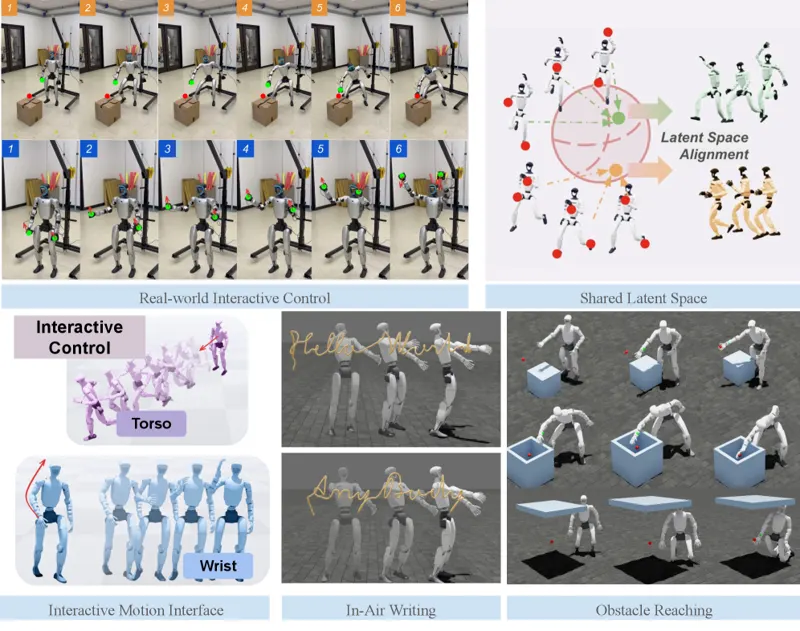
We present AnyBody, a unified whole-body humanoid controller driven by an arbitrary subset of body keypoints chosen at deploy time. Prior physics-based trackers either rely on expensive full-body motion capture and error-prone trajectory retargeting, which bottleneck scalable data collection and policy learning, or decompose upper- and lower-body control into separate hierarchical representations, sacrificing the coordinated whole-body motions that loco-manipulation requires. We close this gap by learning a single latent motion representation that any keypoint subset can address. To achieve this, we first train a privileged teacher tracker on a large unstructured motion corpus and distill it online into a deterministic encoder-decoder student whose latent space is a unit sphere. We then train a transformer keypoint encoder that admits any subset of body keypoints through masked self-attention, aligning it to the privileged latent. Additionally, we treat the frozen decoder as a motor prior and specialize downstream tasks with a lightweight residual corrector in the latent space. We demonstrate the effectiveness of AnyBody by tracking large-scale human motions from arbitrary keypoint subsets, free-form control, flexibly teleoperating, and learning downstream behaviors including locomotion, in-air writing, and obstacle-reach.
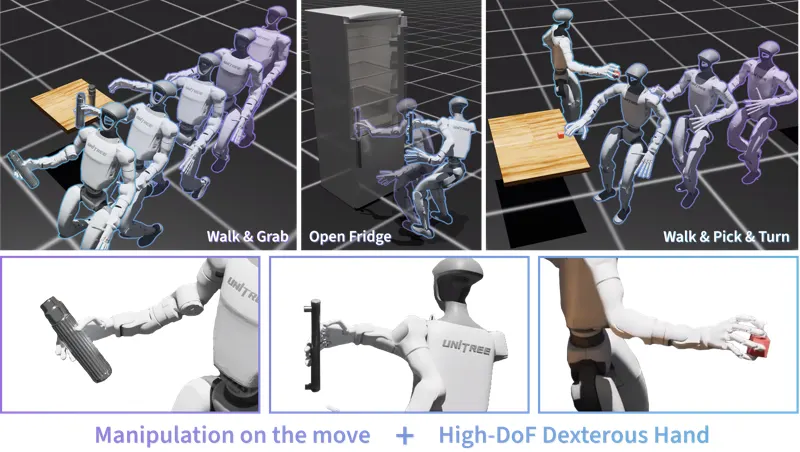
Humanoid loco-manipulation is often simplified into a stop-and-go process: walking to an object, stopping to manipulate it, and then resuming locomotion. It also commonly relies on low degree-of-freedom (DoF) end effectors that behave like an open-close grasp primitive. We introduce CoorDex, a learning pipeline that converts high-dimensional body and dexterous hand control into coordinated latent residual control, enabling high-DoF dexterous loco-manipulation on the move. Starting from simulated whole-body and hand demonstrations, CoorDex trains privileged motion tracking teachers for the humanoid body and dexterous hand, distills them into proprioception-conditioned latent priors, and uses the frozen priors as the action space for downstream residual reinforcement learning. A coordinated latent residual policy composes these priors through shared task context and separate body-hand residual heads, preserving natural whole-body motion while improving finger-level contact reliability. CoorDex enables a Unitree G1 humanoid with a 20-DoF WUJI hand to execute dexterous manipulation while in motion, including non-stop bottle grasping and carrying, fridge door opening on the move, and cube pick-and-turn. Ablations on the walk-grasp-carry task show that joint-space PPO, joint-space hand control, and monolithic latent prediction all fail under the same reward budget, while the latent-prior interface and coordinated residual structure make high-dimensional contact-rich loco-manipulation trainable. Project Page: https://skevinci.github.io/coordex/
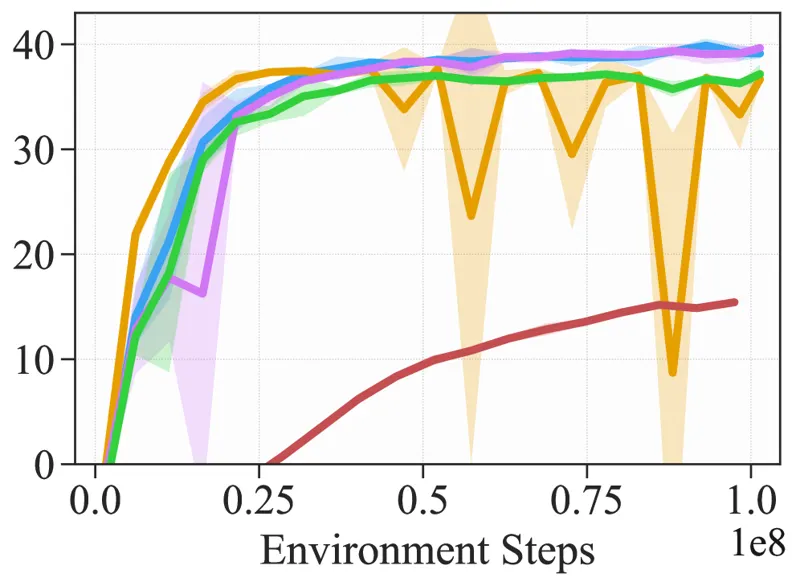
Scalable reinforcement learning has popularized high-throughput sampling architectures, which significantly compresses the training time for off-policy methods in robotic locomotion. However, the rapid increase of data volume and update frequency undermines the stability of value-based methods and diminishes the plasticity of policy networks. To address these challenges, this work presents FastDSAC, a fast and high-performance variant of the Distributional Actor-Critic algorithm designed for parallel sampling scenarios. Specifically, we introduce a truncated Gaussian distribution to approximate the learned policy, which effectively excludes out-of-distribution actions that strain target value estimation while keeping necessary stochasticity for exploration. The proposed action constraint functions as an implicit regularization, which counteracts the plasticity loss typically caused by aggressive gradient updates. This preservation of network adaptability enhances sample efficiency, particularly in scenarios with a high update-to-data ratio, and accelerates the early training process. In contrast to prior fast reinforcement learning approaches that rely on discrete value distributions, our method utilizes a continuous Gaussian representation equipped with adaptive variance regulation, which improves value estimation accuracy by sampling confident and informative transitions. Extensive experiments on MuJoCo Playground and HumanoidBench demonstrate that FastDSAC not only stabilizes the overall training process but also achieves superior asymptotic performance and faster convergence compared to state-of-the-art baselines.
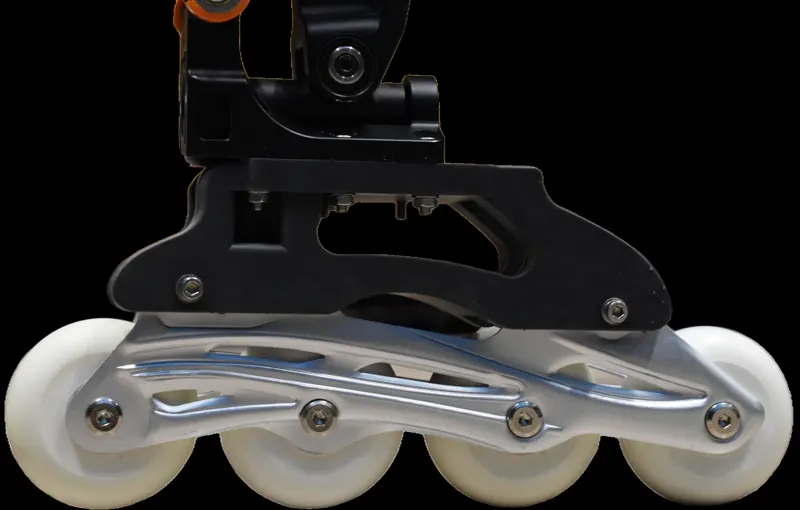
As humanoid robots become increasingly dynamic, coupling them with reinforcement learning offers a promising approach to solving the complex, underactuated mechanics of passive inline skating. Equipping a humanoid robot with passive inline skating wheels presents an opportunity to combine the versatile agility of humanoids with the high-speed, energy-efficient locomotion strategies utilized by human skaters. In this paper, we train and deploy a reinforcement learning control policy that enables novel locomotion strategies for a humanoid robot modified to equip consumer inline skates instead of conventional feet. Unlike previous work limited to quadrupedal robots or actively driven wheels, our system allows for precise 6-DoF control of the skates to execute dynamic, edge-driven propulsion strategies. Our skating strategies emerge entirely from our reward structure, without reliance on human motion data, imitation learning, or kinematic priors. We overcome the inherent instability of passive wheels and simulation contact artifacts by utilizing different geometric wheel models (spherical and ellipsoidal) during training and validation, along with a custom success-based command curriculum and a specialized rolling reward. Consequently, our policy demonstrates up to a 50% reduction in Cost of Transport (CoT) compared to standard walking gaits. The resulting policy successfully transfers zero-shot to the physical Booster T1 hardware. Real-world deployments demonstrate dynamic balance, the ability to reject active physical perturbations, and agile locomotion strategies capable of turning at speed. A video of our results can be found at https://www.youtube.com/watch?v=-_APcOS7uFo.