Skip to content
← Tags

#Humanoid Locomotion (8)

HuMBLE: Human Motion-Driven Behavior Learning for Embodied Locomotion

HuMBLE: Human Motion-Driven Behavior Learning for Embodied Locomotion

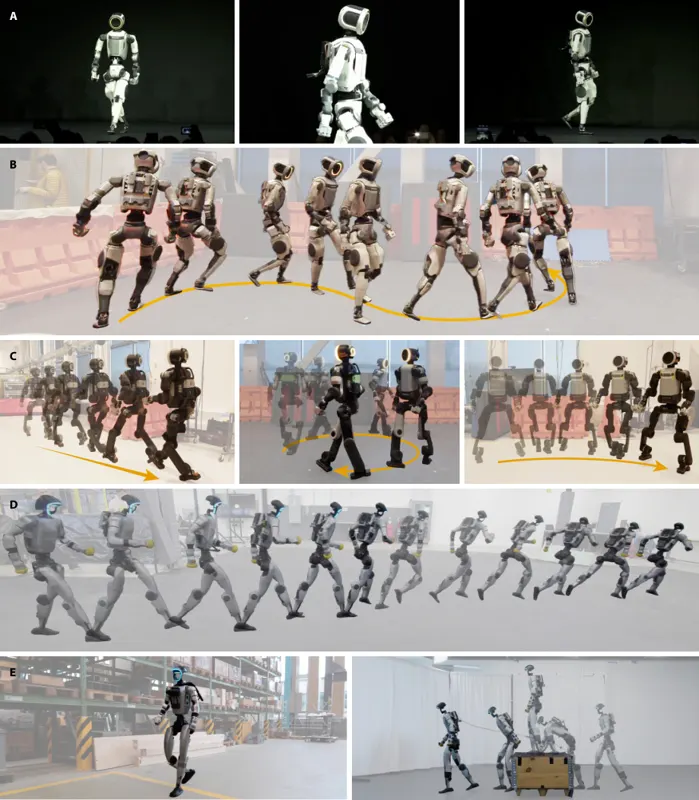
Despite recent advances in humanoid locomotion, controllers optimized for command tracking and robustness tend to produce mechanical gaits, whereas controllers tied to human motion data often fail to generalize to commands outside the data distribution. This work introduces a learning framework that balances these competing objectives to synthesize real-time steerable, robust, and biomimetic locomotion policies from human data. Using an in-house curated locomotion dataset covering diverse speeds and directions, we first learn a natural locomotion prior policy through a teacher-student distillation process. Specifically, we train a full-body reference-conditioned policy with Reinforcement Learning (RL), then distill it into a lightweight prior policy conditioned solely on proprioception and a planar torso-velocity steering command. Next, we fine-tune the prior policy with multi-task RL to expand command coverage and robustness beyond the data distribution, pairing a goal-conditioned task that tracks arbitrary commands with a reference-guided task that tracks the human data as an explicit style regularizer. We validate our framework on three humanoid robots: the Boston Dynamics Atlas R1, Atlas D1, and Unitree G1. Experimental results demonstrate robust performance across real-world scenarios, including direct user-controlled locomotion in indoor and outdoor environments, and integration as the locomotion layer within hierarchical control stacks. Benchmarks against Tabula Rasa RL policies trained without human data and ablation studies confirm that our framework yields a lightweight, deployable policy that reconstructs coordinated whole-body behavior from a steering command, retaining the human gait characteristics while remaining robust and fully steerable.

Mike Zhang, Dongho Kang, Kevin Bergamin · 540 views · Oct 7, 2026
Humanoid LocomotionMotion ImitationReinforcement LearningOct 7, 2026
Generate, Track, Improve: Perceptive Multi-Skill Humanoid Locomotion with RL-Fine-Tuned Motion Generators

Generate, Track, Improve: Perceptive Multi-Skill Humanoid Locomotion with RL-Fine-Tuned Motion Generators

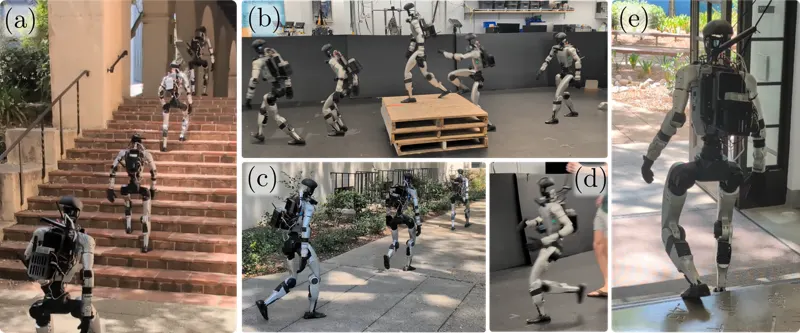
General purpose humanoids require locomotion controllers that are multi-skill, perceptive, dynamic, and robust enough to go anywhere humans can. In this work, we present a two layer locomotion architecture: (1) a perceptive flow matching motion generator plans whole body trajectories from raw depth images while a (2) perceptive tracking policy trained with control-guided RL follows these motions. Both policies are trained on a library of terrain consistent motion clips created with dynamically optimized human data which yields both accurate velocity tracking and terrain consistent references. Our central contribution is a simple yet effective off-policy RL fine tuning loop that improves the motion generator. A structured search method is used with the generator to gather data for advantage weighted regression. This off-policy loop is much more sample efficient than on-policy residual fine tuning and improves terrain consistency on unseen geometries and skill compositions. We find that successful terrain traversals increased by up to 25 percentage points and skill selection improved by up to 80 percentage points. By using raw depth images to perceive the environment no odometry or height maps are needed, and outdoor deployment is easy. With two cameras, the policy can see terrain coming from further away and adjust its velocity regardless of the commanded speed so it can traverse the terrain. A single policy pair enables a Unitree G1 humanoid to walk, run, stand, jump on and off of boxes, and traverse stairs in outdoor environments. Project page: https://zolkin1.github.io/generate-track-improve/

Zachary Olkin, William D. Compton, Aaron D. Ames · 662 views · Sep 25, 2026
Humanoid LocomotionPerceptive LocomotionReinforcement LearningSep 25, 2026
CAP: Continuously Adaptive Perception-Blind Humanoid Locomotion via Learned Denoising

CAP: Continuously Adaptive Perception-Blind Humanoid Locomotion via Learned Denoising

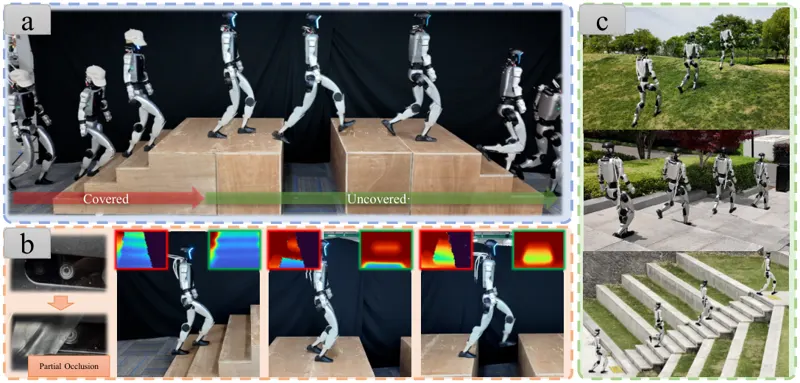
Humanoid locomotion across complex terrain demands forward-looking exteroception to anticipate obstacles, yet this signal is unreliable in real-world deployment, failing partially and intermittently. Existing perceptive policies often assume that depth observations remain clean and in-distribution, while recent attempts to unify perceptive and blind control typically route or switch between separate sub-policies, leaving recoverable information in partially corrupted depth unexploited. We instead propose CAP, a single-stage humanoid locomotion policy that recovers this signal with a perceptive world-model encoder trained as a learned denoiser to reconstruct clean depth from a corrupted input, together with a co-active proprioceptive variational encoder that supplies depth-free body-state information. A coupled training recipe pairs a depth-noise curriculum on the world-model input with world-model feature dropout on the policy-facing latent, exposing the policy to failures across the entire perception-quality spectrum. In simulation, CAP matches or improves upon perceptive baselines when depth remains informative, and degrades more smoothly than a binary-switching baseline as perception worsens. On the Unitree G1, controlled trials and indoor-outdoor deployments demonstrate perception-robust locomotion under intermittent occlusion, real-sensor corruption, and outdoor depth artifacts.

Chen, Hongjin, Xu, Zijun, Ma, Shihao · 1.1k views · Sep 10, 2026
Humanoid LocomotionWorld ModelsDepth DenoisingSep 10, 2026

As an Amazon Associate, we earn from qualifying purchases.