Skip to content

Open-sourceproject atlas

A reviewed field guide to robotics, embodied AI and agent software, arranged by what each repository actually does.

opencode: the open-source coding agent split into client and server
Lead repositoryanomalyco/opencode

opencode: the open-source coding agent split into client and server

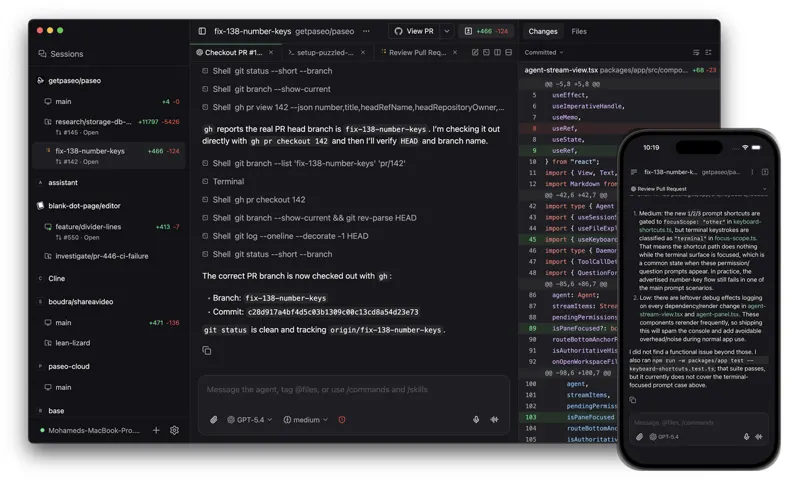
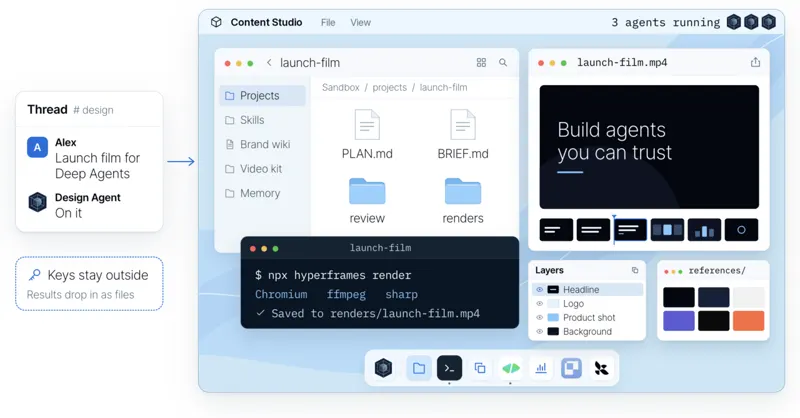
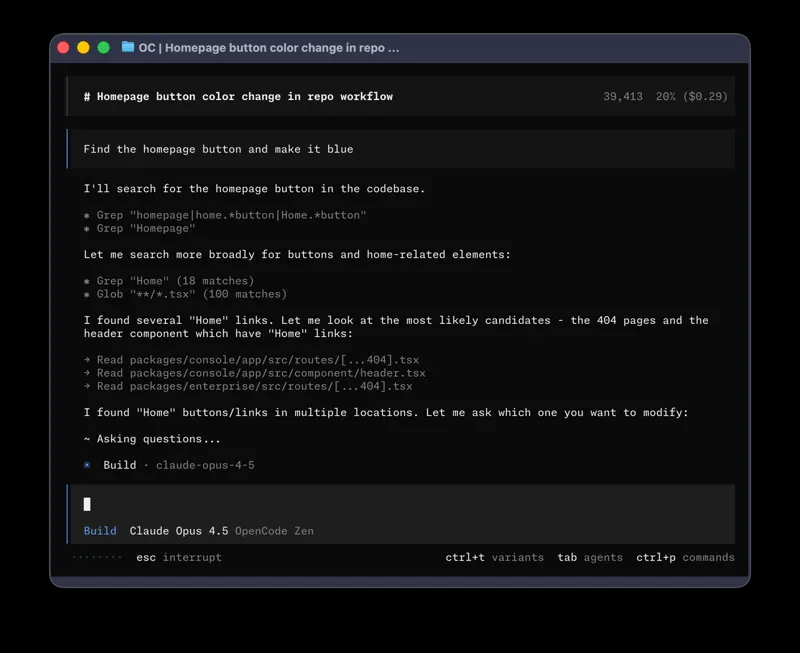
anomalyco/opencode (formerly sst/opencode, 210k stars, MIT) splits the coding agent into a client layer and a server layer: the server exposes OpenAPI 3.1 plus an SDK generated from the spec, and the TUI is just one remote frontend of it, so a single session can be driven from a terminal, an IDE, GitHub Actions and ACP clients such as Zed. More than 75 providers plug in through the AI SDK and Models.dev, OpenCode Zen offers a curated gateway of models tested before listing, the 35+ built-in LSPs ship disabled with docs stating they are not always a net win, skills resolve from .opencode, .claude and .agents roots, and permissions are a three-state allow/ask/deny. It is the most engineering-first branch of open-source coding agents: interface before UI.

138reviewed projects
127builders
12languages
12domains

Find a project by domain

Four collections and twelve task-based domains cover the full catalog. Domains, tags and search compose.

Project index

Start with the work a repository performs, then search by repository, technology, lab or topic.

Physical Intelligence

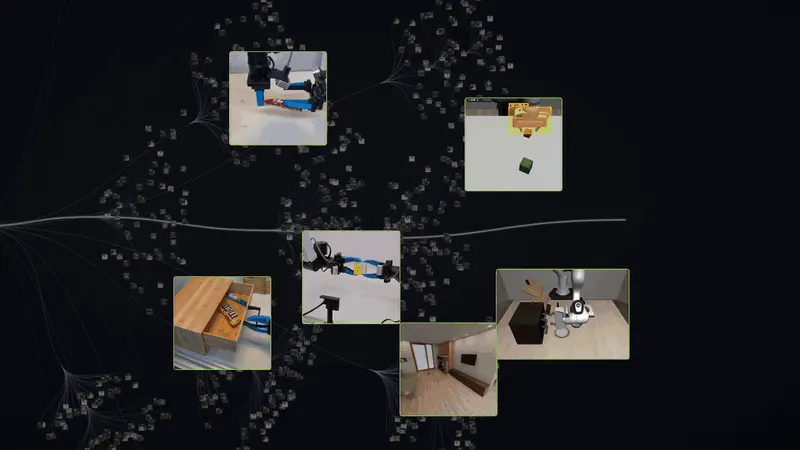
From robot bodies to embodied models, spatial perception and simulation.

33 projects

Robot Platforms, Hardware & Control

Complete robots, actuators, mechanisms, locomotion, whole-body control, teleoperation and industrial robot interfaces.

11 projects
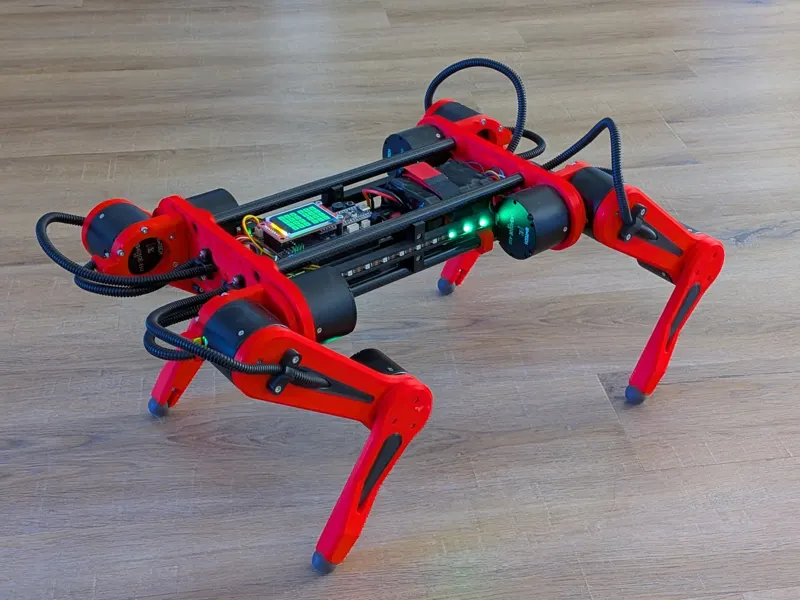
ElectroPup: a 12-DoF 3D-Printed Open-Source Quadruped
Robot PlatformsPython

ElectroPup

ElectroPup is a 4.5 kg, 12-DoF DIY quadruped: twelve MG4010E-i10v3 CAN BLDC actuators split into four per-leg CAN segments, a Raspberry Pi 5 for compute, and a single ~7,700-line pure-Python service with no ROS in the stack. The repository publishes OnShape CAD, two KiCad v8 boards, a bill of materials, measured weights and power draw (21.6 W suspended, 33.8 W standing), plus MuJoCo simulation, a React Native/Expo browser UI, four Bezier-foot gaits, and a full build guide. The author also documents known gaps: no license file, no contact sensing, and a simulation model without approximate masses or inertias.

reubenstr/ElectroPup35 stars4 forks
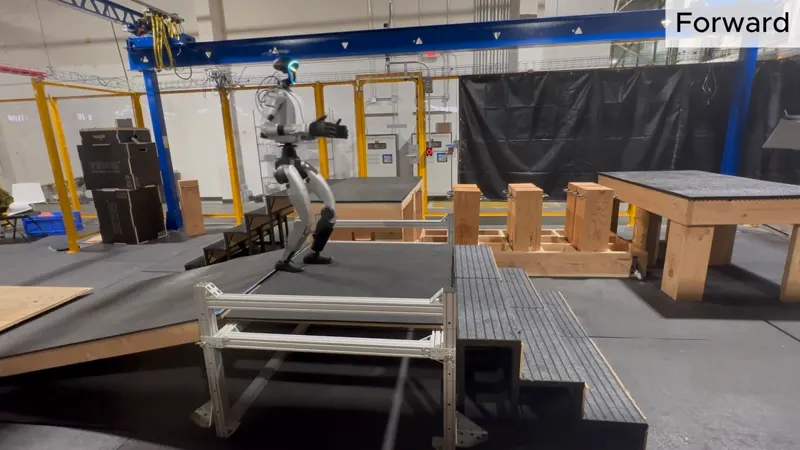
RPL: Learning Robust Humanoid Perceptive Locomotion on Challenging Terrains
Robot PlatformsPython

RPL

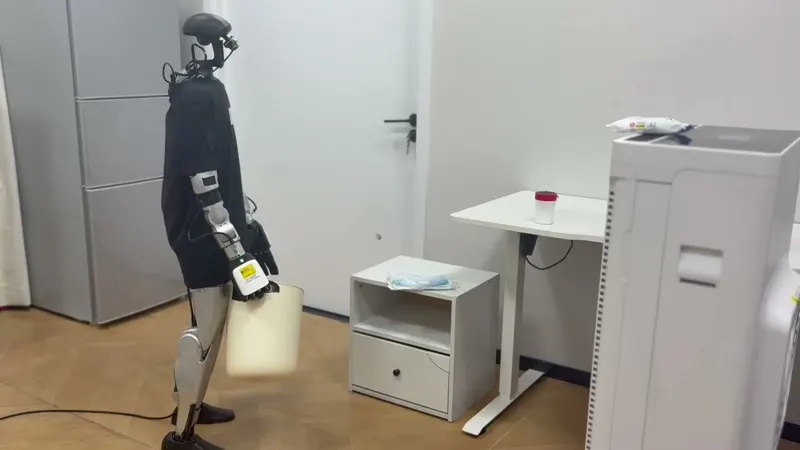
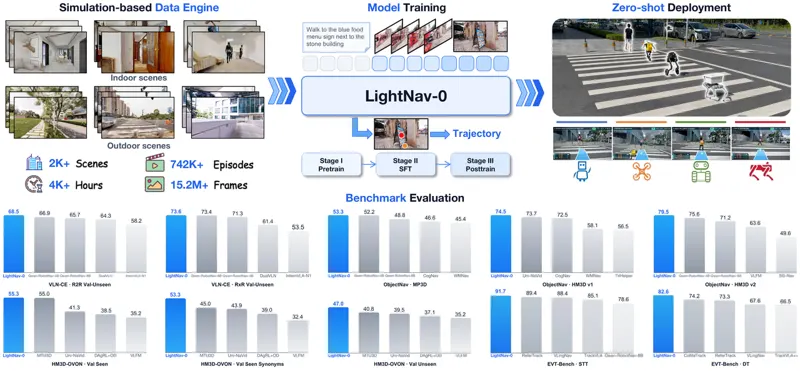
CoRL 2026 open-source release from Amazon FAR with CMU, Stanford and UC Berkeley: per-terrain multi-actor PPO experts trained on privileged height maps are distilled into a dual-depth-camera vision transformer student, robustified by velocity-gated depth feature scaling and random side masking, and backed by a multi-depth ray-casting pipeline 5x faster than IsaacSim Warp. On a Unitree G1 the single policy walks bidirectionally with a 2 kg payload over 20 degree slopes, 22/25/30 cm stairs and stepping stones with 60 cm gaps.

amazon-far/RPL15 stars3 forks

Embodied AI & Robot Learning

VLA, manipulation policies, motion learning, skill libraries and robot models from pretraining to real-world deployment.

5 projects

Perception, Navigation & Spatial AI

LiDAR localization, mapping, open-vocabulary vision, spatial understanding and autonomous navigation.

7 projects

Simulation, 3D & World Models

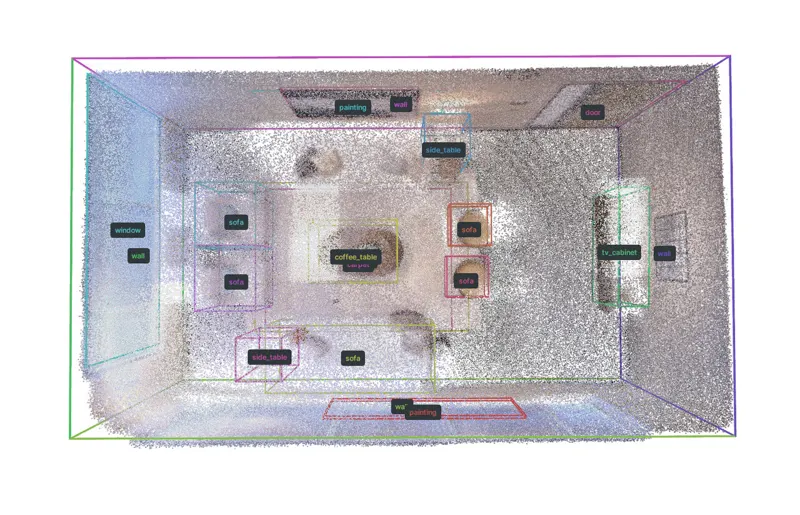
Physics engines, parallel simulation, 3D generation and reconstruction, interactive world models and synthetic training environments.

10 projects
Genesis World: The Unified Multi-Physics Simulation Platform for Physical AI
Simulation & World ModelsPython

Genesis World

Genesis AI's open simulation platform for physical AI: one Pythonic API over a multi-physics engine (rigid, FEM, MPM, PBD, SPH, Stable Fluid, IPC), the Nyx path tracer, and Quadrants, a cross-platform Python-to-GPU compiler. It is built to be the evaluation engine for robot foundation models rather than a data factory: 30,000 parallel environments at 43M FPS, and under a zero-shot real-to-sim protocol, sim-vs-real evaluation agreement of Pearson 0.8996 with mean maximum rank violation 0.0166. Apache 2.0, 29.9k stars.

Genesis-Embodied-AI/genesis-world30k stars2.9k forks
Simulation & World ModelsPython

MCP for Blender

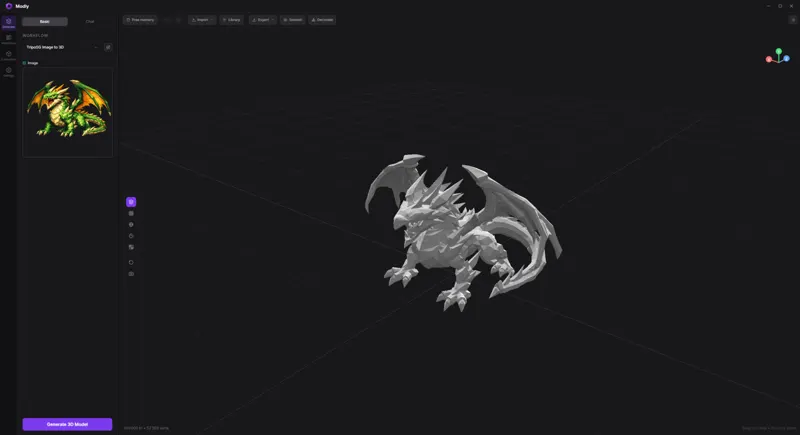
Formerly blender-mcp, a third-party community plugin (the README states on its first screen that it is not made by Blender), MIT licensed, Python, and the highest-starred entry among 3D MCP servers. The PyPI package is now mcp-for-blender, yet uvx blender-mcp still runs and existing configs need no change. Two components only: an addon inside the Blender process runs a socket server that actually executes commands (the only place with bpy, the current scene and the UI thread), while a separate MCP server process translates protocol, joined by JSON over TCP on localhost:9876 by default. The source defines 32 @mcp.tool() decorators across four layers - perception (get_scene_info, get_object_info, get_viewport_screenshot returning an MCP Image, closing an act-then-look loop), reference lookup (bpy_api_lookup and describe_node_type so the model queries instead of guessing socket order and enum names), execution (execute_blender_code as the escape hatch, set_texture, export_scene to GLB/FBX), and asset retrieval and generation (Poly Haven with semantic search, importing the .blend source and writing attribution properties; Poly Pizza with about 10,600 low-poly models, size normalisation and automatic CC-BY credit; Sketchfab; Hyper3D Rodin text-to-3D and image-to-3D; Tencent Hunyuan3D distinguishing the mainland ai3d endpoint from the international hunyuan one). On security, arbitrary code execution is the design rather than a bug: an optional safe mode (BLENDER_MCP_SAFE_MODE=1) statically validates scripts before running, blocking file access, subprocesses, network and persistent code while modelling, rendering, saving, import and export pass normally, and blocked scripts return to the model with the reason so it can retry. Content telemetry is off by default, and a dedicated disable_telemetry tool can only turn collection off. 29.2k stars. Not run with Blender locally yet, so this is graded as pending reproduction.

ahujasid/mcp-for-blender29k stars2.7k forks

Agent Workflows

Write and understand code, operate computers and carry long-running work to completion.

50 projects

Coding Agents, Skills & Delivery

Agents that write code, reusable skills, parallel workspaces and engineering pipelines from planning through delivery.

15 projects
opencode: the open-source coding agent split into client and server
Coding AgentsTypeScript

opencode

anomalyco/opencode (formerly sst/opencode, 210k stars, MIT) splits the coding agent into a client layer and a server layer: the server exposes OpenAPI 3.1 plus an SDK generated from the spec, and the TUI is just one remote frontend of it, so a single session can be driven from a terminal, an IDE, GitHub Actions and ACP clients such as Zed. More than 75 providers plug in through the AI SDK and Models.dev, OpenCode Zen offers a curated gateway of models tested before listing, the 35+ built-in LSPs ship disabled with docs stating they are not always a net win, skills resolve from .opencode, .claude and .agents roots, and permissions are a three-state allow/ask/deny. It is the most engineering-first branch of open-source coding agents: interface before UI.

anomalyco/opencode211k stars28k forks
Coding AgentsTypeScript

Orca

Orca calls itself an ADE (Agentic Development Environment), the AI orchestrator for 100x builders (75k+ stars, MIT/TypeScript, YC-backed). Central mechanism: fan one prompt across Codex, Claude Code, OpenCode and Pi, each isolated in its own git worktree, then compare results and merge the winner. Also WebGL terminals, Design Mode (click a UI element to send its HTML/CSS/screenshot into the prompt), native GitHub and Linear integration, diff annotations routed back to the agent, SSH worktrees and mobile notifications. Not independently benchmarked; graded needs-reproduction.

stablyai/orca76k stars5.0k forks
Coding AgentsShell

planning-with-files

planning-with-files (27k+ stars, MIT): persistent file-based planning for AI coding agents and long-running tasks — keeps task_plan.md / findings.md / progress.md on disk and lifecycle hooks re-inject the plan into context every turn, so the plan survives /clear, compaction and crashes; a Stop hook forms a deterministic completion gate that holds the agent until the plan reports complete. Project measurements: the on-disk plan cut a 13.3-turn re-orientation to 5.0 turns, 3-of-3 blind A/B wins, 96.7% assertion pass rate. Covers 60+ agents via the Agent Skills standard, with native plugins for Claude Code, Codex CLI, Pi, Hermes, OpenCode and DeepSeek Harness, plus localized skill variants (AR/DE/ES/zh-CN/zh-TW). Pattern follows Manus's "Markdown as working memory on disk"; parallel tasks get isolated .planning/ dirs; /plan-attest locks the plan with SHA-256.

OthmanAdi/planning-with-files27k stars2.3k forks
Coding AgentsTypeScript

Learn Harness Engineering

An open-source, project-based course (14 lectures, 8 projects, 15 languages) on building the instructions/state/verification/scope/lifecycle subsystems that make frontier models reliable inside real repos — includes reverse-engineered harness breakdowns of Pi, Claude Code, Codex and DeepSeek, plus loop- and graph-engineering advanced lectures. MIT licensed, ships a harness-creator skill and a zero-dependency audit script.

walkinglabs/learn-harness-engineering19k stars2.0k forks
Coding AgentsTypeScript

MiMo Code

Xiaomi open-sourced terminal-native AI coding assistant, TypeScript built with bun. The source is MIT but usage is additionally bound by USE_RESTRICTIONS.md, the MiMo terms of service and the trademark policy - read those before treating it as plain MIT. The README states it is a fork of OpenCode: it keeps the multi-provider, TUI, LSP, MCP and plugin core and adds persistent memory (SQLite FTS5 full-text search across four kinds - project MEMORY.md, session checkpoints, scratch notes and task progress - injected automatically on session resume), intelligent context management (near the limit it rebuilds from the latest checkpoint plus project memory plus task progress plus retained recent messages, ranked by importance against a token budget), goals and stop conditions (/goal sets the condition, and when the agent wants to stop a separate judge model assesses whether it was truly met, which targets optimistic early quitting), and deterministic JS workflows in a sandbox (compose splits independent tasks into isolated git worktrees with per-task TDD; also deep-research, fact-check with three-reviewer adversarial voting, and research-experiment with an anti-metric-gaming audit). Twenty built-in skills (arxiv, claude-code, codex, docx, pdf, pptx, xlsx, html-to-video, product-design and more), compatible with four skill roots - .agents/skills, .claude/skills, .codex/skills, .opencode/skills - where a user skill of the same name overrides the built-in. /dream and /distill are its signature: the first distils recent session trajectories into project memory and prunes stale entries, the second finds your repeated manual routines and packages high-confidence candidates into reusable skills. Model agnostic - the Xiaomi platform, Codex/ChatGPT OAuth, or any OpenAI-compatible endpoint. 13.4k stars. Not installed or run yet; memory-restore accuracy, judge-model effectiveness and the vendor-stated cache hit rates are unverified, so this is graded as pending reproduction.
XiaomiMiMo/MiMo-Code13k stars1.4k forks

Agent Runtimes, Orchestration & Memory

Agent harnesses, multi-agent orchestration, long-horizon control planes, durable memory, sandboxes and general runtimes.

19 projects
Agent RuntimesPython

Hermes Agent

The self-improving agent from Nous Research (248k+ stars). Its learning loop has five mechanisms: periodic memory nudges, autonomous skill creation after tasks, skills that self-improve in use, FTS5 session search with LLM summarization, and Honcho user modeling. One TUI, seven terminal backends (local/Docker/SSH/Singularity/Modal/Daytona/Vercel Sandbox), six chat platforms from a single gateway, no model lock-in. It doubles as a trajectory data-production apparatus. Self-improvement is falsifiable and no controlled experiment has been run, so this is graded as needing reproduction.

NousResearch/hermes-agent248k stars52k forks
Agent RuntimesTypeScript

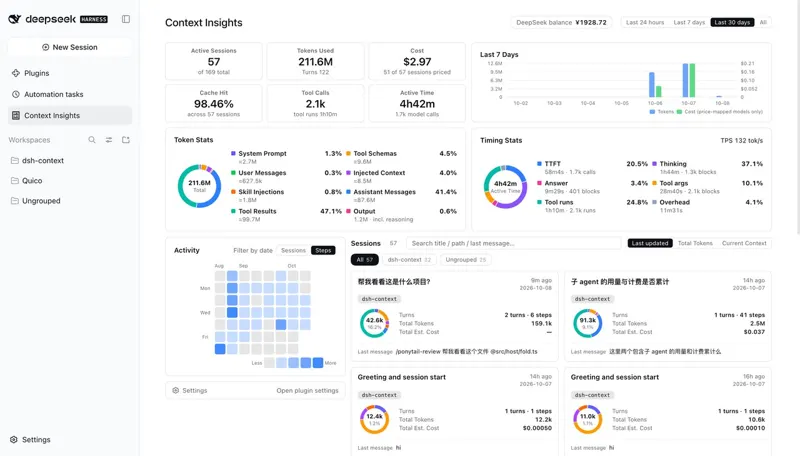
DeepSeek Harness

DeepSeek AI's open-source agent harness (CLI dsh, MIT, 233k+ stars). The kernel provides only plugin-system semantics; tools, surfaces and model access all attach as plugins, on top of Cordis' paradigm for spatiotemporal composability (arXiv:2608.25512). It is in developer preview with an explicit warning about compatibility-breaking changes, and SAFETY.md is required reading before you run it. Not benchmarked yet, so this entry is graded as needing reproduction.

deepseek-ai/deepseek-harness234k stars28k forks
Agent RuntimesTypeScript

Pi

Pi Agent Harness (formerly badlogic/pi-mono; 108k+ stars, MIT/TypeScript). Not one CLI but layered packages usable on their own: pi-coding-agent (interactive coding agent), pi-agent-core (runtime with tool calling and state), pi-ai (unified multi-provider LLM API), plus chord composition runtime, pi-telemetry contracts, pi-durable persistence and pi-tui differential terminal rendering. The README states plainly that there is no built-in permission system and offers micro-VM / Docker / sandbox paths instead. Not independently benchmarked; graded needs-reproduction.

earendil-works/pi109k stars14k forks
Agent RuntimesPython

LangGraph

A low-level stateful-graph orchestration framework from LangChain, MIT licensed, with Python and JS/TS implementations, and Klarna, Replit and Elastic named as production users in the README. Its lineage is stated in the acknowledgements - inspired by Google Pregel and Apache Beam, interface borrowing from NetworkX - which means the BSP graph-computation model applied to agents: nodes are model calls or tool executions, edges are control flow, state is an explicit object. The value is not in the loop-the-model-with-tools layer but in four runtime capabilities: durable execution (resume exactly where it stopped after a crash), human-in-the-loop interrupts (approval can stay suspended for hours or days), separate short-term and long-term memory, and LangSmith execution-path tracing. Its actual claim is that agent reliability is a runtime problem, not a model problem. Usable without LangChain; any CompiledStateGraph can be handed to Deep Agents above it as a sub-agent. 42.1k stars. Not run yet, and checkpoint-resume consistency is unverified, so this is graded as pending reproduction.
langchain-ai/langgraph42k stars7.1k forks
Agent RuntimesPython

Deep Agents

The README opens by calling itself an off-the-shelf agent harness: MIT licensed, Python (plus deepagents.js), built on LangGraph, so streaming, durability and checkpoints are inherited rather than rewritten. The key to reading it is the acknowledgement - inspired by Claude Code, trying to figure out what makes it general and pushing that further - which makes this a reverse-engineering exercise: take a closed coding agent that is known to work well, open it up, and ask what actually lets it handle long tasks. Its answer is four bundled things: a pluggable-backend file system (the artefacts of long tasks are files, not messages, so context keeps only pointers), sub-agents each with their own window (context isolation and compression, not extra helpers), long-thread summarisation with tool output offloaded to disk, and on-demand Skills. Also sandboxed shell execution, cross-session persistent memory, human-in-the-loop approval/edit/reject before a tool call runs, and any MCP server as a tool. Model agnostic: frontier APIs, open weights hosted on Baseten or Fireworks, and self-hosted Ollama/vLLM/llama.cpp all work, with three lines of create_deep_agent giving you a planning, file-reading-and-writing agent. The security section is unusually blunt - it follows a trust-the-LLM model, boundaries must be enforced at the tool and sandbox layer, and you should not expect the model to restrain itself. 29.7k stars. Not run yet; sub-agent isolation quality and summarisation information loss are unverified, so this is graded as pending reproduction.

langchain-ai/deepagents30k stars4.2k forks
Octop: a self-hosted multi-user, multi-agent assistant in one Python process
Agent RuntimesPython

Octop

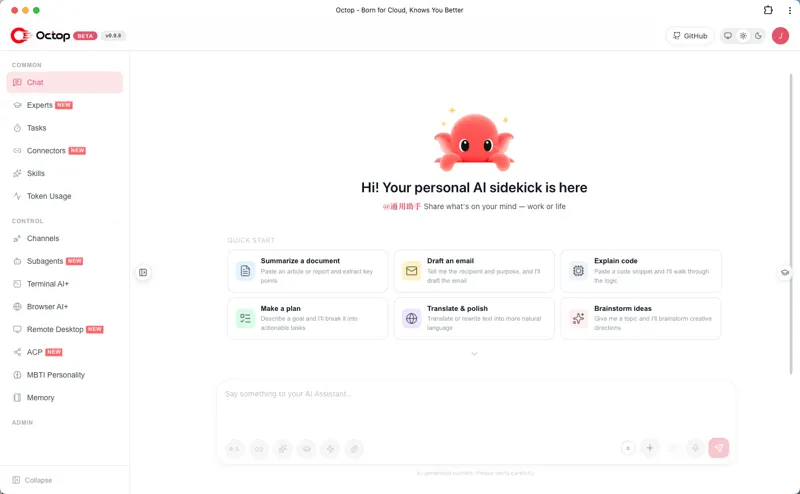
Tencent Cloud's open-source, self-hosted AI assistant platform (MIT, 8,777 stars). One process serves the FastAPI backend, React dashboard, CLI, IM channels and cron, with a SQLite WAL control plane and optional PostgreSQL. It composes four runtime libraries (octop-harness, octop-gateway, octop-memory, octop-browser) into a single self-hostable product, adding an expert library with AgentTeams, bidirectional ACP, a cross-instance Bridge, tool guardrails and PII redaction, with ADRs and line-level specs as reviewable evidence.

TencentCloud/Octop8.8k stars1.1k forks
Agent RuntimesPython

HarnessRouter

HarnessRouter Community Edition is the self-hosted, Apache-2.0 implementation of a unified interface for agent harnesses: it turns existing harnesses like Codex, Claude Code, Hermes, PI and DSH into plug-and-play agent backends, so your product runs tasks, retrieves results and switches harnesses through one API. It implements the open Unified Harness Protocol (UHP) and exposes an OpenAI Responses-compatible API, meaning existing Responses SDKs, streaming parsers and UI components work against a UHP server out of the box. The platform handles persistent sessions, streaming progress, files/artifacts, cancellation and structured failures. Inside the container, a three-layer architecture (Console :3000, the only published port, proxies to Gateway :8080 for the Responses API and harness lifecycle, which talks over loopback to Runner :8081 executing harnesses in session workspaces) isolates sessions with separate workspaces and OS users rather than separate containers. Ships with a Console UI, Bring-Your-Own-Key model integrations, custom harness configuration (instructions/tools/skills) and Starter Kits; the UHP spec, machine-readable schemas and a conformance suite live in the repo, with a cloud offering on the same protocol at harnessrouter.ai. For product teams drowning in per-harness integrations, it collapses 36 integration responsibilities into one standardized protocol layer.

HarnessRouter/harnessrouter2.8k stars290 forks
Agent RuntimesTypeScript

CopilotKit open-sources OpenDots

CopilotKit open-sourced OpenDots (MIT) on Oct 1: a fully self-hostable template for always-on AI coworkers — its answer to OpenAI's closed Dots (powered by GPT-6 Astra). Each Dot is a specialist agent with a name, role, instructions and tool allowlist, plus its own computer via OpenBot's container supervisor (browser profile and workspace files persist across stop/start). Dots move seamlessly between text chat, realtime voice calls and Slack: calls pair a separate compute agent so long work keeps running mid-conversation, all sharing the same context and tool permissions. AG-UI carries streamed messages, tool calls and agent state between any agent harness and the UI; human-in-the-loop cards pause tool calls for approval; Spaces and Pages hold working documents. Built on TanStack AI + CopilotKit React SDK + Threads + Channels SDK. Clone and customize — enterprise-ready.

CopilotKit/OpenDots591 stars73 forks

Code Intelligence, Review & Reverse Engineering

Code graphs, repository understanding, review, migration, security testing, binary analysis and reverse engineering.

10 projects
Code IntelligenceGo

Alibaba open-sources Open Code Review

Originating from Alibaba's internal official AI review assistant (tens of thousands of devs, millions of defects over two years): hybrid deterministic pipelines + LLM Agent, line-level comments, built-in NPE/thread-safety/XSS/SQL-injection rulesets, plugins for Claude Code/Codex/Cursor and more, CI/CD integration, and a public benchmark of 200 real PRs with 1,505 annotated issues. OpenAI/Anthropic compatible.

alibaba/open-code-review43k stars3.1k forks

Browser, Desktop & Mobile Execution

Agents that operate browsers, desktops and mobile devices, including GUI agents, automation and accessibility control.

6 projects

Model Runtime

Train, serve and run models faster, smaller and cheaper.

13 projects

Inference, Training & Local Deployment

Inference serving, quantization, fine-tuning, caching, speculative decoding, model routing and local/edge execution.

13 projects
Model SystemsC++

llama.cpp

An MIT-licensed, dependency-free plain C/C++ inference implementation built on ggml. Seventeen backends span CUDA, Metal, HIP, Vulkan, SYCL, WebGPU, CANN, Hexagon, MUSA, zDNN and ZenDNN; integer quantisation runs 1.5 to 8 bits; CPU+GPU hybrid inference makes models larger than VRAM runnable at all; and GGUF, its output format, is a de facto standard that even vLLM consumes. Two lines - llama cli or llama serve - start an OpenAI-compatible server.

ggml-org/llama.cpp130k stars24k forks
Model SystemsPython

vLLM

An inference and serving library out of UC Berkeley's Sky Computing Lab with 2000+ contributors: paged KV memory, continuous batching and chunked prefill, CUDA/HIP graphs with torch.compile, quantisation across FP8/MXFP4/NVFP4/GGUF, pluggable attention kernels (FlashInfer, TRTLLM-GEN, FlashMLA), four speculative decoding routes (n-gram, suffix, EAGLE, DFlash), tensor/pipeline/data/expert/context parallelism with P/D disaggregation, and both OpenAI and Anthropic protocols.

vllm-project/vllm93k stars23k forks
Model SystemsPython

unsloth

Self-described as the first desktop app to run and train models (Windows/macOS/Linux; multi-GPU across NVIDIA, AMD, Intel, CPU and Vulkan). Fine-tuning is claimed at 2x faster with 70% less VRAM, the post-training menu covers LoRA, QLoRA, full fine-tuning, pretraining, GRPO, DPO and FP8, and export reaches GGUF, NVFP4 and FP8. Unsloth Start connects Claude Code or Codex to local weights in one command; the model list includes Qwen3.8, GLM-5.3-Flash, Kimi K3, DeepSeek-V4, MiniMax-H3 and Gemma 4, with private web search, deep research, auto-compaction and RAG built in.

unslothai/unsloth77k stars7.1k forks
Model SystemsPython

SGLang

A high-performance serving framework hosted by LMSYS: RadixAttention prefix caching, a zero-overhead CPU scheduler, prefill-decode disaggregation, DFlash and Spec V2 speculative decoding, compressed finite state machines for structured output, and large-scale expert parallelism (96 H100 GPUs; 3.8x prefill and 4.8x decode on GB200 NVL72 part II). Its day-0 ledger covers Kimi K3, DeepSeek-V4, GLM5.2 NVFP4, Nemotron 3 and MiniMax M2, and AReaL, Miles, slime, Tunix and verl all use it as an RL rollout backend.

sgl-project/sglang37k stars9.2k forks
Model SystemsPython

TensorRT-LLM

NVIDIA's inference optimisation library for LLMs and visual generation models, fully open source since 2025-03-22. Its 28 tech blogs form an auditable engineering ledger: Skip Softmax and sparse attention for long context, the three-part expert parallelism series with one-sided AlltoAll over NVLink, DWDP for NVL72, guided decoding cooperating with speculative decoding, inference-time compute, and evaluating agentic serving with trace replay and job-level metrics. Claims include Llama 4 Maverick above 1,000 TPS per user and 40,000+ tok/s on B200; Bing and NAVER Place run it in production.

NVIDIA/TensorRT-LLM15k stars2.8k forks
Model SystemsRust

Dynamo

NVIDIA's open-source (Apache-2.0) orchestration layer, Rust for the performance path and Python for extensibility. It explicitly does not replace SGLang, TensorRT-LLM or vLLM - it wires them into a coordinated multi-node system: disaggregated prefill/decode, KV-aware routing (2x faster TTFT on Qwen3-Coder 480B), KVBM offloading KV cache to CPU/SSD/remote, ModelExpress streaming weights over NVLink for 7x faster cold starts, an SLA-driven Planner (80% fewer breaches at 5% lower TCO in Alibaba production), and Grove for topology-aware NVL72 scheduling.

ai-dynamo/dynamo8.2k stars1.6k forks
Model SystemsC++

NInfer

A from-scratch C++/CUDA inference engine for five explicitly registered Qwen checkpoints on one NVIDIA GeForce RTX 5090. Startup-frozen residency picks MTP or DFlash speculative decoding, Vision, and one of five KV storage formats; a shared Device KV pool plus pinned Host State/KV checkpoints reuse exact prompt prefixes across 240k-token contexts. Measured aggregate decode reaches 1,146.9 tok/s at concurrency 8 and 15,544.3 tok/s on a 7,680-token prefill.

Neroued/ninfer1.4k stars261 forks

Content & Knowledge

Generate media, produce designs and documents, organize knowledge and apply it to real work.

42 projects

Speech, Image, Video & Digital Humans

Speech synthesis and recognition, image and video generation, real-time media, digital humans and production tools.

14 projects
OpenMontage: Turn Your AI Coding Assistant Into a Full Video Production Studio
MediaPython

OpenMontage

Open-source agentic video production system with no code orchestrator in sight: your AI coding assistant is the orchestrator, driven by YAML pipeline manifests, Markdown stage-director skills, 100+ registered tools and a seven-dimension scored provider selector. Research, proposal, script, scene plan, assets, edit and compose run as gated stages with creative approvals, budget governance and an auditable decision trail; with zero API keys it still cuts real-footage videos from Piper TTS, Archive.org, NASA, Wikimedia and free stock corpora, while the Backlot board shows every stage, storyboard gate and dollar live.

calesthio/OpenMontage71k stars9.2k forks
LiveKit Agents: Realtime Voice AI Agents as Programmable Participants
MediaPython

LiveKit Agents

LiveKit Agents is an open-source framework for realtime voice AI agents (Apache-2.0, 15.0k stars): the agent joins a WebRTC room as a server-side programmable participant that can hear, see and speak. Four abstractions - Agent, AgentSession, entrypoint, AgentServer - sit on 83 pluggable STT/LLM/TTS/Realtime plugins and LiveKit Inference model strings, while conversation robustness is handled in-framework by a transformer turn detector, adaptive interruption detection and AMD answering-machine detection; MCP support, multi-agent handoffs, pytest event-stream assertions with LLM judges, and console/dev/start run modes connect it to production dispatch and the telephony stack.

livekit/agents15k stars4.0k forks
SANA: 4K Text-to-Image That Fits in Laptop VRAM
MediaPython

SANA

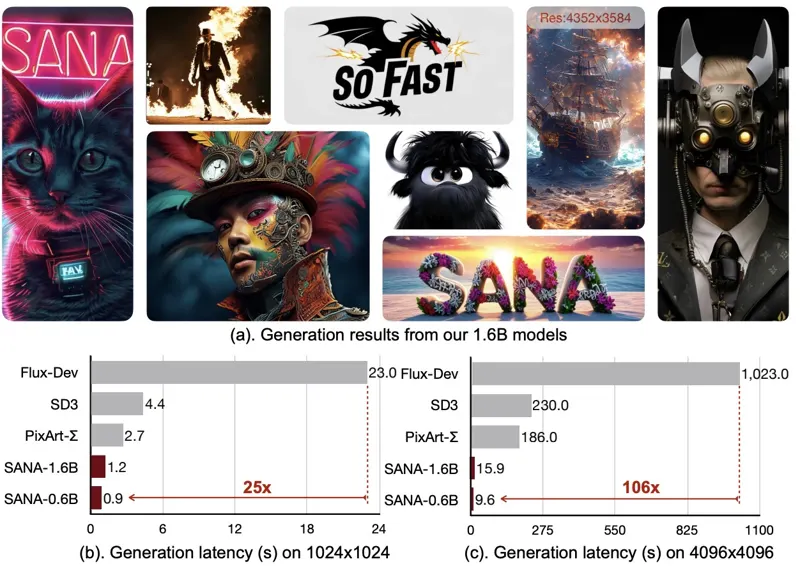
SANA is NVIDIA Labs open-source codebase for high-resolution image and video generation (9k+ stars, Apache-2.0, PyTorch). Its efficiency comes from two structural changes: linear attention replaces vanilla attention in the transformer, and a deep compression autoencoder compresses images 32x instead of the usual 8x. Official figures: the 0.6B model renders a 1024 image in 0.9 s, roughly one fortieth of FLUX-dev 23 s, while FID improves from 10.15 to 5.61. The series now spans one-step generation, video, world models and streaming editing, and runs 4K in 8 GB of VRAM under 4-bit quantization. No benchmarks reproduced; recorded as unverified.

NVlabs/Sana9.2k stars737 forks
MediaTypeScript

SmartSub

SmartSub is an open-source desktop tool (5.5k Stars, MIT license) that packs the entire audio/video subtitle and dubbing pipeline — speech-to-text, translation, proofreading, TTS dubbing, burn-in — into one app. Supports 8 transcription engines (whisper.cpp/faster-whisper/FunASR/Qwen3-ASR/FireRedASR/Parakeet etc.), 20 translation services, local TTS with zero-shot voice cloning. Built-in AI assistant (multimodal visual diagnostics + Agentic tool-calling) and 111 MCP tools + CLI commands for Cursor/Claude Code/Codex integration. Full pipeline runs completely free, cross-platform Windows/macOS/Linux with full GPU acceleration.

buxuku/SmartSub5.5k stars417 forks

Design, Documents, Office & CAD

Interface design, presentations, Office documents, diagrams, CAD, architecture and patent workflows.

20 projects
Design & DocumentsPython

UI UX Pro Max

An open-source AI skill that injects design intelligence into coding agents: one request generates a complete design system (style + colors + typography + anti-patterns) from 192 industry reasoning rules, 79 searchable UI styles, 192 color palettes, 74 font pairings, 25 chart types and 22 tech stacks (React, Next.js, Astro, SwiftUI, Flutter, Three.js and more). The v2.0 flagship Design System Generator runs five parallel searches (product type, style, palette, landing pattern, typography) through a BM25-ranked reasoning engine to output pattern, style, colors, typography, effects, anti-patterns and a pre-delivery checklist (4.5:1 contrast, no emoji icons, cursor-pointer, prefers-reduced-motion, four responsive breakpoints). MIT licensed, one-line npm CLI install, works with Claude Code and other coding agents.

nextlevelbuilder/ui-ux-pro-max-skill132k stars14k forks
Design & DocumentsTypeScript

Framelink MCP for Figma

Also known as Figma-Context-MCP, npm package figma-developer-mcp, TypeScript, MIT, and a third-party implementation rather than the Dev Mode MCP server Figma ships itself. It exposes only two tools: get_figma_data (read-only) and download_figma_images (removable with –skip-image-downloads, and confined to writing inside –image-dir). The narrow surface is deliberate; the engineering sits in the fetch → simplify → serialize pipeline behind it. Simplify uses composable extractors (layout, text, visuals, component, plus the allExtractors, layoutAndText, contentOnly, visualsOnly and layoutOnly bundles) to compress the raw Figma response into semantic layout and styling in a single tree walk, with maxDepth and nodeFilter, and outputs tree (default, cheapest in tokens), yaml or json. The part worth copying is that compression effectiveness is a metric computed on every call: rawSizeKb against simplifiedSizeKb, rawNodeCount against simplifiedNodeCount, component/instance/text/image node counts, namedStyleCount (the source comment states a high count is a design-system maturity signal), hasVariables (whether Figma Variables are used at all), and separate fetch/simplify/serialize timings; the same hooks drive MCP progress notifications and heartbeats so a large file taking tens of seconds does not look hung. Judgement shows in the details: node IDs accept both the plain and the deeply nested instance shape, the depth parameter description says do not use it unless the user explicitly asks, the proxy default deliberately avoids installing EnvHttpProxyAgent when no proxy variables exist so a stale variable cannot route traffic through an intermediary returning 403, and stdio mode warns at startup when –image-dir is unset. Credentials come from FIGMA_API_KEY or FIGMA_OAUTH_TOKEN; telemetry can be disabled with –no-telemetry or DO_NOT_TRACK=1 and secrets are redacted from reports. 15.9k stars. It generates no frontend code - the output is design facts, and translating them into React, Vue or SwiftUI is your coding agent job. Not yet run against a Figma file of our own, and no screenshot-versus-structured-data accuracy comparison, so this is graded as pending reproduction.

GLips/Figma-Context-MCP16k stars1.3k forks
Design & DocumentsPython

patent-disclosure-skill

patent-disclosure-skill (China Patents skill) is an open-source Agent Skills suite (MIT, Python 3.9+, Playwright-powered) covering the full Chinese patent workflow, built so that hands-on R&D engineers stop getting stuck at "how do I mine patentable points, write the prior-art search, and deliver figures plus an editable Word file". Eight sub-skills: patent-disclosure drafts invention/utility/design disclosures (mines protectable points from design docs and code, runs prior-art checks, sanitizes, writes, and iterates with multi-version archives and change traces, plus protective 1+N portfolio planning); patent-application converts disclosures into claims, spec, abstract and figures; patent-docket runs a disclosure-engineer-vs-patent-attorney role-play workflow that plans autonomously and asks rather than fabricates; patent-reader turns a publication number or PDF into plain-language notes and graphs, accumulating into a private Obsidian patent knowledge base; patent-map renders semantic terrain maps, applicant quadrants, family citation networks, tech-effect matrices and dashboards, all locally; patent-oa assists office-action responses (clause-by-clause Q&A plus RAG over distilled practitioner expertise); patent-search queries by name/company/classification and reverse-engineers search strings from a product photo or a claim; patent-exam-policy tracks CNIPA announcements and flags which drafting techniques may be outdated. It reads and generates figures: design line art from product photos, structure line drawings with part-number callouts, and isometric multi-view projections from CAD models. Disclosures land as timestamped output directories with mermaid diagrams; revisions coexist as new versions.
handsomestWei/patent-disclosure-skill11k stars1.1k forks
Design & DocumentsJavaScript

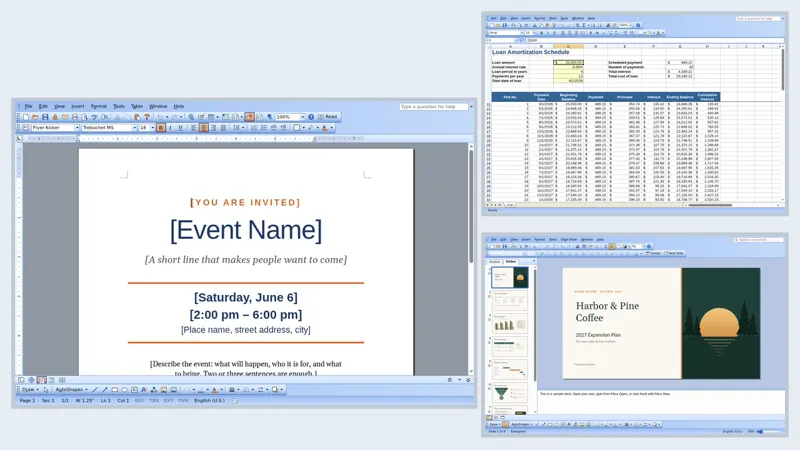
DeepSeek open-sources dsh-libreoffice-kit

Open-sourced internal component of DeepSeek Harness (npm @deepseek-ai/libreoffice-kit + dsoffice CLI): Office-to-PDF export (OOXML + 97-2003 binary), spreadsheet recalculation, and page-by-page PNG rendering of Office/PDF inputs. Font-friendly = font discovery / preserve requested families / configurable fallbacks (Carlito for Calibri, Caladea for Cambria) / missingFonts reporting and budgets. Prebuilt engines for macOS ARM64/x64, Windows ARM64/x64 and Linux WASM bundle offline, with downloads slimmed 37-39%; no dependence on a user LibreOffice install.

deepseek-ai/dsh-libreoffice-kit41 stars2 forks

Knowledge, Research & Applied Systems

Knowledge bases, retrieval, research workspaces, education, CRM and applications built for specific industries.

8 projects
Knowledge & ResearchPython

DeepTutor

DeepTutor is HKUDS's open-source "lifelong personalized tutoring" platform (Apache-2.0, Python 3.11+ / Next.js 16, arXiv 2604.26962, 40.6k stars): chat, multi-engine RAG knowledge bases, living books, writing and practice unified in one learning workspace. Highlights: (1) Subagents & Partners — consult real agent harnesses on your machine (Claude Code, Codex, Grok CLI, Kimi, opencode, Hermes, DeepSeek and more) from inside a chat turn, streaming their work into the conversation, plus persistent IM companions; (2) multi-engine knowledge — versioned RAG libraries across LlamaIndex, PageIndex, GraphRAG, LightRAG (incl. remote server), self-hosted WeKnora, Tencent IMA, MarginNote 4, Kiwix ZIM archives and Obsidian vaults, with pluggable parsing (MinerU/Docling/Tika/markitdown/PyMuPDF4LLM/LiteParse) and KBs that track GitHub repos and doc sites with 24h hash-diffed sync; (3) Book compiles sources into editable typed blocks (text/quizzes/flashcards/timelines/concept graphs/interactive HTML), exports Markdown, and long compiles pause-and-resume; (4) personalized learning (Mastery Path, immersive reading with verified citations, read-aloud/quiz/translation) and a Co-Writer split-view Markdown workspace with KaTeX live preview; (5) an office-skills code sandbox running model-generated code over docx/pdf/pptx/xlsx; (6) an agent-native CLI — the open SKILL.md format is picked up automatically by Claude Code/Codex, and deeptutor run wraps into LangChain/AutoGen loops. Led by Bingxi Zhao, fully open source with no paid online products.

HKUDS/DeepTutor41k stars5.1k forks
OpenResearch: A Local-First Workspace That Turns Coding Agents into Research Agents
Knowledge & ResearchRust

OpenResearch

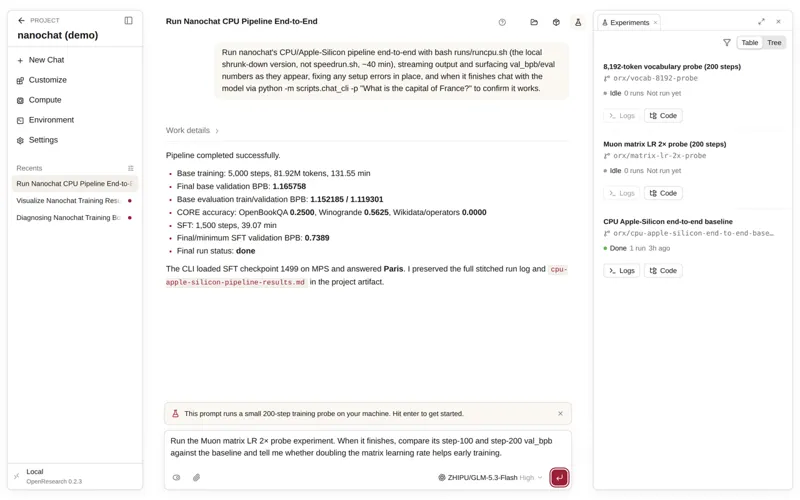
OpenResearch (orx) is the local-first research workspace open-sourced by alphaXiv: a single Rust binary that turns Claude Code, Codex, OpenCode, Cursor, or Google Antigravity into research agents that review literature, form hypotheses, run experiments, and produce artifacts. It organizes work as a git-native experiment tree under a fixed run contract, drives experiments through a repair/refill/promote/stop autoresearch loop, and treats run logs and manifests as the only evidence. Written from a close read of the v0.2.13 source and a hands-on run of the bundled nanochat demo.

alphaXiv/OpenResearch6.2k stars395 forks
Knowledge & Research

AI Agent HandBook

Alibaba Cloud open-source (Apache-2.0) white paper distilling enterprise agent deployment experience across the agent lifecycle — architecture, building, runtime, governance and optimization — in 30 Markdown chapters. Core thesis: understand the Model/Harness responsibility boundary instead of attributing everything to model capability. Covers agent loops, task state machines, context builders, action planes, MCP/A2A, sandbox runtimes, AI-gateway governance and evaluation flywheels, plus a 2026 agent developer survey and real cases (ABACI kernel-patch testing, Kitta code review, Bilibili content insights).

aliyun/ai-agent-handbook704 stars114 forks

As an Amazon Associate, we earn from qualifying purchases.