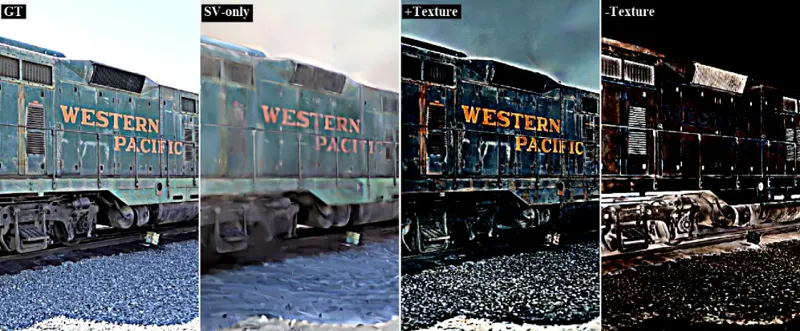
Recent extensions of 3D Gaussian Splatting (3DGS) capture fine color details using hash-grid-based appearance parameterization but incur high computational cost during fragment rendering. We introduce a decoupled radiance representation that models low-frequency geometry and view dependent appearance features with 2D surfels while representing high-frequency textures via a view-independent spatial hash grid that is baked into a compact texture atlas. By including sparsity-enhancing optimizations that penalize semi-transparency and per-primitive falloff, our method aggressively prunes insignificant surfels and achieves significantly faster and sparser reconstructions than prior work. Exploiting geometric sparsity and efficient GPU texture mapping, our approach achieves up to a fivefold speedup over 3DGS while preserving state-of-the-art visual fidelity, enabling real-time 4K rendering at 60 FPS on consumer hardware.
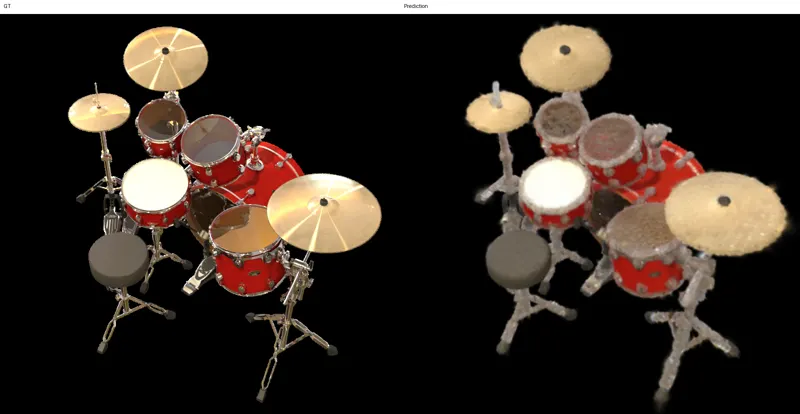
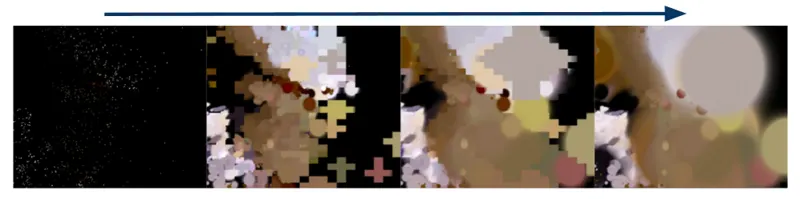
On-the-fly reconstruction is a key requirement for many applications in robotics and autonomous navigation. Variational Bayes Gaussian Splatting (VBGS) enables continual learning without replay buffers using Coordinate Ascent Variational Inference (CAVI), but its per-frame iterations over all observed points make it too slow for real-time use with strict memory and latency requirements. We present ImprovedVBGS, an accelerated framework for on-the-fly continual reconstruction. This is achieved primarily through (i) spatially truncated variational inference, and (ii) improved reassignment that uses forwarding, truncation and eliminates wasteful dynamic recompilation. On the NeRF synthetic dataset, we reduce mean per-frame latency from ~84.0 s to ~0.050 s on an RTX 3070 Ti, a 1680x speed-up while maintaining reconstruction quality.
We present the first implementation of a 3D Gaussian renderer on an Intelligence Processing Unit (IPU), comprising 1,472 independent tiles with only on-chip SRAM; constraints that approximate properties of efficient sensor-processor architectures. Our input scenes are 3D Gaussian maps from real-world sequences. Each tile 'owns' a screen-space region of the framebuffer; Gaussian primitives are routed to destination tiles via Manhattan-distance hops on a north-east-west-south (NEWS) grid, then distributed to overlapping neighbours in an expanding tree pattern. Computation follows the IPU's Bulk Synchronous Parallel (BSP) model, with inter-tile communication defined at compile time. We show this hardware allows us to exploit spatial and temporal locality by enabling local data transfer between cores. We evaluate the bottlenecks in this SRAM-only implementation: inter-tile bandwidth, per-tile SRAM capacity, and workload imbalance from non-uniform Gaussian density. We analyse how these constraints affect performance and render quality. This exploration raises broader questions for conventional GPUs and 3D representations, suggesting that direct inter-SM (streaming multiprocessor) communication might offer ways to reduce DRAM access in GPU kernels. We discuss these implications for the future of on-sensor and DRAM-free architectures. Project page: https://nmjfry.github.io/ipu-3dgs/
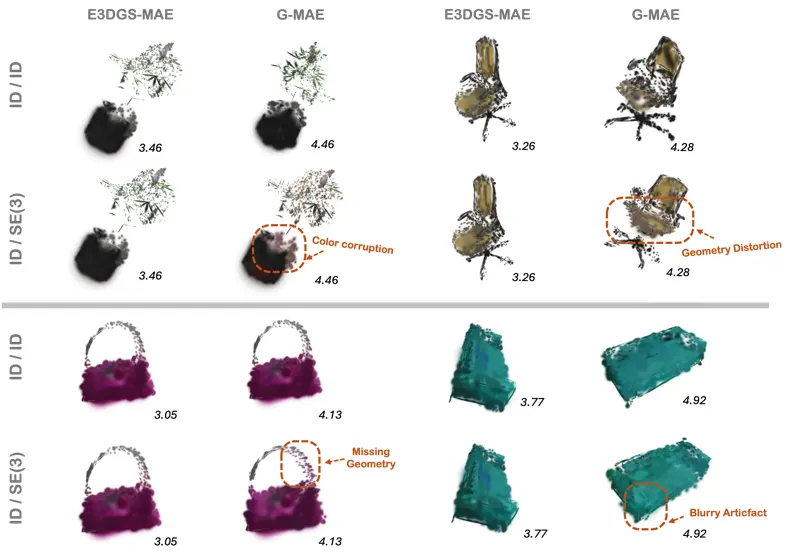
3D Gaussian Splatting (3DGS) captures scenes by coupling explicit geometry (position, covariance) with view-dependent photometry (Spherical Harmonics). However, building SE(3)-equivariant architectures on these primitives presents a fundamental representation bottleneck. Color has been treated as a signal rather than a geometric entity, making it nontrivial to unify symmetry across geometry and appearance as the camera frame changes. While translations are handled by relative coordinates, rotations act heterogeneously across attributes: μ↦ Rμ, Σ↦ RΣR^, and f_ℓ↦ D^ℓ(R)f_ℓ. This mismatch complicates strict equivariance, leading existing methods to either discard or flatten SH coefficients, thereby breaking symmetry. We propose a unified solution rooted in representation theory: for SH degrees ℓ≤2, photometry is algebraically isomorphic to a rank-2 geometric tensor. We prove that the Wigner-D action on these SH coefficients can be exactly reformulated as the conjugation action on 3×3 matrices. Leveraging this, we introduce the Unified Matrix Embedding, a lifting that maps all Gaussian attributes into a unified carrier space, gl(3). Building on the "Color-as-Geometry" formulation, we present E3DGS, a rigid-body (SE(3)) equivariant architecture that processes 3D Gaussians without Clebsch-Gordan tensor products. Evaluations on object vision and action-conditioned Gaussian world modeling demonstrate that our unified approach yields strong robustness under camera-frame changes and improved data efficiency.