Skip to content
RobotWorld

Papers

DL-SLAM: Enabling High-Fidelity Gaussian Splatting SLAM in Dynamic Environments based on Dual-Level Probability

DL-SLAM: Enabling High-Fidelity Gaussian Splatting SLAM in Dynamic Environments based on Dual-Level Probability

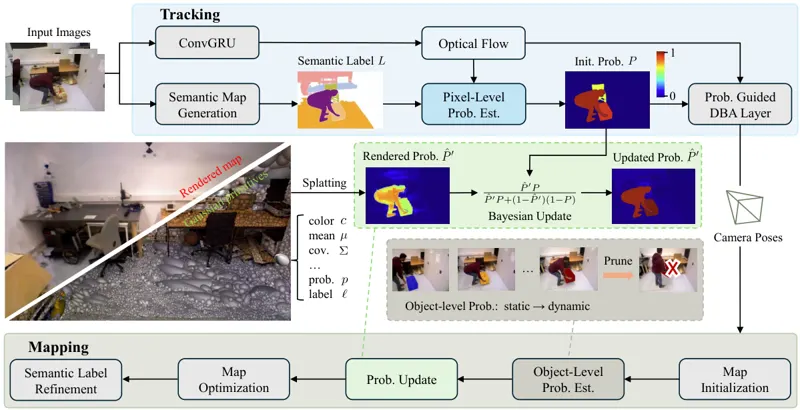
Recent advances in 3D Gaussian Splatting (3DGS) have enabled significant progress in dense dynamic Simultaneous Localization And Mapping (SLAM). Prevailing methods typically discard predefined dynamic objects, ignoring that transiently static objects offer valuable geometric constraints for pose estimation. A recent work attempts to leverage this potential by employing per-pixel uncertainty maps to quantify the magnitude of motion. While this approach enables transiently static objects to enhance pose estimation, it erroneously integrates these objects into the static map, resulting in persistent artifacts. Moreover, its reliance on purely geometric information leads to ambiguous object boundaries in the uncertainty maps. To overcome these limitations, we present DL-SLAM, a monocular Gaussian Splatting SLAM system built upon a novel dual-level probabilistic framework. Our method computes dynamic probability maps by combining semantic and geometric information. These pixel-level probabilities are lifted to 3D and aggregated to derive an object-level dynamic probability for each instance. Object-level probability enables the categorical pruning of dynamic Gaussians, resulting in an artifact-free static map. The static map, in turn, provides a geometrically consistent guidance to refine the pixel-wise probabilities, enhancing their reliability. Experimental results demonstrate that DL-SLAM outperforms existing approaches, improving tracking accuracy by up to 13\% while generating high-fidelity semantic maps.

动态环境Dynamic EnvironmentsSLAMZiheng Xu, Qingfeng Li, Xuefeng Liu·Jul 2, 2026
QIRF Quantum-Inspired Non-Orthogonal Function-Space Compression for 3D Gaussian Splatting

QIRF Quantum-Inspired Non-Orthogonal Function-Space Compression for 3D Gaussian Splatting

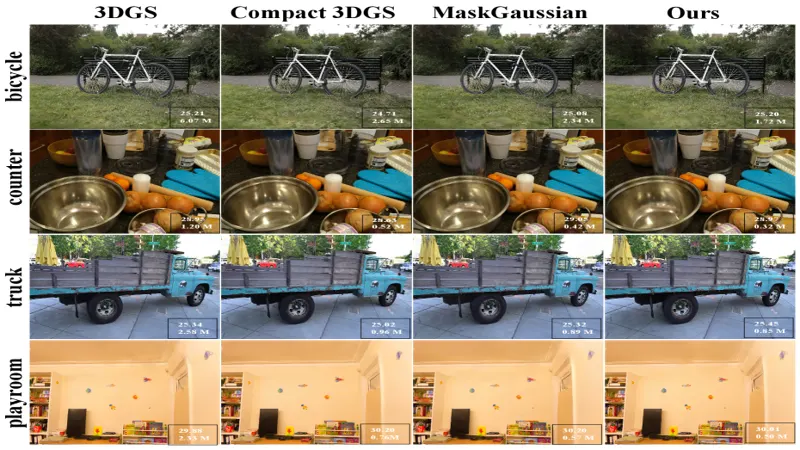
3D Gaussian Splatting (3DGS) achieves high-quality real-time rendering by representing a scene with a large collection of anisotropic Gaussian primitives. However, complex scenes often require millions of Gaussians, resulting in substantial storage and rendering costs. Existing compression methods mainly reduce redundancy through primitive-wise pruning, attribute quantization, clustering, or neural coding, while redundancy caused by strongly overlapping and non-orthogonal Gaussian basis functions remains largely unexplored. We present QIRF, a quantum-inspired non-orthogonal function-space compression method for 3D Gaussian Splatting. QIRF models neighboring Gaussian primitives as a local non-orthogonal basis and formulates primitive reduction as a subspace-aware selection problem. Specifically, an analytic Gaussian overlap matrix and a radiance-response density matrix are constructed to characterize functional redundancy and rendering relevance. Generalized eigendecomposition is then used to identify the dominant local subspace and select representative Gaussian primitives. An RRDM-based response model and detail-aware safeguarding further preserve visually important high-frequency structures under aggressive pruning. Experiments on 13 scenes from Mip-NeRF 360, Tanks and Temples, and Deep Blending show that QIRF reduces the Gaussian count and raw PLY storage by 71.7 percent on average, corresponding to approximately 3.54 times compression, while maintaining reconstruction quality comparable to 3DGS and achieving a marginal average PSNR improvement of 0.10 dB. QIRF also improves the average rendering speed over 3DGS by 34.3 percent. These results suggest that non-orthogonal function-space redundancy is an important yet underexplored source of representational redundancy in explicit Gaussian radiance fields.

Paper3D Gaussian Splatting3DGSShizeng Jiang, Hao Zhang, Xuerui Ma·Jul 20, 2026
ZeroSplat: Generalized Referring Segmentation in 3D Gaussian Splatting

ZeroSplat: Generalized Referring Segmentation in 3D Gaussian Splatting

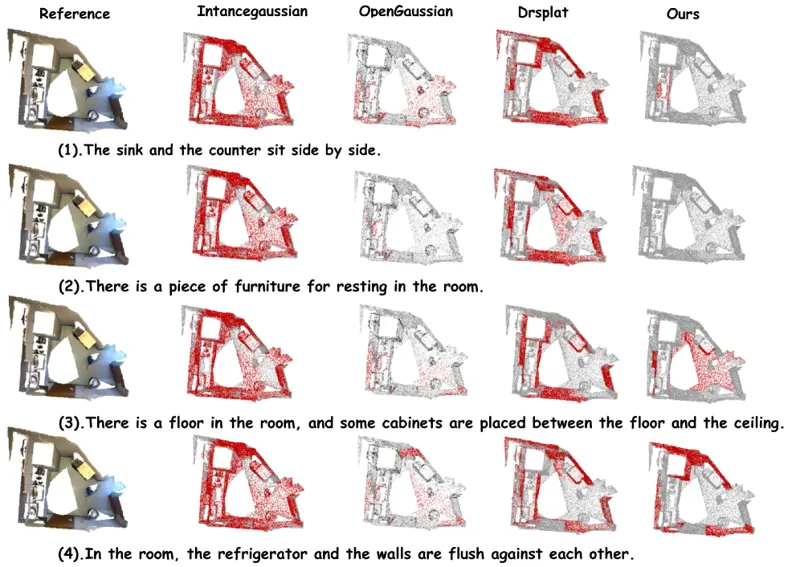
Recent advancements in 3D Gaussian Splatting (3DGS) have enabled language-guided scene understanding. However, existing Referring 3D Gaussian Splatting (R3DGS) methods are fundamentally restricted to single-target queries. To reflect the ambiguity of real-world instructions, we introduce the Generalized Referring 3D Gaussian Splatting Segmentation (GR3DGS) task, which requires dynamically segmenting an arbitrary number of targets (0, 1, or $N$). To facilitate comprehensive evaluation of this new task, we construct two new benchmarks: GR-LERF and GR-ScanNet. Crucially, existing R3DGS paradigms exhibit fundamental technical bottlenecks that severely limit their performance on the GR3DGS task: they lack intrinsic 3D point-level understanding by operating merely on 2D rendered pixels, and they incur prohibitive computational overhead by requiring per-scene optimization to embed heavy semantic features. To dismantle these bottlenecks, we propose ZeroSplat, a novel training-free and zero-feature framework. ZeroSplat lifts 2D Vision-Language Model (VLM) priors into 3D space through robust multi-view geometric constraints. This strategy enables intrinsic point-level understanding without incurring any additional feature storage. Extensive experiments demonstrate that ZeroSplat significantly outperforms state-of-the-art methods across generalized and single-target scenarios while maintaining exceptional efficiency. Project Page: https://inkmind-ai.github.io/ZeroSplat

Paper3D Gaussian Splatting3DGSJiayu Ding, Meilu Song, Xiaoyi Zhang·Jul 21, 2026
RealVDeblur: One-Step Diffusion for Generalizable Real-World Video Deblurring

RealVDeblur: One-Step Diffusion for Generalizable Real-World Video Deblurring

Real-world video deblurring remains challenging due to diverse motion patterns, complex degradations, and the scarcity of realistic training data, yet robust restoration is critical for downstream pipelines such as mobile imaging and 3D reconstruction. This work presents \textbf{RealVDeblur}, an efficient generative framework designed to improve in-the-wild robustness under diverse real capture conditions. First, a large-scale, physically grounded blur synthesis pipeline is constructed from scene-level 3D Gaussian Splatting (3DGS) assets and high-frame-rate videos, providing realistic training data covering both camera-induced and object-motion blur. Second, a video diffusion prior is leveraged for restoration; to better accommodate frame-dependent blur variations, temporal compression in the VAE is disabled and a frame-wise encoding scheme is adopted. For practical deployment on long videos, multi-step diffusion sampling is distilled into an efficient one-step generator, and a training-free Temporal Window Mask stabilizes inference beyond the training horizon with constant memory usage. Extensive experiments on diverse real-world benchmarks demonstrate strong perceptual quality, semantic fidelity, and temporal consistency on unseen videos, as well as improved robustness in downstream 3D reconstruction under severe motion blur. Project page: https://rbjin.github.io/RealVDeblur

Paper3D Gaussian Splatting3DGSRenbiao Jin, Mingxin Yang, Yutian Chen·Jul 22, 2026
Visual Relocalization from Sparse Views in Aliased and Low-Texture Environments via Novel View Synthesis

Visual Relocalization from Sparse Views in Aliased and Low-Texture Environments via Novel View Synthesis

Visual localization becomes extremely challenging in planetary-like terrains characterized by low texture, perceptual aliasing, harsh illumination, and sparse, weakly overlapping viewpoints induced by forward rover motion and unconstrained driving directions. Under these conditions, state-of-the-art image-to-image and image-to-map matching pipelines suffer significant performance degradation. In this work, we propose a visual relocalization method that departs from classical correspondence-based pipelines by directly estimating camera poses against a differentiable map representation built with 3D Gaussian Splatting (3DGS). Our key contribution is a geometry-aware training strategy that combines photometric and geometric losses, where the geometric supervision is provided for the first time by combining multi-view stereo (MVS) and LiDAR depths. We show that this joint optimization produces a 3DGS model that better fits the underlying scene geometry, leading to improved photometric and geometric consistency and more robust, accurate single-image 6-DoF pose estimation. Extensive experiments on data acquired in planetary-analog environments validate the effectiveness of our approach, showing substantial gains in relocalization accuracy under challenging conditions. Code is available at https://github.com/DLR-RM/multimodal-gsplat-relocalization.

Paper3D Gaussian Splatting3DGSMaria Peribañez, Javier Civera, Rudolph Triebel·Jul 24, 2026
Fashion-3DLR: A Controllable 3D Garment Generation Using Pairwise Fashion Elements for Intelligent Design

Fashion-3DLR: A Controllable 3D Garment Generation Using Pairwise Fashion Elements for Intelligent Design

AI-generated content (AIGC) has made significant progress, with 2D generative models becoming ready-to-use tools for the digital fashion industry. However, 3D garment generation remains in its nascent stage, where in the realm of fashion, the semantic information of diverse design elements exhibits intricate coupling relationships in 3D representations, posing substantial challenges for generating diverse 3D garments. In this work, to handle the above problem, We introduce Fashion-3DLR, a novel 3D garment generation framework that utilizes diverse design elements to create high-quality, versatile 3D garment assets. Specifically, to bridge the semantic gaps between different fashion elements, we propose a Garment Feature Fusion Diffusion Transformer (GFF-DiT) module to integrate 2D fashion design elements, e.g., sketch and texture, into latent space. Within the latent space, we then employ a rectified flow transformer to generate geometry latents, which can be decoded into various 3D garment representations, including 3D Gaussians and meshes. Furthermore, we integrate Fashion-3DLR into downstream tasks, achieving the 3D Gaussian Splatting (3DGS)-driven cloth physical simulation and mesh-based virtual try-on. Experimental results indicate that Fashion-3DLR surpass the previous state-of-the-art methods, which verify that the proposed work can generate well-structured, non-watertight garments capable of physical simulation and virtual try-on, underscoring its potential as a versatile 3D garment design tool.

Paper3D Gaussian Splatting3DGSShenghao Yang, Hongtao Zhang, Yuhan Yi·Jul 25, 2026
Head Avatars with Dynamic Explicit Hair

Head Avatars with Dynamic Explicit Hair

We present DynHair, a novel method for tracking and modeling dynamic hair for human head avatars. From video input, we reconstruct a dynamic head avatar with an explicit strand-based hair representation using structured 3D Gaussian Splatting. In contrast to the face region of human head avatars, which can be modeled with 3D Gaussians that are attached or generated with respect to some expressive 3D head model, hair is particularly challenging as it exhibits dynamic motion effects. Therefore, we present a novel method that models the dynamic deformations of the hair strands using a temporal network that is conditioned on angular velocity and acceleration of the head, as well as relative gravity. Specifically, an LSTM encodes the motion history and modulates per-point strand features via FiLM conditioning which further used by MLP to produce physically plausible displacements to canonical hairstyle. We jointly optimize this motion and appearance representation of the hair, with a 3DGS-based representation of the face-region, via differentiable Gaussian splatting with photometric, geometric, and physics-based supervision. As a result of our method, we retrieve hair tracking of the training video data and an animatable head avatar with controllable hair dynamics. In our experiments, we demonstrate state-of-the-art performance in terms of hair dynamics, temporal consistency, and generalization across subjects.

Paper3D Gaussian Splatting3DGSVanessa Sklyarova, Haonan Chen, Berna Kabadayi·Jul 26, 2026