Skip to content
Tags

#Gait optimization (17)

X-Morph: Human Motion Priors for Scalable Robot Learning Across Morphologies

X-Morph: Human Motion Priors for Scalable Robot Learning Across Morphologies

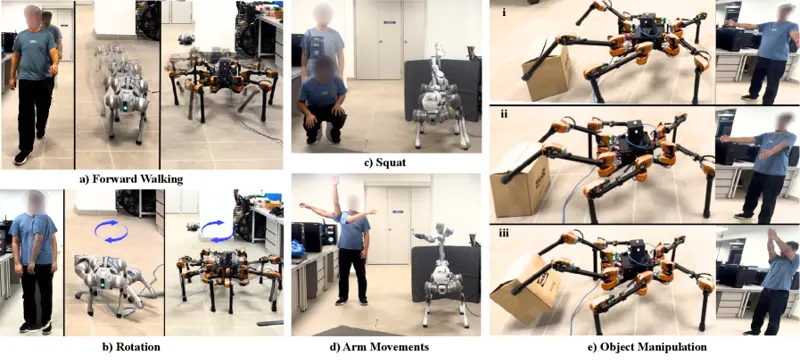
Recent progress in humanoid behavior models has been driven in large part by abundant human motion data, but comparable motion data is scarce for non-humanoid legged robots such as quadrupeds, hexapods, and quadruped manipulators. A promising alternative is to repurpose human motion across embodiments; however, direct retargeting often produces motions that are visually plausible yet physically inconsistent or difficult to track under robot dynamics. We present X-Morph, a human-motion-to-robot-behavior pipeline that converts human motion into deployable locomotion and loco-manipulation policies for diverse non-humanoid legged morphologies. A cross-morphology retargeting stage converts human motions into kinematically plausible, intent-preserving robot references, which are then tracked by a privileged RL policy and distilled into a causal student policy. We evaluate X-Morph on three morphologically distinct platforms: a quadruped, a hexapod, and a quadruped equipped with a manipulator. The resulting policies track diverse retargeted motions, generalize to unseen human motions, and support downstream use cases including video-based teleoperation, behavior-prior control, and text-conditioned motion generation. These results suggest that large-scale human motion can serve as a substrate for learning broad, reusable behavior priors beyond humanoid robots. Project page: https://maker-rat.github.io/morph/

Ritwik Sharma, Shivam Sood, Arhaan JainJun 29, 2026
RetargetingLegged robotsGait optimizationJun 29, 2026
Multi-Rate Nonlinear Model Predictive Control for Wall-Supported Bipedal Locomotion of Quadrupedal Robots

Multi-Rate Nonlinear Model Predictive Control for Wall-Supported Bipedal Locomotion of Quadrupedal Robots

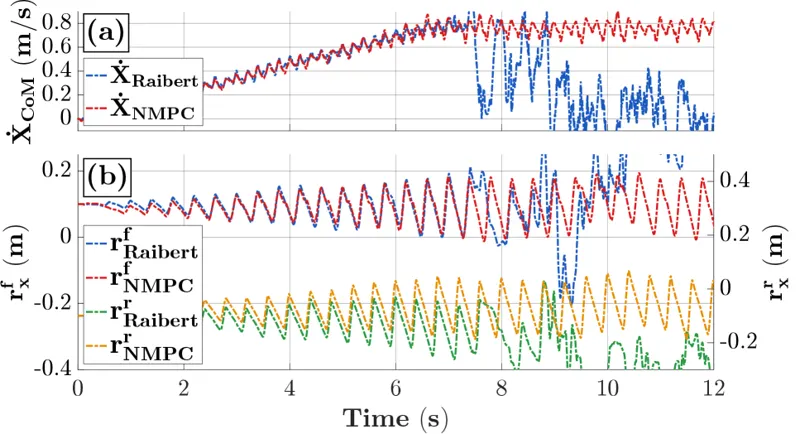
This paper presents a novel layered planning and control framework based on multi-rate nonlinear model predictive control (MR-NMPC) that enables quadrupedal robots to perform hybrid bipedal locomotion with wall-assisted support in constrained environments. Real-time trajectory optimization for this locomotion presents significant challenges, as the controller must simultaneously plan for both the contact points and the continuous trajectories of the robot's center of mass (CoM) and orientation within the robot's nonlinear dynamics while accounting for unilateral contact constraints, underactuation, and the switching nature of the robot's dynamics. At the high level of the control framework, an MR-NMPC is proposed, which dynamically plans both the discrete-time trajectories of the contact points and the continuous-time trajectories of the CoM and orientation, using a single rigid body (SRB) dynamics model. By incorporating contact-point planning within the multi-rate optimal control framework, this approach enhances dynamic stability compared to heuristic foot placement strategies. At the low level of the control framework, a nonlinear whole-body controller (WBC) based on virtual constraints and a quadratic program enforces full-order dynamics and tracks the MR-NMPC references. The proposed approach is validated through extensive numerical simulations demonstrating the robust wall-assisted bipedal locomotion of a Unitree A1 quadrupedal robot on rough terrains and under external disturbances in a constrained environment. Comparative analysis shows that the proposed MR-NMPC achieves a 2.9 times higher success rate compared to conventional MPC with heuristic-based foot placement strategies in negotiating irregular terrain at high speeds.

Taizoon Chunawala, Jeeseop Kim, Kaveh Akbari HamedJul 2, 2026
MPCNMPCWall-SupportedJul 2, 2026
Actuator Reality Shaping for Zero-Shot Sim-to-Real Robot Learning

Actuator Reality Shaping for Zero-Shot Sim-to-Real Robot Learning

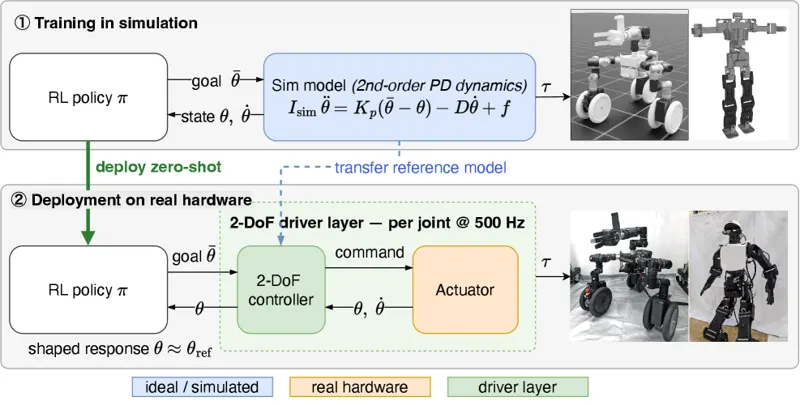
Sim-to-real transfer in robot learning is often limited by discrepancies between the ideal actuator dynamics assumed during policy training and the nonlinear, hardware-dependent behavior of physical motors. While conventional approaches attempt to bridge this gap by increasing simulator fidelity through system identification, domain randomization, or learned actuator models, we introduce an alternative paradigm: actuator reality shaping. Instead of modifying the simulator to match the real world, our method shapes the closed-loop behavior of physical actuators to match the idealized second-order reference dynamics used in simulation. By equipping each joint with a two-degree-of-freedom feedforward–feedback controller, we decouple reference-response shaping from robust stabilization, thereby providing a standardized actuator interface for reinforcement learning policies. As a result, policies trained only with the prescribed reference model can be deployed zero-shot on real hardware without task-level fine-tuning or learned actuator models. We validate the approach on a single-joint high-gear-ratio servo under external loads and a 7-DOF robotic arm reaching task, where actuator reality shaping substantially reduces sim-to-real tracking error and improves zero-shot task performance compared with standard servo-control and representative real-to-sim-to-real baselines. We further demonstrate zero-shot transfer on a wheeled-legged robot driving over a slope and a humanoid robot walking, suggesting that actuator reality shaping can serve as a reusable interface for robot learning across diverse hardware platforms. Project page: https://syamamori.github.io/ActuatorRealityShaping.github.io/

Satoshi Yamamori, Koji Ishihara, Kenjiro MinamikawaJul 2, 2026
Sim-to-RealZero-ShotActuatorsJul 2, 2026
EgoHTR: Egocentric 4D Demonstrations of Human Terrain Traversal

EgoHTR: Egocentric 4D Demonstrations of Human Terrain Traversal

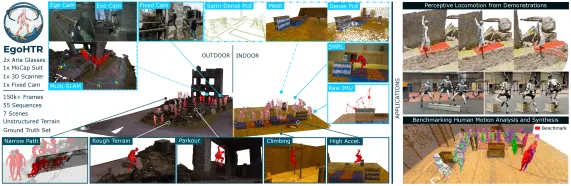
Deploying humanoid robots in unstructured terrain remains an open problem. While classic reinforcement learning struggles with the sheer complexity of real-world interactions, more promising methods leveraging human priors remain limited to models lacking contextual awareness. The restricted motion synthesis is a direct consequence of existing dataset pipelines failing to capture human-scene sequences in challenging environments. To bridge this gap between humanoid learning and scene reconstruction, we introduce the Egocentric Human-Terrain Reconstruction (EgoHTR) dataset. We develop and open-source a reconstruction pipeline capturing 55 scene-aligned 4D human motion sequences in diverse, complex environments using a multi-sensor setup of egocentric wearables and a portable 3D scanner. The resulting dataset comprises over 150k frames, which we evaluate against motion-capture ground truth, demonstrating state-of-the-art accuracy and establishing a rigorous benchmark for human motion analysis and synthesis. Further, we leverage this data to train perceptive locomotion policies, demonstrating hardware deployment on a Unitree G1 for reconstructed reference motions. Our pipeline enables community-driven dataset extensions and factors the problem to help researchers build foundational, context-aware robots that reliably traverse uneven terrain.

Alex Brandes, Haig Conti Georges Sajelian, Manthan PatelJul 15, 2026
4DTerrain TraversalGait optimizationJul 15, 2026
DynaWM: Dynamics-Aware Distillation with World Model and Momentum Targets for Smooth Locomotion over Continuous Stairs

DynaWM: Dynamics-Aware Distillation with World Model and Momentum Targets for Smooth Locomotion over Continuous Stairs

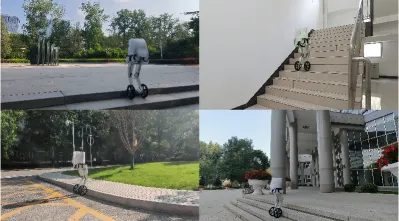
Recent advances in control have enabled bipedal-wheeled robots to traverse slopes and single-step obstacles, yet long staircase traversal remains challenging as current teacher-student frameworks suffer from weakened dynamics-aware representations and incomplete terrain geometry encoding. To bridge this gap, we propose DynaWM, a dynamics-aware representation learning framework. To enhance terrain encoding capability and enable transparent assessment, we introduce a world model as a regularizer to enforce forward-dynamics awareness, preserving comprehensive terrain geometry while facilitating hierarchical encoding visualization. To stabilize knowledge transfer, we employ a momentum target encoder to provide consistent distillation targets, preventing dimensional collapse from non-stationary teacher updates. Evaluation of the learned representations through Principal Component Analysis (PCA) visualization and quantitative metrics reveals that our encoder hierarchically captures terrain geometry with higher terrain encoding capability, leading to enhanced terrain adaptability and motion smoothness. Experimental results in simulation and real hardware demonstrate that our method achieves superior terrain adaptability and motion smoothness, enabling bipedal-wheeled robots to overcome diverse continuous stairs, as shown in Fig. 1.

Haidong Hou, Zhangguo Yu, Hengbo QiJun 23, 2026
World ModelsContinuous StairsGait optimizationJun 23, 2026
FastDSAC: Enhancing Policy Plasticity via Constrained Exploration for Scalable Humanoid Locomotion

FastDSAC: Enhancing Policy Plasticity via Constrained Exploration for Scalable Humanoid Locomotion

Scalable reinforcement learning has popularized high-throughput sampling architectures, which significantly compresses the training time for off-policy methods in robotic locomotion. However, the rapid increase of data volume and update frequency undermines the stability of value-based methods and diminishes the plasticity of policy networks. To address these challenges, this work presents FastDSAC, a fast and high-performance variant of the Distributional Actor-Critic algorithm designed for parallel sampling scenarios. Specifically, we introduce a truncated Gaussian distribution to approximate the learned policy, which effectively excludes out-of-distribution actions that strain target value estimation while keeping necessary stochasticity for exploration. The proposed action constraint functions as an implicit regularization, which counteracts the plasticity loss typically caused by aggressive gradient updates. This preservation of network adaptability enhances sample efficiency, particularly in scenarios with a high update-to-data ratio, and accelerates the early training process. In contrast to prior fast reinforcement learning approaches that rely on discrete value distributions, our method utilizes a continuous Gaussian representation equipped with adaptive variance regulation, which improves value estimation accuracy by sampling confident and informative transitions. Extensive experiments on MuJoCo Playground and HumanoidBench demonstrate that FastDSAC not only stabilizes the overall training process but also achieves superior asymptotic performance and faster convergence compared to state-of-the-art baselines.

Guanchen Lu, Yajuan Dun, Yi ZhouJun 30, 2026
SACPlasticityHumanoidBenchJun 30, 2026
Reinforcement Learning-Based Control for an Inline Skating Humanoid Robot

Reinforcement Learning-Based Control for an Inline Skating Humanoid Robot

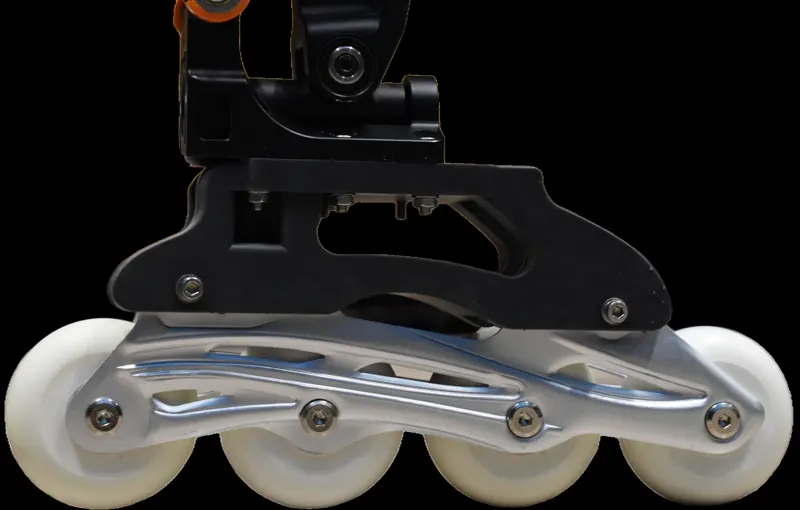
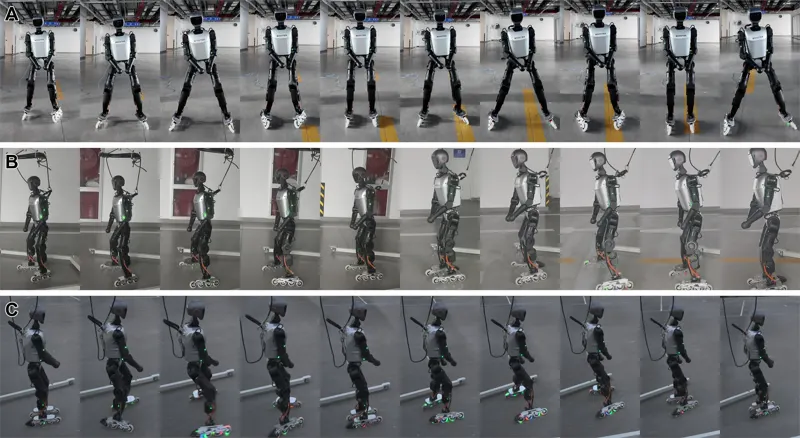
As humanoid robots become increasingly dynamic, coupling them with reinforcement learning offers a promising approach to solving the complex, underactuated mechanics of passive inline skating. Equipping a humanoid robot with passive inline skating wheels presents an opportunity to combine the versatile agility of humanoids with the high-speed, energy-efficient locomotion strategies utilized by human skaters. In this paper, we train and deploy a reinforcement learning control policy that enables novel locomotion strategies for a humanoid robot modified to equip consumer inline skates instead of conventional feet. Unlike previous work limited to quadrupedal robots or actively driven wheels, our system allows for precise 6-DoF control of the skates to execute dynamic, edge-driven propulsion strategies. Our skating strategies emerge entirely from our reward structure, without reliance on human motion data, imitation learning, or kinematic priors. We overcome the inherent instability of passive wheels and simulation contact artifacts by utilizing different geometric wheel models (spherical and ellipsoidal) during training and validation, along with a custom success-based command curriculum and a specialized rolling reward. Consequently, our policy demonstrates up to a 50% reduction in Cost of Transport (CoT) compared to standard walking gaits. The resulting policy successfully transfers zero-shot to the physical Booster T1 hardware. Real-world deployments demonstrate dynamic balance, the ability to reject active physical perturbations, and agile locomotion strategies capable of turning at speed. A video of our results can be found at https://www.youtube.com/watch?v=-_APcOS7uFo.

Ethan Marot, Thomas Bi, Clemens SchwarkeJun 30, 2026
Inline SkatingGait optimizationHumanoidJun 30, 2026
Physics-Guided Biomechanical Gait Adaptation for Humanoid Locomotion on Extreme Sloped Terrains

Physics-Guided Biomechanical Gait Adaptation for Humanoid Locomotion on Extreme Sloped Terrains

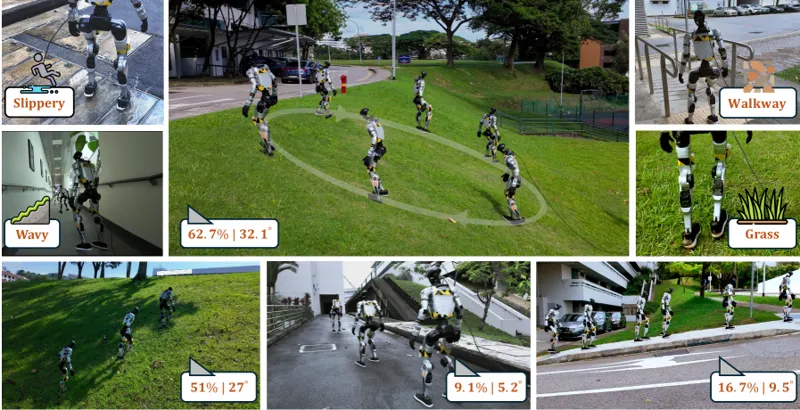
Model-free reinforcement learning has enabled impressive humanoid locomotion; however, control on steep slopes remains largely unexplored. Unlike flat or discrete terrains, sloped terrains impose a persistent gravitational bias that demands simultaneous stability and posture control. Consequently, under generic reward formulations, policies can converge to slow, conservative low-center-of-mass (CoM) crouched gaits. In this work, we propose a novel two-stage physics-guided framework, dubbed HumoSlope, dedicated to robust humanoid locomotion on diverse sloped terrains. Specifically, Stage I establishes a terrain-consistent balance prior by introducing a slope-adaptive Zero Moment Point (ZMP) regularizer evaluated directly on the local inclined support plane rather than a world-horizontal reference. To prevent the resulting policy from defaulting to a crouched posture, Stage II introduces the Biomechanical Slope Gait Adapter (BSGA). Utilizing extracted macroscopic terrain descriptors as privileged, training-only signals, BSGA dynamically gates soft reward priors to modulate CoM height and lower-limb coordination based on the estimated slope geometry – encouraging hip-dominant uphill propulsion and knee-oriented downhill braking. Crucially, the deployed actor remains entirely proprioceptive, requiring no online exteroceptive sensing. Extensive Sim-to-Real experiments demonstrate that our framework effectively mitigates posture degeneration and enables blind, continuous traversal of outdoor grass slopes up to 62.7% (32.1^∘), validating a physics-guided approach to challenging slope terrain adaptation.

Xuanyu Chen, Mohan Liu, Dengchen MeiJul 8, 2026
ZMPHumanoidGait optimizationJul 8, 2026
SKooP: Symmetric Koopman Predictions for Faster and More Generalizable Legged Robot Locomotion with Reinforcement Learning

SKooP: Symmetric Koopman Predictions for Faster and More Generalizable Legged Robot Locomotion with Reinforcement Learning

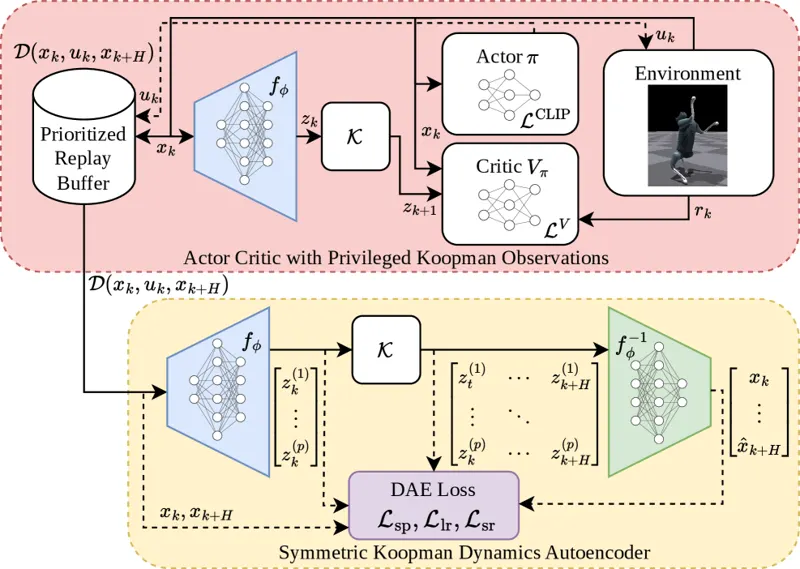
Reinforcement learning (RL) algorithms classically suffer from poor sample efficiency. In robotics, a recent line of work has emerged addressing this problem by encoding physics priors in the learning process. However, most of these approaches are validated on well-defined, low-dimensional benchmark systems rather than high-dimensional robots with complex nonlinear dynamics. In this paper, we introduce SKooP (Symmetric Koopman Predictions), an approach combining the advantages of morphological symmetries with those of a Koopman model learned via autoencoder to enhance policy learning. SKooP learns a Koopman model of the system dynamics alongside the policy. The resulting Koopman predictions are used as privileged observations for the critic, allowing the agent to learn based on smoother, more informative features. We also incorporate group symmetries into the actor, critic, encoder and decoder networks to produce a highly equivariant policy. The SKooP approach is validated via in-depth analysis of the learned Koopman models and symmetric policies to showcase how each of these influences the agent's performance. We also show that the learned policies are transferable to different simulation environments. Our results show that SKooP consistently reduces convergence time and increases the learned reward for multiple challenging bipedal locomotion tasks on a quadruped robot. Project page: https://evelyd.github.io/SymmetricKoopmanPredictions

Evelyn D'Elia, Weishu Zhan, Giulio TurrisiJul 13, 2026
KoopmanReinforcement LearningGait optimizationJul 13, 2026
Robust bipedal locomotion on flowable slopes via foot-driven terrain manipulation

Robust bipedal locomotion on flowable slopes via foot-driven terrain manipulation

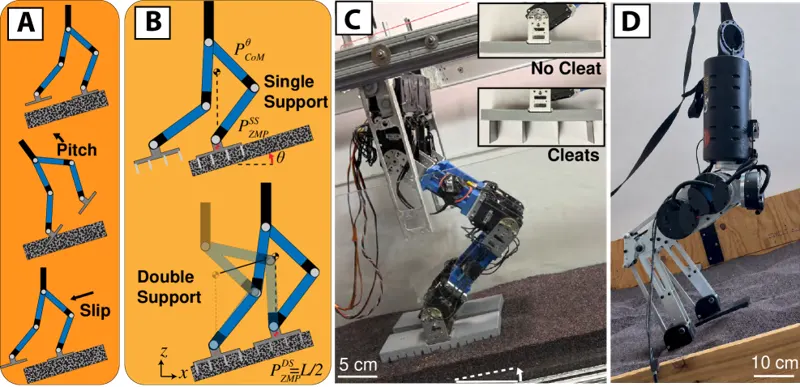
Bipedal robots are challenging to control because they operate close to instability, where small variations in foot-terrain contact can rapidly destabilize locomotion. On rigid terrain, bipedal robots mitigate this fragility by using well-established contact mechanics and control strategies. On flowable surfaces such as granular slopes, foot contact can induce large surface deformations and solid-fluid-like transitions, coupling terrain effects with robot dynamics, leading to underperformance or failure. This is partly due to the lack of reliable methods to represent the dynamics of flowable terrain, making it difficult to account for terrain effects in locomotion design. Here, we investigate how controlling terrain response can improve bipedal locomotion on granular slopes by studying the terradynamics of cleated feet, thin plates emanating from the foot soles. Systematic studies of a small-scale (1.4 kg) robophysical biped reveal that cleats with sparse and dense spacing lead to excessive terrain yielding and resistance, respectively, degrading performance and leading to failure. An intermediate cleat spacing distributes interaction forces to maintain substrate stresses near (or below) the yield threshold, enabling walking on granular slopes up to 30 degrees. Guided by these principles, we design a foot that actively adjusts cleat depth and accommodates both rigid and granular terrain. We also demonstrate that the principles of effective foot-terrain interaction translate to a larger (15 kg) autonomous biped. Our study presents an alternative to conventional body-centric robot control approaches, which regulate terrain-induced effects through body motion, by instead regulating terrain interactions through limb-centric approach.

Deniz Kerimoglu, Junnosuke Kamohara, Jiyeon MaengJul 13, 2026
GranularCleatGait optimizationJul 13, 2026
GaitSpan: Growing Humanoid Locomotion from Walking to Running

GaitSpan: Growing Humanoid Locomotion from Walking to Running

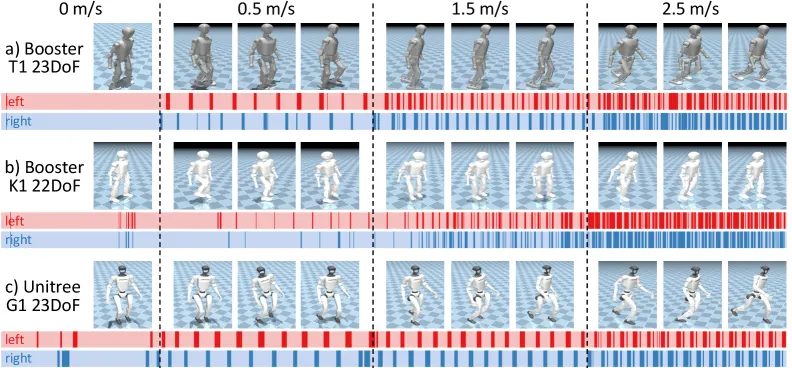
A humanoid that can walk should not relearn locomotion from scratch to jog or run. Yet current approaches often obtain gait diversity by prescribing gait schedules, imitating motion clips, training experts to switch between or distilling skills into one policy. These strategies can produce impressive behaviors, but offer limited flexibility across continuous speed commands, terrains, and morphologies. We study skill growth with GaitSpan, a framework that expands a pretrained, basic walking policy into faster locomotion. It treats walking as a seed skill: reusable motor structure for balance, support, body coordination, and contact transition that can be regenerated at new rhythms, extended into longer/higher strides, and corrected by residual adaptation. This expansion has three aspects: 1) rhythm generation, which modulates the frozen walking policy with multiple internal clocks and learns command-conditioned combinations of the resulting canonical actions; 2) stride shaping, which rewards dynamic locomotion patterns appropriate for higher commanded speeds using a physically grounded objective inspired by spring-loaded inverted pendulum dynamics; and 3) residual adaptation, which captures motion details not accounted for by rhythm generation or stride shaping. GaitSpan is the first to deliver a single command-conditioned humanoid policy that spans walking, jogging, and running-like regimes covering a continuous speed range, transfers across morphologies, and deploys zero-shot on unseen sim-to-sim, and real-world terrains. Compared with baselines either trained with multi-experts or imitation from humans, it learns faster and achieves stronger gait performance.

Kwan-Yee Lin, Zilin Wang, Janelle J. LiuJul 13, 2026
HumanoidGaitReinforcement LearningJul 13, 2026
Learning Reusable Hybrid Motion Priors for Humanoid Locomotion from Motion Imitation

Learning Reusable Hybrid Motion Priors for Humanoid Locomotion from Motion Imitation

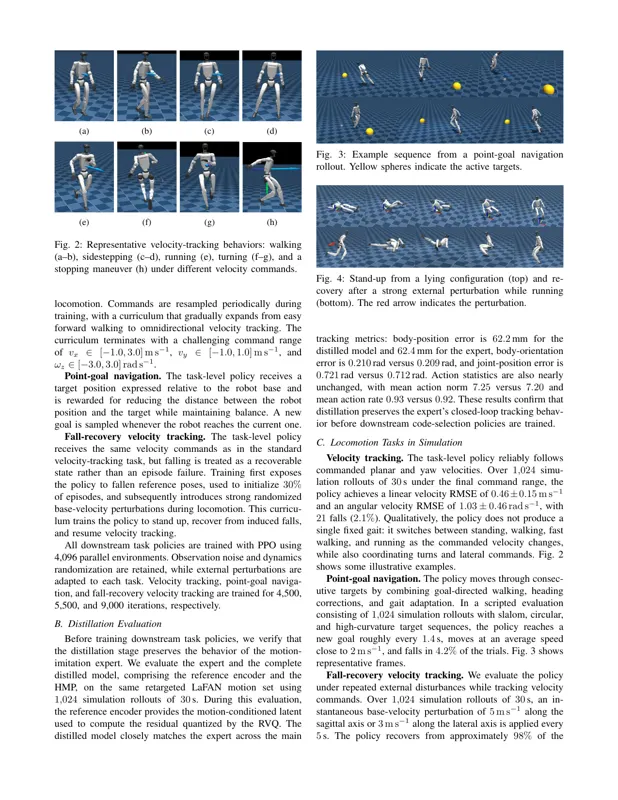
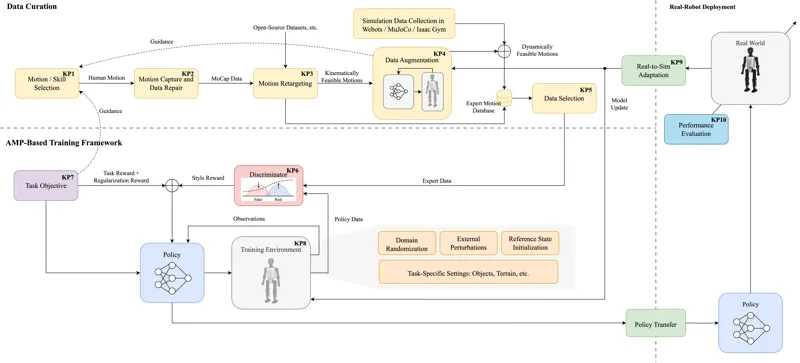
Reinforcement learning can produce robust humanoid controllers, but each new task is typically trained as a separate policy with its own reward design and training process. Motion imitation provides an alternative source of motor competence by training policies to track retargeted human motions, yet the resulting controllers remain reference trackers and are not directly usable as task policies. We propose a three-stage pipeline that turns motion-imitation skills into a reusable hybrid motion prior (HMP) for humanoid locomotion. First, an expert policy is trained to imitate retargeted human motion-capture clips. Second, the expert is distilled into a frozen architecture composed of a proprioceptive encoder, a residual vector-quantized (RVQ) codebook, and an action decoder. Third, task-level policies are trained to solve locomotion tasks by selecting discrete codebook entries while the HMP remains frozen. We evaluate the method on velocity tracking, point-goal navigation, and fall-recovery velocity tracking in simulation, and deploy the velocity-tracking policy on a real Unitree G1 robot. The distillation process preserves the tracking behavior of the expert, while the resulting HMP can be reused without retraining as the action interface for different downstream locomotion policies. The learned HMP reveals an interpretable codebook structure in which the number of active RVQ stages modulates the available gait patterns. We further show that training the codebook with the rotation trick improves latent organization and reduces downstream falls compared with a standard straight-through estimator.

Valerio Belli, Valerio Modugno, Enrico Mingo HoffmanJul 27, 2026
Motion ImitationHumanoidGait optimizationJul 27, 2026
RAVEN: Reinforcement-Adaptive Visibility-Graph Planning for Robust Humanoid Navigation with Collision-Free MPC

RAVEN: Reinforcement-Adaptive Visibility-Graph Planning for Robust Humanoid Navigation with Collision-Free MPC

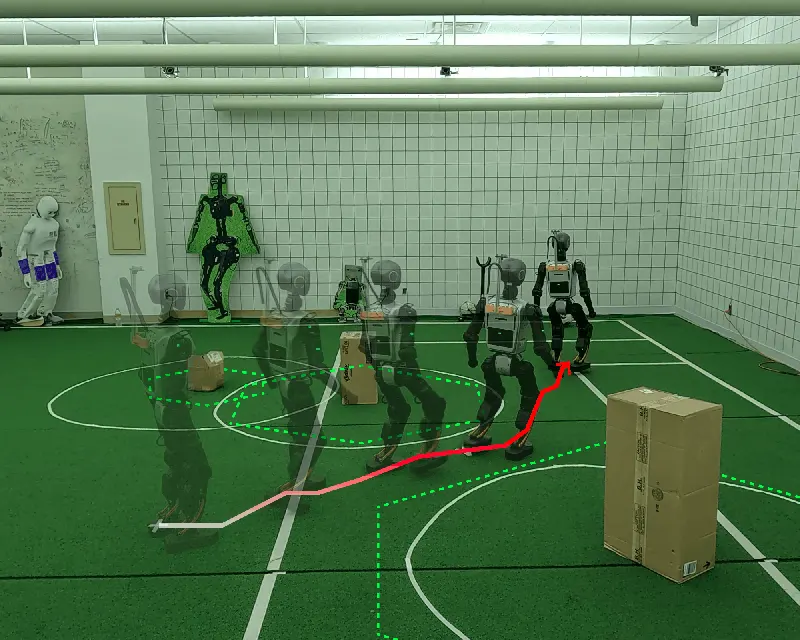
Humanoid navigation in dynamic environments requires long-horizon planning while respecting short-horizon dynamic and safety constraints. Classical visibility-graph planners combined with model predictive control (MPC) can efficiently generate collision-free trajectories, but their performance depends on manually tuned parameters and accurate system modeling. In real robotic systems, control delays, state-estimation noise, and locomotion uncertainties can cause overshoot and constraint violations even when the nominal path is geometrically optimal. We propose RAVEN, a hierarchical reinforcement learning (RL)-MPC framework for robust humanoid navigation. Unlike prior approaches that use learning to tune cost weights or replace planning entirely, RAVEN employs RL to adapt the geometric construction of a visibility-graph planner by modifying obstacle inflation and related graph parameters. By directly reshaping the free-space geometry, the learned planner alters the topology of the global path to compensate for delay and tracking imperfections. A collision-free MPC layer then tracks the planned trajectory while explicitly enforcing velocity bounds and obstacle-avoidance constraints. By training under realistic delays and observation noise, RAVEN learns planning adaptations that improve robustness while retaining explicit long-horizon geometric planning and constrained optimization, in contrast to end-to-end learning approaches. We evaluate RAVEN against a manually tuned visibility-graph MPC baseline and a pure RL navigation policy. Results demonstrate reduced overshoot near obstacles, improved robustness in narrow passages, and more reliable navigation under delay and noise. These findings indicate that reinforcement-adaptive graph construction combined with constrained MPC provides an effective and interpretable alternative to end-to-end learning for robust humanoid navigation.

Ruochen Hou, Shiqi Wang, Beom Jun KimJul 17, 2026
MPCNavigationGait optimizationJul 17, 2026