Skip to content
Tags

#Vision-language models (8)

Try Once, Then Optimal: De-Redundified Procedure Memory for Cross-Episode Exploration Amortization

Try Once, Then Optimal: De-Redundified Procedure Memory for Cross-Episode Exploration Amortization

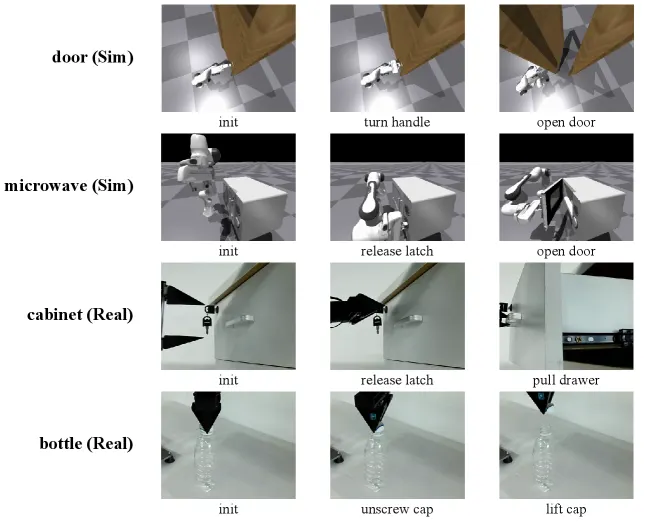
Manipulating objects with hidden internal state, such as a latched microwave, forces a robot to probe before it can act. Yet a robot that has solved an instance once re-runs the same probes whenever it encounters that instance again, because existing cross-episode memories target task success and organize reuse around states, not the object or the cost of re-exploring it. We present Instance-Oriented Memory (IOM), an object-centric framework that amortizes this exploration: from a single encounter that uncovers the hidden state, whether or not it succeeds, IOM records a short procedure for manipulating that instance, keys it on the object's identifiable features, and injects it as a soft bias on a procedure-conditioned policy. A later encounter recognizes the object and recalls its procedure instead of re-exploring. We instantiate this distillation with an off-the-shelf vision-language model (VLM) that parses each encounter into the procedure without task-specific training. Across four articulated-object tasks, two in simulation (microwave, door) and two on a real robot (bottle, cabinet), an oracle procedure memory cuts manipulation operations by 16-30% over re-exploration at non-regressing success, and the VLM instantiation recovers 69-88% of that saving out of the box. Because the procedure is a soft bias on a feedback-driven policy, an incorrect memory is recovered from rather than obeyed: success holds even when a retrieved procedure is wrong, as for ≈12% of door instances. Across all tasks the benefit is purely one of efficiency: success never regresses, and on the real robot even improves. Code will be released upon acceptance.

Haizhou Ge, Haochen Ouyang, Zhixing ChenJul 26, 2026
Vision-language modelsJul 26, 2026
PathScale-R1: Cross-scale Reasoning for Pathological Image Analysis

PathScale-R1: Cross-scale Reasoning for Pathological Image Analysis

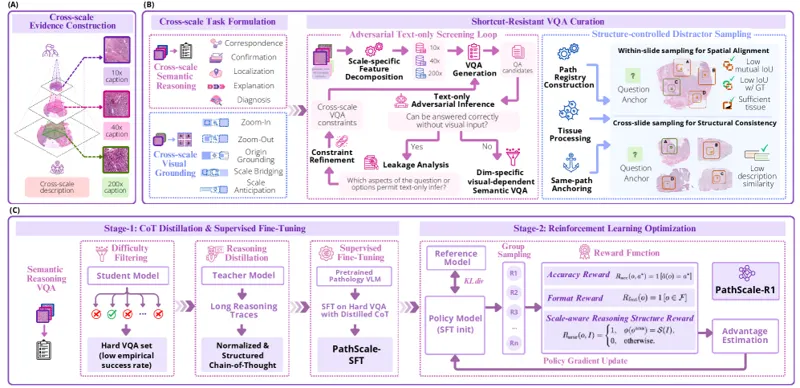
Pathological diagnosis is inherently multi-scale, requiring the integration of global tissue architecture at low magnification with cellular morphology at higher magnification. However, existing pathology benchmarks and vision-language models (VLMs) are still largely developed under single-scale settings, limiting their ability to learn clinically meaningful multi-magnification reasoning. Moreover, naively constructed visual question answering (VQA) tasks may be susceptible to text-only or superficial visual shortcuts, leading to unreliable assessments of visual understanding. To address these limitations, we introduce a benchmark and training framework for shortcut-resistant cross-scale pathology reasoning. We design an Adversarial Text-only Screening strategy for semantic reasoning questions and a Structure-controlled Distractor Sampling strategy for visual grounding questions, encouraging models to rely on cross-scale visual evidence. Based on this pipeline, we construct PathScale-VQA, a high-quality cross-scale pathology VQA benchmark with 10,373 multiple-choice questions grounded in 1,368 diagnostic paths across multiple magnification levels. Building on the semantic reasoning set, PathScale-R1 is optimized through Difficulty-driven Reasoning Distillation supervised fine-tuning followed by reinforcement learning with a Scale-aware Reasoning Structure reward, which encourages the use of evidence across magnifications. Extensive experiments demonstrate state-of-the-art performance of PathScale-R1 on cross-scale reasoning tasks and effective transfer to conventional single-scale pathology VQA. Our code is available at https://github.com/iMVR-PL/PathScale-R1.

Chi Phan, Tianyi Zhang, Yufeng WuJul 26, 2026
Vision-language modelsJul 26, 2026
Memory for Attention: Language-Conditioned Re-Perception with a Vision–Language–Motion Map

Memory for Attention: Language-Conditioned Re-Perception with a Vision–Language–Motion Map

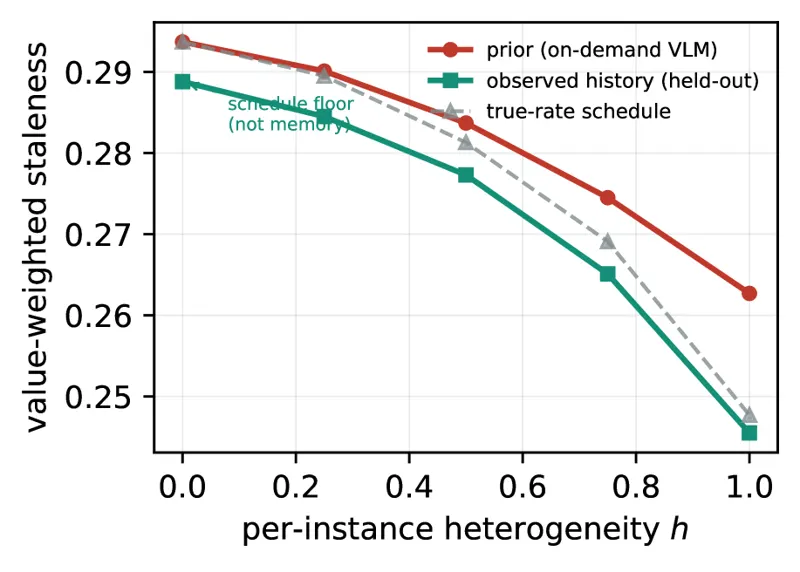
A robot carrying a persistent, behavior-annotated map faces two planning questions, and its memory answers only one well. The spatial-navigation question – how to walk around a room – we address first and report a negative: building on Vision–Language–Motion Maps (VLMM), a behavior-aware planner cost cuts a planning-time objective by ∼35% over 28 AI2-THOR scenes, but under closed-loop execution the real benefit nearly vanishes (∼4%) and an on-demand vision–language model (VLM) does as well. The resource-allocation question differs: under a limited perception budget, what should the robot re-observe now to keep its map fresh? Framing re-perception as this attention decision, we show a persistent map's memory (change-history, or even just recency of last sighting) yields the best schedule (held-out), matching an oracle, while the memoryless VLM prior is poor. Because the schedule reallocates budget toward what matters, memory's benefit concentrates on the important objects (∼1.6× the mean), and a downstream fetch task confirms fewer wasted trips; the gain grows with per-instance heterogeneity exactly as a Cauchy–Schwarz bound predicts – it equals Var(λ), the variance of root-volatility. With a real CLIP prior on rendered objects the advantage is +21–26%. The map's distinctive value appears when the task is language-conditioned: told what to track, VLMM grounds the relevant objects (open-vocabulary) and tracks their change (memory), beating even a strong relevance-weighted recency baseline (+2.5%) – so its motion channel adds value beyond a last-seen timestamp – and an on-demand VLM (+8.9%); neither language nor dynamics alone suffices. The map earns its keep not by telling the robot how to walk around a room, but by telling it what to pay attention to.

Dibyendu GhoshJul 26, 2026
Vision-language modelsJul 26, 2026
Be Consistent! Enhancing Robust Visual Reasoning in LVLMs with Consistency Constraints

Be Consistent! Enhancing Robust Visual Reasoning in LVLMs with Consistency Constraints

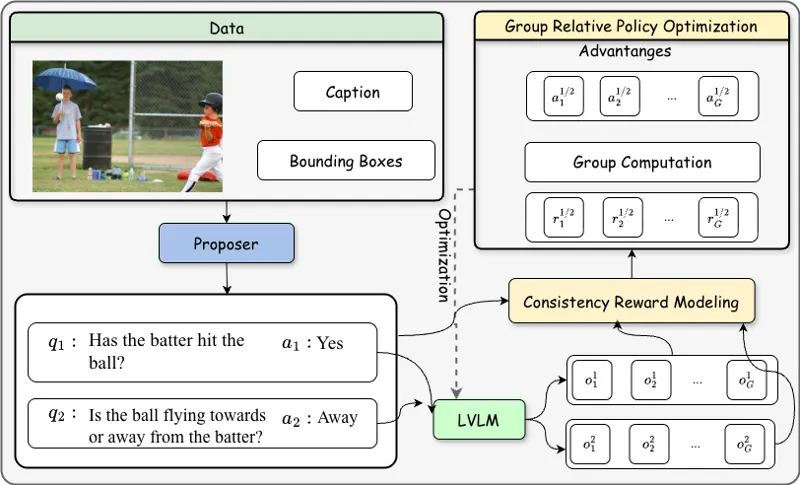
While Large Vision-Language Models (LVLMs) exhibit strong perceptual capabilities, they remain vulnerable in visual reasoning tasks. Existing benchmarks largely focus on symbolic mathematical or scientific problems and simple vision-centric tasks, offering limited assessment of complex visual reasoning and logical consistency, a critical requirement for reliable reasoning systems. We introduce ConVBench, a complex vision-centric reasoning benchmark in which each image is paired with two logically equivalent questions across six categories: action and state, complex counting, spatial reasoning, causal and intent understanding, commonsense reasoning, and temporal perception. To complement this benchmark, we define two evaluation metrics, logical consistency and robust accuracy, that jointly assess both the correctness and consistency of model responses. We further present ConVLM, which improves LVLM reasoning through Group Relative Policy Optimization (GRPO)-based reinforcement learning with a novel consistency reward. This method leverages automatically generated logically equivalent question-answer pairs and a dual-reward design combining accuracy- and consistency-based signals, encouraging agreement between paired responses. The framework functions effectively with or without strict answer supervision.

Liqiang Jing, Xiong Zhou, Siddharth VariaJul 23, 2026
LVLMVisual ReasoningConsistencyJul 23, 2026
Agentic Real2Sim: Physics-based World Modeling with Vision-Language Agents

Agentic Real2Sim: Physics-based World Modeling with Vision-Language Agents

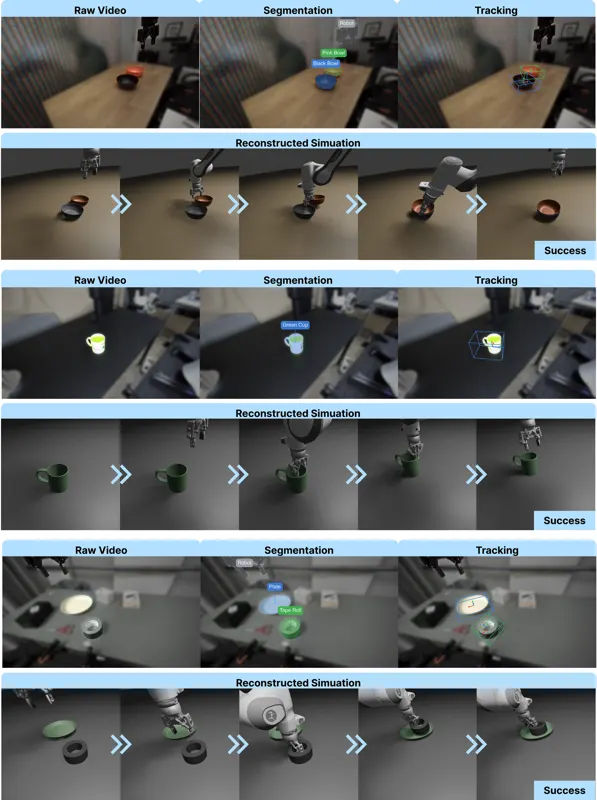
Real-to-sim conversion for robotic interaction with objects remains labor-intensive because it requires more than visual reconstruction: a streamlined real2sim process must recover scene geometries and object states, infer physical parameters, and assemble actors, objects, cameras, poses, and trajectories into a runnable physical simulation. Today this process still depends on manual tuning of visual foundation models, mesh cleanup, coordinate-frame alignment, and brittle workflow glue across visual perception tools and simulators. We introduce Agentic Real2Sim, a framework for generalized physical world modeling with vision-language agents, converting a real-world recording of object-robot interaction into a simulatable episodic twin which preserves observations, geometries, robot interactions, and object states. We evaluate Agentic Real2Sim on rigid-object manipulation, deformable-object interaction, and humanoid motion scenes, spanning domains that are usually handled by separate Real2Sim pipelines, marking a first step toward scalable conversion. The framework's agentic decisions can be driven by an open-weight VLM backend at a small fraction of the cost of frontier models, while attaining comparable conversion success rate. We aim to use the resulting real-world-aligned twins for downstream robotics tasks, specifically policy learning and evaluation. The project site is available at https://agentic-real2sim.github.io/.

Guanxiong Chen, Qianjun Xia, Jiawei PengJul 21, 2026
Sim-to-RealWorld ModelsVision-language modelsJul 21, 2026
STeP: Signal Temporal Logic for Precise Specifications for Action Generation with Vision Language Models

STeP: Signal Temporal Logic for Precise Specifications for Action Generation with Vision Language Models

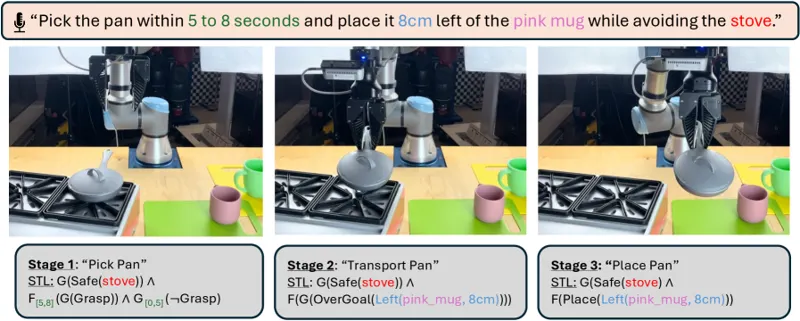
Vision-language-action (VLA) models have shown impressive generalization, but often lack interpretability and can struggle to follow precise natural language instructions that encode spatial, temporal, and logical requirements. We propose a hierarchical framework that uses Signal Temporal Logic (STL) as a shared representation connecting high-level language understanding with low-level robot execution. A high-level policy leverages a VLM to decompose language instructions into high-level subtasks, generate STL specifications for each subtask, and choose a low-level policy for executing each subtask. The STL specifications translate language-derived intent into precise constraints, and the low-level policy selection determines whether those constraints are enforced directly through STL-guided model-predictive control or monitored during execution of a learned policy for perceptually complex, or contact-rich behaviors. By integrating STL into plan validation, low-level policy, subtask monitoring, and replanning, our framework enables language-derived plans to be checked, optimized, and revised at runtime using a common formal structure. We evaluate the approach on a real-world tabletop domain, demonstrating how formal specifications can improve the precision, reliability, and interpretability of language-conditioned robot planning.

Kasra Torshizi, Anukriti Singh, Sidharth MathurJul 20, 2026
Vision-language modelsTemporal LogicMotion GenerationJul 20, 2026