Skip to content
Tags

#World-action models (12)

SimWAM: A Simple World Action Model for End-to-End Autonomous Driving

SimWAM: A Simple World Action Model for End-to-End Autonomous Driving

World-Action Models (WAMs) improve end-to-end autonomous driving by transferring video dynamics priors to action prediction, but existing methods require costly future generation at inference. We present SimWAM, a simple yet effective WAM that uses video generation purely as a training signal. It co-trains a pretrained video expert and a lightweight action expert with joint flow matching. An isolated attention mask keeps action prediction independent of future frames, allowing the video branch to be discarded after training and leaving a self-contained planner that directly predicts trajectories. Since the two experts share no parameters and interact only through a unified attention interface, the video backbone could be replaced and the action expert scaled independently without modifying the learning objective or inference pipeline. We further apply reinforcement learning to optimize a compositional driving reward beyond trajectory imitation. Our SimWAM achieves $91.5$ PDMS on NAVSIM, surpasses state-of-the-art WAM-based planners with substantially lower latency, and transfers zero-shot to nuScenes. These results position SimWAM as a simple yet solid baseline that could readily benefit from advances in video generation for efficient autonomous driving. The code and model weights are available at https://github.com/H-EmbodVis/SimWAM/

Zongchuang Zhao, Xin Zhou, Tianyang XuAug 7, 2026
NAVSIMSimWAMWorld-action modelsAug 7, 2026
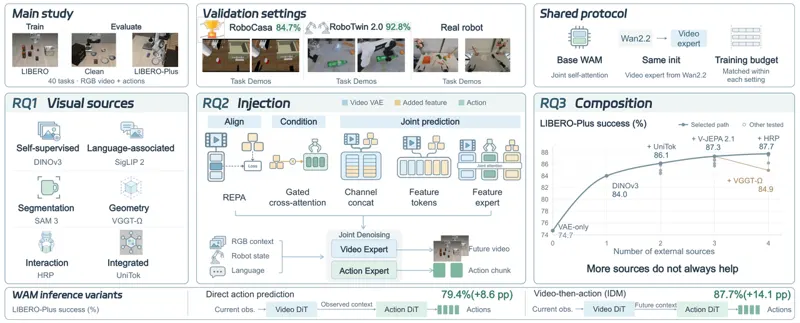
Robust-WAM: Bridging Generative Pretraining and Semantic Foresight in World-Action Models

Robust-WAM: Bridging Generative Pretraining and Semantic Foresight in World-Action Models

Mainstream World-Action Models (WAMs) adapt pretrained video generation models (VGMs) for robot control, transferring their learned dynamics prior for action prediction. These VGMs are typically trained in a variational autoencoder (VAE) latent space. However, the VAE latent space is optimized for pixel reconstruction, which rewards fine appearance detail and leaves the action prediction fragile under visual shifts. Recent works build WAMs in semantic latent space, which are more robust to appearance shifts. However, these models cannot leverage the large-scale VGM pretraining that exists only in VAE space. To overcome this dilemma, we propose Robust-WAM, a general post-training method for video-generation-based WAMs that preserves the VAE-based generative path and adds a lightweight semantic foresight alignment objective on the action stream. This retains the large-scale VGM pretraining while grounding actions in appearance-invariant dynamics that stay reliable under illumination shifts and other visual out-of-distribution conditions. Specifically, we employ learnable query tokens to bring future-scene semantics into the action stream by aligning their output hidden states with the semantic foresight of future ground-truth frames. To establish the temporal correspondence between each query and the future step it describes, we give it the positional encoding of the matching action tokens. Experiments on out-of-distribution generalization simulation benchmarks and a real-robot setup show that our Robust-WAM consistently improves the success rates of multiple WAM baselines without sacrificing in-distribution performance.

Haodong Yan, Junfeng Li, Junjie HeAug 6, 2026
VAERobust-WAMWorld ModelsAug 6, 2026