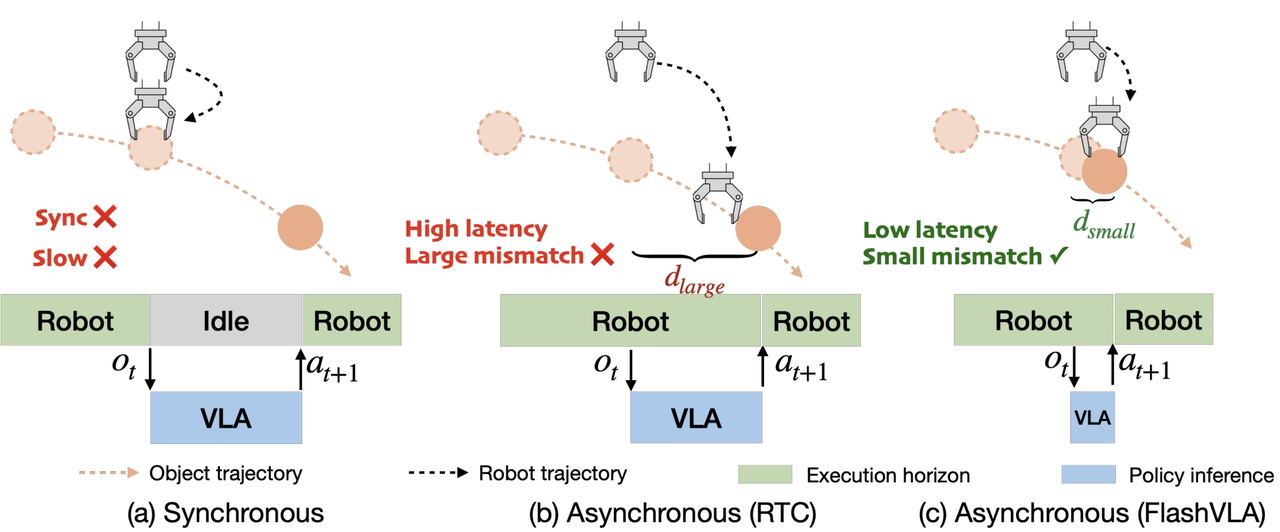
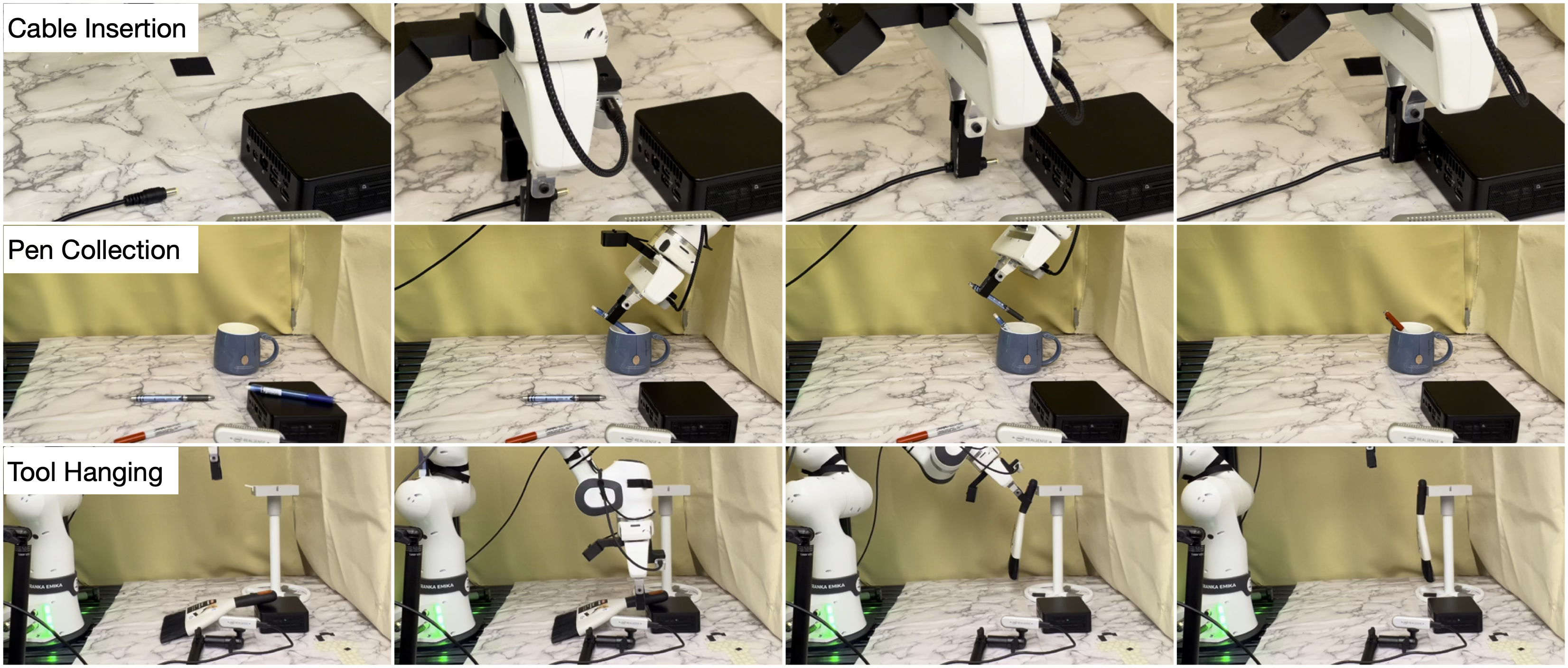
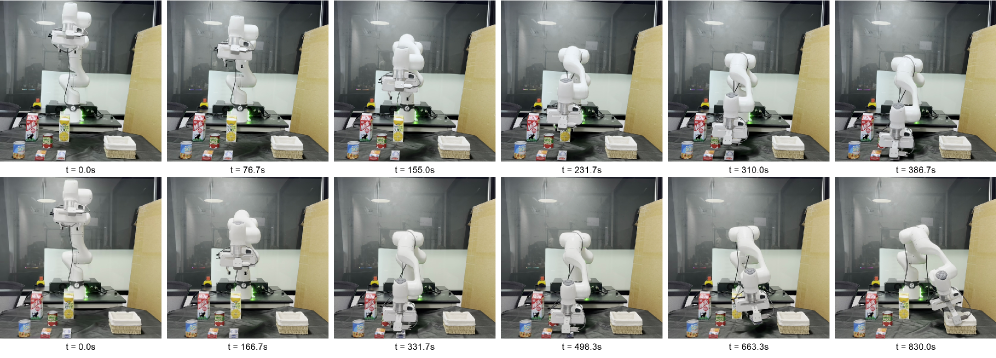
Vision-Language-Action (VLA) models are increasingly promising for robotic manipulation, yet their real-world deployment remains bottlenecked by high inference latency and unstable asynchronous execution. This challenge is particularly pronounced in flow-matching-based VLA models, where action decoding requires multiple iterative steps conditioned on the VLM context. While efficient inference methods improve control frequency and asynchronous methods reduce execution idle time, existing approaches often fail to jointly achieve low-latency inference and accurate, temporally consistent asynchronous execution. We introduce \textbf{FlashVLA}, a streaming action decoding framework that addresses both challenges in a unified formulation. FlashVLA maintains a streaming action buffer with multiple chunks at different noise levels and decodes them using chunk-wise causal attention. This design allows FlashVLA to produce one executable action chunk per inference step. Moreover, its chunk-wise autoregressive formulation implicitly preserves action continuity, enabling smooth asynchronous execution without extra future-state conditioning. Across extensive simulated and real-world experiments, FlashVLA substantially improves inference speed while maintaining strong task performance. It can achieve $\geq$30\,Hz control frequency on a single GPU with smooth asynchronous inference in real-world deployment.
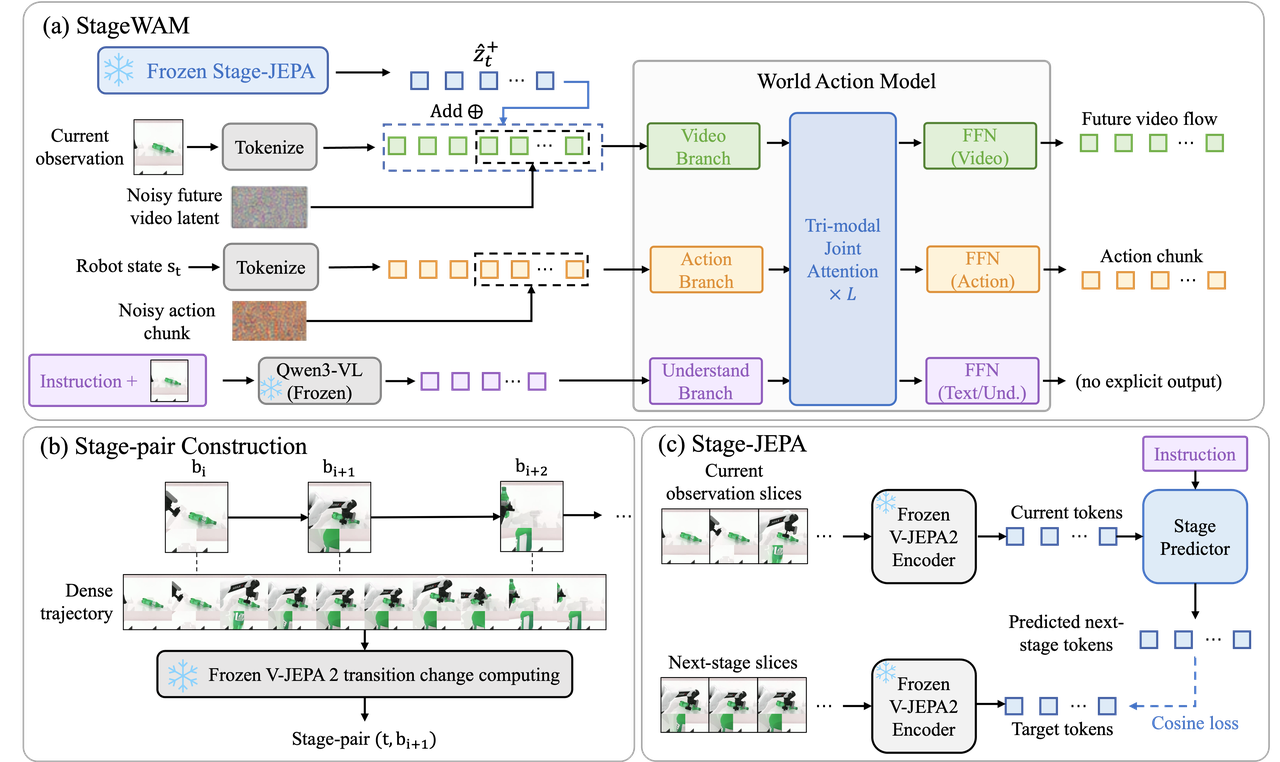
Generalist robot policies aim to map multimodal observations and linguistic task instructions to actions across diverse tasks. However, existing methods typically represent the future as a fixed, short video-action chunk. This short-term future captures local scene evolution for action execution, but it does not explicitly describe the stage-level future that specifies how a task should progress from its current stage to the next. We therefore distinguish two complementary futures for robot manipulation: a short-term physical future to capture local scene evolution and a stage-level semantic future to represent task progress. We introduce StageWAM, which augments a Motus-based World Action Model (WAM) with Stage-JEPA, a goal-conditioned Joint-Embedding Predictive Architecture (JEPA) predictor. Given the current observation and task instruction, Stage-JEPA uses a frozen V-JEPA2 encoder to extract the current-state representation and predicts the latent target of the next inferred stage. Across 50 RoboTwin 2.0 tasks in clean and randomized environments, StageWAM achieves 90.25% overall success and reduces the mean number of execution steps in successful rollouts by 5.97% relative to the strongest baseline.
Action chunking---predicting and executing multiple actions instead of a single action---has proven to be a critical component for learning effective robotic control policies. However, our precise understanding of why action chunking improves performance has remained limited. In this work we seek to close this gap. Through rigorous experimental evaluations in both simulated and real-world settings, we show that existing hypotheses for the success of action chunking---temporal consistency, horizon reduction, and representation learning---fail to explain the success of action chunking. Instead, we find that action chunking benefits from greater non-Markovian expressivity and reduced compounding error compared to Markovian policies, but, in many settings of interest, these effects can be fully captured by delayed policies, which at each step predict a single action based on the observation $k$ steps in the past. We then show that there exists an additional benefit of action chunking that we refer to as implicit ensembling. In particular, by learning a diversity of temporal relationships (that is, $a_t | o_t, a_t | o_{t-1}, \ldots$), action-chunked policies exhibit behavior matching that of a model ensemble, increasing their robustness and generalization ability over policies that only learn a single temporal relationship. Building on these insights, we show that in simulated and real-world robotic control settings, we can match the performance of action chunking without action chunking---by deploying an action chunking policy as an ensemble of policies with randomized delays. Furthermore, we propose a policy class that amplifies the benefits of action chunking by explicitly instantiating an ensemble, and which we show significantly improves over the performance of action chunking in many domains.
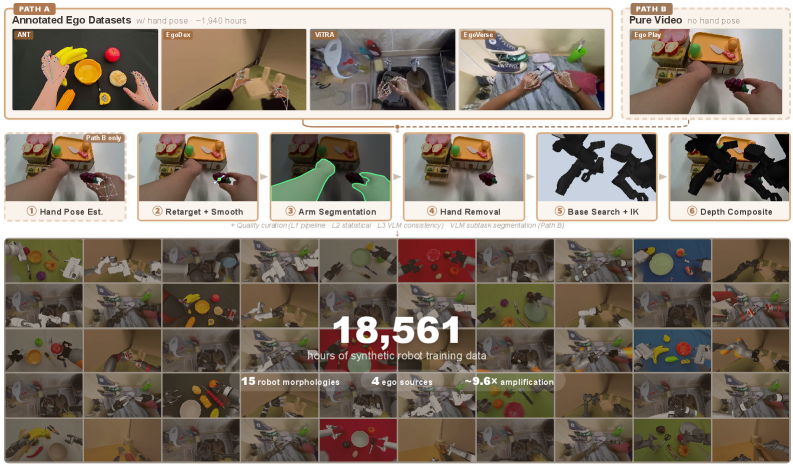
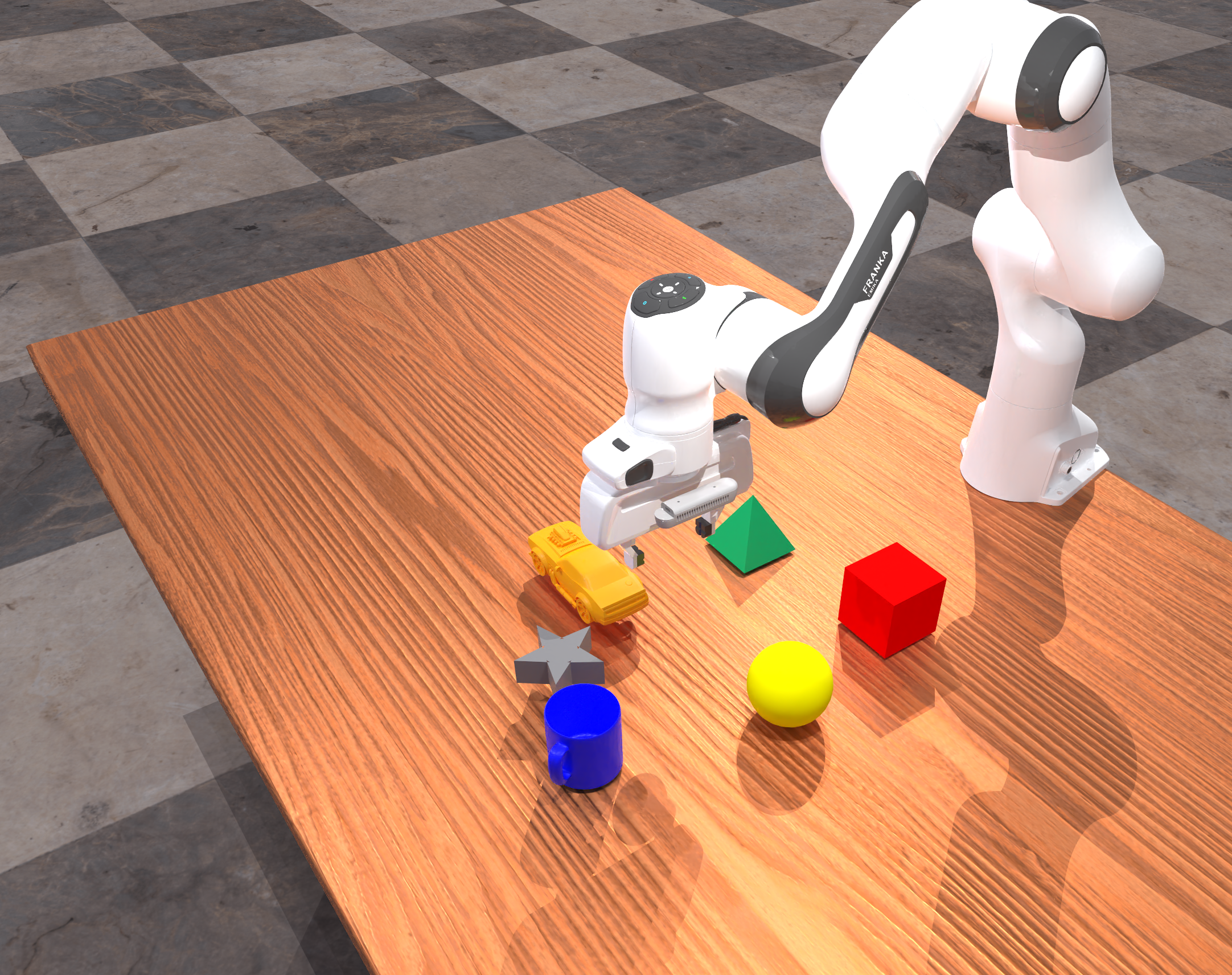
Learning generalizable robot manipulation policies requires large-scale and diverse demonstration data. Egocentric human manipulation videos offer rich scene and task diversity, and prior work has shown that retargeting and rendering such videos into robot-format data can yield effective per-task policies at small scale. However, whether this approach can provide pretraining benefits for vision-language-action models at scale remains unexplored. We present \textbf{Ego2Robot}, a scalable pipeline that converts egocentric human manipulation videos into robot training data through action retargeting, robot-arm visual synthesis, and multi-level quality curation. Ego2Robot supports both curated datasets and in-the-wild videos, producing 18,561 hours of robot training data spanning 15 robot morphologies, making it the largest ego-to-robot dataset to date. To evaluate generalization, we extend RoboTwin2.0 with disentangled perturbation axes covering visual appearance, scene layout, embodiment morphology, and task semantics. Experiments show that joint pretraining on Ego2Robot-synthesized and robot data consistently improves out-of-distribution generalization across multiple perturbation types, with benefits validated on real-robot deployment. Project page: https://www-ye.github.io/ego2robot_blog/
Pretrained dense visual features from Vision Transformers (ViTs) are powerful yet have been underutilized in robot learning. Modern robot policies either compress each observation into a single global token, or rely on visual backbones trained from scratch, sacrificing both fine-grained spatial detail and the benefits of large-scale visual pre-training. While there exist policies that do operate on dense patch features like large vision-language-action models (VLAs), they tend to be heavy and slow, inheriting the full cost of a billion-parameter vision-language model (VLM) backbone. We close this gap with Patch Policy, a minimal architectural extension that enables transformer-based policies to consume dense pre-trained patch tokens directly without the computational overhead of a full VLM. At its core is a block-causal attention mask that preserves the temporal causality of standard policies while letting the model attend over many patch tokens per observation, alongside other state information. Patch Policy is lightweight, fast, and highly effective. Across four simulated and three real-world environment suites, our method achieves a 40% relative improvement over policies using state-of-the-art global-pooled representations. Furthermore, it surpasses fine-tuned OpenVLA-OFT by 18% while using roughly 0.7% of the parameters. We believe Patch Policy provides a pipeline for the robotics community to readily leverage continuing progress in visual representation learning, without sacrificing the training efficiency or inference speed required for high-frequency, reactive control. Videos can be viewed at https://patch-policy.github.io
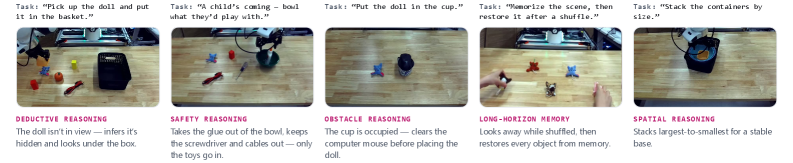
General-purpose robots need to reason about their actions, combining perception, world knowledge, planning, success detection, recovery, and low-level control. Today's state-of-the-art models attempt to combine all these capabilities into the learned policy via large-scale pre-training. Instead, we show that these capabilities can be decomposed into a general language-conditioned policy/control agent and a high-level agent manager/orchestrator. Rather than training policies to reason via pre-training, we build a closed-loop physical agent orchestrator that can do high-level planning, decompose the goal into achievable subgoals, command low-level motor commands, track and verify the outcome from low-level observations, and recover from failures. Our Physical Agency orchestrator (Pigey) can control existing vision-language-action (VLA) policies as well as parametrized skills to solve complex reasoning tasks in the real world, without any additional data collection or post-training. We evaluate Pigey extensively across simulation benchmarks and challenging real-world robotic manipulation tasks, and demonstrate significant performance improvements over existing generalist policies. On LIBERO-PRO, Pigey advances the state-of-the-art by over 4x (12.8% -> 53.3%) with no task-specific fine-tuning. On a real robot, Pigey lifts the frozen policy from near-zero to over 90% on reasoning-limited tasks. We call the difference between what frozen motor skills achieve alone and inside the agentic loop the orchestration gap.
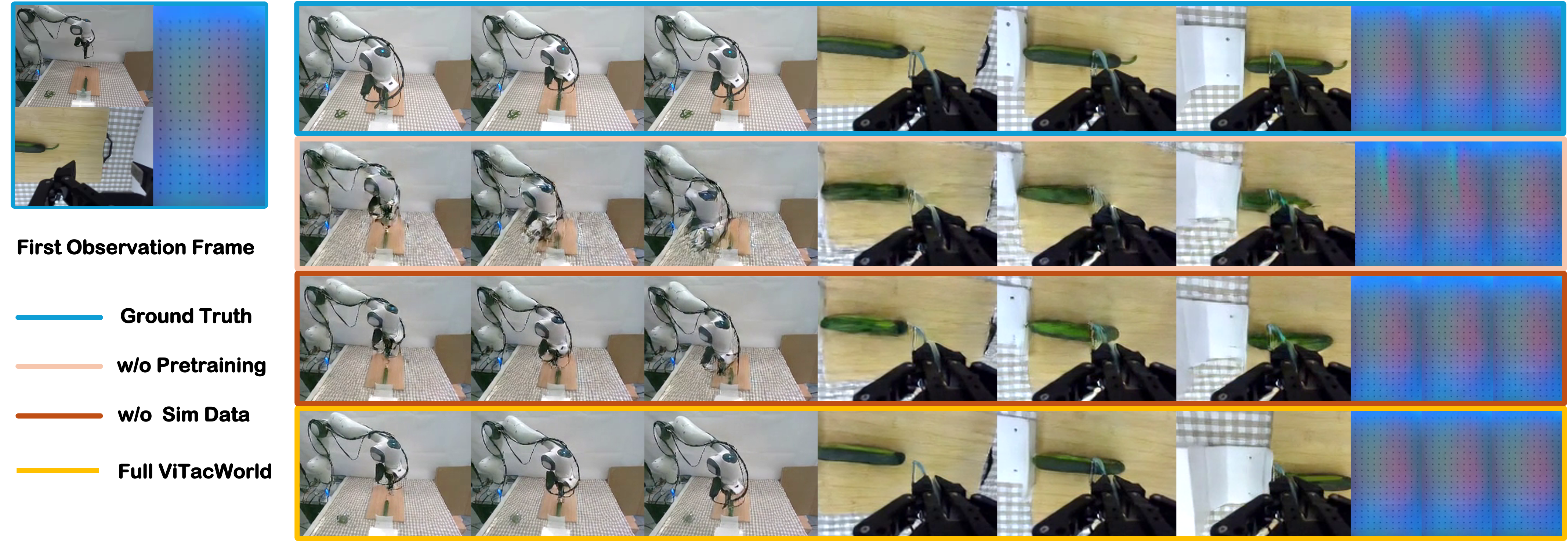
Contact-rich robot manipulation requires physical interaction cues that are often invisible to cameras, making tactile sensing essential for robust control. However, scaling visuo-tactile robot learning remains difficult because real tactile interaction data are expensive to collect, hardware-dependent, and limited in task and scene diversity. We present ViTacWorld, an action-conditioned visuo-tactile world model for scalable contact-rich robot manipulation. ViTacWorld leverages public real tactile datasets and a constructed simulation environment to scale visuo-tactile-action data, exploiting the fact that tactile signals are directly grounded in physical contact and can exhibit a smaller simulation-to-real gap than purely visual observations. The model is first pretrained with large-scale real and simulated visuo-tactile trajectories, and then finetuned with real-world policy rollouts to better match downstream manipulation behaviors. Given robot actions, ViTacWorld predicts temporally aligned visual observations and tactile feedback, enabling visuo-tactile-action rollout generation. To the best of our knowledge, ViTacWorld is the first framework that uses a world model for robot visuo-tactile-action trajectory generation and policy evaluation. It serves two roles: synthesizing rollouts to improve downstream tactile policies, and evaluating policies by predicting action-conditioned visuo-tactile outcomes under controlled action sequences. Experiments on contact-rich manipulation tasks show that ViTacWorld generates physically meaningful rollouts, improves policy performance through scalable data augmentation, and enables action-conditioned policy evaluation. Project page: https://vitacworld.github.io/
Compositional generalization is essential for robot to follow diverse instructions. However, pretrained policies are known to take shortcuts, deferring to salient cues rather than grounding language. We introduce a diagnostic framework that localizes this failure to individual \textit{instruction factors}, \textit{e.g.,} reusable semantic components such as color, verb, object, size, and spatial attribute. Our framework formalizes instruction factor bias, the tendency of fine-tuned policies to over-rely on dominant factors as shortcuts, and quantifies it through two metrics: Factor Dominance Rate (FDR), capturing pairwise bias between factors, and Factor Dominance Hierarchy (FDH), aggregating these into a global ranking. Evaluation on six foundation policies reveals broadly consistent ordering, \textit{i.e.}, color $\geq$ object $\geq$ spatial $\geq$ verb $\geq$ size, with color dominant, and verb and size most under-grounded. We further show the diagnosis is actionable: a bias-aware data collection strategy that reallocates a fixed budget toward under-grounded factors outperforms baselines in simulation and on a real robot using half the demonstrations, thereby enabling more sample-efficient and generalizable policy learning.
Learning effective robot manipulation policies requires diverse, high-quality demonstrations, yet existing data pipelines are often difficult to scale because they rely on specialized hardware, centralized operators, or fixed task suites. We present AXIS, a growable community-driven data engine and benchmark for scalable robot learning, which enables browser-based teleoperation for large-scale demonstration collection, automatically generates and validates new manipulation tasks, and transforms community-collected demonstrations into training-ready data through automated success checking, quality filtering, trajectory smoothing, and visual and physics-based augmentation. The AXIS dataset currently contains 207 diverse tasks and 50K+ trajectories. Meanwhile, AXIS organizes data into task snapshots and evaluates policies with a systematic held-out protocol. We compare vision-language-action (VLA) policies under a unified AXIS evaluation suite and analyze scaling behavior across different data volumes. Continual pretraining on AXIS substantially improves the overall success rate of $π_{0.5}$ by 5.8%, outperforms the model pretrained on RoboCasa365 by 37.3%, and exhibits consistent scaling with increasing data volume, with the largest gains observed under layout, sensor-noise, and camera perturbations.
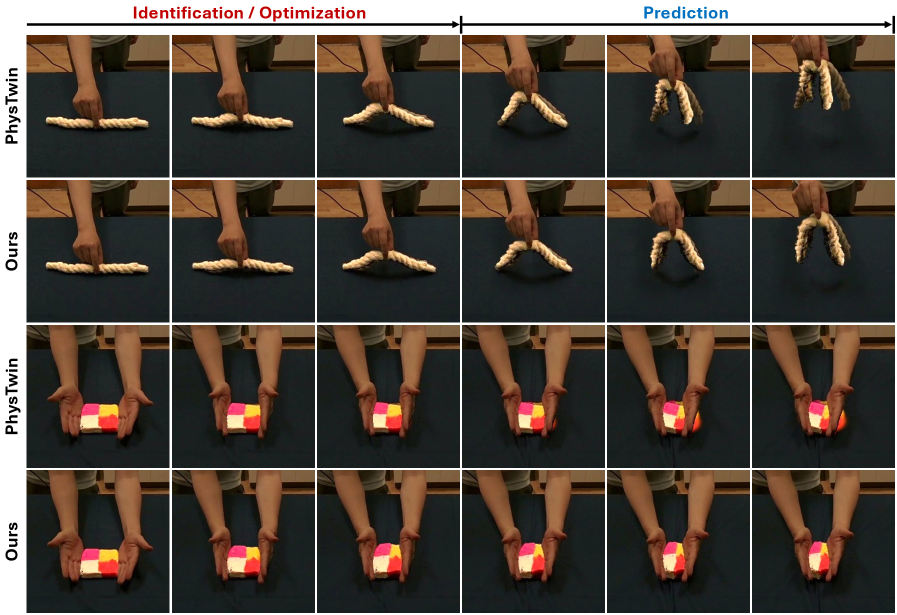
Predicting how deformable objects evolve under robotic manipulation is a longstanding challenge. Existing approaches typically rely on per-object optimization to fit material parameters, which can be slow and cannot generalize, while end-to-end learned alternatives extrapolate poorly and often violate basic physical structure. We present PhysCoRe, a physics-corrected residual world model that couples a differentiable Material Point Method (MPM) simulator with two feed-forward neural networks. A material refinement module, Material from Motion (MfM), infers per-particle elasticity from visual observations, grounding the simulator in object-specific physics. A residual correction module, Residual from Dynamics (RfD), learns the discrepancy and predicts corrections to the simulator's internal dynamics, absorbing systematic biases that the analytical model cannot capture. This design also supports online material identification on novel objects. MfM adapts from limited interactions, and its predictive uncertainty steers further exploration toward the regions where its estimate is least confident. Experiments on real deformable-object manipulation sequences show that PhysCoRe outperforms state-of-the-art baselines in prediction accuracy, and that its predicted confidence forms a reliable distribution across the object's geometry, providing a natural signal for future confidence-guided exploration.