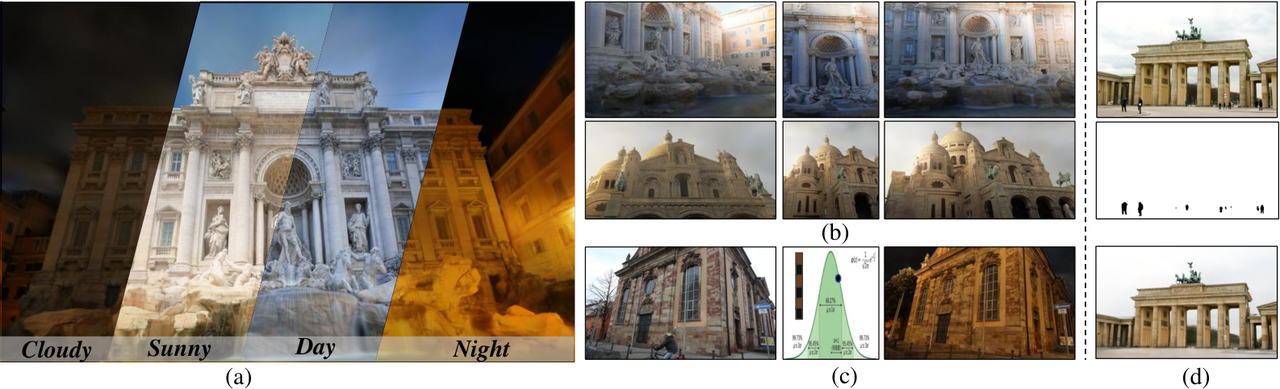
3D Gaussian Splatting (3DGS) delivers real-time and high-fidelity rendering but remains challenged by unconstrained in-the-wild scenes, where drastic appearance variations and transient objects violate multi-view consistency. Existing methods are fundamentally limited by independent and discrete embeddings that struggle to capture continuous environmental changes or model spatially-varying local illumination. To address these limitations, we propose \textbf{WilLaGS}, a unified framework for robust 3D scene reconstruction and generative appearance synthesis under unconstrained settings. Specifically, we introduce a generative appearance model where a $β$-VAE learns a structured and continuous manifold of global appearance. Conditioned on the latent code, we construct a 3D neural appearance field that generates dynamic Tri-Plane features to encode spatially-varying local illumination effects. Furthermore, to suppress transient artifacts, we present a self-supervised perceptual masking mechanism that leverages a Teacher-Student (EMA) architecture to derive a stable scene consensus, robustly identifying inconsistent regions via perceptual discrepancies. Extensive experiments on multiple datasets demonstrate that \textbf{WilLaGS} achieves state-of-the-art performance in reconstruction quality and novel view appearance synthesis, while maintaining real-time rendering efficiency.
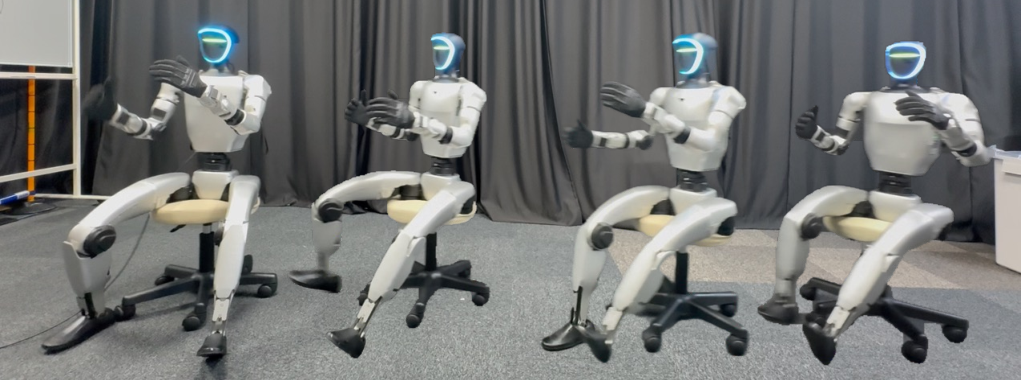
Research on omnidirectional seated locomotion for humanoids on passive chairs. Policies use proprioception only, outperforming standing in tracking. Analyzes regularization effects on convergence.
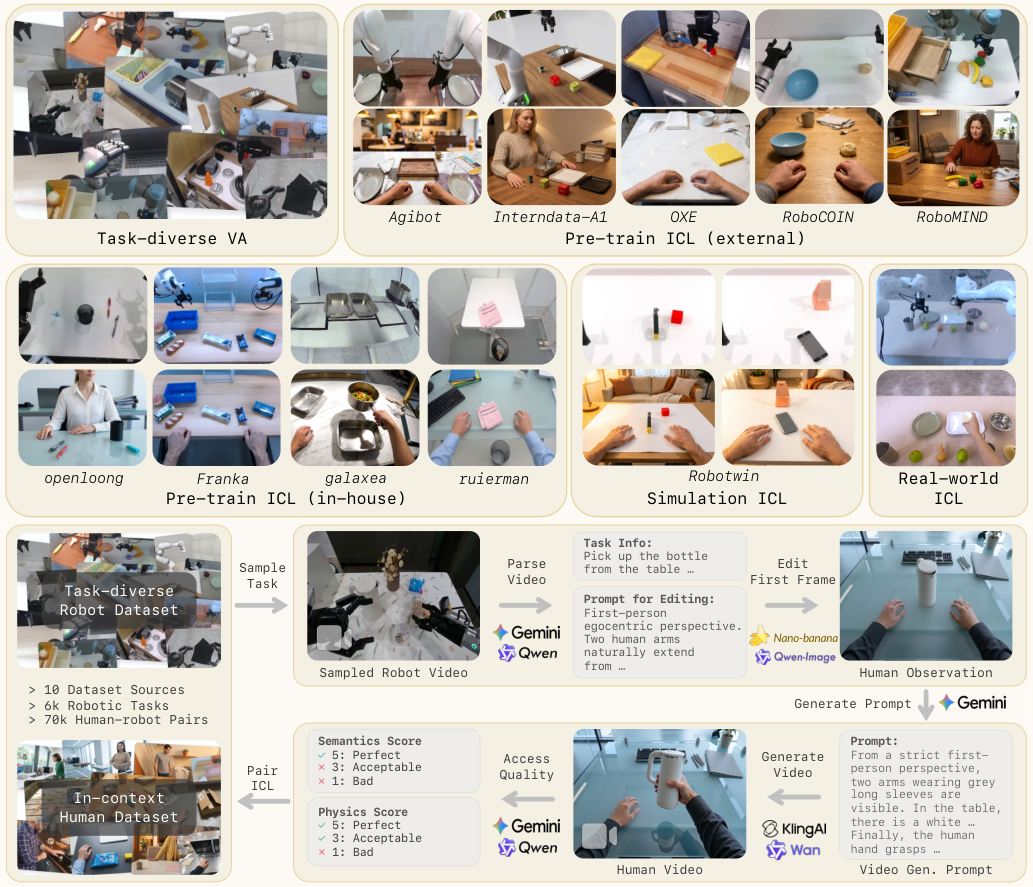
Zero-shot cross-task generalization, where a policy must execute manipulation tasks never seen during training, remains a central challenge in robot learning. In large language models, a novel task can be performed simply by specifying it in the context, without any parameter update. This form of in-context learning (ICL) turns generalization into a problem of task specification. To achieve cross-task generalization, we bring this paradigm to robotic manipulation, and argue that the natural task specification for manipulation is a human video: unlike language, it provides rich visual cues about the intended task evolution. We present Zero-WAM, a causal video-action model that executes unseen tasks by following in-context human video guidance. To address the scarcity of task-rich paired human-robot data, we propose an automatic pipeline that converts task-sampled robot trajectories into semantically matched human videos, yielding HumanGen, a dataset of 74.2K human-robot ICL pairs across 8.6K tasks. For model training, we further introduce an in-context future chunk prediction (IFP) objective that suppresses shortcuts learned from seen tasks and forces the policy to draw task information from the video prompt. On seven unseen tasks in RoboTwin 2.0 simulation, Zero-WAM achieves a 47.0% average success rate, an absolute improvement of 29.5 percentage points over the strongest video-action baseline. In real-world evaluations, it follows human video guidance to generalize to unseen task configurations involving multi-object scenes, long-horizon manipulation, and fine-grained insertion.
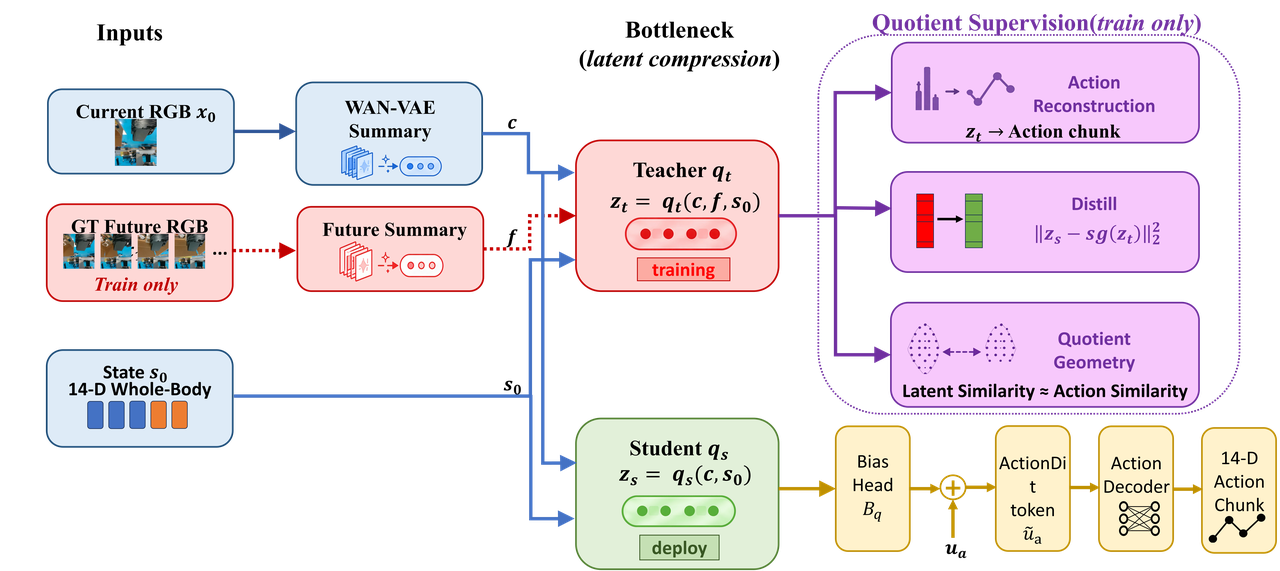
DECOWAM adapts a frozen FastWAM video-action backbone to legged mobile manipulation via decoupled interfaces — an action-equivalent future bottleneck, adversarial base/arm factorization, and ego-motion-aware video conditioning — cutting Stage-2 trainable parameters 232x while leading real-robot deployment at 58.2% success.
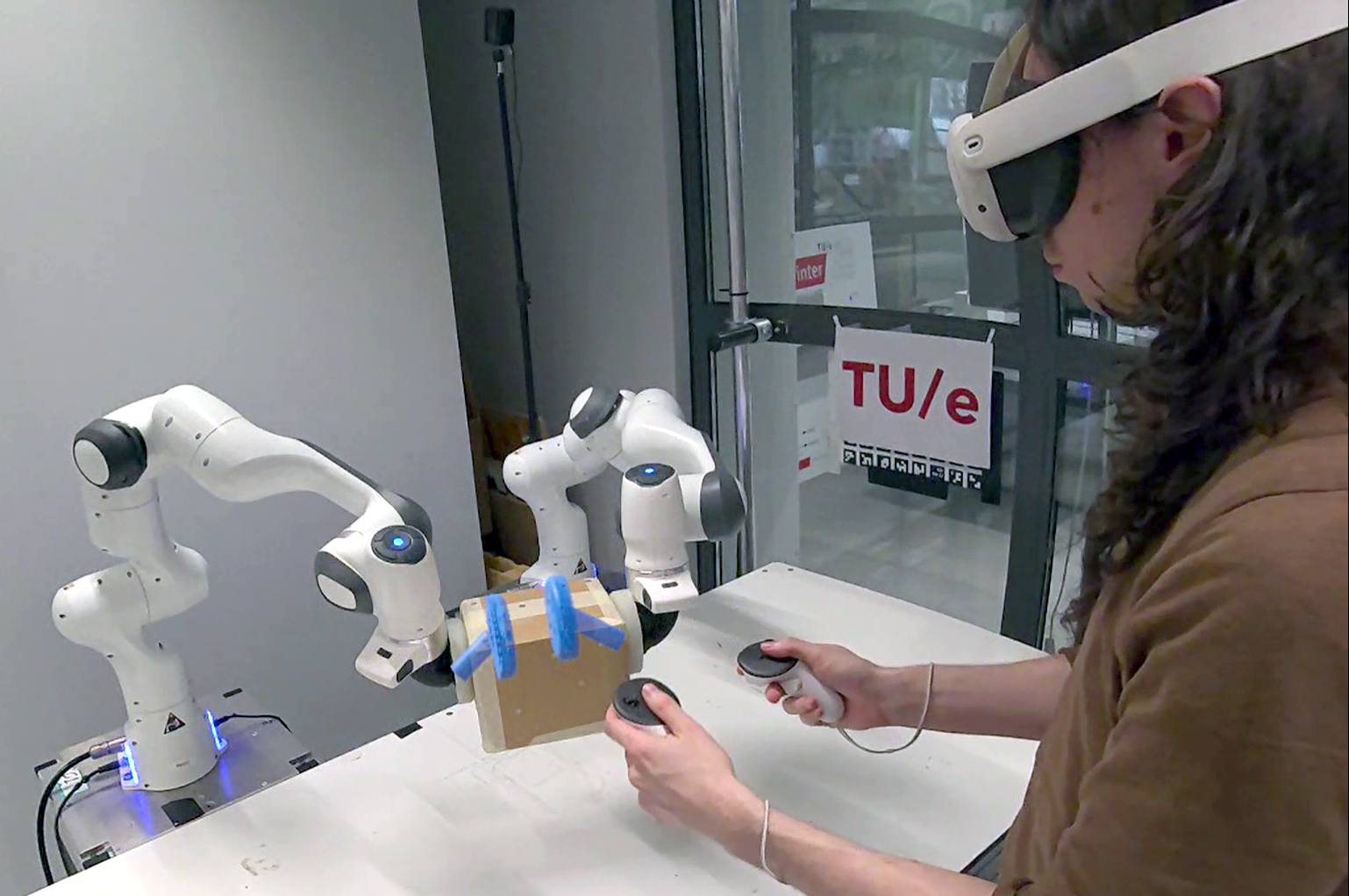
Study proposes AR visualization of impedance targets for force feedback without haptics. Dual-arm test shows 24% time reduction in force-critical tasks.
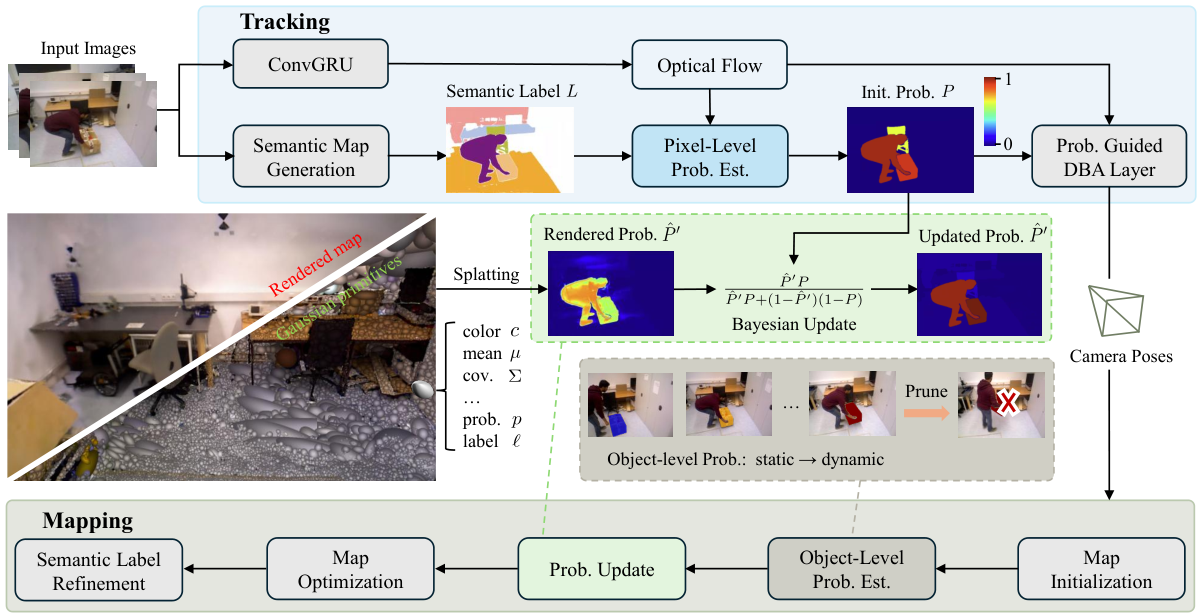
Recent advances in 3D Gaussian Splatting (3DGS) have enabled significant progress in dense dynamic Simultaneous Localization And Mapping (SLAM). Prevailing methods typically discard predefined dynamic objects, ignoring that transiently static objects offer valuable geometric constraints for pose estimation. A recent work attempts to leverage this potential by employing per-pixel uncertainty maps to quantify the magnitude of motion. While this approach enables transiently static objects to enhance pose estimation, it erroneously integrates these objects into the static map, resulting in persistent artifacts. Moreover, its reliance on purely geometric information leads to ambiguous object boundaries in the uncertainty maps. To overcome these limitations, we present DL-SLAM, a monocular Gaussian Splatting SLAM system built upon a novel dual-level probabilistic framework. Our method computes dynamic probability maps by combining semantic and geometric information. These pixel-level probabilities are lifted to 3D and aggregated to derive an object-level dynamic probability for each instance. Object-level probability enables the categorical pruning of dynamic Gaussians, resulting in an artifact-free static map. The static map, in turn, provides a geometrically consistent guidance to refine the pixel-wise probabilities, enhancing their reliability. Experimental results demonstrate that DL-SLAM outperforms existing approaches, improving tracking accuracy by up to 13\% while generating high-fidelity semantic maps.
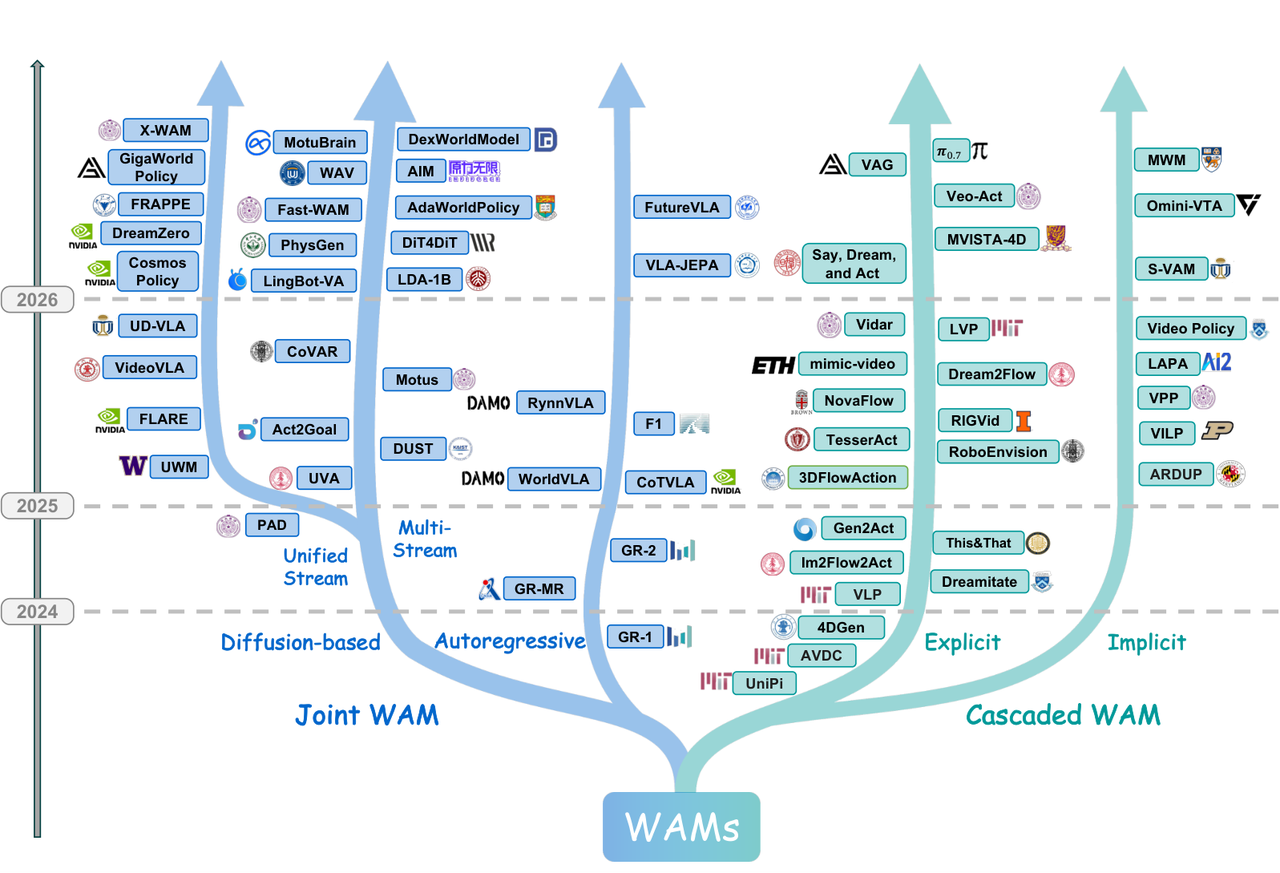
Introduces World Action Models (WAMs) to unify predictive state modeling with action generation, addressing VLA limitations. Proposes taxonomy and analyzes data ecosystem.
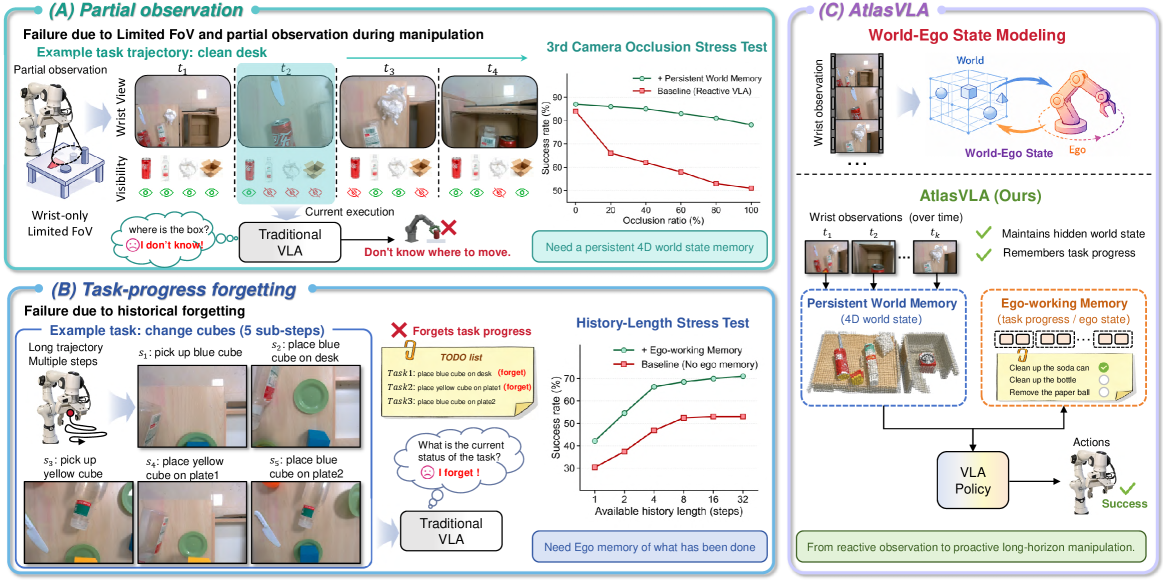
While Vision-Language-Action (VLA) models have advanced embodied AI, their fundamentally reactive paradigm severely limits performance in partially observable and long-horizon tasks. When restricted to a single wrist-mounted camera, they inevitably suffer from perception forgetting as objects exit the field of view, and temporal task-progress forgetting} during multi-step execution. To overcome these bottlenecks, we propose AtlasVLA, a novel framework that transitions from direct reactive manipulation to proactive reasoning through a persistent world-ego state. AtlasVLA features a dual-memory architecture: a 4D Persistent World State Memory that lifts transient 2D observations into a globally updated, voxel-hashed spatial state to resolve visual blind spots, and an Ego-Working State Memory that tracks historical ego state and task progress. By conditioning a diffusion transformer (DiT) on this joint World-Ego state, AtlasVLA enables robust spatial reasoning. Extensive evaluations across LIBERO, RLBench, and real-world benchmarks demonstrate that AtlasVLA achieves state-of-the-art performance using solely a wrist camera. Remarkably, it decisively outperforms multi-view baselines, yielding absolute success rate improvements of 9.4% on LIBERO-Long and 17.5% in real-world long-horizon tasks.
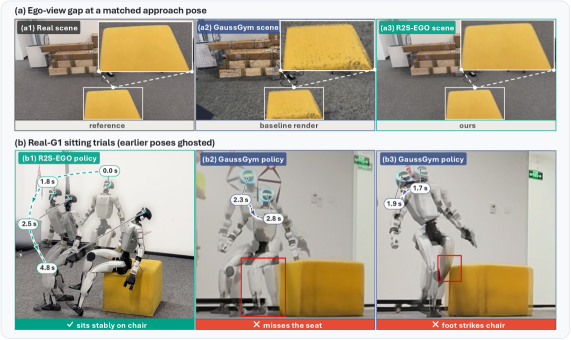
Real-to-sim (R2S) depends on scene representations that render observations along robot ego trajectories, yet dense multi-view capture limits per-environment real-image capture-count efficiency, and sparse human capture can leave behavior-scoped robot views under-supported. Camera-controlled synthesis can fill missing views, but its use in R2S requires behavior-admissible queries and capture-anchored structural conditioning. We present R2S-EGO, which couples a simulator-derived robot proxy that represents the behavior-scoped executable query domain with a capture-anchored geometry proxy that supplies scene-specific structural conditions. Within this domain, fixed- budget selection targets current support deficits for which geometry support is available. The generated observations are assimilated as pseudo-observations to refine the visual asset, while real captures remain anchors. The fused geometry proxy also supplies the scene collision surface, which is refreshed between rounds. Together, these updates refine the existing simulation scene while its robot dynamics and control stack stay fixed. Across 48 frozen Unitree G1 ego views in three Replica scenes, six-view R2S-EGO reaches 19.062 dB PSNR, compared with 14.226 dB for the strongest reported R2S baseline. Across five paired policy-training seeds, R2S-EGO achieves 82.5% +/- 6.8% real-G1 sitting success, compared with 10.0% +/- 10.5% for GaussGym.
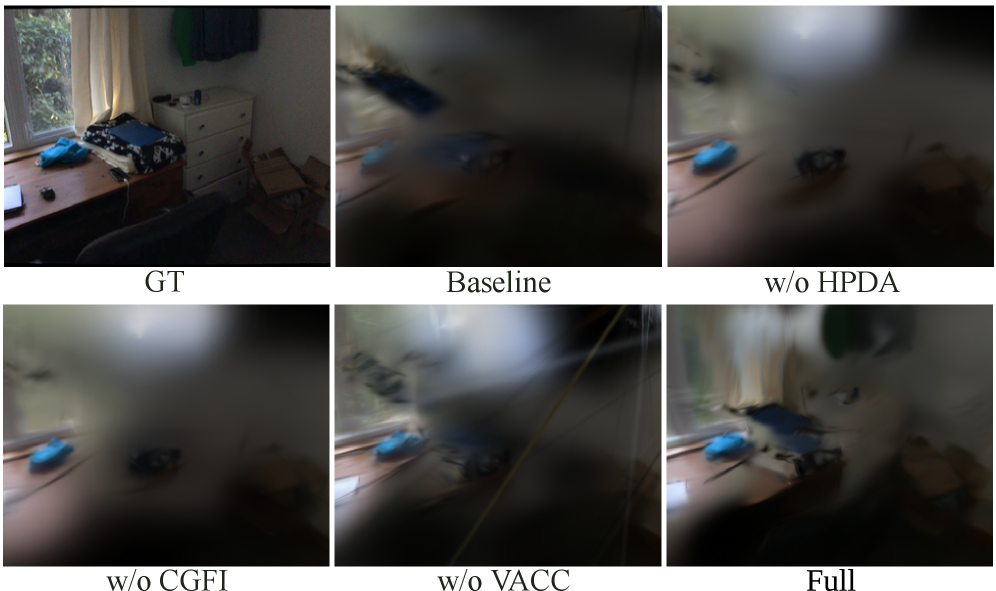
Feed-forward 3D Gaussian Splatting enables efficient novel-view synthesis without per-scene optimization, but most existing methods assume a fixed set of context views and process them jointly. This limits their applicability to online scenarios where calibrated views arrive sequentially and the scene must be updated causally. We present \emph{StreamSplat}, a streaming feed-forward 3DGS framework that incrementally maintains a persistent geometry-grounded scene state and decodes it into renderable 3D Gaussians after each input chunk. StreamSplat centers on a \textbf{Voxel-Aligned Causal Cache (VACC)}, which stores historical 3D tokens in a memory-bounded voxel structure so that memory grows with explored scene geometry rather than stream length. To better reuse history during causal prediction, we introduce \textbf{History-Projected Depth Anchoring (HPDA)} to project cached geometry as depth guidance for current cost-volume estimation, and \textbf{Cache-Guided Feature Injection (CGFI)} to inject cached latent evidence into Gaussian-token regression. Experiments on DL3DV, RealEstate10K, and ScanNet show that StreamSplat remains competitive with state-of-the-art feed-forward 3DGS methods under sparse causal inputs, despite not using future views or full-scene context. More importantly, it scales to long input streams with 256, 512, and 1024 views where fixed-view baselines run out of memory, yielding sustained improvements in novel-view synthesis quality as more observations arrive. The code will be made publicly available upon acceptance.
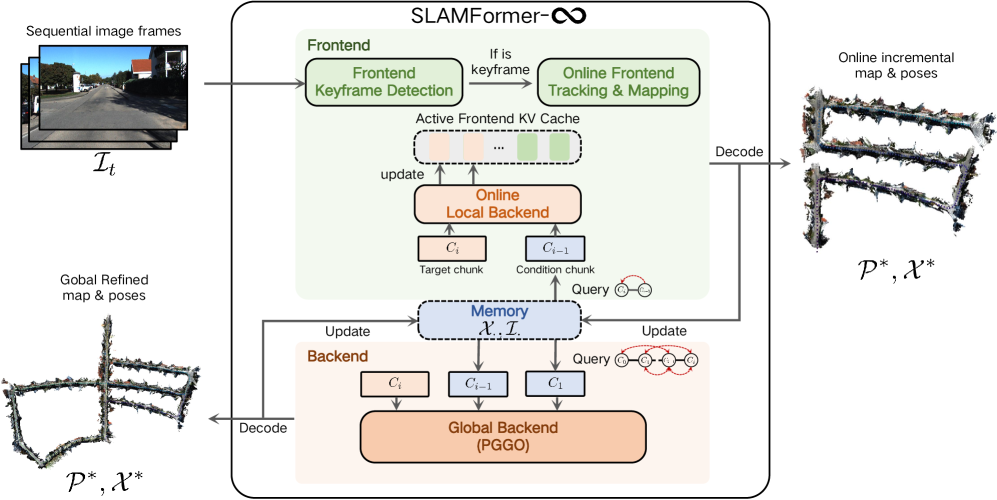
We introduce the Infinite SLAM Transformer (SLAMFormer-$\infty$), the first geometric transformer capable of supporting both long-range frontend and backend processing without an explicit distance bound. Instead of relying on a first-frame-anchored formulation, SLAMFormer-$\infty$ employs memory conditions to define flexible coordinate systems and scales for input frames, enabling more expressive structural conditioning. Built upon this formulation, the frontend preserves efficient local computation, while the backend jointly optimizes long-range trajectories and scene geometry in a globally consistent manner. Experimental results demonstrate that SLAMFormer-$\infty$ achieves superior or highly competitive performance in both trajectory estimation and scene reconstruction across large-scale datasets. Notably, SLAMFormer-$\infty$ generalizes to extremely long trajectories, successfully operating on sequences exceeding $17\mathrm{km}$.
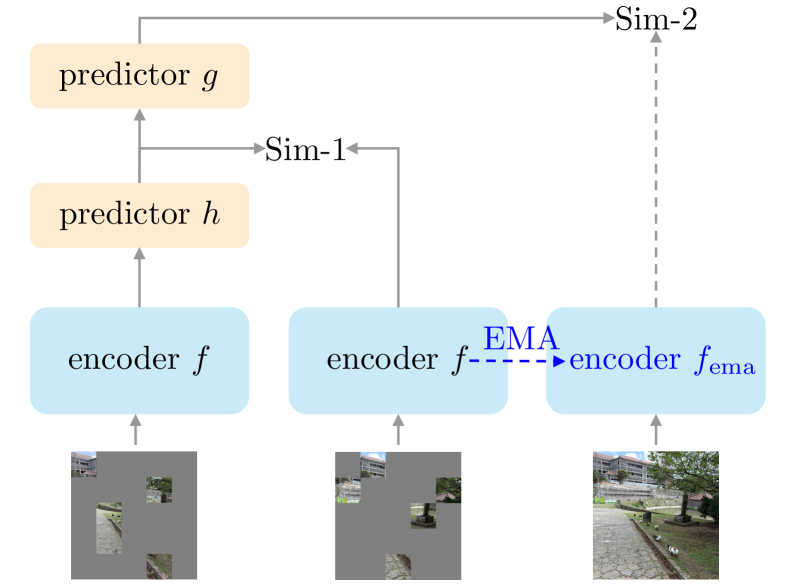
Investigates the effect of Siamese student encoders in JEPA-based self-supervised representation learning. SiamJEPA uses masked Siamese student encoders with an EMA teacher, acting as an effective regularizer that improves representation separability and accelerates early-stage learning, outperforming single-encoder JEPA variants under limited budgets.