Skip to content
RobotWorld

Papers

DELTA: Deformable Elevation-Based Local Terrain Attention Encoder for Sparse-Terrain Quadrupedal Locomotion

DELTA: Deformable Elevation-Based Local Terrain Attention Encoder for Sparse-Terrain Quadrupedal Locomotion

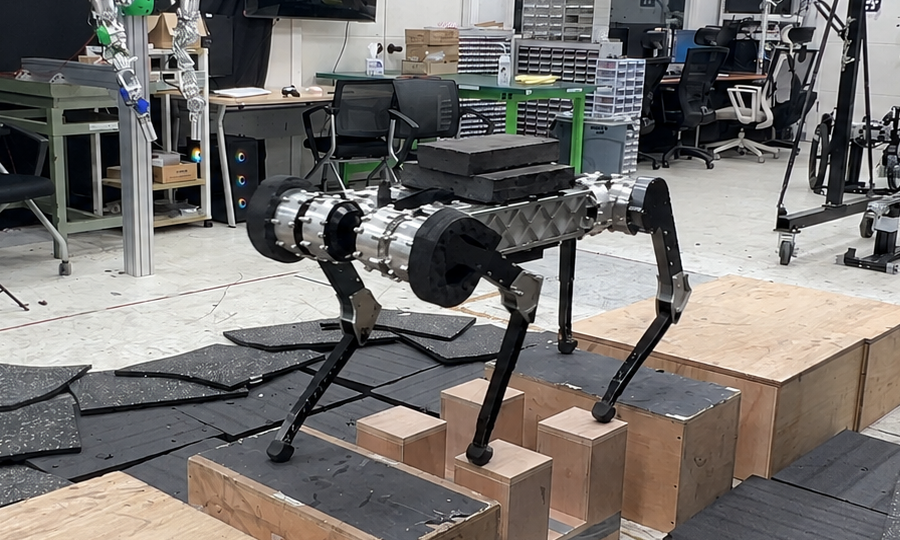
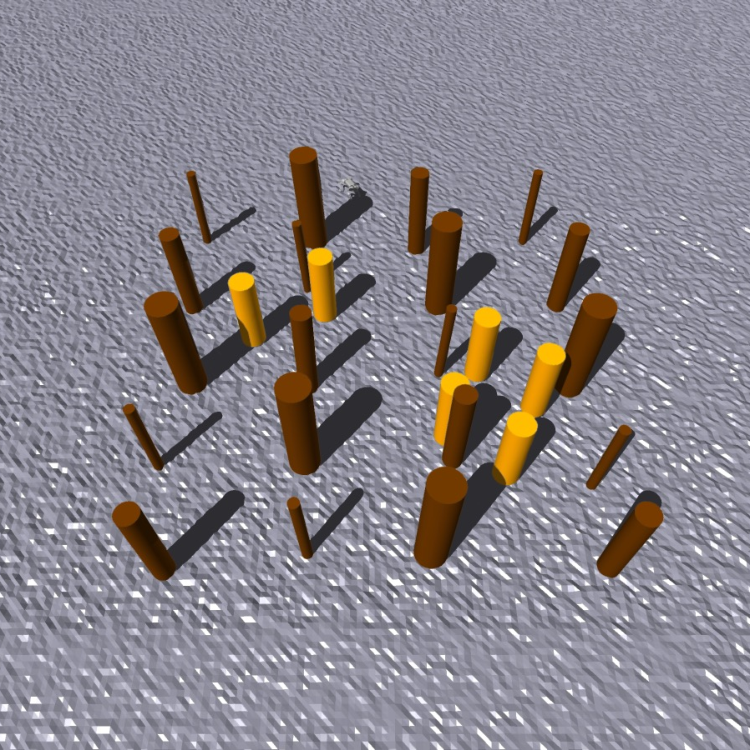
Stable quadrupedal locomotion on sparse terrain requires selecting state-relevant terrain evidence for precise foot placement. Model-based foothold planners provide precise foothold selection but rely heavily on explicit model assumptions. Recent attention-based map encoding (AME) studies show that end-to-end reinforcement learning (RL) can learn implicit foothold guidance. However, the computational cost of dense AME encoding grows with map resolution, limiting its scalability to fine-grained sparse terrain. We propose DELTA, a Deformable Elevation-Based Local Terrain Attention encoder. DELTA predicts state-conditioned sampling locations, forms terrain evidence tokens from adaptive local elevation patches, and attends only to a fixed-size token set. With fixed sampling and patch settings, DELTA's encoder cost is independent of map resolution. Experiments show that DELTA achieves final traversal performance comparable to AME at the standard resolution while improving learning efficiency. This fixed encoder cost enables the use of higher-resolution terrain maps, improving traversal on fine-grained sparse terrain. DELTA also demonstrates strong generalization to unseen mixed evaluation courses composed of continuous and discrete terrain elements. Beyond simulation, DELTA demonstrates successful sim-to-real transfer on RAIBO2. Analysis of the learned sampling offsets and attention weights shows that DELTA samples steppable regions and attends to terrain evidence relevant to future touchdowns without foothold labels or attention supervision.

四足机器人四足运动强化学习Sanghyun Park, Moonkyu Jung, Jemin Hwangbo·Aug 22, 2026
ABot-AgentOS: A General Robotic Agent OS with Lifelong Multi-modal Memory

ABot-AgentOS: A General Robotic Agent OS with Lifelong Multi-modal Memory

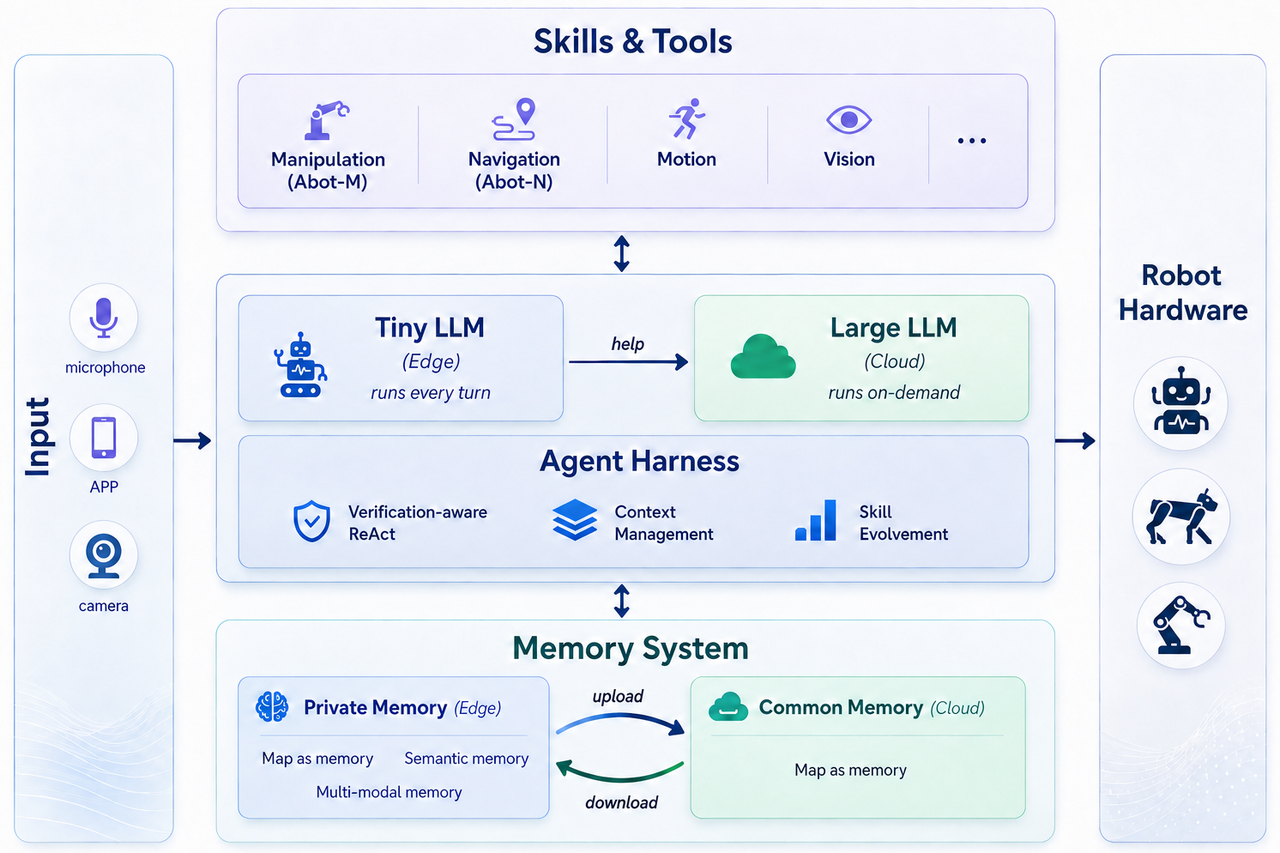
Recent VLM and VLA systems have improved robotic perception and action prediction, yet long-horizon embodied agents still require a general runtime layer for reasoning, memory, tool use, verification, and cross-embodiment execution. We present ABot-AgentOS, a general robotic Agent Operating System that sits above low-level controllers and provides a deliberative agent layer for scene-conditioned planning, context-isolated skill execution, multi-stage verification, multi-modal memory, and edge-cloud collaboration. To evaluate such systems, we introduce EmbodiedWorldBench, an executable benchmark with 16 indoor, outdoor, and hybrid scenes, four difficulty levels, and over 200 tasks involving navigation, object search, NPC dialogue, dynamic events, and trace-grounded scoring. ABot-AgentOS further introduces Universal Multi-modal Graph Memory, a persistent source-grounded substrate that converts dialogue, visual observations, spatial context, temporal relations, and task traces into typed nodes and edges. A failure-driven self-evolution loop converts diagnosed memory failures into gated runtime evo-assets that are promoted only to later evaluation splits, preventing current-split ground-truth leakage while enabling continual improvement. On an initial EmbodiedWorldBench subset, ABot-AgentOS improves over a single-controller baseline in both task success and goal completion. Across memory benchmarks, ABot-AgentOS Static achieves 87.5 on LoCoMo, 59.9 on OpenEQA EM-EQA, 88.6 on Mem-Gallery, and 76.5 Acc@All on NExT-QA; self-evolution further improves LoCoMo to 88.7, OpenEQA to 60.4, and Mem-Gallery to 89.0. These results suggest that a general Agent OS layer can improve long-horizon embodied execution while providing persistent, auditable memory for continual interaction.
机器人智能体AgentOS智能体操作系统Jiayi Tian, Shiao Liu, Yuting Xu·Jul 11, 2026
Learning Athletic Humanoid Tennis Skills from Imperfect Human Motion Data

Learning Athletic Humanoid Tennis Skills from Imperfect Human Motion Data

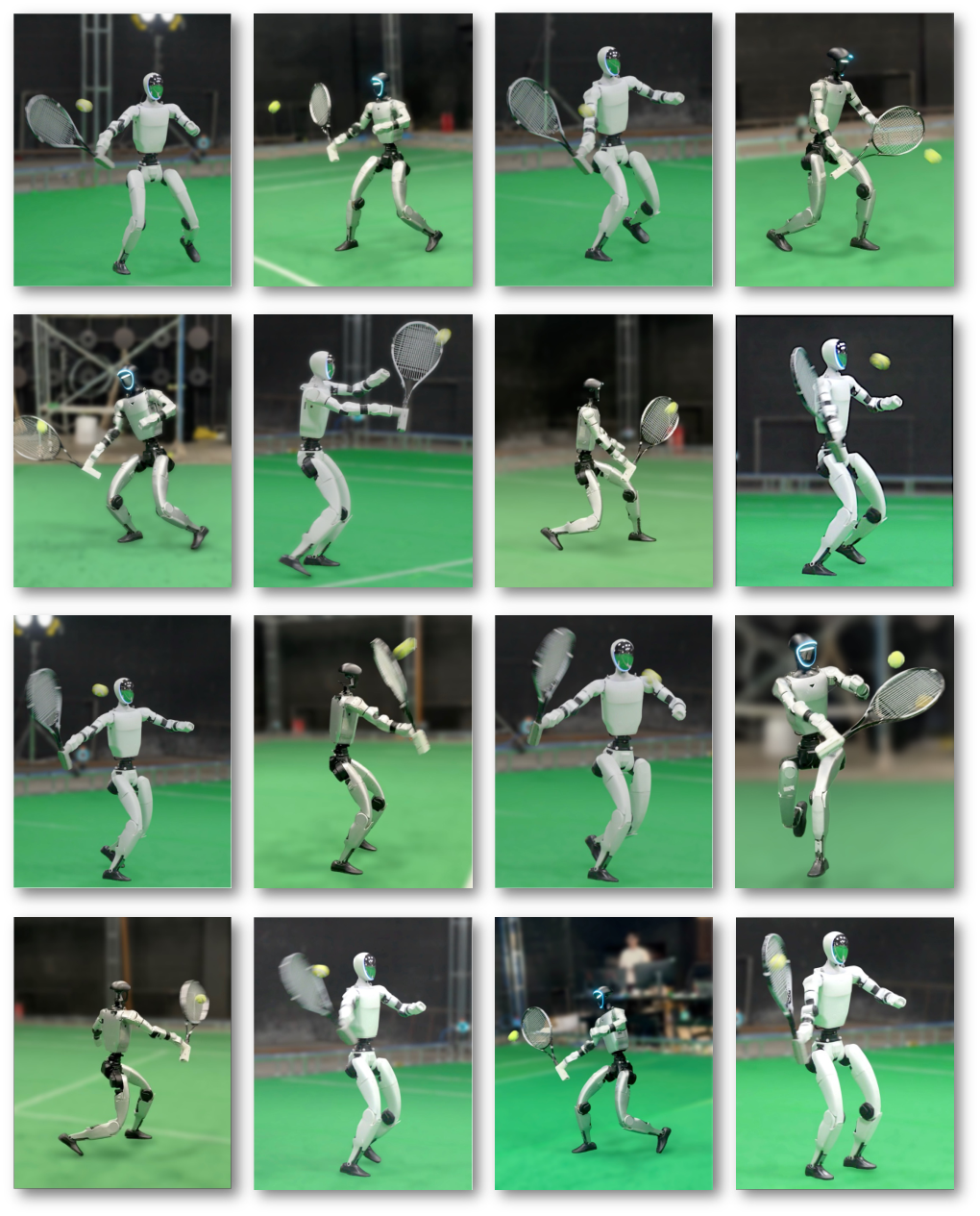
Human athletes demonstrate versatile and highly-dynamic tennis skills to successfully conduct competitive rallies with a high-speed tennis ball. However, reproducing such behaviors on humanoid robots is difficult, partially due to the lack of perfect humanoid action data or human kinematic motion data in tennis scenarios as reference. In this work, we propose LATENT, a system that Learns Athletic humanoid TEnnis skills from imperfect human motioN daTa. The imperfect human motion data consist only of motion fragments that capture the primitive skills used when playing tennis rather than precise and complete human-tennis motion sequences from real-world tennis matches, thereby significantly reducing the difficulty of data collection. Our key insight is that, despite being imperfect, such quasi-realistic data still provide priors about human primitive skills in tennis scenarios. With further correction and composition, we learn a humanoid policy that can consistently strike incoming balls under a wide range of conditions and return them to target locations, while preserving natural motion styles. We also propose a series of designs for robust sim-to-real transfer and deploy our policy on the Unitree G1 humanoid robot. Our method achieves surprising results in the real world and can stably sustain multi-shot rallies with human players. Project page: https://zzk273.github.io/LATENT/

LATENT人形机器人网球Zhikai Zhang, Haofei Lu, Yunrui Lian·Mar 13, 2026
Tac4Loco: Learning Spatiotemporal Plantar Pressure Representations for Humanoid Locomotion

Tac4Loco: Learning Spatiotemporal Plantar Pressure Representations for Humanoid Locomotion

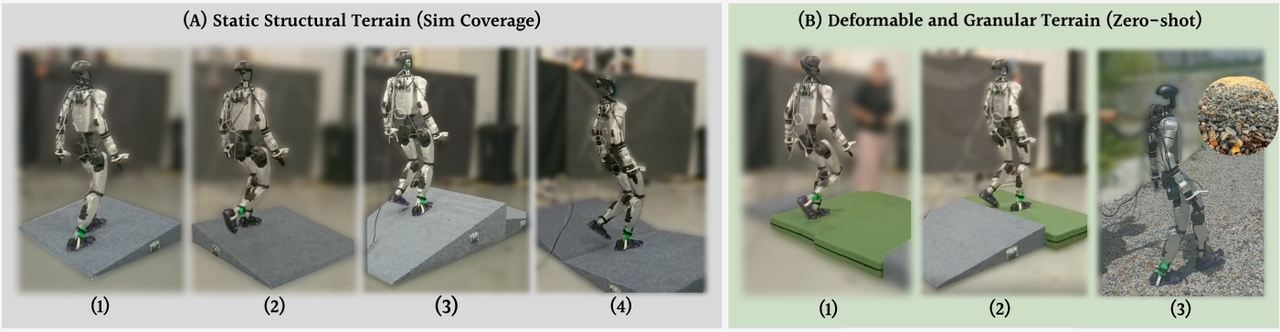
Humanoid robots are expected to traverse complex terrains, where the plantar support may vary dramatically due to foot placement errors, ground properties, and transient dynamics. To achieve robust locomotion, the robots are required to adapt to uneven terrain and uncertain foot--ground interactions. Existing locomotion policies rely primarily on proprioception or exteroceptive terrain perception, where the former provides only indirect evidence of plantar support, while the latter predicts contact conditions before touchdown but cannot observe the actual support in real-time. Although some studies incorporate plantar contacts as an auxiliary perception, they rely mainly on summary statistics, overlooking the spatial topology of plantar pressure, which provides a more direct characterization of the realized contact state. To bridge this gap, we present Tac4Loco, a tactile-perceptive framework that incorporates multi-array plantar pressure as direct feedback for humanoid locomotion. We formulate a topology-preserving ordinal representation to map simulated and physical sensor signals into a shared observation space, with a dual-branch encoder for extracting their spatial and temporal representations. Subsequently, the learned spatiotemporal features are integrated with augmented proprioception including terrain estimation cues, and provided to an asymmetric actor-critic architecture for policy learning. Extensive simulation and real-world experiments demonstrate improved tracking performance and support adaptation on terrains with inclined, partial, asymmetric, and changing support. We further demonstrate its zero-shot deployment on unseen compliant and unstructured terrains, including a foam platform and a gravel road. All code and experimental configurations will be released as open-source to facilitate reproducibility.

人形机器人足底压力触觉感知Ziyun Liu, Sikai Guo, Zheng Li·Aug 16, 2026
Learning Agile Navigation in Crowded Environments for Quadruped Robots

Learning Agile Navigation in Crowded Environments for Quadruped Robots

Navigating dynamic and crowded environments presents significant challenges for quadruped robots due to severe sensor occlusion and unpredictable human motion. Existing approaches face a trade-off: model-based methods, such as Velocity Obstacles (VO), theoretically guarantee safety but rely on accurate obstacle motion estimates that often fail in dense crowds, while end-to-end learning methods offer robustness but lack motion prediction capability of obstacles, leading to collisions or conservative behaviors. To solve this, we propose VOP-Nav, a novel navigation system that combines the geometric safety of VO with the agile adaptability of end-to-end learning. Using only local onboard observations, our system avoids explicit obstacle detection and tracking pipelines. The VOP-Net processes multi-frame LiDAR data to implicitly encode dynamic constraints and predict a safe velocity region derived from Velocity Obstacle theory. Importantly, the VO predictions serve a dual role: they are used as input to the navigation policy during inference and as a reward signal during training to encourage safe motion. Evaluations in Isaac Gym demonstrate that VOP-Nav achieves higher success rates than all baselines while balancing locomotion speed and collision avoidance. Real-world deployment on a Unitree Go2 quadruped robot further validates the system's robustness and efficiency in complex indoor and outdoor dynamic environments.

四足机器人quadruped导航Shuyu Wu, Zeyu Liu, Tianbao Zhang·Jul 16, 2026
HAF: Adapting Generalist VLAs to Humanoid Whole-Body Loco-manipulation via Hierarchical Action Flow and Spectral Latent RL

HAF: Adapting Generalist VLAs to Humanoid Whole-Body Loco-manipulation via Hierarchical Action Flow and Spectral Latent RL

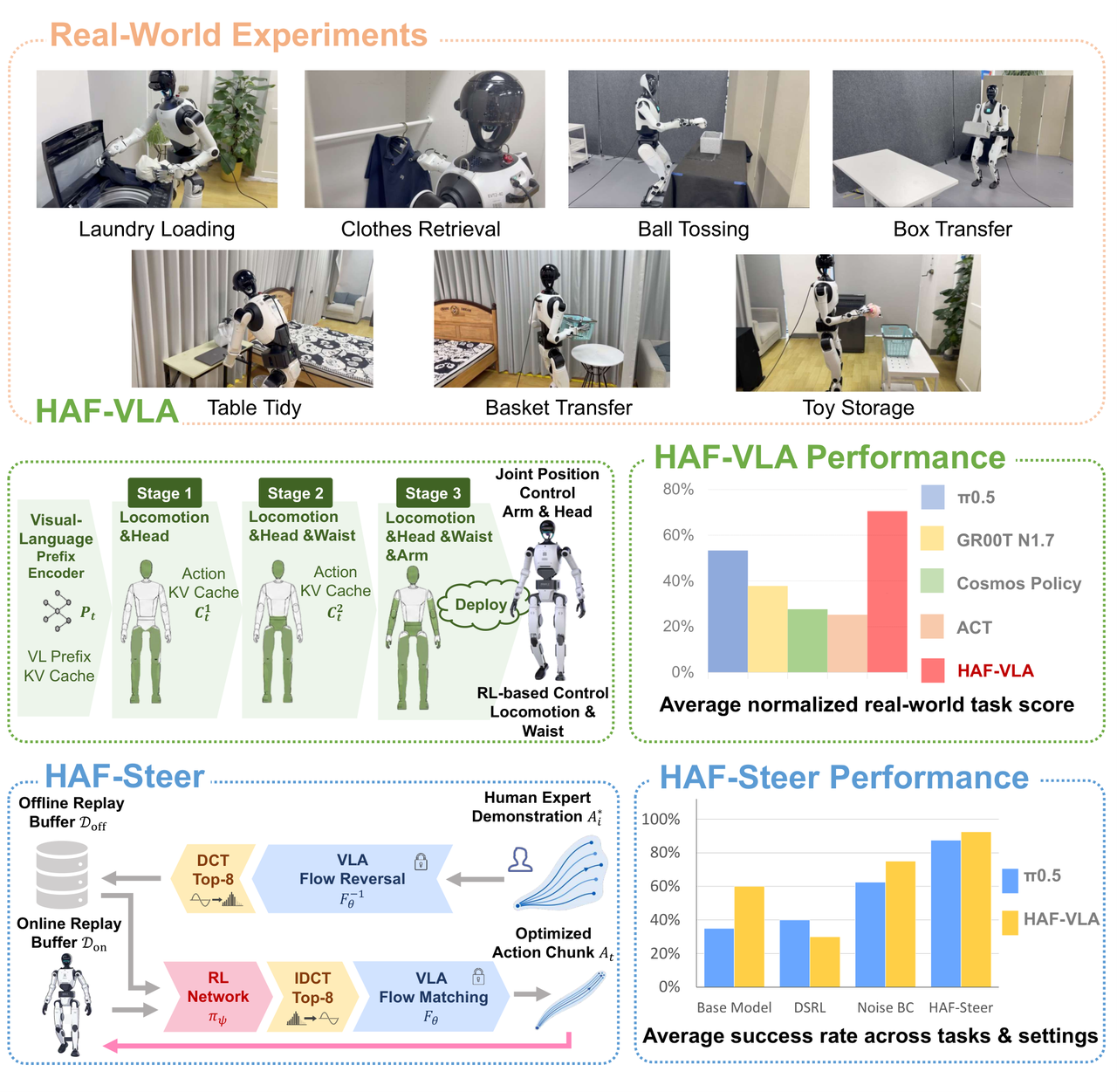
Humanoid robots hold great promise as general-purpose agents in human-centered environments, yet generalist vision-language-action (VLA) foundation models are not readily applicable to humanoid whole-body loco-manipulation. The high dimensionality and interdependence of humanoid motions make it challenging for conventional single-stage VLA architectures to coordinate locomotion, waist posture, and dual-arm manipulation effectively. Moreover, policies trained through offline behavior cloning can remain suboptimal during real-world deployment. Although online reinforcement learning can refine policies through real-world interaction, directly tuning large VLA backbones demands excessive computation and may introduce safety risks during real-robot exploration. To address these bottlenecks, we introduce HAF (Humanoid Adaptation Framework), a two-part framework consisting of HAF-VLA and HAF-Steer that transfers off-the-shelf generalist VLA foundation models to humanoid whole-body loco-manipulation. HAF-VLA is a hierarchical action-flow generator built on a pretrained flow-matching VLA. It splits full-body action denoising into three sequential stages with stage embeddings and cross-stage KV caches that retain kinematic dependencies, avoiding incoherent whole-body actions from one-shot generation. On top of the frozen HAF-VLA, HAF-Steer is a latent offline-to-online RL pipeline that leverages flow-matching invertibility and DCT-based dimensionality reduction to restrict RL optimization to a compact noise subspace and train a regularized SAC policy. This avoids updating the large VLA backbone and enables efficient real-world policy refinement. Evaluated on seven real-world humanoid loco-manipulation tasks, HAF surpasses vanilla single-stage VLA baselines and improves whole-body coordination and task performance. Project website: https://grange007.github.io/HAF .

VLA人形机器人humanoidLangzhe Gu, Chengkai Hou, Meng Li·Aug 17, 2026