Skip to content
RobotWorld

Papers

GigaBrain-0.7: Scaling Embodied Foundation Models to Emergent Capabilities with a Three-System Architecture

GigaBrain-0.7: Scaling Embodied Foundation Models to Emergent Capabilities with a Three-System Architecture

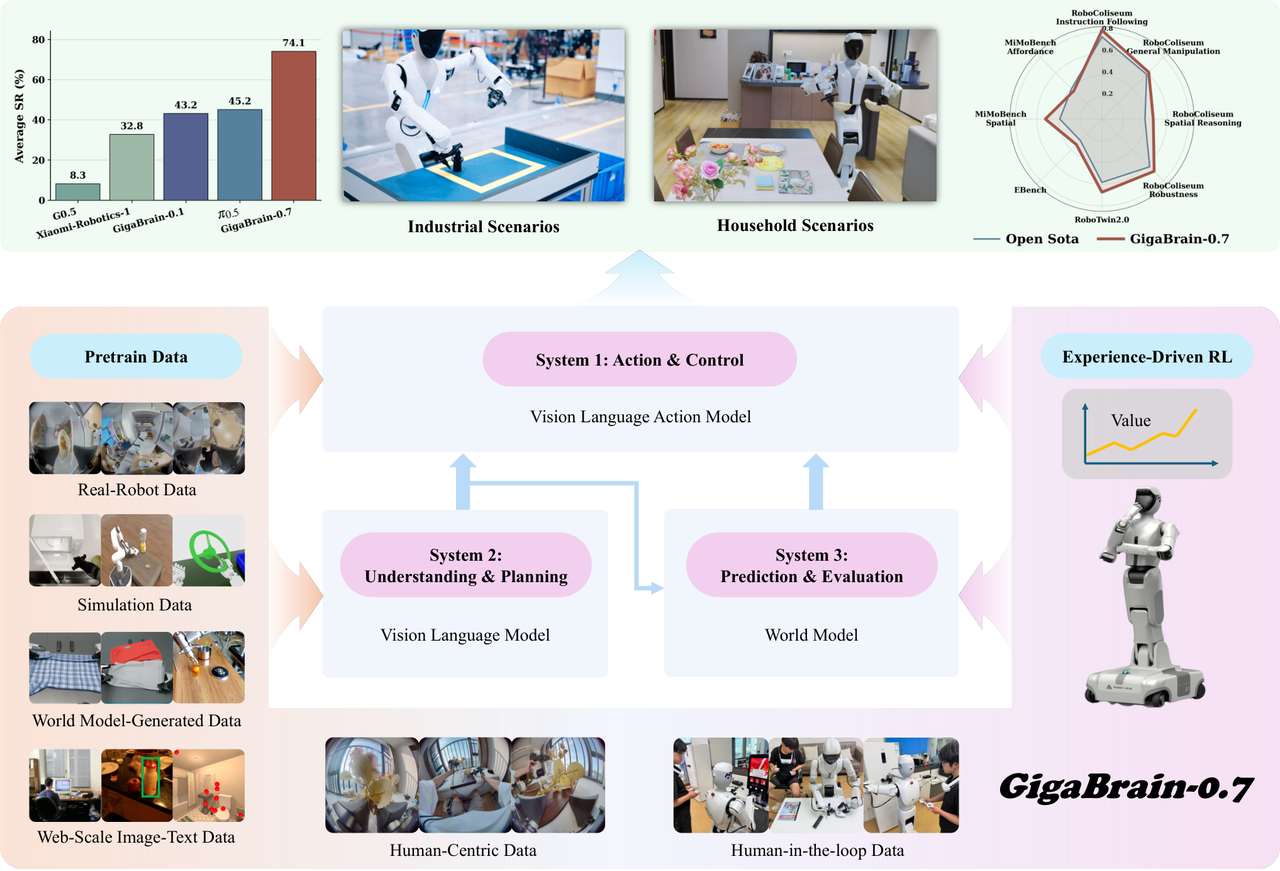
Vision-language-action (VLA) models have become a dominant paradigm for generalist embodied agents, demonstrating strong complex and long-horizon task completion in structured settings. Yet it remains an open question whether current VLA systems can benefit from more effective architectural design, scale to substantially larger and more heterogeneous data regimes, and achieve broader generalization across tasks and embodiments. To this end, we present GigaBrain-0.7, an embodied foundation model with substantially improved generalization across diverse robot embodiments. Specifically, GigaBrain-0.7 unifies understanding, prediction, and action through a three-system architecture, scales pretraining to over 37,000 hours of heterogeneous embodied data, and introduces one-stage alignment training that jointly optimizes vision-language understanding and multi-embodiment action generation. Compared with the preceding GigaBrain-0 series and prior state-of-the-art models including $π_{0.5}$, GigaBrain-0.7 achieves substantial improvements in foundation zero-shot capabilities, language-conditioned instruction following, and post-training task success rates. In particular, on our in-house Maker H01 platform and mainstream robot embodiments, GigaBrain-0.7 demonstrates strong task adaptability and completion ability across both home and industrial scenarios. All training code and pretrained model weights will be released.

VLA具身智能世界模型 GigaBrain Team, Angen Ye, Axiang Sun·Aug 16, 2026
Zero-WAM: In-Context World-Action Modeling from Human Videos for Open-Ended Task Generalization

Zero-WAM: In-Context World-Action Modeling from Human Videos for Open-Ended Task Generalization

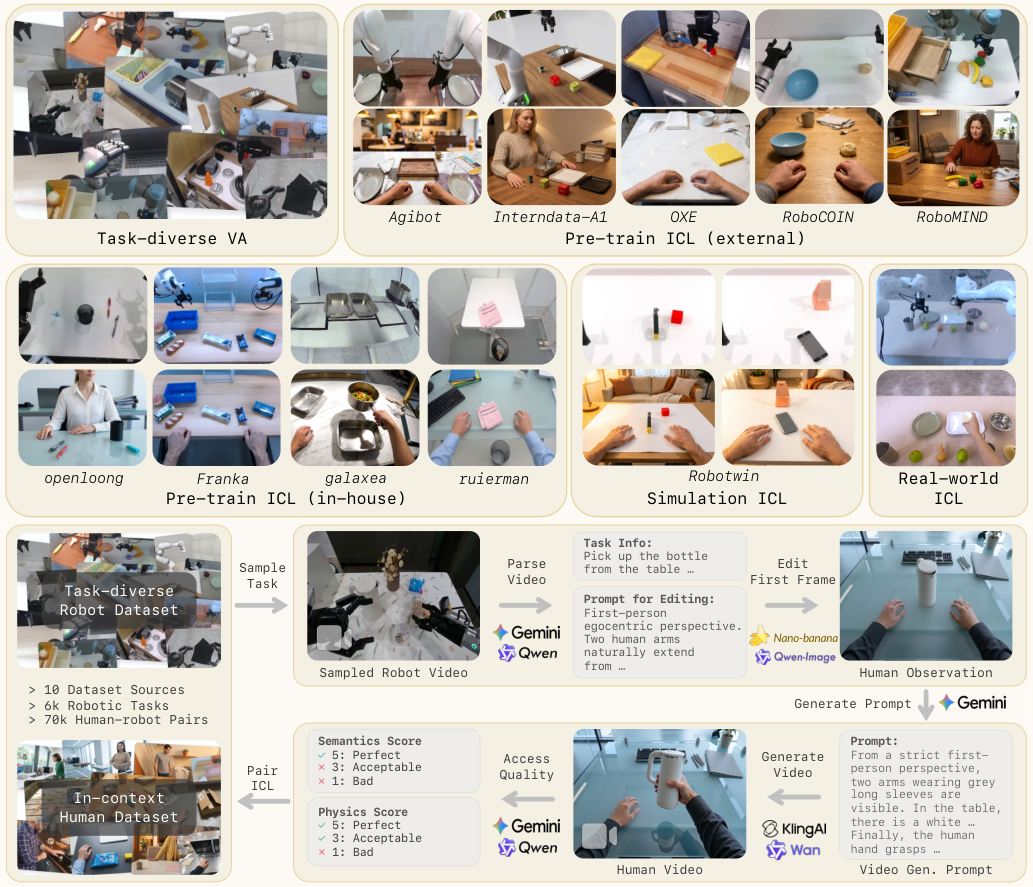
Zero-shot cross-task generalization, where a policy must execute manipulation tasks never seen during training, remains a central challenge in robot learning. In large language models, a novel task can be performed simply by specifying it in the context, without any parameter update. This form of in-context learning (ICL) turns generalization into a problem of task specification. To achieve cross-task generalization, we bring this paradigm to robotic manipulation, and argue that the natural task specification for manipulation is a human video: unlike language, it provides rich visual cues about the intended task evolution. We present Zero-WAM, a causal video-action model that executes unseen tasks by following in-context human video guidance. To address the scarcity of task-rich paired human-robot data, we propose an automatic pipeline that converts task-sampled robot trajectories into semantically matched human videos, yielding HumanGen, a dataset of 74.2K human-robot ICL pairs across 8.6K tasks. For model training, we further introduce an in-context future chunk prediction (IFP) objective that suppresses shortcuts learned from seen tasks and forces the policy to draw task information from the video prompt. On seven unseen tasks in RoboTwin 2.0 simulation, Zero-WAM achieves a 47.0% average success rate, an absolute improvement of 29.5 percentage points over the strongest video-action baseline. In real-world evaluations, it follows human video guidance to generalize to unseen task configurations involving multi-object scenes, long-horizon manipulation, and fine-grained insertion.

世界模型上下文学习人类视频示教Jiaming Zhou, Qihang Zhang, Gangwei Xu·Aug 26, 2026
PhyAI: Real-Time Physical AI at the Edge, Scalable Rollouts in the Cloud

PhyAI: Real-Time Physical AI at the Edge, Scalable Rollouts in the Cloud

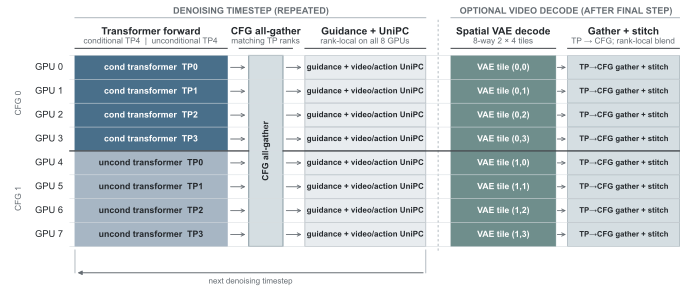
Physical AI policies require inference throughout their lifecycle, including model evaluation, cloud reinforcement learning rollout, edge GPU serving, and onboard deployment. Although these settings share the same checkpoint and action semantics, they often rely on separate inference programs. To unify them, we build PhyAI, a Physical AI inference engine with a single runtime that keeps architecture-specific conditioning, solver, cache, and output logic in model adapters while sharing graph execution, kernels, memory management, and parallel services. The same codebase runs vision-language-action (VLA) models and world-action models (WAMs) on single or multiple GPUs across onboard, edge, and cloud deployments. We used the adapter interface to add MiniCPM-Robot on the day of its release. PhyAI achieves 1.40x-4.65x speedups over the official implementations of pi0, pi0.5, GR00T N1.7, and MiniCPM-Robot. On Cosmos3-Nano-Policy-DROID it reduces latency from 2.46 to 1.18 s on eight H20 GPUs (CFG=2, TP=4), a 2.08x speedup. Specialized runtimes remain faster in several configurations, so our goal is one runtime with competitive latency rather than the fastest result in every case. Detailed profiles reveal why different models need different execution policies: on a Hopper-series GPU at batch size one, the pi0.5 action expert accounts for 8.8% of FLOPs but 57.2% of latency; at batch size 32 its share drops to 13.5% and throughput reaches about 100 samples/s. Cosmos3 remains generation-dominated and gains only 14.3% throughput as batch size increases from 1 to 16. We further introduce the control-time Roofline, which distinguishes inference-bound from environment-bound control; the measured pi0.5 points on four LIBERO suites are environment-bound while Cosmos3 stays inference-bound. Code and benchmarks: https://github.com/mingti-org/phyai.
Physical AI推理引擎VLAChenghua Wang, Daliang Xu, Dongqi Cai·Aug 4, 2026
Robust-WAM: Bridging Generative Pretraining and Semantic Foresight in World-Action Models

Robust-WAM: Bridging Generative Pretraining and Semantic Foresight in World-Action Models

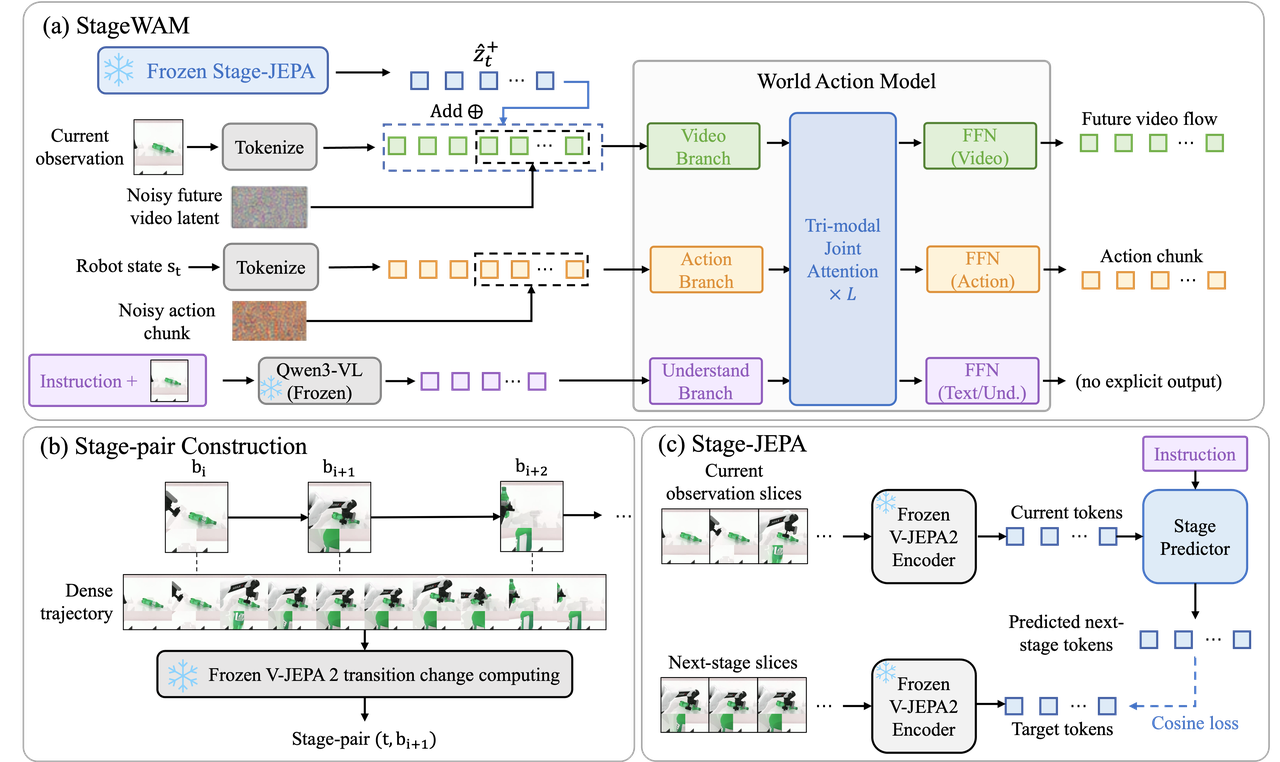
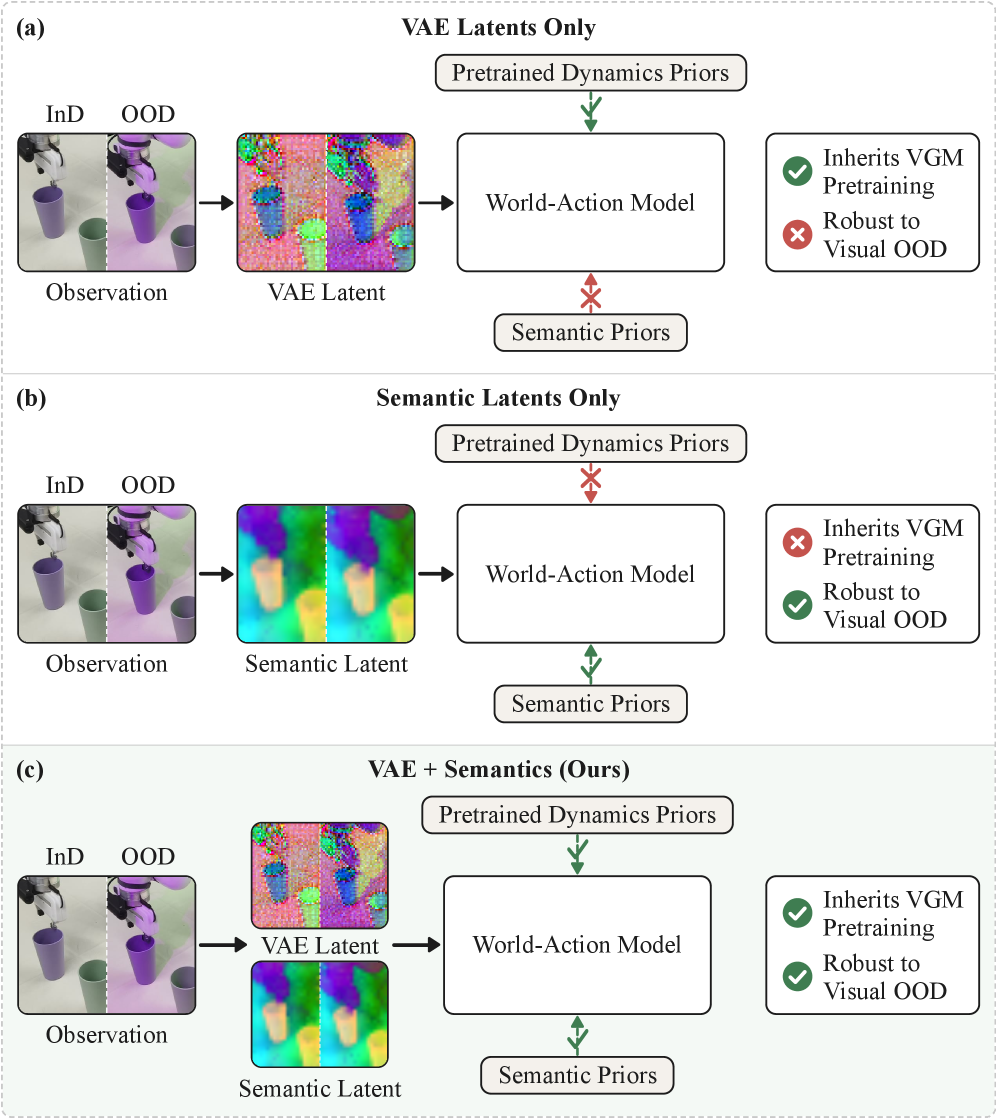
Mainstream World-Action Models (WAMs) adapt pretrained video generation models (VGMs) for robot control, transferring their learned dynamics prior for action prediction. These VGMs are typically trained in a variational autoencoder (VAE) latent space. However, the VAE latent space is optimized for pixel reconstruction, which rewards fine appearance detail and leaves the action prediction fragile under visual shifts. Recent works build WAMs in semantic latent space, which are more robust to appearance shifts. However, these models cannot leverage the large-scale VGM pretraining that exists only in VAE space. To overcome this dilemma, we propose Robust-WAM, a general post-training method for video-generation-based WAMs that preserves the VAE-based generative path and adds a lightweight semantic foresight alignment objective on the action stream. This retains the large-scale VGM pretraining while grounding actions in appearance-invariant dynamics that stay reliable under illumination shifts and other visual out-of-distribution conditions. Specifically, we employ learnable query tokens to bring future-scene semantics into the action stream by aligning their output hidden states with the semantic foresight of future ground-truth frames. To establish the temporal correspondence between each query and the future step it describes, we give it the positional encoding of the matching action tokens. Experiments on out-of-distribution generalization simulation benchmarks and a real-robot setup show that our Robust-WAM consistently improves the success rates of multiple WAM baselines without sacrificing in-distribution performance.

世界模型世界-动作模型视频生成Haodong Yan, Junfeng Li, Junjie He·Aug 6, 2026