Skip to content
METATRON: A Promptable Whole-Body Execution Layer for Humanoids

METATRON: A Promptable Whole-Body Execution Layer for Humanoids

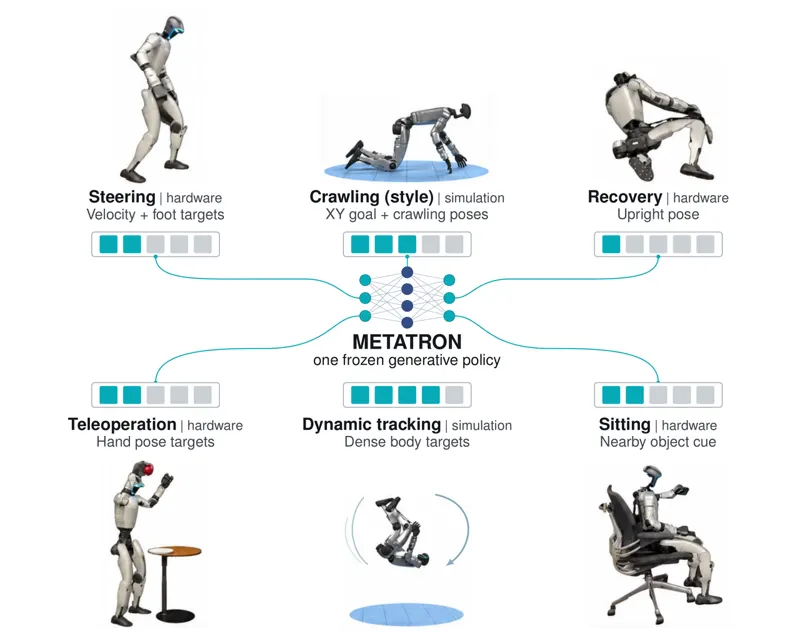
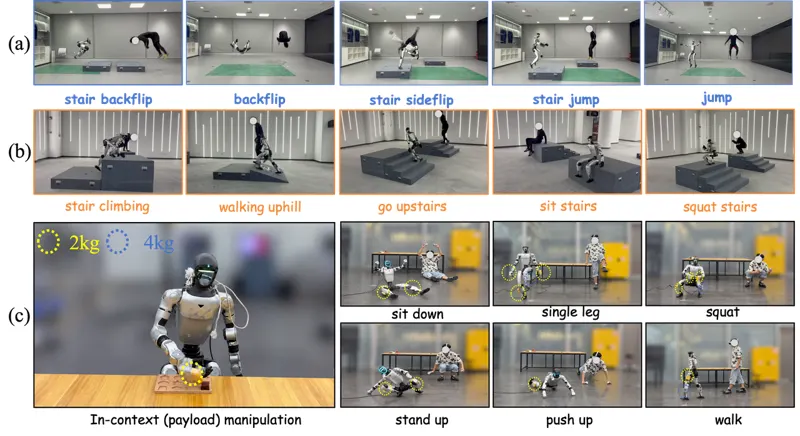
Humanoid controllers often require task-specific training despite sharing the need for balance and whole-body coordination. We present Metatron, a promptable whole-body execution layer combining a generative base policy with a programmable skill layer. The base policy receives partial goals, collectively called a prompt, that can combine timed body-part targets, velocity commands, and style cues. It produces diverse whole-body motions consistent with these goals. Training combines motion capture, synthetic recovery trajectories, and retargeted scene-interaction motions. After training, the policy is frozen. Stateful programs called skills express task intent as prompts at each control step, drawing rough geometric sketches that the policy turns into coordinated movement. Skills are ordinary code, refined by coding agents that analyze motion data and fit compact rules without task-specific policy training. On the physical Unitree G1, one frozen checkpoint supports walking, recovery, teleoperated object pickup, and sitting on furniture. Comparative evaluations show higher reaching success and push robustness than the tested reference-tracking pipelines. The same recipe produces climbing and acrobatics on a simulated character. Metatron enables coding agents to turn learned motor capabilities into new skills through code, without further policy training.
HumanoidWhole-Body Control
Chen Tessler, Yifeng Jiang, Alec Otto · 849 views · Oct 27, 2026
Compliant GMT: Making General Motion Tracking Compliant via Residual Reference Adaptation

Compliant GMT: Making General Motion Tracking Compliant via Residual Reference Adaptation

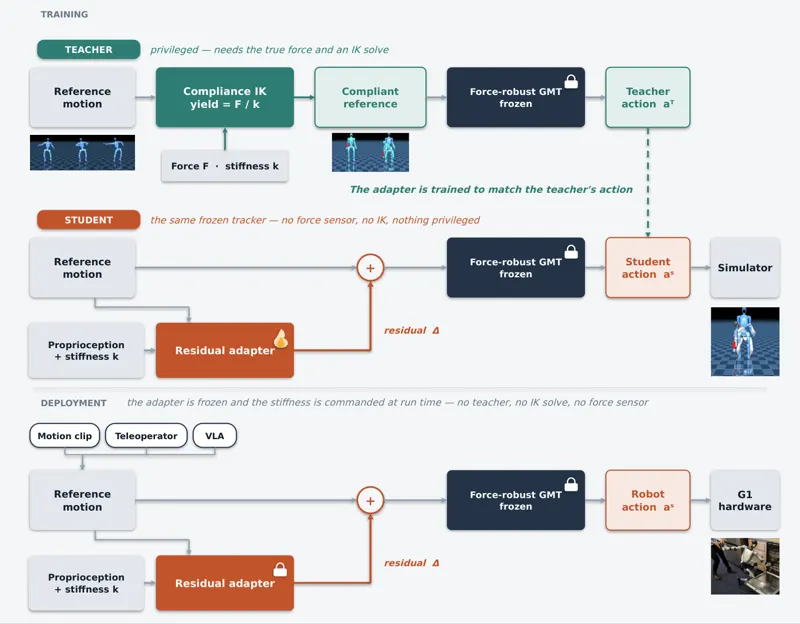
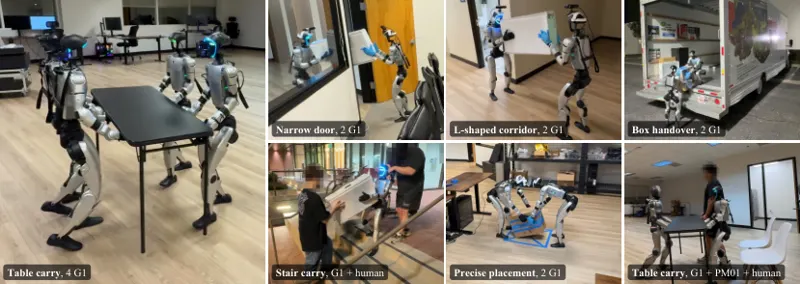
We propose Compliant GMT (C-GMT), a modular framework for full-body compliant responses in general motion tracking. As humanoid robots move into real world deployment, they not only need to perform any motion but also respond safely and robustly to interaction forces. Existing general motion tracking policies can imitate diverse motions but are trained to be stiff, leading to unexpected and unsafe behaviors under disturbance. Prior work in compliant humanoid control trades off compliance and generality. There exist examples of full-body compliant responses, but these are heavily curated to single-reference policies. On the other hand, general motion trackers (GMT) are trained to rigidly imitate massive motion capture datasets. Our key insight is to leverage the generality of pretrained GMTs for motion tracking while introducing compliance from a residual adapter that conditions on a history of proprioception. This enables our approach, C-GMT, to achieve both general motion tracking and whole-body compliant responses. Compared to state-of-the-art general motion trackers and single-motion compliant policies, C-GMT demonstrates competitive performance in both motion tracking accuracy and compliance adherence. We further demonstrate improved safety, robustness, and error tolerance in simulation and real-world G1 experiments.

HumanoidMotion Tracking
Venki Parsuram, Michelle Wang, Jin-Hyuk Hong · 395 views · Oct 15, 2026

As an Amazon Associate, we earn from qualifying purchases.