Skip to content
← Tags
VT-Bridge: Bridging Pretrained Foundation VLAs to VTLAs via Lightweight Residual Adaptation

VT-Bridge: Bridging Pretrained Foundation VLAs to VTLAs via Lightweight Residual Adaptation

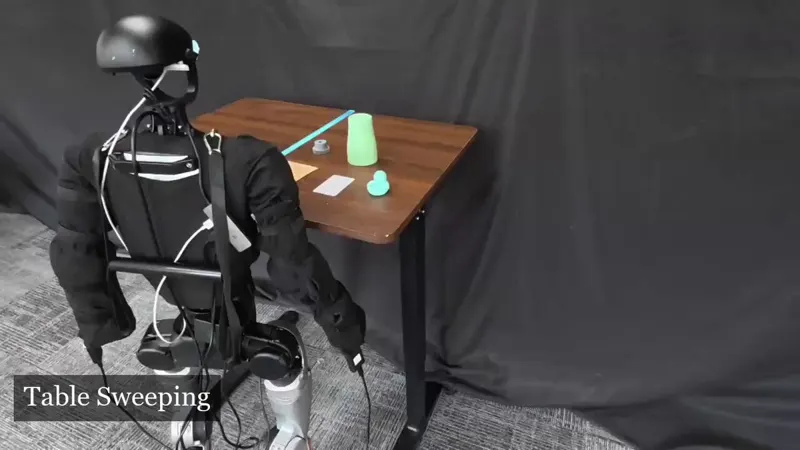
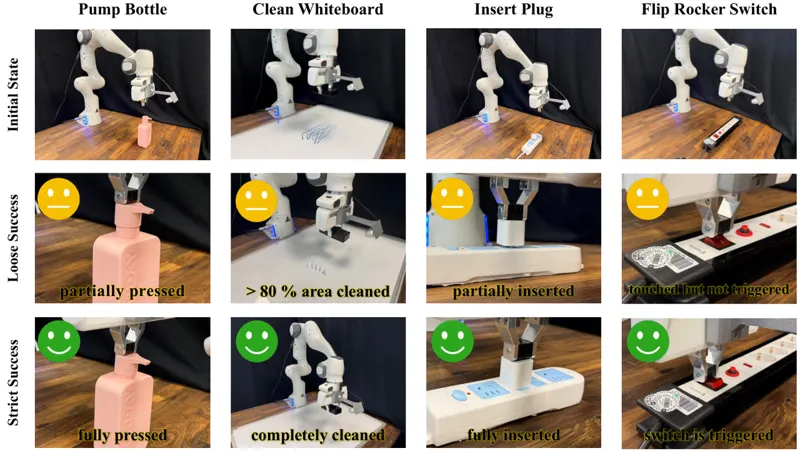
Vision-Tactile-Language-Action (VTLA) models have demonstrated clear advantages over Vision-Language-Action (VLA) models in contact-rich manipulation. However, developing VTLA models is severely constrained by the massive amounts of vision-tactile data and computational resources required. To address this bottleneck, we propose VT-Bridge, a lightweight residual adaptation strategy that bridges pretrained foundation VLAs to VTLAs. Rather than training a VTLA model from scratch or modifying the original architecture of a pretrained VLA, VT-Bridge employs an identical lightweight residual-adapter architecture across VLA backbones and uses backbone-specific weights to refine actions at the robot execution frequency. This design substantially lowers the data and training barriers. Specifically, it requires up to 50 vision-tactile demonstrations per task to fine-tune a VLA backbone and train a 0.98M-parameter residual adapter. Experiments with three representative VLA backbones (π₀, π_0.5, and SmolVLA) across four contact-rich manipulation tasks further demonstrate its consistent effectiveness across VLA architectures. On average, VT-Bridge raises the task completion rate from 11.7% with task-level VLA fine-tuning alone to 62.9%. Together, these findings demonstrate the broad applicability, effectiveness, and accessibility of VT-Bridge for contact-rich manipulation. The project page is available at https://hoxnocha.github.io/vt-bridge-web/.
Yansong Wu, Tuo Yang, Rongping Zhao · 42 views · Sep 18, 2026
Tactile SensingVLAContact-Rich ManipulationSep 18, 2026
TacitVLA: Reasoning Vision-Language-Action Models Without Reasoning Latency

TacitVLA: Reasoning Vision-Language-Action Models Without Reasoning Latency

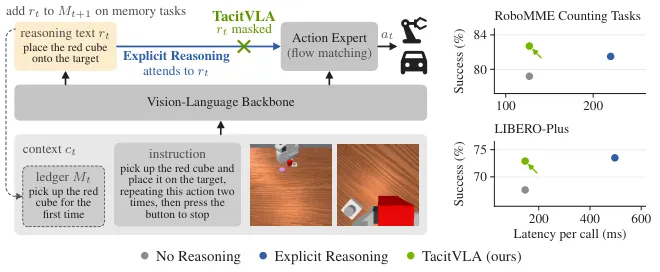
Textual reasoning before acting has improved vision-language-action (VLA) models, but at the cost of latency: every action conditioned on the reasoning text must wait for autoregressive decoding. We show that actions do not need to wait for or condition on the generated reasoning to benefit from it, because the reasoning supervision already improves the backbone representation. We introduce TacitVLA, a reasoning VLA whose action expert never attends to the reasoning it generates for the current call. On long-horizon tasks where the reasoning text also serves as episodic memory, it can generate each entry during action execution rather than before acting. We evaluate it in a controlled study on four benchmarks spanning manipulation and autonomous driving, memory and non-memory tasks: RoboMME, RMBench, LIBERO, and PhysicalAI-AV. On all four, TacitVLA matches the performance of its explicit-reasoning counterpart at up to 3.4x lower latency, and matches the latency of the same architecture trained without reasoning at up to +17.1% success. In absolute terms, it surpasses the best previously published results on the RoboMME Counting suite (82.7% vs. 66.8%) and RMBench (77.5% vs. 56.5%), and reaches 72.9% on LIBERO-Plus and a 52.5% scene score on the public split of the PhysicalAI-AV closed-loop driving challenge. Project page: https://tacitvla.github.io.

Jack Lu, Yurong You, Boyi Li · 59 views · Oct 13, 2026
VLAEmbodied ReasoningManipulationOct 13, 2026
Beyond Data Scaling: Representation-Centric Continued Pre-training for Vision-Language-Action Models

Beyond Data Scaling: Representation-Centric Continued Pre-training for Vision-Language-Action Models

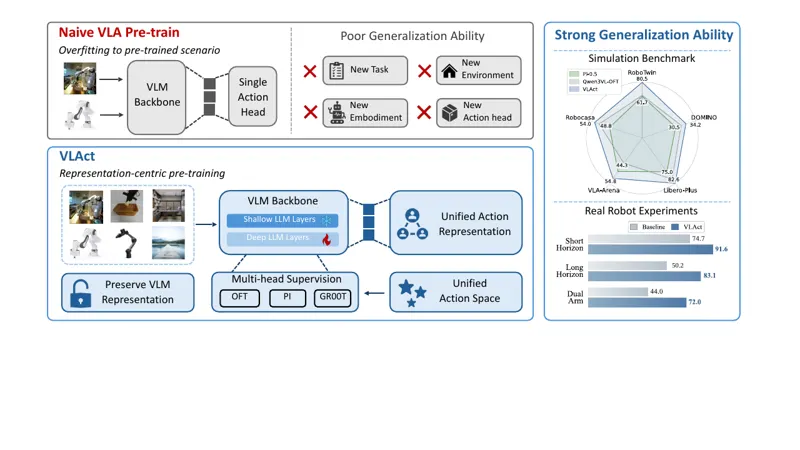
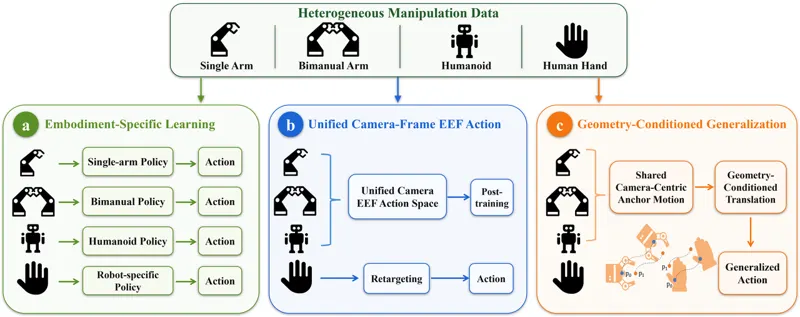
Scaling robot data is crucial for building generalist Vision-Language-Action (VLA) models, yet robot trajectories are harder to scale than web-scale image-text data because embodied collection is costly and sparsely covers the physical world. This makes representation quality a central bottleneck: under a fixed robot-data budget, continued pre-training must turn limited trajectories into transferable visual-action knowledge rather than merely fit actions. We propose VLAct, a VLA-oriented VLM backbone trained on broad, heterogeneous, multi-embodiment robot data before task-specific fine-tuning. VLAct preserves the broad VLM prior and encourages shared action semantics across embodiments through VLM-prior preservation, multi-head continuous action co-supervision, and a partially unified cross-embodiment action layout, while allowing task-specific action heads during fine-tuning. Across simulation, real-world, and unseen-embodiment transfer, VLAct consistently improves downstream performance under fixed fine-tuning protocols. On LIBERO-Plus and RoboTwin 2.0, VLAct surpasses industrial VLA systems including ABot-M0 and LingBot-VLA, achieving success rates of 82.6% and 92.5%. On RoboDojo, VLAct ranks sixth among all policies by success rate and outperforms all explicitly designated world-action model (WAM) entries on both metrics. Most notably, on RoboCasa-GR1, an unseen humanoid embodiment, VLAct using only 20% of downstream trajectories outperforms the full-data GR00T-N1.6 baseline. These results are obtained using fully open-source data and only a 16-GPU training setup, showing that representation-centric continued pre-training can deliver highly competitive performance under a modest compute budget and is an important independent axis of VLA progress beyond data scaling.

Senqiao Yang, Chengyao Wang, Yuxin Chen · 242 views · Aug 27, 2026
VLAContinued Pre-trainingCross-EmbodimentAug 27, 2026

As an Amazon Associate, we earn from qualifying purchases.