Skip to content
←Back to the radar

SOTA · embodied

Embodied AI

Real-robot manipulation, navigation, VLA and whole-body control

Embodied AI is the interface between AI and the physical world, and the cell with the largest current capability gap: what language can already write down, a robot arm often cannot do. Its relation to AGI lies in irreversibility - a physical robot has no save file, one failure can damage an object, a machine or a person, and that forces this domain to solve everything an agent can dodge in pure software: real-time behaviour, sensor noise, contact dynamics, safety boundaries. This domain has two real rulers, which puts embodied ahead of the games domain. On the physical side, the RoboDojo real-robot board (2026-09-22) is led by Pi-05 with an average of 22.9 (arxX5 27.7 / piper 32.0 / piperX 9.1), followed by InternVLA-A1 at 12.0, GalaxeaVLA (G0) at 9.0 and Xiaomi-Robotics-0 at 7.9. In simulation, the RoboDojo sim board is led by Dexmal's DM0.5 at an average of 24.9 (longHorizon 33.7, precision 24.82, generalizationStd 23.49), then GalaxeaVLA (G0.5) at 20.23 and Xiaomi-Robotics-1 at 20.07. Reading the two boards against each other is itself the single most important piece of intelligence in this domain: the simulation leader scores in roughly the same range as the real-robot leader, but the ranking is completely reshuffled, which says sim-to-real transfer remains the main source of loss in the field.

RULERCALVIN, LIBERO, Open X-Embodiment, real robots

The ladder

5
Embodied AI

Genesis World: The Unified Multi-Physics Simulation Platform for Physical AI

Genesis AI's open simulation platform for physical AI: one Pythonic API over a multi-physics engine (rigid, FEM, MPM, PBD, SPH, Stable Fluid, IPC), the Nyx path tracer, and Quadrants, a cross-platform Python-to-GPU compiler. It is built to be the evaluation engine for robot foundation models rather than a data factory: 30,000 parallel environments at 43M FPS, and under a zero-shot real-to-sim protocol, sim-vs-real evaluation agreement of Pearson 0.8996 with mean maximum rank violation 0.0166. Apache 2.0, 29.9k stars.

30kGitHub stars
Genesis World: The Unified Multi-Physics Simulation Platform for Physical AI
Embodied AI

Dexbotic: A One-Stop VLA Toolbox for Pretraining, Fine-Tuning, Inference, and Evaluation

A one-stop VLA toolbox from Dexmal: the unified DexData format spans pretraining, fine-tuning (full/LoRA/RL), inference, and evaluation, supporting mainstream models (π0, CogACT, OFT, MemVLA, GR00T N1) plus the in-house dual-expert DM0; DB-pretraining brings consistent gains across five simulation benchmarks, with 62% average success on RoboChallenge Table30 real-robot evaluation.

1.4kGitHub stars
Dexbotic: A One-Stop VLA Toolbox for Pretraining, Fine-Tuning, Inference, and Evaluation
Embodied AI

ASPIRE: Agentic /Skills Discovery for Robotics

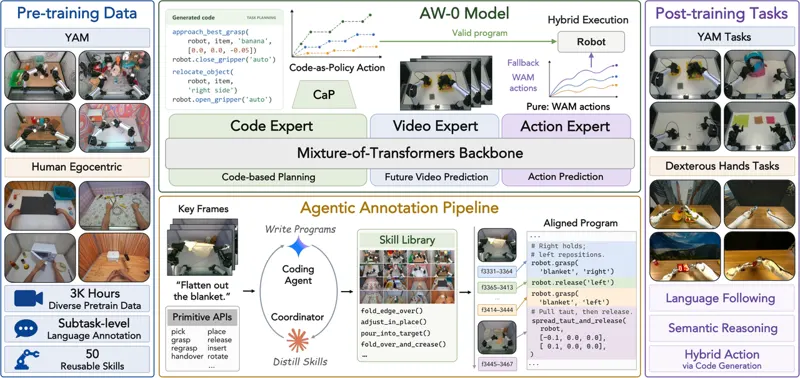
ASPIRE is the continual-learning system NVIDIA open-sourced with the University of Michigan, UIUC, Berkeley and CMU (paper arXiv:2607.00272, Apache-2.0). No gradient descent: a coding agent repeatedly writes, runs and repairs robot control programs (code-as-policy) inside a closed-loop execution engine, promotes only verified fixes into a reusable skill library, and uses evolutionary search to escape single-trajectory patching. Driven by Claude Opus 5.5 it averages 99% success across all 80 LIBERO-Pro tasks and 100% on representative Robosuite and BEHAVIOR-1K tasks; perturbed manipulation improves by up to 77%, and unseen long-horizon tasks reach 31% zero-shot against a 4% baseline. On hardware, skills discovered in simulation transfer across embodiments to a real dual-arm station, and online learning even teaches the robot to solve a Rubik's Cube.

884GitHub stars
ASPIRE: Agentic /Skills Discovery for Robotics
Embodied AI

Bimo: a 45 cm Open-Source Hip-Head Biped Trained in Isaac Lab and Distilled onto an RP2040

Bimo is a 45 cm, roughly 1.6 kg hip-head biped kit: eight STS-3215 bus servos, a BNO08x 9-DoF IMU, four VL53L0X rangefinders, two 180-degree cameras, and a custom RP2040 board closing a 20 Hz control loop. The repository publishes the Python control API (1023 lines), three MCU firmware builds (1349 lines), a ROS2 wrapper (1431 lines) and an Isaac Lab training environment (874 lines: six reward terms, dense domain randomization, and a system-identified STS3215Actuator with 3.113 Hz bandwidth, directional gear backlash and a 5 ms bus delay), plus a 26MB Bimo.usd model. The CPG gait's 104 Fourier coefficients and per-joint amplitude gains are hardcoded in both Python and C, and a [256,128,64] PPO teacher distills into a [64,32] student that goes through onnx2c into the firmware, so the robot walks untethered on the MCU. All code is Apache-2.0, but the CAD and electronics the README promises are still marked coming soon: no STL, STEP, schematic, gerbers or BOM exist in the working tree or in git history, and neither release ships pretrained weights (zero assets) or a DIY assembly manual. Currently v1.1.0 with 198 stars, in pre-order status.

198GitHub stars
Bimo: a 45 cm Open-Source Hip-Head Biped Trained in Isaac Lab and Distilled onto an RP2040
3D & World Models

Text-to-CAD: the open-source plugin and skill suite that gives coding agents CAD superpowers

text-to-cad turns parametric CAD into a local agent skill: plain language or an image becomes a STEP model with STL/3MF/GLB exports, plus DFM review, dimensioned drawings, URDF/SRDF/SDF robot descriptions and 3D printing, sheet metal and CNC integrations. Kernel is build123d on OCP; the shape is twelve skills plus the cadgen engine and a local CAD Viewer. MIT, about 20.6k stars.

21kGitHub stars
Text-to-CAD: the open-source plugin and skill suite that gives coding agents CAD superpowers

Latest demos

1112

Papers & deep reads
392
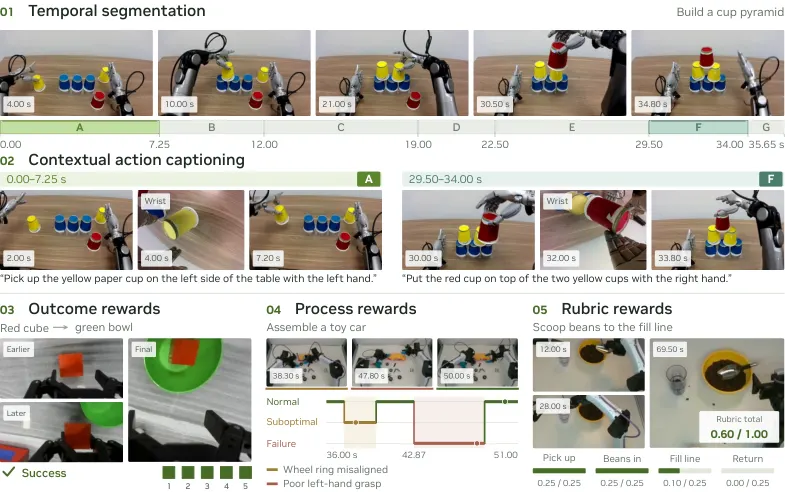
D&A: Decoupling Description and Assessment Enables VLMs as Zero-Shot Robotic Reward Models2026-11-02D&A: Decoupling Description and Assessment Enables VLMs as Zero-Shot Robotic Reward ModelsVision-Language Models (VLMs) hold promise for zero-shot video task-progress estimation in robot learning, yet existing frameworks frequently suffer from confirmation bias, hallucinating progress in failed executions due to implicit success assumptions or relative temporal ranking designs. Naive prompting of frontier models collapses into a binary success detector that fails to capture nuanced, non-linear progress and failures. While post-training approaches can mitigate this through explicit training, they demand expensive real-world robotics data and require computationally intensive post-training for every individual base model. To resolve these limitations, we introduce D&A (Describe & Assess): our approach decouples progress estimation into an objective, task-grounded textual description of scene dynamics followed by an assessment phase using explicit rubrics. By compelling the VLM to synthesize an explicit, text-based definition of absolute success before scoring, the framework anchors evaluations to an external, global criterion rather than the video's internal timeline. Empirical results demonstrate that our method calibrates zero-shot estimates and mitigates confirmation bias, providing fine-grained, partial progress metrics that accurately penalize failed executions while correctly interpolating successful runs. Being purely prompt-based, D&A generalizes across tasks, embodiments, and benchmarks---matching or surpassing post-trained reward models---and its reward estimates enable efficient downstream reinforcement learning.
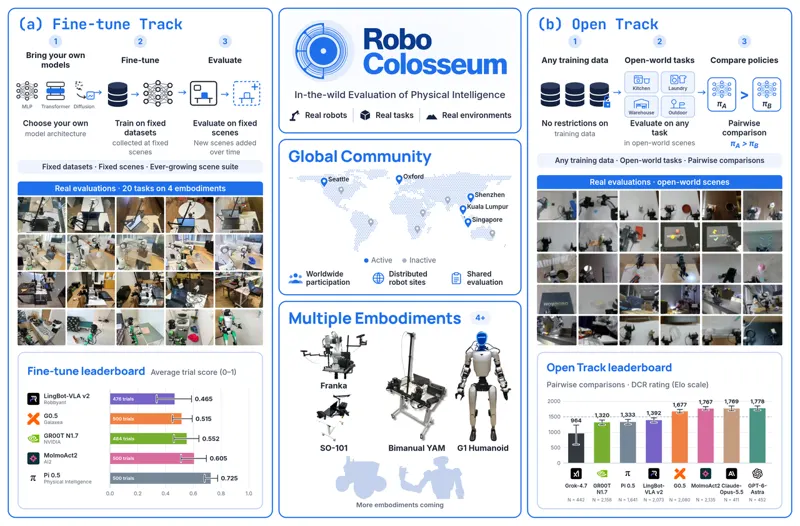
RoboColosseum: Evaluating Physical Intelligence at Scale In-The-Wild2026-11-02RoboColosseum: Evaluating Physical Intelligence at Scale In-The-WildGeneral-purpose robot policies must work across robots, tasks, and environments, yet the variation that makes physical trials informative also makes them difficult to reproduce. We introduce RoboColosseum, a distributed evaluation framework that combines unified policy serving and standardized protocols across a network of locally operated robots in diverse environments. Our initial study evaluates five vision-language-action (VLA) policies and three frontier AI agents across four embodiments (SO-101, Franka, Bimanual-YAM, and G1 Humanoid). The Open Track compares models without task-specific adaptation in blinded, pairwise trials under matched local conditions. The Fine-tune Track measures how well VLA policies adapt to 20 tasks across all four embodiments when each policy receives the same 100 demonstrations per task. Across 5,699 pairwise Open Track comparisons at 124 sites, frontier agents rival specialized VLA policies, while all systems struggle to complete open-world tasks reliably. After fine-tuning, GR00T N1.7 leads on SO-101 and pi0.5 leads on Franka and Bimanual-YAM. Policy rankings show weak agreement across embodiment-specific task suites (Kendall W = 0.24). Open Track rankings poorly predict relative performance after fine-tuning, with substantial rank reversals on all three embodiments shared between tracks. Measuring partial progress reveals differences that task success alone misses. On the G1 Humanoid, no policy completes any of the five tasks, yet average progress ranges from 13.3% to 23.2% across policies. Open Track rankings stabilize as trials accumulate, and active matchmaking achieves comparable ranking agreement with substantially fewer physical trials than uniform sampling. These results show how distributed physical evaluation can reveal where robot policies generalize, how well they adapt to new tasks, and how far they progress on tasks they fail to complete.
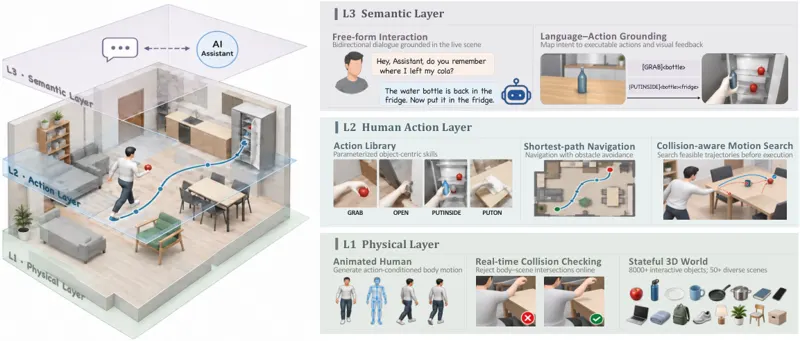
InteractiveWorld: A Verifiable Human-Centric Environment for Building Better Interactive MLLM Assistants2026-10-25InteractiveWorld: A Verifiable Human-Centric Environment for Building Better Interactive MLLM AssistantsPeople have long dreamed of an assistant that is always there to guide them and remind what they forget, from new dishes to lost keys. Powered by multimodal large language models (MLLMs), egocentric AI assistants on wearable devices are bringing this dream within reach: they see what the user sees and give instructions for user's physical work when necessary. However, testing such assistance is challenging and usually requires real people. The expensive and rare real interaction data leaves a key question unanswered: Can today's MLLMs truly help people in physical world? To answer this question, we propose InteractiveWorld, the first verifiable environment for closed-loop interaction between human and AI assistant. Unlike existing robot-centric simulators, InteractiveWorld lets the assistant guide a human agent who observes the scene, understands instructions, and acts independently. It thus realistically simulates how AI assistant collaborates with human: the assistant instructs, the human acts, and the environment executes actions and updates what they see next. Building on it, we introduce InteractiveBench, the first dynamic benchmark for egocentric AI assistants, with 120 multi-turn tasks across six categories. In each task, the assistant guides the human in real time, and every instruction shapes the outcome, which is scored by verifiable, state-based rewards. Experiments with 12 frontier MLLMs show they are still far from reliable assistants. Even the strongest model, Claude Fable 5.1, achieves at most 20% and 25% on long-horizon Guidance and Planning tasks, respectively. Overall, our work offers a verifiable platform and a rigorous evaluation set, laying a solid foundation for research on interactive MLLM assistants that truly help people in the physical world.
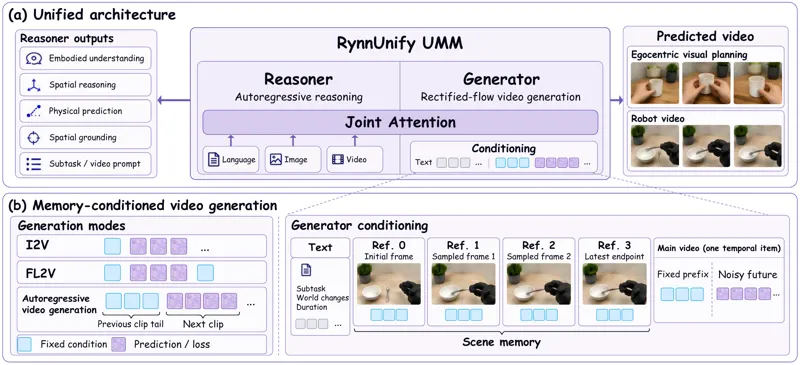
RynnUnify: Towards Unified Embodied Brain2026-10-23RynnUnify: Towards Unified Embodied BrainWe introduce RynnUnify, a 16B unified embodied model that combines strong embodied understanding with long-horizon visual planning through interleaved video--language reasoning. With capabilities spanning spatial reasoning, physical prediction, and grounding, RynnUnify connects an understanding of the physical world with visual anticipation of how it evolves across successive subtasks. Building on these capabilities, we further develop an agentic extension through reinforcement learning to selectively use video predictions for reasoning about unobserved states and interaction outcomes. We also develop a world-action extension of the full RynnUnify model, translating its understanding and prediction capabilities into robot control. To evaluate these capabilities, we introduce Rynn-VP and Rynn-GEU for long-horizon visual planning and anticipatory reasoning. Experiments show that RynnUnify achieves the highest average embodied understanding score among the evaluated unified multimodal models and improves the Rynn-VP overall score by 9.75 points over Cosmos 3 Nano. Its agentic extension improves the Rynn-GEU average by 6.0 points over direct reasoning, while the world-action extension achieves 51.5\% success on 20 selected composite RoboCasa365 tasks and 46.7\% average success across three real-robot tasks. Together, these results establish RynnUnify as a shared foundation for embodied understanding, visual planning, and robot control, taking a step toward a unified embodied brain.
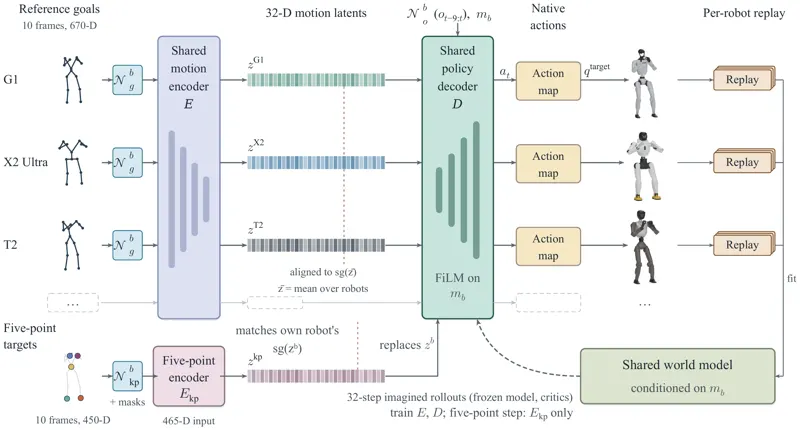
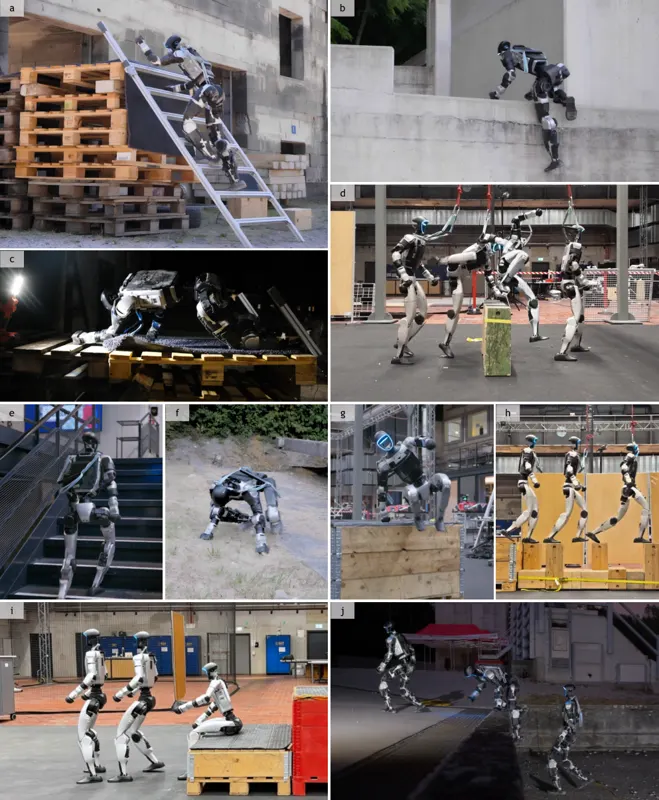
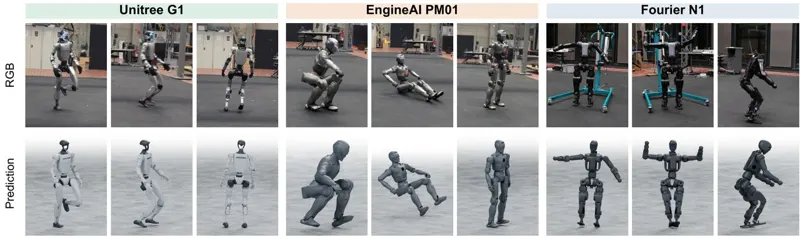
Humanoid Mobility via Attention-based Contacts2026-10-22Humanoid Mobility via Attention-based ContactsHumanoid mobility over complex terrain requires accurate foot placement and coordinated whole-body motion capable of robust adaptation. Reinforcement learning (RL) policies trained without motion references generalize well across terrains, yet eliciting effective whole-body coordination through reward design and exploration alone remains challenging. In contrast, reference-based methods yield natural motions but struggle to adapt beyond the predefined trajectories in their training data. We introduce a learning framework that bridges these two approaches by using motion data strictly as a training prior. An explicit, self-supervised, attention-based contact planner predicts future body-environment contacts, while a contact-conditioned tracker translates these plans into coordinated whole-body motion. Together, they establish contact as an interface between sensory observations and control actions. This abstraction allows the policy to internalize the contact-aware structure of locomotion rather than directly replicating kinematics. Consequently, a single policy can exploit data-driven motion priors for natural whole-body coordination while retaining the flexibility to discover environment-dependent behaviors through reinforcement learning. Building on the learned contact planner and tracker, a subsequent fine-tuning stage bootstraps their acquired capabilities to explore environment variations beyond those covered by the original motion data. Operating entirely from onboard observations without any reference inputs at deployment, this framework enables versatile humanoid mobility in challenging environments.
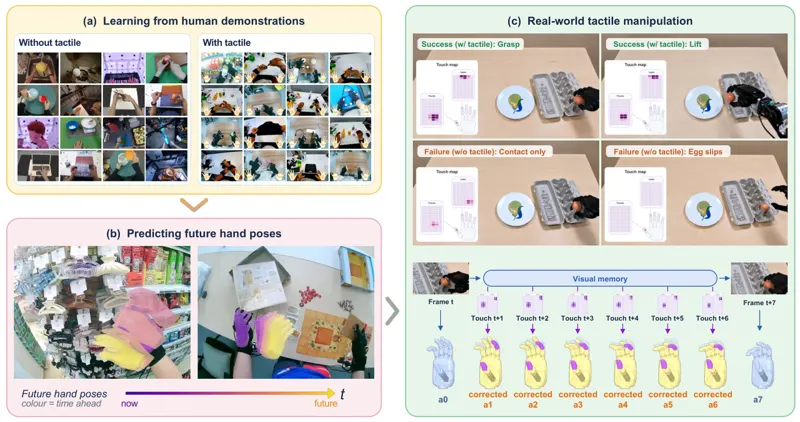
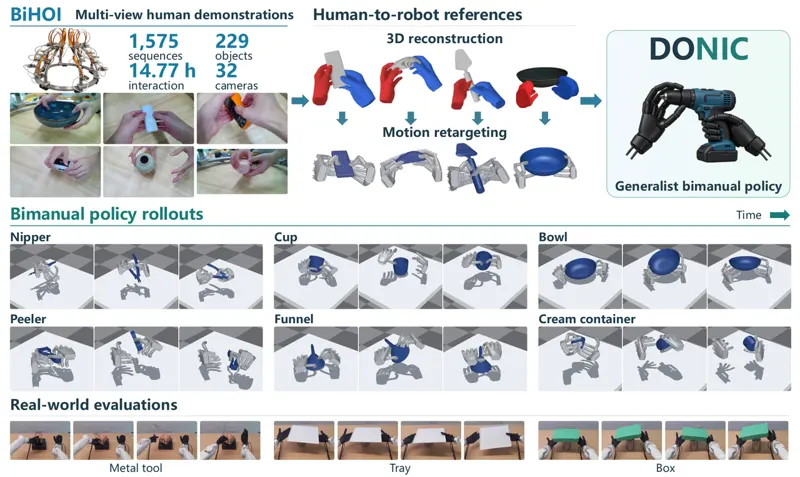
DONIC: Generalist Dexterous Bimanual Tracking Control from Human Demonstrations2026-10-21DONIC: Generalist Dexterous Bimanual Tracking Control from Human DemonstrationsDespite recent progress in dexterous reference tracking, existing models focus primarily on single-hand manipulation and a limited range of interactions, leaving the bimanual dexterous behaviors common in real life unaddressed. The scarcity of contact-rich bimanual manipulation data and the increased complexity of coordinating contacts make developing a generalist bimanual tracker particularly challenging. Therefore, we present 1) DONIC, the first generalist bimanual tracker jointly trained across operation categories and human-motion sources, together with 2) BiHOI, a multi-view dataset of 1,575 sequences spanning 229 objects and emphasizing sustained bimanual interaction, where reconstructed interactions are retargeted into robot references. DONIC combines proximal policy optimization with behavioral cloning in a feedback loop that recycles verified successful executions into training demonstrations. An object-centered per-hand reward maintains object-motion feedback while supervising each hand according to its reference contact role. Clip-Centered Advantages remove reference-dependent advantage offsets while preserving within-trajectory differences. Together, these designs enable one single policy to learn coordinated manipulation across heterogeneous references. Without finetuning, a single checkpoint achieves 86.79% success on unseen trajectories of training objects and 57.32% on held-out objects, surpassing the state-of-the-art bimanual tracking baselines by 77.36 and 45.73 percentage points.

Open source

14

Assets you can use now

No installable skill wired to this domain yet.

Boundaries & failure modes

The readings in this domain have to be interpreted with physical intuition, or they will mislead you. One, the absolute level is still low: the real-robot leader Pi-05 averages 22.9, meaning under RoboDojo's task protocol success is below a quarter, and second place at 12.0 falls off a cliff - this domain has not yet formed the dense first tier that mature fields have, so a single-point lead may come from task bias rather than general capability. Two, per-platform variance is enormous: Pi-05 scores 32.0 on piper but only 9.1 on piperX, the same model differing more than threefold across hardware, while vendor releases usually quote only the best platform. Per-platform readings are therefore printed in this domain, and citing the average alone is not allowed. Three, simulation and real-robot rankings swap: DM0.5 leads the sim board at 24.9 but is not in the top tier on real hardware, and Pi-05 is the reverse, and that inconsistency itself says simulation scores cannot be extrapolated to real robots, so any claim of "superhuman in simulation" needs separate verification. Four, long horizon and memory are the weakest axes: the longHorizon sub-scores on the sim board sit mostly between 23 and 44 while precision is higher, which says current VLA systems are good at short-range dexterous manipulation and bad at multi-step procedures. Five, generalisation to random perturbation barely exists: generalizationRand runs from 1.57 to 11.44, the lowest band across all dimensions, and real-world changes in lighting, material and pose are exactly that kind of perturbation. Six, cost and data: real-robot data cannot be scraped from the internet, one teleoperated demonstration costs human minutes, and that is the structural reason this domain advances more slowly than language, not a lack of effort.

As an Amazon Associate, we earn from qualifying purchases.