Skip to content
← Tags

#Reinforcement Learning (168)

Speech & AudioMediaTopC

Fun-CosyVoice3-0.5B: open TTS that turns controllability into an interface

The third generation LLM based speech synthesis system from the FunAudioLLM group at Alibaba, 0.5B parameters, released as Fun-CosyVoice3-0.5B-2512 with base and RL weight sets plus training and inference scripts; the code repository has moved to QwenAudio/CosyVoice (Apache-2.0, 23,794 stars, verified through the GitHub API on 2026-09-29). It sits at the open source top row for speech in the audio domain, and the reason is not that it sounds most human but that it gives each of the four failure modes of production TTS an explicit interface: misread polyphonic characters go through pronunciation correction with Chinese pinyin or English CMU phonemes written straight into the input, wrong readings of numbers and symbols go through the built in text normalisation, collapsed long sentences go through RAS repetition aware sampling, and low latency goes through bidirectional streaming with an official first packet at 150ms, which is the right order of magnitude to sit inside a realtime conversational agent. Three readings matter on the metric sheet. The test-zh speaker similarity of 78.0 is the highest among 0.5B open models and above the human baseline of 75.5, yet still below the closed source Seed-TTS at 79.6, so open source first holds while world first does not. The test-hard column is the real strength, base 6.71 and RL 5.44 being the lowest in the table and better than the closed source 7.59, and hard is exactly long sentences and tongue twisters, so that lead maps to usable real scripts. English needs a discount: base test-en similarity 71.8 sits below the human baseline 73.4 and only the RL tier WER of 1.68 recovers it. Base and RL are two post training weights of one architecture, with all three error rates falling (zh CER down 33 percent, hard CER down 19 percent) and all three similarities slipping slightly, which is a good trade for broadcast and support workloads where one misread character is an incident, while voice fidelity work for a specific IP should audition the RL tier first. The repository also ships GRPO training scripts and a triton plus TensorRT-LLM runtime claimed at four times the speed of HF transformers, so post training is a path others can continue rather than a one off delivery, and the language surface covers nine languages with more than eighteen Chinese dialect accents, a tier the closed APIs still barely offer. Boundaries: the licence is two layered, Apache-2.0 for code while the weight terms live on the model pages and must be checked separately before commercial use; every reading comes from the evaluation of the authors themselves with no third party blind listening table to cross check and not recomputed here; zero shot cloning similarity comes from standard sets while real deployments depend on the noise and style of the reference recording. Graded C (vendor claim).
78.0test-zh speaker similarity (0.5B open-weight tier, human baseline 75.5)Vendor Claim · 2025-12
ProductAlibaba Tongyi FunAudioLLM (QwenAudio)SiteRepo
Fun-CosyVoice3-0.5B: open TTS that turns controllability into an interface
AI CodingDevelopmentTopC

Cursor: one of the few vendors holding all three layers - in-house coding model, own harness, cloud-parallel execution

Cursor began as a VS Code fork from Anysphere and by 2026 is one of very few vendors holding three layers at once: an in-house agentic coding model (Composer), its own harness, and cloud-parallel execution - layers that feed each other, since the real long tasks running through the product every day become RL environments and the resulting Composer is tuned against the tool surface of Cursor itself. The Agent is officially decomposed into instructions (system prompt plus rules), tools (file editing, codebase search, terminal execution) and model, with instructions and tools tuned per frontier model and no cap on tool calls. Composer 2 (2026-03-19) reports CursorBench 61.3, Terminal-Bench 2.0 61.7 and SWE-bench Multilingual 73.7 at $0.50 input / $2.50 output per million tokens, with the same-intelligence fast tier as the product default. Composer 2.5 (2026-05-18) stops adding benchmark tables and targets long-horizon persistence, instruction following and collaboration feel via targeted RL with text feedback (hint-augmented policy as teacher, original-context policy as student, an on-policy distillation KL term) plus 25x the synthetic tasks of Composer 2, including dynamic feature-removal problems. Eval footnotes disclose harness differences: Anthropic models on Claude Code, OpenAI models on Simple Codex, Cursor scores on the Harbor framework averaged over 5 runs per pairing. Boundaries: Composer is closed source and is not the same thing as the open-weight base, CursorBench is in-house, and the forked IDE lags the upstream extension ecosystem. Confidence C (vendor-claim).

61.7Terminal-Bench 2.0 (Composer 2, Harbor / mean of 5 runs)Vendor Claim · 2026-03
ProductAnysphereSite
Cursor: one of the few vendors holding all three layers - in-house coding model, own harness, cloud-parallel execution
MathResearchTopC

Kimina-Prover: reaching 92.2% on miniF2F with whole-proof RL and no search tree

The Lean 4 theorem proving line from Moonshot AI with Numina, deliberately contrarian: no prover feedback in training or inference, no Monte Carlo tree search, value function or process reward model (arXiv:2504.11354), so search is internalised into a single whole-proof generation, and a custom Formal Reasoning Pattern writes a natural-language draft before Lean code, recasting a sparse binary reward as a language problem. The base is Qwen2.5-72B with up to 32K context. Keep two generations apart: Preview (2025-04) reached 80.7% on miniF2F-test at pass@8192, the first public result above 80%; the 72B model (2025-07-10) reached 92.2% after adding TTRL search and error repair, the highest public reading then and the number on the card, while pass@1 under the same protocol is only 63.9%. Equal-budget pass@1/32/1024 of 63.9/84.0/87.7 leads the 671B DeepSeek-Prover-V2 (61.9/82.4/86.6) at all three budgets. Discounts: that table is Kimina's own and its DeepSeek rows are their reruns, the repo declares no licence, and miniF2F holds 244 problems now past 92%, so its power to separate frontier models is decaying. No third-party board exists here, so read the numbers as direction. Graded C (vendor-stated): nothing recomputed on a pinned commit.

92.2%miniF2F (after TTRL search)Vendor Claim · 2025-07
ResearchMoonshot AI (Numina & Kimi)SiteRepo
Kimina-Prover: reaching 92.2% on miniF2F with whole-proof RL and no search tree
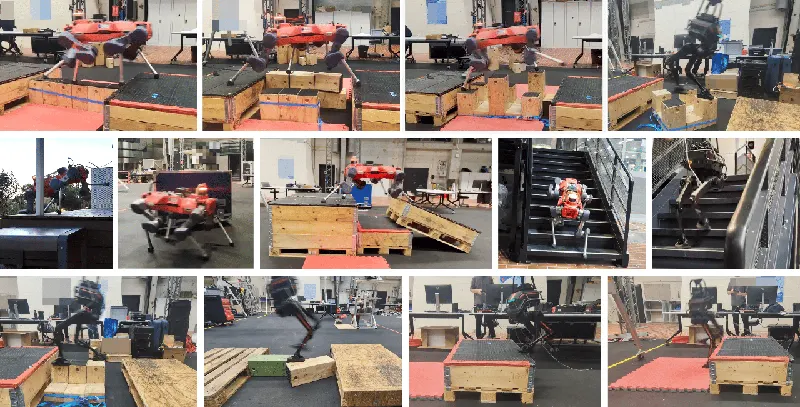
Agile and Generalized Legged Locomotion via Attention-Based Neural Map Encoding

Agile and Generalized Legged Locomotion via Attention-Based Neural Map Encoding

Achieving agile and generalized legged locomotion across terrains requires tight integration of perception and control, especially under occlusions and sparse footholds. Existing methods have demonstrated agility on parkour courses but often rely on end-to-end sensorimotor models with limited generalization and interpretability. By contrast, methods targeting generalized locomotion typically exhibit limited agility and struggle with visual occlusions. We introduce a unified reinforcement learning (RL) framework for agile and generalized locomotion that incorporates a novel attention-based map encoder in the control policy. This encoder extracts local and global mapping features and uses attention mechanisms to focus on salient regions, producing an interpretable and generalized embedding for RL-based control. We further propose a learning-based mapping pipeline that provides fast, uncertainty-aware terrain representations robust to noise and occlusions, serving as policy inputs. It uses neural networks to convert depth observations into local elevations with uncertainties, and fuses them with odometry. The pipeline also integrates with parallel simulation so that we can train controllers with online mapping, aiding sim-to-real transfer. We validate our framework with the proposed mapping pipeline on a quadruped and a biped robot, and the resulting controllers demonstrate strong agility and generalization to unseen terrains in simulation and in real-world experiments.

Chong Zhang, Victor Klemm, Fan Yang · 299 views · Jan 13, 2026
Legged LocomotionReinforcement LearningNeural MappingJan 13, 2026
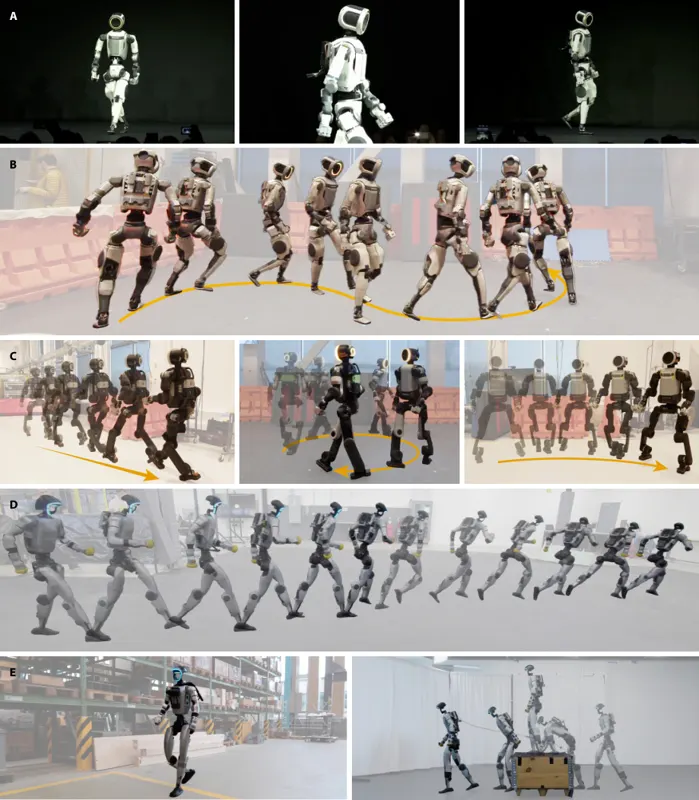
HuMBLE: Human Motion-Driven Behavior Learning for Embodied Locomotion

HuMBLE: Human Motion-Driven Behavior Learning for Embodied Locomotion

Despite recent advances in humanoid locomotion, controllers optimized for command tracking and robustness tend to produce mechanical gaits, whereas controllers tied to human motion data often fail to generalize to commands outside the data distribution. This work introduces a learning framework that balances these competing objectives to synthesize real-time steerable, robust, and biomimetic locomotion policies from human data. Using an in-house curated locomotion dataset covering diverse speeds and directions, we first learn a natural locomotion prior policy through a teacher-student distillation process. Specifically, we train a full-body reference-conditioned policy with Reinforcement Learning (RL), then distill it into a lightweight prior policy conditioned solely on proprioception and a planar torso-velocity steering command. Next, we fine-tune the prior policy with multi-task RL to expand command coverage and robustness beyond the data distribution, pairing a goal-conditioned task that tracks arbitrary commands with a reference-guided task that tracks the human data as an explicit style regularizer. We validate our framework on three humanoid robots: the Boston Dynamics Atlas R1, Atlas D1, and Unitree G1. Experimental results demonstrate robust performance across real-world scenarios, including direct user-controlled locomotion in indoor and outdoor environments, and integration as the locomotion layer within hierarchical control stacks. Benchmarks against Tabula Rasa RL policies trained without human data and ablation studies confirm that our framework yields a lightweight, deployable policy that reconstructs coordinated whole-body behavior from a steering command, retaining the human gait characteristics while remaining robust and fully steerable.

Mike Zhang, Dongho Kang, Kevin Bergamin · 539 views · Oct 7, 2026
Humanoid LocomotionMotion ImitationReinforcement LearningOct 7, 2026

As an Amazon Associate, we earn from qualifying purchases.