Skip to content
Tags

#Vision-language-action (VLA) (11)

VLA-Corrector: Lightweight Detect-and-Correct Inference for Adaptive Action Horizon

VLA-Corrector: Lightweight Detect-and-Correct Inference for Adaptive Action Horizon

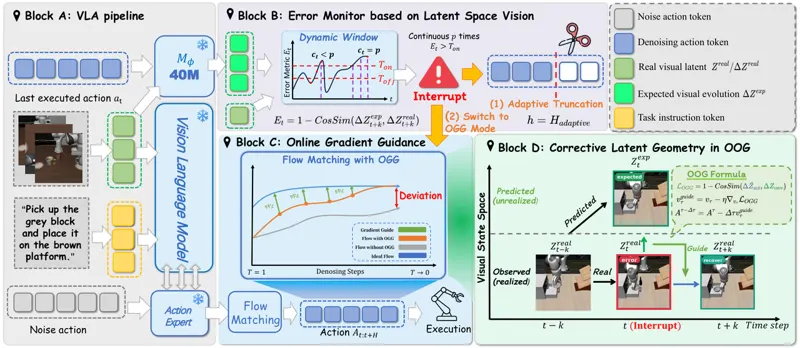
Vision-Language-Action (VLA) foundation models have recently achieved strong progress in embodied intelligence. To reduce policy-call frequency while preserving temporal coherence, most generative policies adopt an action chunk mechanism, executing multiple future actions in an open-loop manner under a fixed action horizon. However, this "predict-then-blindly-execute" paradigm sacrifices closed-loop reactivity: in contact-rich physical interactions, even small local perturbations can rapidly amplify within the open-loop blind spot, leading to compounding errors and ultimately task failure. To address this limitation, we propose VLA-Corrector, a lightweight corrective inference framework for action-chunked VLA policies. Without modifying the backbone policy weights, VLA-Corrector introduces a lightweight Latent-space Vision Monitor (LVM) that continuously compares predicted and actual visual feature evolution, enabling online detection of visual dynamics deviations. Once persistent deviation is detected, the system triggers a truncation event, discards the remaining stale actions, and invokes corrective replanning via Online Gradient Guidance (OGG). The detect-and-correct mechanism of VLA-Corrector naturally induces an event-triggered adaptive action horizon: it preserves long-horizon execution when the current chunk remains reliable, and invokes short-horizon corrective replanning when execution begins to drift. In doing so, VLA-Corrector mitigates the trade-off imposed by static horizons between execution robustness and policy-call frequency. It can be integrated into different VLA models without further retraining the VLA backbone, interrupting compounding errors while preserving much of the efficiency benefit of action chunking and substantially improving robustness in long-horizon, contact-rich robotic manipulation tasks.

Yi Pan, Miao Pan, Qi LuJul 2, 2026
VLARobotic ManipulationAction chunkingJul 2, 2026
Reasoning as a Double-Edged Sword: Architecture and Cross-Stage Robustness in Vision-Language-Action Models

Reasoning as a Double-Edged Sword: Architecture and Cross-Stage Robustness in Vision-Language-Action Models

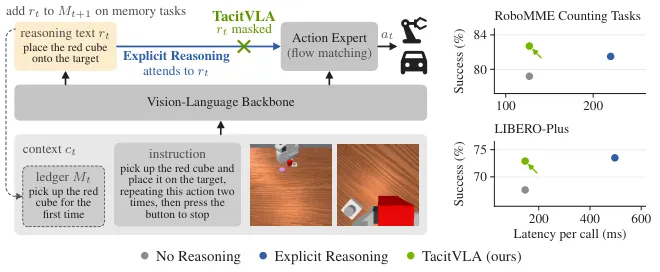
Does adding a reasoning step make a Vision-Language-Action (VLA) model more robust to perturbation? Intuitively, a policy that reasons before acting should absorb a perturbed input better than one that maps observations directly to actions. We test this premise head-on across three models that span the reasoning spectrum (no reasoning, a text chain-of-thought, and a latent iterative loop), perturbing each at the vision, reasoning, and action stages on LIBERO and SimplerEnv. Two questions organize the study: does the reasoning design shift robustness, and can the reasoning be read back at runtime as a safety signal? We find that the latent-iterative model is by far the least robust: under both stochastic noise and white-box perturbation its task success collapses, while the other two hold. This fragility is structural rather than cumulative: varying the reasoning depth at inference barely moves it. Reasoning outputs can in principle be monitored, but the monitors fail under fair tests. A plan–action consistency probe that looks near-perfect under naive evaluation falls to chance under adaptive attack. Under matched-FPR calibration, fusing it with an action-anomaly probe never lifts defended success above undefended. Scoped to these output-level behavioral probes under white-box vision-stage attack, this ceiling is a precondition that any viable defense must first satisfy.

Tuan Duong Trinh, Naveed Akhtar, Basim AzamJul 20, 2026
VLAVision-language-action (VLA)Jul 20, 2026
A Few Words Go a Long Way: Language Guided Robot Policy Synthesis

A Few Words Go a Long Way: Language Guided Robot Policy Synthesis

While vision-language-action models have demonstrated impressive zero-shot manipulation capabilities, they remain fundamentally black box policies that are difficult to interpret, adapt, or correct when they inevitably fail. In this work, we propose ARCHITECT, a framework that treats robot policy acquisition as an interactive program synthesis task. ARCHITECT leverages the reasoning capabilities of LLM coding agents to synthesize modular robot programs that utilize a suite of perception and control tools. Unlike end-to-end models where distribution shift leads to unpredictable, cascading failures, our modular architecture allows users to isolate failures and localize feedback at the level of abstraction required. We introduce an iterative process where a human supervisor provides natural language corrections to steer the policy. These corrections are grounded in the policy code by program execution traces and distilled into a persistent skill library, a form of long-term in-context learning which enables the agent to accumulate a repertoire of reusable, interpretable behaviors. In a benchmark evaluation on a Franka Panda robot, ARCHITECT outperforms state-of-the-art VLA models and program synthesis baselines on complex, long-horizon tasks, including articulated object manipulation and cloth folding. Our results demonstrate that the synthesized skill library enables the system to transfer to novel tasks with decreasing human intervention, providing a steerable and data-efficient alternative to black-box robot learning. Website: https://robo-architect.github.io/

Daphne Chen, Archit Ritesh Jain, Eric GoossenJul 26, 2026
VLAVision-language-action (VLA)Jul 26, 2026
MulRobBench: A Decision-Level Benchmark for Safe and Security-Policy-Compliant Multimodal UAV Agents

MulRobBench: A Decision-Level Benchmark for Safe and Security-Policy-Compliant Multimodal UAV Agents

Smart-city airspace is transforming Uncrewed Aerial Vehicles (UAVs) from passive sensing platforms into cyber-physical decision makers that must follow operational rules under degraded observations and ambiguous language. Existing UAV and multimodal benchmarks evaluate perception, navigation, collaboration, and reasoning, but few assess whether physical evidence, protocol constraints, and action risk remain coupled during critical decisions. We introduce MulRobBench, an offline, protocol-conditioned benchmark for Vision-Language-Action (VLA) UAV agents in smart-city environments. MulRobBench integrates real UAV multimodal observations, protocol-level security policies, and action-level cyber-physical safety into a unified evaluation framework. The benchmark contains 3,024 samples spanning 17 task taxonomy nodes and 12 scoring dimensions across four stages: operational context understanding, multimodal evidence arbitration, degradation-aware reasoning, and risk-aware action planning. Evaluation combines semantic scoring with structural diagnostics, including policy compliance, format compliance, unsafe actions, parsing failures, and dimension-level validity. Across 17 multimodal models, the best semantic protocol-decision score reaches only 0.5141, while the best strict mean scoring-dimension accuracy is 0.1599. A controlled 20-anchor modality-ablation study changes 4-15 action selections per model, confirming that both visual and textual inputs influence decisions. Analysis identifies modality-trust selection, constraint extraction, glare, missing data, and operator shorthand as the primary causes of decision instability. MulRobBench provides a reproducible benchmark for trustworthy multimodal UAV decision making under realistic operational constraints.

Belal S. Alsinglawi, Weizheng Wang, Junyi WuJul 26, 2026
VLAVision-language-action (VLA)Jul 26, 2026
FutureRTC: Real-Time Robot Execution with Anticipatory-Conditioned Action Chunking

FutureRTC: Real-Time Robot Execution with Anticipatory-Conditioned Action Chunking

Real-time deployment of Vision-Language-Action (VLA) policies necessitates asynchronous execution, wherein subsequent action chunks are computed concurrently with the execution of the current chunk, leading to prediction-execution misalignment and manifesting as inter-chunk discontinuities. Existing methods either superficially smooth chunk boundaries, require costly policy optimization, or exclusively forward-predict proprioceptive states yet neglect critical visual observations. In this paper, we propose FutureRTC, a plug-and-play adaptation framework that predicts execution-time observations and states for asynchronous VLA control without modifying the underlying policy. Specifically, FutureRTC features a state correction module to compensate for the discrepancy between rolled-forward and actual execution-time proprioceptive states and an observation prediction module that forecasts execution-time visual representations by leveraging robot motion as an explicit physical prior through motion-aware feature transport and reconstruction. Furthermore, we introduce a policy consistency loss to align the action chunks generated from predicted contexts with those produced under the expected execution-time inputs of the VLA policy. Extensive experiments across simulated and real-world environments demonstrate that FutureRTC achieves superior robustness to inference delays, resulting in smoother trajectories, faster execution, and consistently higher task success rates.

Hai Jiang, Yixian Zou, Binbin LiangJul 27, 2026
VLAVision-language-action (VLA)Jul 27, 2026
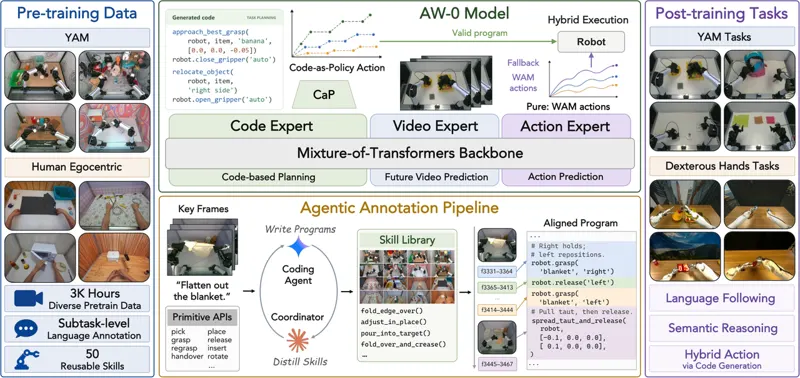
DeVA: Decoupled Video-Action Model with physical guidance for robot policy learning

DeVA: Decoupled Video-Action Model with physical guidance for robot policy learning

Generalizable robot manipulation requires policies that can anticipate how visual scenes evolve while executing language instructions. While recent Vision-Language-Action models benefit from large-scale pretraining, their predominantly static pretraining objectives provide limited supervision for physical dynamics and temporal causality, leaving control-relevant knowledge to be learned from downstream robot demonstrations. Video generative models offer a promising foundation by encoding rich spatiotemporal priors through future predictions. However, existing Video-Action Models either couple video and action prediction in a shared backbone, making policy adaptation harder to optimize, or under-utilize video information when guiding the action branch. In this work, we introduce DeVA, a Decoupled Video-Action model with specialized video and action experts, multi-level feature transfer, and physically salient guidance. DeVA transfers representations from multiple video layers to the action expert, enabling rich information exchange while making policy learning more tractable. It further supervises intermediate video features and the action stream with physically salient guidance (affordance/depth). Experiments on both simulation benchmarks and real-world deployment demonstrate strong performance with limited data, faster convergence than a unified architecture, and clear performance gains from physical guidance.

Mengqi Zhang, Sahil Khose, Simar KareerJul 27, 2026
VLAVision-language-action (VLA)Jul 27, 2026