 1:51
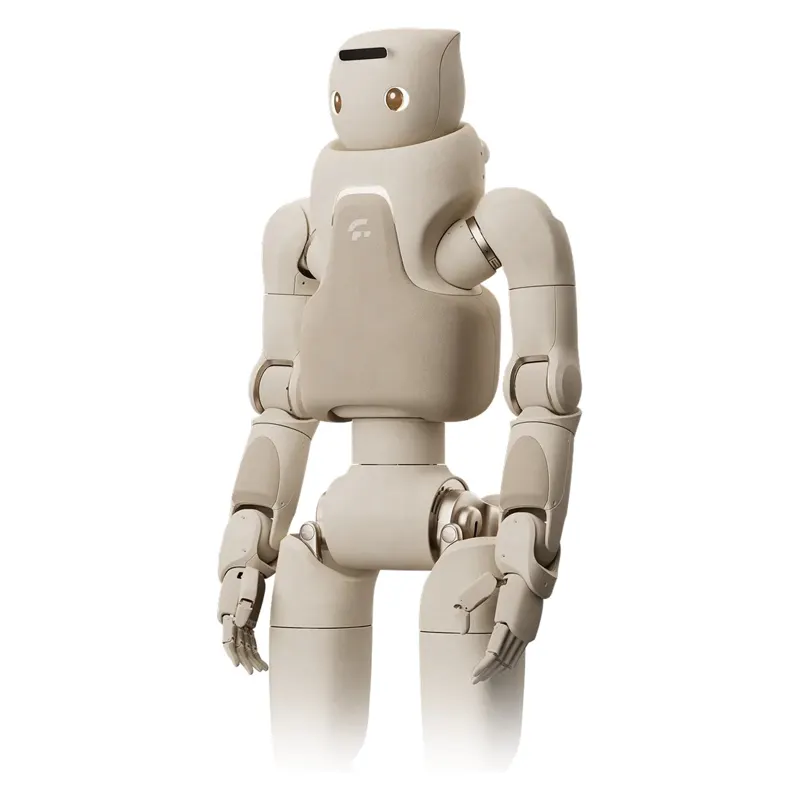
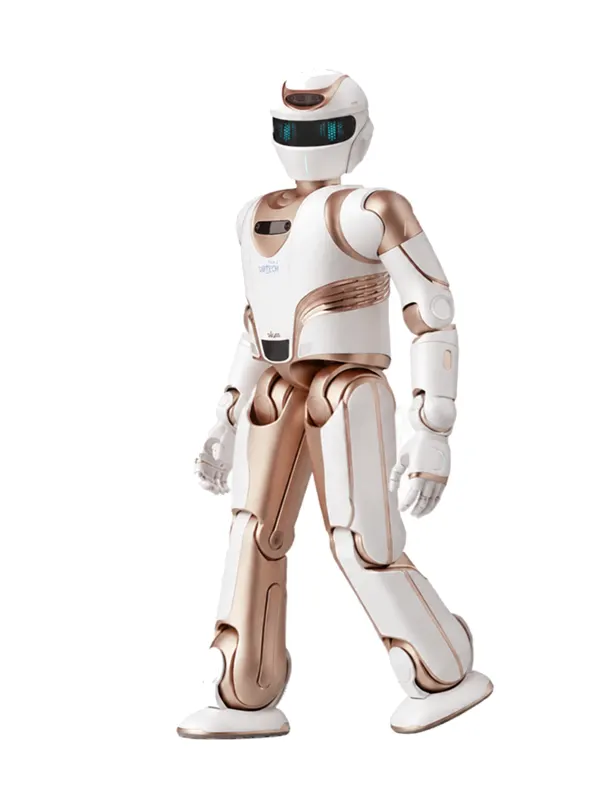
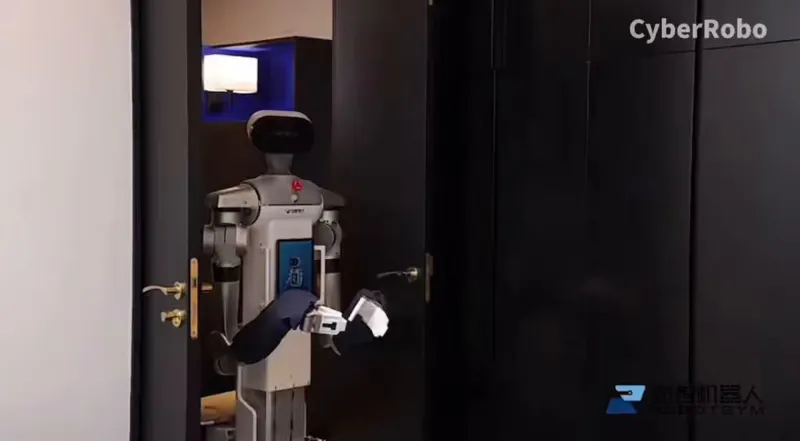
1:51Qijia Q1: Elderly-Care Companion Humanoid
@CyberRobooo · 30 views · 2025-10-12
Service robotsHumanoid robotsElderly Care
1:51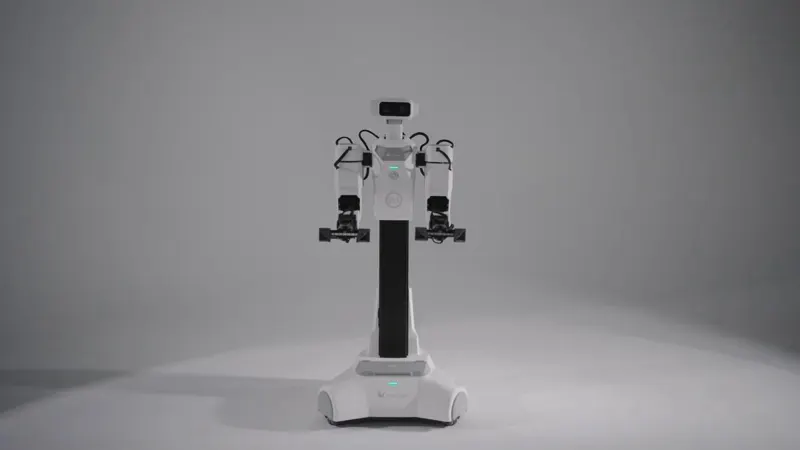 1:27
1:27 0:30
0:30 1:28
1:28 0:06
0:06 1:08
1:08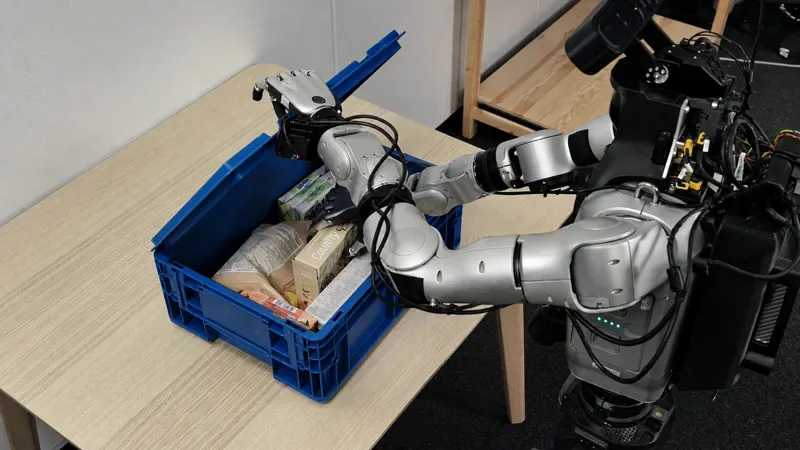 1:37
1:37 0:26
0:26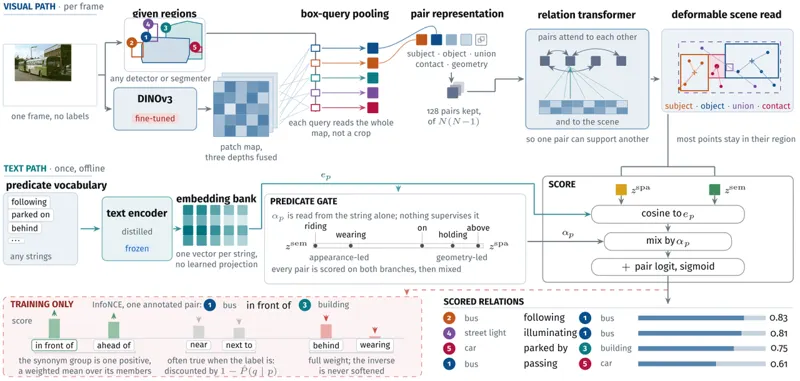
Open-vocabulary detection accepts any class list at inference, and promptable segmentation returns regions without class names: the taxonomy has left the model and become an input. Relation prediction has not. Scene-graph models are still trained and evaluated on the 50 or 56 predicates of one annotation style, their relation head conditioned on object labels and so tied to one detector. Three obstacles explain this, none primarily modelling: no relation corpus is both free-text and verified, a label-conditioned architecture cannot accept a vocabulary it was not trained on, and the standard metric rewards agreement with the training corpus, so a larger vocabulary scores as a regression. We present RelateAnything, a 53M-parameter model taking an image and regions from any source and returning scored relations over a predicate vocabulary supplied at inference as strings. Object labels are never an input, so the region source can change without retraining, and the vocabulary is a bank of text embeddings, not a learned classifier. It runs at 20 ms/frame. Training over 19,103 predicates requires positive-unlabeled supervision and a text encoder that separates antonyms, which contrastive encoders embed at cosine 0.95. To supply the supervision we build RA-4M, 474k images and 4.3M relations over 10,102 free-text predicates, generated against numbered box markers and geometrically verified. To measure it we build OV-SGG-Bench, six axes scored across datasets that the priors standard recall rewards cannot satisfy. On three cross-dataset benchmarks and a fourth zero-shot, RelateAnything has 2.3-3.5x the mean recall of the strongest open-vocabulary method of comparable scale, margins that survive a real detector, and leads a 3B-VLM scene-graph model on both metrics at under 2% of its parameters. In-domain measurement overstates transfer gains ~5x. Model, corpus and benchmark are public.
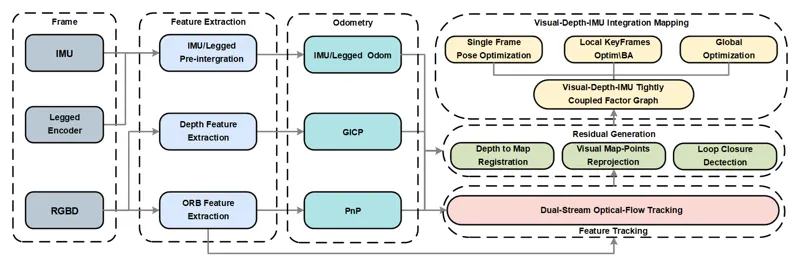
GeoFlow-SLAM targets the feature-matching, initialization, and texture-robustness failures that arise when legged robots move aggressively at high frequency. It tightly couples dual-stream optical flow, legged odometry, PnP, GICP, and depth-to-map geometric constraints in one optimization framework. Experiments on Unitree Go2 and G1 robots plus OpenLORIS, ScanNet, and TUM datasets show state-of-the-art robustness and accuracy.
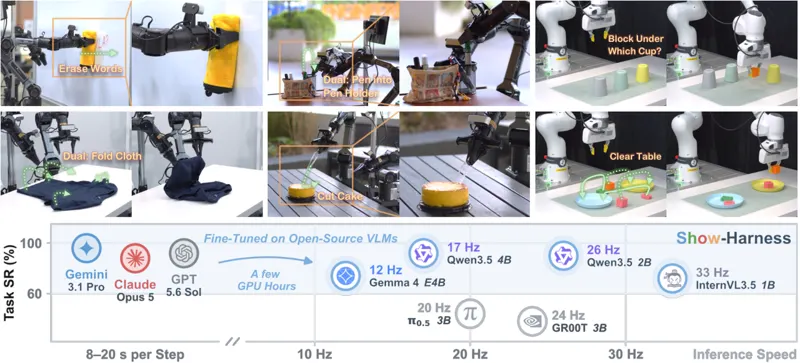
Foundation vision-language models (VLMs) exhibit broad intelligence about the world, yet translating this intelligence into robot control remains challenging. We present Show-Harness, an Embodied Harness that enables VLMs to "play" robots through a compact semantic interface linking intent to action. Show-Harness exposes discrete semantic action units that VLMs can naturally reason over, while embodiment-specific interpreters deterministically ground them into local robot actions, keeping the VLM directly responsible for fine-grained physical decisions. Through the same interface, Show-Harness demonstrates the feasibility of (1) directly unlocking closed-source frontier VLMs for zero-shot robot control, and (2) adapting small-scale open-source VLMs for low-cost deployment with just a few GPU-hours of fine-tuning. We further develop GUMI (GUI Manipulation Interface), which extends the same semantic action space to GUI-based demonstration collection, allowing humans and agents to "play" robots across embodiments without specialized teleoperation hardware. Extensive experiments show that Show-Harness-equipped VLM agents generalize robustly across tasks, embodiments, and environments, outperforming representative agentic and VLA paradigms. These results suggest that the right interface can unlock substantial embodied capability from foundation VLMs, without requiring additional model capacity or costly embodiment-specific pretraining.
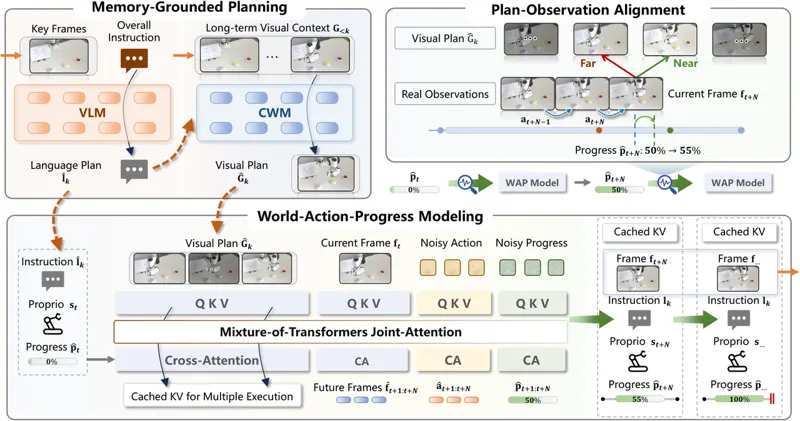
Most robot policies predict actions from the current observation or a short fixed window, yet long-horizon manipulation is non-Markovian: the evidence a decision needs may already be out of view. MaP-WAM treats memory as planning-time evidence instead of executor input. Completed segments are stored as structured multimodal records pairing a language instruction with sparse visual context (8 uniformly sampled frames per segment); a fine-tuned Qwen3.5-4B language planner proposes the next segment-level language plan, and a causal world model initialized from WAN-2.2-5B turns the long-term visual context into a matching visual plan. The two form a memory-grounded plan that conditions a World-Action-Progress executor, a Mixture-of-Transformers extension of a video DiT that jointly predicts action chunks, future visual latents, and execution progress, with progress as a first-class modality. Because the executor only sees a fixed-length plan prefix, its context stays constant as history grows, and block-causal attention makes both planning and execution KV-cacheable; plan-observation alignment calibrates recursively predicted progress against visual-plan frames, and a progress gate (threshold 0.95) triggers segment transitions that write resampled real observations back into memory. On RMBench MaP-WAM reaches 83.3% average success over nine memory-dependent tasks (best baseline LingBot-VA 77.1%), and 78.0% on two real Franka Research 3 tasks (88% Find Button, 68% Press Buttons), while a full-context executor runs out of memory at 1700 history frames and WAP holds an approximately constant 827 ms per action chunk. Limitations: segment structure is taken from benchmark annotations rather than discovered automatically, and plan-observation alignment uses a lightweight training-free pixel-difference metric.
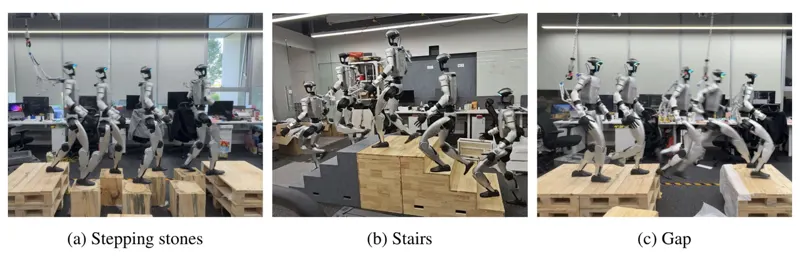
Foothold-constrained terrain is characterized by sparse, discontinuous, or geometrically restricted feasible foot contacts, as encountered on stepping stones, across gaps, and on narrow stair treads. On such terrain, a single misstep often leaves little room to recover, so policies that base foot-placement decisions primarily on the immediately visible terrain are prone to failure. We ask whether a learned predictive summary of near-future observations and rewards can provide the anticipatory information required in such settings. We present World-Model-Augmented Visual Locomotion (WM-LOCO), which jointly trains a recurrent world model and a PPO policy. Conditioned on proprioception and a single onboard depth image, the world model produces a predictive recurrent feature that guides the policy, without explicit foothold labels. In simulation, WM-LOCO succeeds on gaps and stepping stones where a matched baseline fails completely, and matches the baseline's success rate on stairs while improving stride efficiency and reducing pelvis acceleration. We deploy the same policy onboard a physical Unitree G1 humanoid using onboard proprioception and a single depth stream; it traverses all three terrain classes with an average success rate of 93.3%.
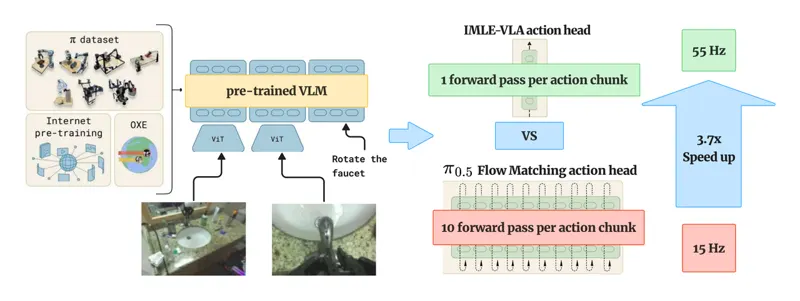
Vision-language-action (VLA) policies leverage pretrained vision-language backbones to achieve strong cross-task generalization. A leading design couples this backbone with a dedicated continuous action head trained via diffusion or flow matching. However, such heads rely on iterative multi-step sampling, for example 10 Euler steps in π_0.5. This creates an inference bottleneck that produces stop-and-go movement in the robot and slower task completion. We introduce IMLE-VLA, which replaces the iterative action head with a single-step conditional generator trained via conditional Implicit Maximum Likelihood Estimation (cIMLE). The cIMLE objective promotes multimodal action coverage, avoiding the mode collapse of naive regression heads while eliminating multi-step sampling entirely. When IMLE-VLA is applied to π_0.5, it increases inference frequency 3.67x (55 Hz vs. 15 Hz), enabling up to 11x higher action throughput. On the 40-task LIBERO benchmark, IMLE-VLA achieves the highest average success rate (98.0%) among all baselines while leading in inference frequency. Under the test-time perturbations of LIBERO-plus, IMLE-VLA retains π_0.5's robustness while other baselines degrade sharply, confirming that the cIMLE head preserves generalization. Real-world experiments on a Franka Emika Panda across four tasks demonstrate smoother motion (2.2x to 3.0x lower jerk) and faster task completion, with IMLE-VLA outperforming π_0.5 on every task and reducing average VLA inference time per episode by 3.9x to 6.6x. Videos and code are available at https://kianhk6.github.io/IMLE-VLA/

The run book behind PaperRoute: mechanics before art, engine and look as separate threads, Blender driven by headless Python, Meshy for faces, review renders driving iteration, 39 tracked hours.

Meta distills compliance expertise into 200+ structured files, splits what the agent knows from how it reasons via recipes, and compiles expert fixes into regression-tested edits, no model retraining.
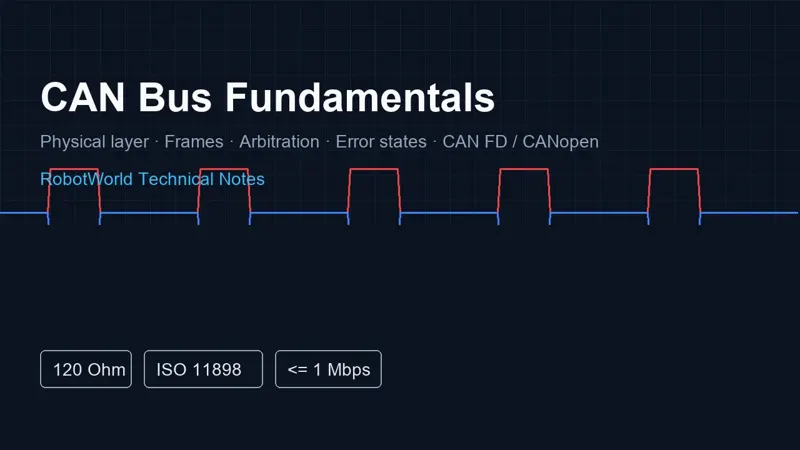
A robotics-oriented walkthrough of CAN: protocol contrast, 120Ω termination and differential levels, standard/extended frames, bit stuffing and bit timing, non-destructive arbitration, TEC/REC error states, plus when to reach for CAN FD or CANopen on joint and actuator buses.
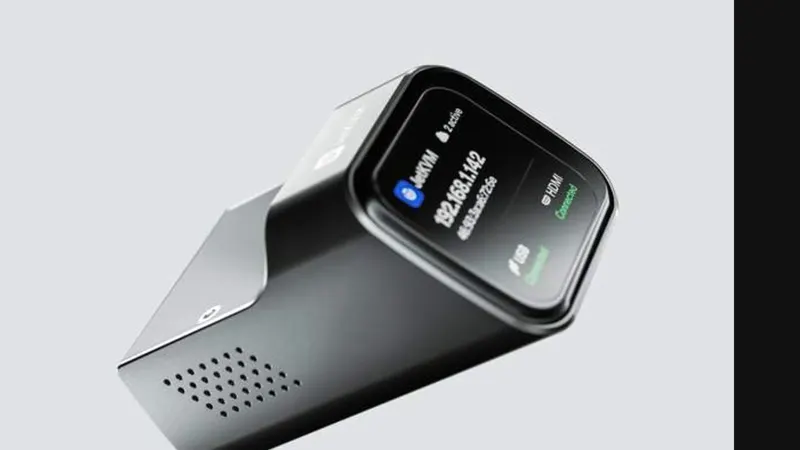 Hardware★11855%
Next generation open-source KVM over IP for $69
JetKVM
 Gadgets★6145%
A lightweight EDC with an M390 blade that can cut through almost anything...
Hacksmith Industries
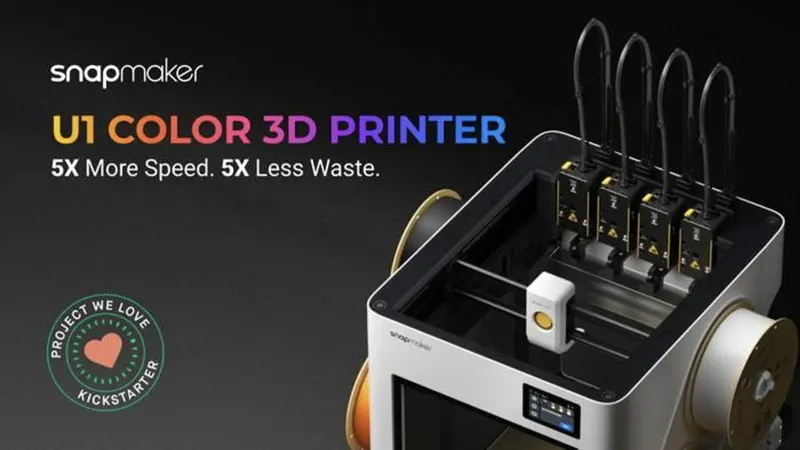 3D Printing★20614%
4 Toolheads | 5s Toolhead Swap | Multi-Material | Low Waste | 500 mm/s Speed | Smart Calibration | Auto Filament System | App Control
Snapmaker
 Hardware★10290%
No noise to disturb sleep with Active Noise Cancellation and Snore Masking System. Sleep better with AI brainwave audio. Ultra comfort.
soundcore
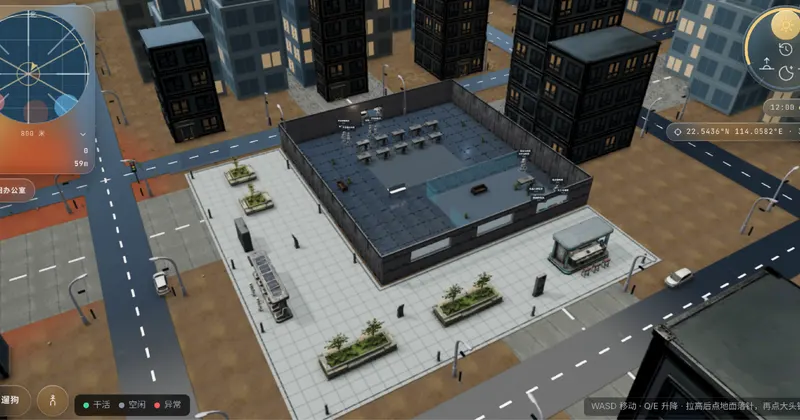
A 100 km 3D city that opens in seconds — the digital twin of the AI agents that build this site: crawling, blogs, papers, industry and investment analysis.
100km city · opens in seconds · Live task stream · Agent-maintained
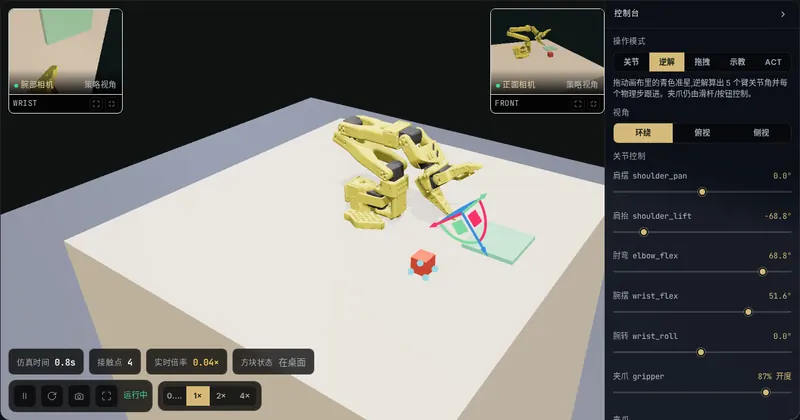
An SO-101 6-DoF arm running MuJoCo physics in your browser: joint teleoperation, IK end-effector dragging and gripper pick-and-place into a basket. No install.
MuJoCo WASM physics · SO-101 · 6 DoF · Contacts / telemetry HUD
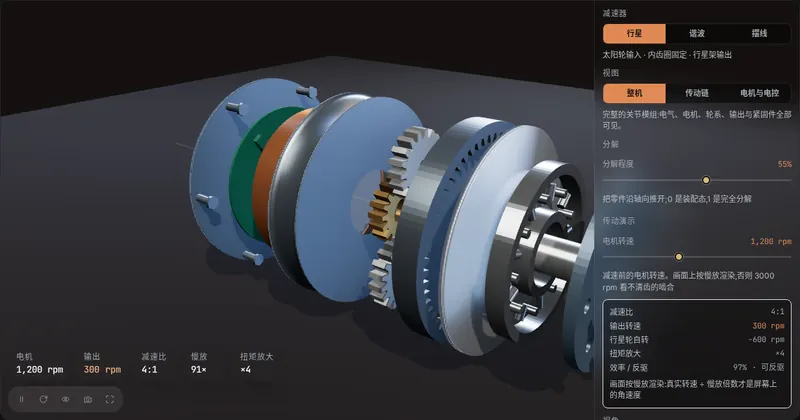
Take a humanoid joint module apart layer by layer: brushless motor, magnetic encoder, planetary / harmonic / cycloidal drive and output flange. Switch architectures on one page — exploded view plus analytic kinematics.
Three gearbox types · Planetary / harmonic / cycloidal · Analytic kinematics · explode
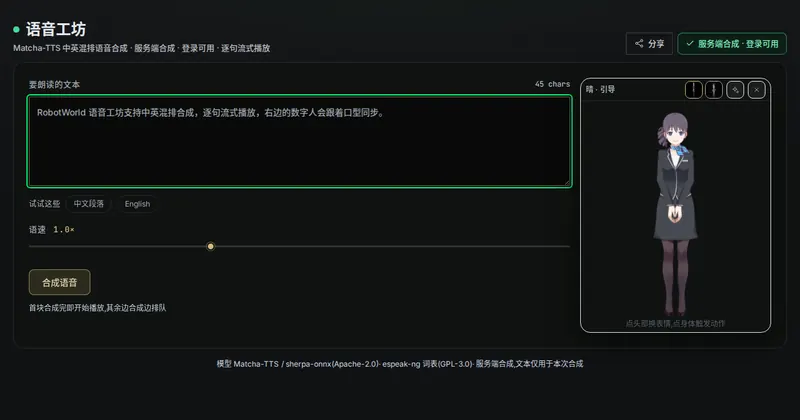
Matcha-TTS mixed zh/en speech synthesis: server-side synthesis with sentence-streamed playback and full-article read-aloud for papers and blogs. Sign-in required.
Matcha-TTS · server-side · Mixed zh / en · Full-article read-aloud

A Live2D companion on your desktop: Codex and Claude Code session events spoken out loud, offline Matcha-TTS with mixed zh/en and lip sync, on a draggable transparent stage. The Pro bench sits over herdr - one tree for every agent terminal, the wheel scrolling herdr's own history, ssh and local shells one keystroke away with saved machines renameable, dismissable and restorable, and a codex or claude session already running in your own console imports straight in. Open source, one-line install that carries herdr along.
Live2D · offline TTS · Pro bench · ssh & shells · install.sh bundles herdr